
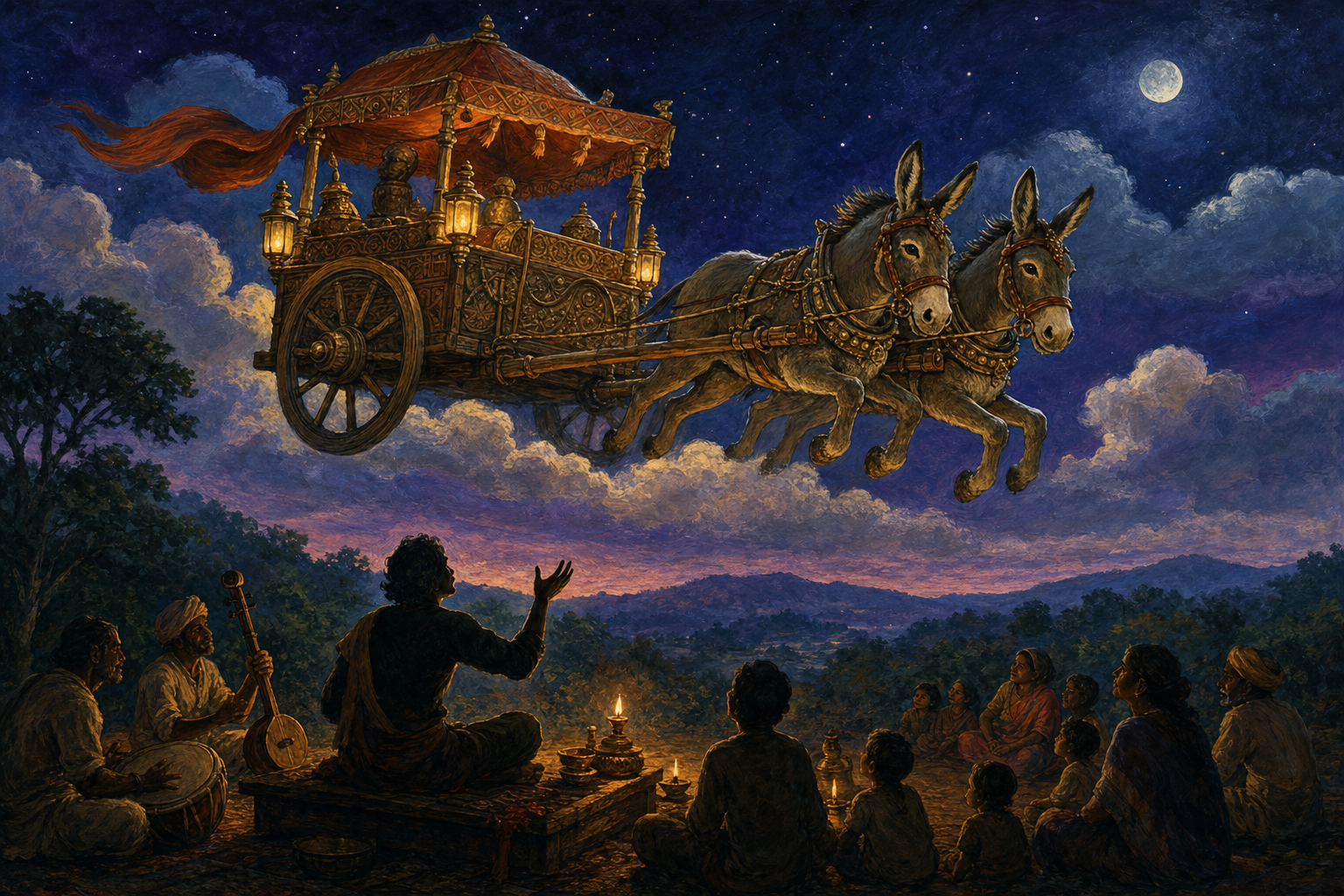
If you have encountered an Adivasi retelling in which Pushpaka Vimana appears as an ass-drawn chariot, you may wonder whether it is still the Ramayana’s celestial vehicle. It can be, provided you keep two things separate: the vehicle described in the classical narrative and the form chosen to represent it in a local performance.
That distinction protects you from two opposite mistakes. You don’t have to pretend that every Ramayana depicts an identical machine, and you don’t have to dismiss a village ratha as a corruption of the epic. You can instead ask a more useful question: what remains constant when a celestial palace is translated into wood, wheels, animal power, song, and procession?
The classical Pushpaka and the village ratha answer different questions
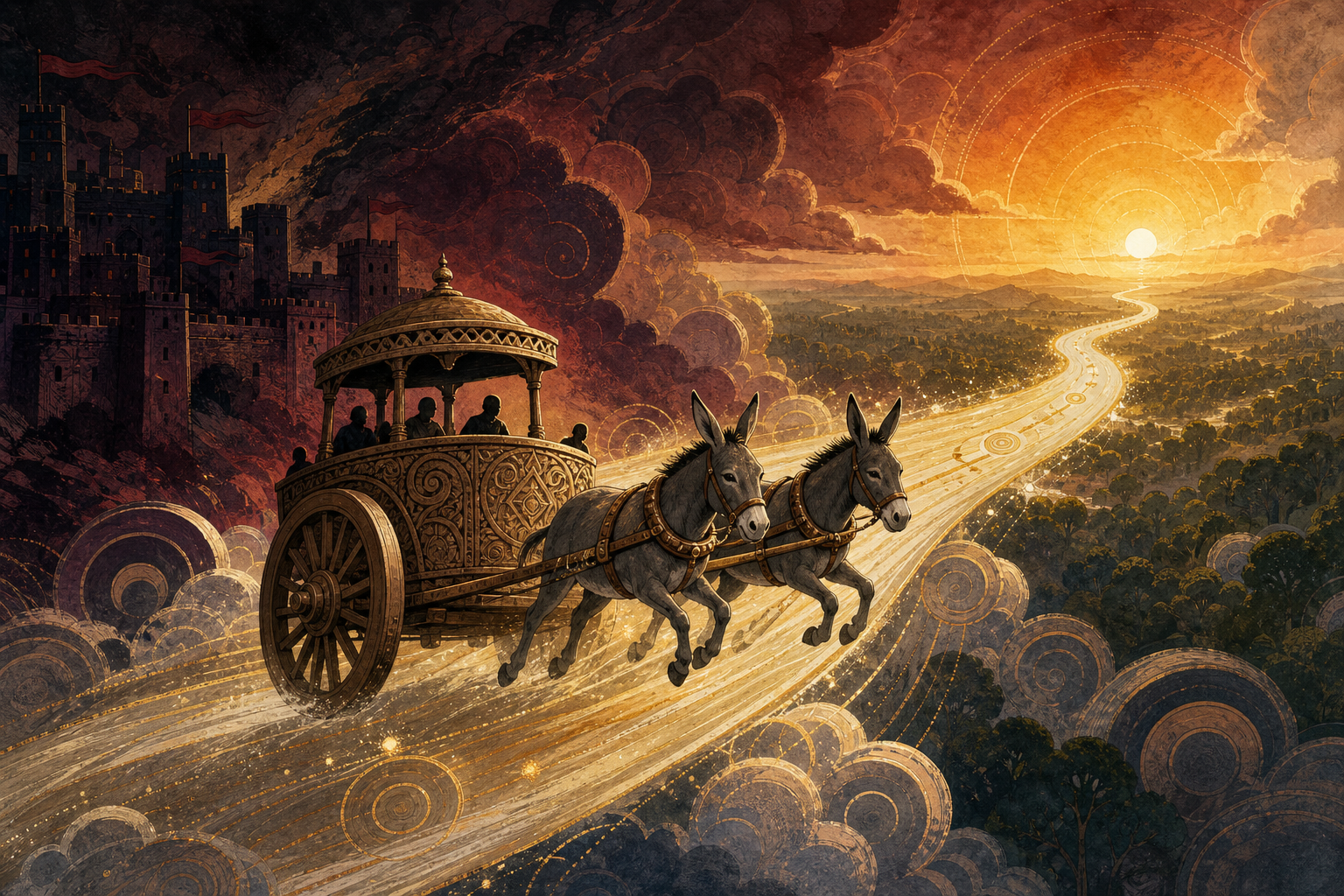
In the Yuddha Kanda of the Valmiki Ramayana, Pushpaka is presented as self-moving, self-luminous, and adorned with flowers. Visvakarma makes it for Brahma; it passes to Kubera; Ravana seizes it; and, after Ravana’s defeat, it carries Sri Rama, Sita, and Lakshmana from Lanka toward Ayodhya.
The sequence gives the vehicle a moral function as well as a practical one. Something appropriated by Ravana now serves Rama’s homecoming. Movement, possession, and rightful rule come back into alignment. Pushpaka therefore signifies more than speed or splendour: it accompanies the restoration of dharma.
Don’t force the Sanskrit word vimana into the narrow modern category of aircraft. Its older semantic range includes a specially measured or apportioned structure, a palace, a radiant celestial mansion, and the superstructure rising above a temple sanctum. In a narrative context it can also designate a celestial conveyance. Pushpaka, meaning flowered or garlanded, adds associations of auspiciousness, fragrance, fertility, purity, and abundance.
This wider vocabulary explains how one sacred image can move between sky, palace, shrine, and procession without becoming meaningless. It does not prove that every usage is identical. It tells you to identify the level of a claim before deciding whether it is accurate.
- Narrative identity: Who travels, where are they going, and what moral event does the journey complete?
- Material representation: Is Pushpaka narrated as a celestial conveyance, built as a ratha, painted as a palace, or enacted through movement and song?
- Local interpretation: What do participants say about the chosen animal, construction, route, and ritual occasion?
A local cart need not reproduce every physical property attributed to Pushpaka in Sanskrit poetry. Its first task may be to make the homecoming visible and participatory. Judge the representation by that performative purpose before treating it as a literal technical diagram.
Read the donkey as a local symbol, not a fixed code
Across parts of central India, Ramayana episodes circulate through oral narration, seasonal jatras, regional theatre, and community performance. Among some Gond-related and neighbouring communities, Pushpaka may be rendered as a ratha drawn by asses. The qualifiers matter. This is a description of particular oral and performative settings, not a licence to say that all Adivasis share one Pushpaka tradition.
The English word ass can sound insulting because it is also used as an insult. That modern reaction is a poor interpretive starting point. In a forest-and-field economy, the donkey is first an animal of labour: sure-footed, durable, familiar, and able to move burdens along ordinary paths. Indian sacred iconography also prevents us from reducing it to a joke; Sitala and Kalaratri are both associated with a donkey as their vahana.
Several readings are therefore possible, but none should be imposed as a universal secret meaning:
- Accessibility: An animal known from everyday work brings an otherwise remote celestial journey into the audience’s own landscape. Divine grace is no longer confined to a royal or heavenly register.
- Endurance and humility: Indian folklore and niti traditions can associate the donkey with forbearance, or titiksha, and steady labour. The homecoming may consequently emphasise perseverance rather than spectacle alone.
- Protection at a crossing: Donkeys can carry protective and threshold associations in folk cosmology. Their links with Sitala and Kalaratri make a warding or path-clearing interpretation possible, especially in a story about crossing from conflict into restored order. That possibility does not prove that every enactment consciously invokes either goddess.
- Ecological translation: Wheels, rope, timber, handlers, animals, and village roads turn celestial motion into something a community can actually stage. The known pace and sound of a cart allow spectators to enter the journey rather than merely hear about it.
The most reliable interpretation begins with the performance itself. If tradition-bearers explain the donkey as a sign of endurance, protection, or humility, preserve that explanation in their terms. If no such explanation is available, present these meanings as interpretive possibilities. A comparison drawn from wider Hindu symbolism is useful, but it is not the same kind of evidence as a community’s own account.
Next, look for the invariant. The material vehicle may change from a flying palace to an animal-drawn ratha, yet the travellers, the return after Ravana’s defeat, and the restoration of rightful order may remain recognizable. In that case, the medium has changed more than the message. If those narrative anchors also change, you are dealing with a more extensive retelling and should describe it accordingly.
Performance turns the homecoming into shared memory
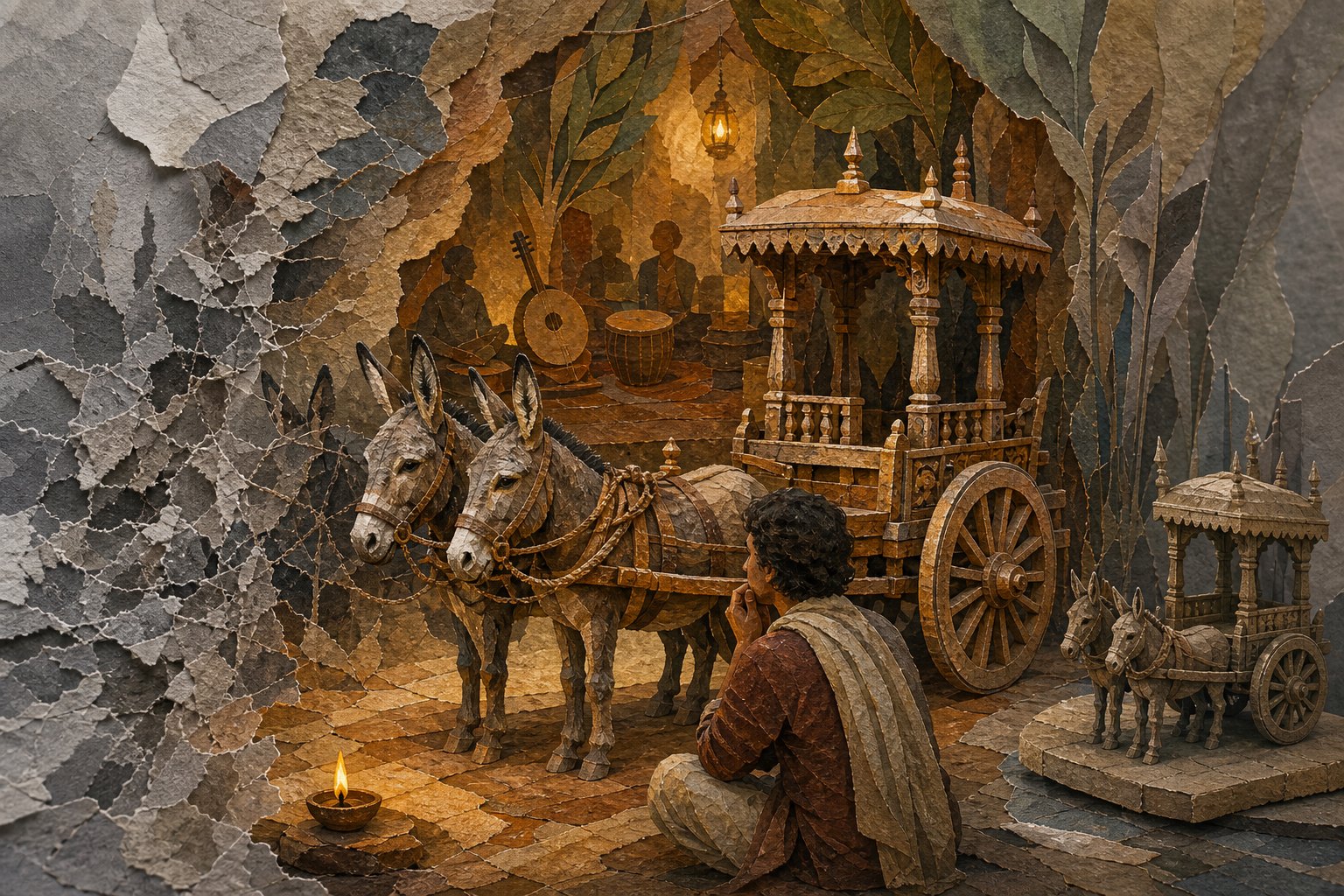
An oral epic does not survive by behaving like a photocopy. It survives because people can remember it, build it, sing it, repair it, and perform it again. Desikarana, or localization, translates a large sacred geography into the roads, animals, materials, speech, and seasonal rhythms of a particular place.
That translation is not automatically a rejection of the Sanskrit Ramayana. Nor does fidelity require every community to reproduce a courtly poetic image in the same physical form. A Ramayana performance can preserve the ethical centre of an episode while changing the sensory means by which people encounter it.
A moving ratha makes that process especially clear. Singers carry the narration. Artisans give it a visible body. Animal handlers make the journey move. Elders can bless the occasion, while children learn the sequence by watching and joining the procession. The vehicle becomes a teaching instrument: dharma is learned not only as a proposition but through coordinated communal action.
The relation between vimana and ratha also has a useful architectural parallel. The temple vimana rises above the garbhagriha and marks the sanctum vertically. During a festival, the deity travels outward among the people on a ratha. An ass-drawn Pushpaka can combine these directions of sacred movement: the celestial image is measured down into a form that can travel through streets, fields, and gathering places.
This habit of interpreting spiritual movement through dwellings and vehicles extends across Dharmic traditions. Jain Ramayana literature, including the Paumacariya, retains a Pushpaka-like celestial conveyance within a distinct Jain ethical world. The Theravada Vimanavatthu speaks of radiant heavenly mansions connected with merit. Sikh scriptural and Sant traditions use the rath as a metaphor for embodiment, discipline, remembrance, and the inward journey.
You should notice the family resemblance without making the traditions interchangeable. These examples do not establish direct borrowing from one another, and their doctrinal settings differ. They show a shared Dharmic capacity to express ethical transformation through images of vehicles, movement, dwelling, and destination.
Localization still has boundaries. It doesn’t mean that any symbol can be assigned any meaning. Follow the characters, actions, sequence, ritual setting, and explanations given by participants. Those details tell you whether a local form is translating an established episode, commenting on it, combining it with another tradition, or creating something new.
Use this five-step test before repeating a claim
Claims about Adivasi religion are often weakened by labels that are too broad. Before you repeat a caption, teach the example, or use it in an argument about the Ramayana, run through these five checks.
- Name the kind of tradition. Is the claim about the Valmiki Ramayana, another written Ramayana, an oral narration, a seasonal jatra, a theatrical prop, or a ritual procession? One cannot silently stand in for another.
- Localize the attribution. Ask which community, which part of central India, and which performance context are meant. The careful formulation is some Gond-related and neighbouring traditions, not Adivasi belief as a single undifferentiated system.
- Describe before interpreting. Establish what is actually represented: an ass-drawn cart, a narrated ratha, a painted image, or a staged journey. Then note when it appears and what action accompanies it. Interpretation should answer to those observable features.
- Separate participant explanation from comparative reading. If a performer, singer, elder, or ritual specialist supplies a meaning, identify it as a tradition-holder’s explanation. If you connect the donkey with humility, endurance, Sitala, Kalaratri, or threshold protection, label that connection as an interpretive possibility unless the local account confirms it.
- Track what remains unchanged. Look for Rama’s return, the movement from Lanka toward Ayodhya, the presence of Sita and Lakshmana, and the restoration of rightful order. The more narrative anchors remain, the stronger the case that the ratha is a local form of Pushpaka rather than an unrelated cart.
Two further conclusions should be refused. A cart used in performance does not prove that the Valmiki Ramayana describes Pushpaka as donkey-powered. Conversely, a modest cart does not prove that the community is ridiculing or degrading the celestial vehicle. It also supplies no engineering evidence for or against modern claims about ancient aviation. A performative object should first be read in its narrative and ritual setting.
A defensible formulation would be: In some central Indian, Gond-related oral and performative settings, Pushpaka may be represented as an ass-drawn ratha, with its precise significance depending on local context. The sweeping statement that Adivasis believe Pushpaka was a donkey-powered aircraft erases differences of community, genre, and meaning.
Key takeaways
- The Valmiki Ramayana’s celestial Pushpaka and a village performance-ratha belong to related but different levels of representation.
- Vimana has a wider sacred vocabulary than the modern word aircraft, including palatial, celestial, architectural, and vehicular senses.
- The donkey can support readings of accessibility, endurance, humility, or protection, but no single reading should be imposed on every community.
- Localization keeps an epic memorable by translating it into available materials, familiar landscapes, and shared action.
- Precise attribution matters: name the community, region, genre, and occasion instead of treating Adivasi tradition as one uniform voice.
- The best test is to identify both the variable form and the enduring narrative function.
When you next encounter an unusual Pushpaka, ask three questions before deciding what it means: whose tradition is this, what is happening in the performance, and which part of the Ramayana’s homecoming remains intact? Clear answers let you honour a living retelling without confusing it with a literal description from another textual or ritual setting.
References
