

Your fingers reach the end of the mala, the count is complete, and then an uncomfortable fact lands: you barely heard the mantra. The mouth continued while the mind planned, remembered, worried, and wandered.
You do not have to choose between abandoning your vow and pretending that mechanical repetition is enough. Keep the vow as the floor of your practice. Then improve one observable thing: hear the mantra you are repeating. That shift turns distraction from a verdict on your devotion into a cue to return.
Let the count protect continuity, not define success
A fixed daily count has real value. It protects japa from mood, convenience, and the endless claim that some other task must come first. On a dry or difficult day, completing the vow keeps your relationship with the practice intact.
But a count measures completed repetitions. It does not tell you whether the Divine Name was distinctly heard, whether the meaning was remembered, or whether the heart was present. This is the danger of what is sometimes called courtesy japa: the practitioner supplies the outward form while withholding sustained attention.
Srila Prabhupada exposed the problem by imitating distracted recitation as “Nish, nish, ram, ram, nish, nish, ram, ram”. The point was not that sacred syllables lose their nature. The problem is that the practitioner has stopped receiving what the tongue is uttering. In bhakti, the aim is remembrance, relationship, service, and love – not merely the production of sound.
His correction was demanding without dismissing discipline. Inattentive chanting does not produce the deepest fruit merely because a quota was completed, yet keeping the vow preserves the container in which attention can mature. Continuity and absorption are therefore not rivals. Continuity gives you another honest opportunity to practise absorption.
At the end of a session, ask two different questions:
- Did I keep the practice I had undertaken? This measures steadiness.
- How often did I clearly hear the mantra and return when I wandered? This measures the quality you are training.
Do not collapse those questions into a single judgement. A difficult session can still express fidelity to a vow. A pleasant session can still be inattentive. Dry but careful repetition may be more honest than warm emotion floating above blurred syllables.
Prepare attention before touching the first bead
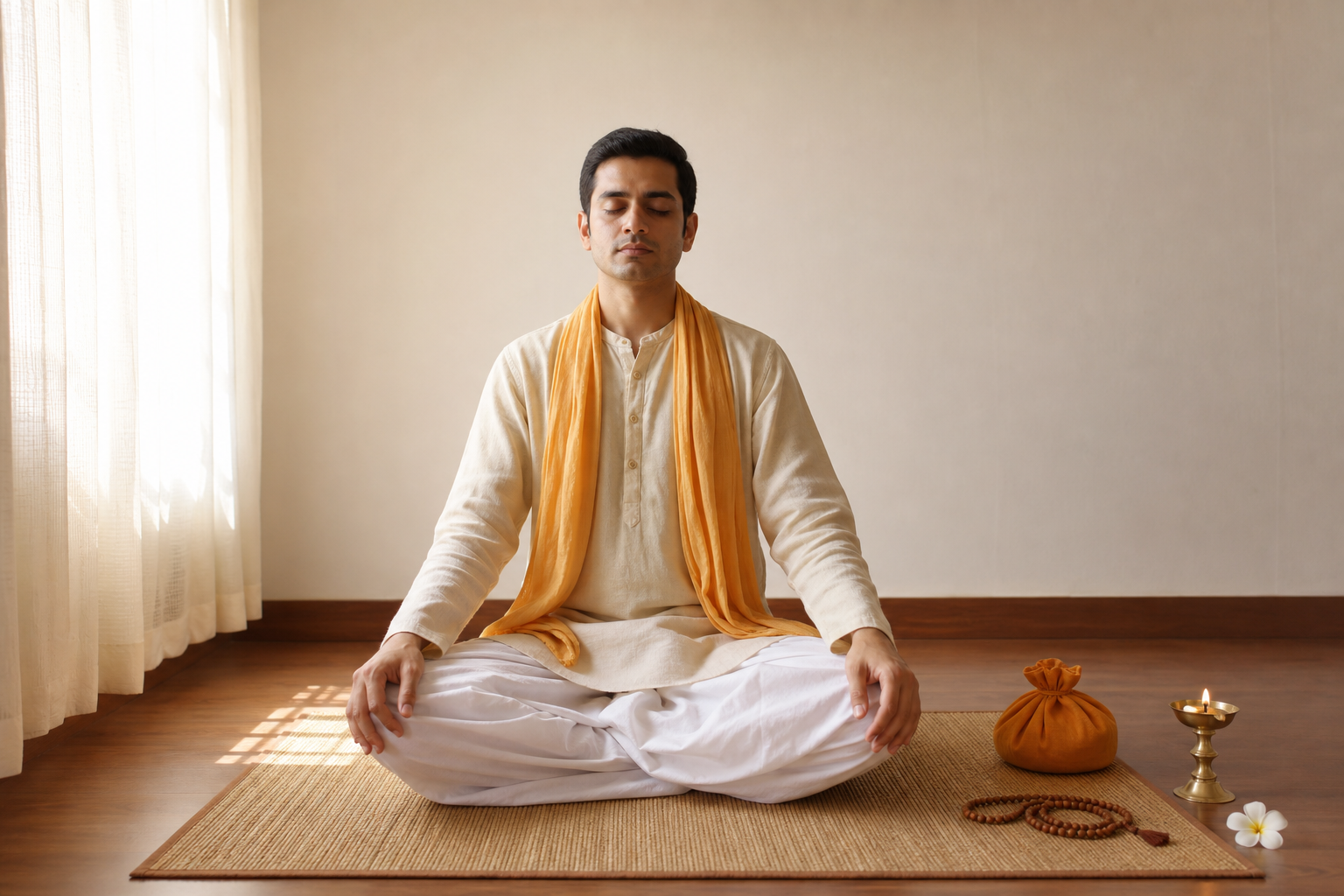
Japa becomes needlessly difficult when you enter it directly from messages, news, arguments, or hurried work. The body may be seated, but attention is still answering the demands of the previous activity. Preparation should be simple enough to repeat every day.
- Make japa the only task. Put the phone out of reach, silence alerts, close unnecessary screens, and decide that nothing will be checked between the first and last bead of the session.
- Use a clean, uncluttered place when possible. A regular place reduces the number of visual and practical decisions competing with the mantra.
- Sit in a stable, comfortable posture with the spine naturally aligned. You need enough ease to remain still and enough alertness not to drift toward sleep.
- Let the breath settle toward four to six comfortable breaths per minute before beginning. Do not force this rate. If it produces strain or preoccupation with breathing, return to a natural rhythm.
- State one short sankalpa. “I will hear every syllable” is enough. On a restless day, use: “Whenever I notice wandering, I will return without complaint.”
The sankalpa should give attention a task, not demand a spiritual experience. “I must feel ecstasy” cannot be performed by command. “I will listen to this repetition” can be enacted immediately.
Protecting sacred time also requires proportion. Dharma includes duties to family and others. Choose a time that reduces predictable conflict, and use shorter blocks when responsibilities make an uninterrupted session unrealistic. Resenting a person who needs you does not deepen remembrance. The purpose of a routine is to support devotion and service, not to give the ego another performance to defend.
Make clear sound the primary object of attention
The simplest instruction for attentive japa is also the most exacting: pronounce the mantra clearly enough that you can hear it, and listen closely enough that each syllable registers. The ear should not be several repetitions behind the tongue.
Use the form and pronunciation received through your tradition. Then apply these practical checks:
- In audible or soft-voice japa, let the sound be clear rather than merely loud. Volume cannot repair swallowed syllables.
- In silent japa, form every syllable internally as though you were whispering it. A vague mental impression of the mantra is not the same as complete inner articulation.
- If words merge, endings disappear, or the mala advances faster than the ear can follow, slow down until the full mantra becomes distinct.
- If an excessively slow pace leaves large gaps in which stories enter, restore a gentle, continuous cadence. The useful tempo is neither the fastest nor the slowest; it is the pace at which clarity remains stable.
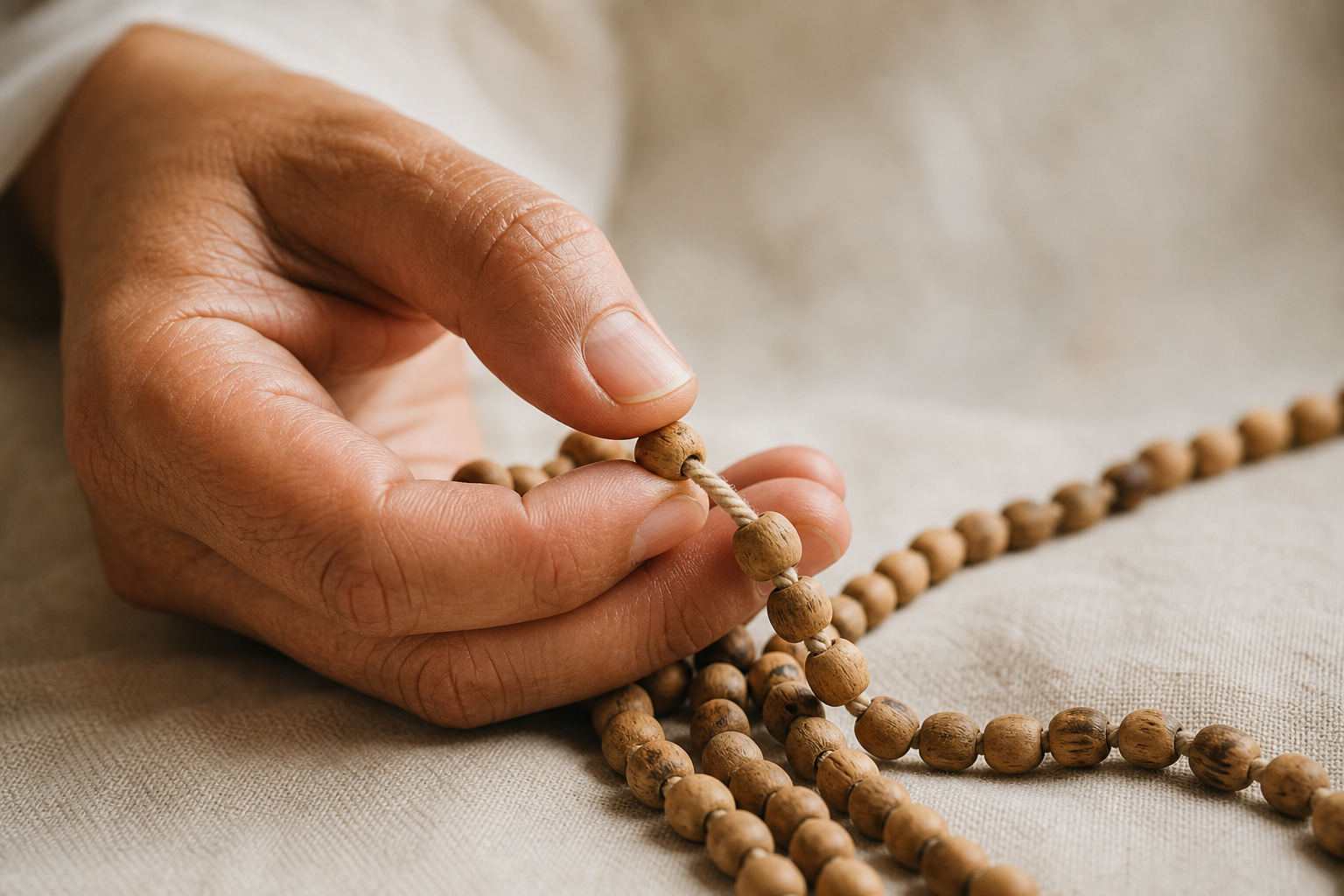
- Follow your lineage’s rules for handling the mala. Use the movement of the bead as secondary feedback: a repetition has ended, another is beginning, and attention has one more opportunity to return.
Breath, bead, and touch can help detect wandering, but they should not displace the mantra. The sound is primary. The other anchors function like guardrails: when awareness slips, they help you notice that it has slipped.
When you discover that the mind has left, use a compact repair:
- Notice the departure without beginning an argument with yourself.
- Return to the sound you are actually making.
- Restore clear pronunciation if the syllables have blurred.
- Continue at a pace the ear can follow instead of accelerating to compensate for lost time.
The return is not an interruption of practice. It is the central movement being trained. Every noticed lapse gives you a chance to place attention back where the sankalpa directed it.
Multitasking directly weakens this work. Dividing attention between mantra and a screen degrades phonetic clarity and meaningful engagement. Even a brief glance can turn one stream of attention into several unfinished streams. If the device is needed for a counter or recording, set it before beginning and do not use it for anything else during japa.
Clear sound alone, however, can become sterile. Give the mind one concise remembrance of meaning before a round. In Hare Krishna japa, that may be the relational invocation of the Divine Names and a prayer for service. In Sikh simran, it may be remembrance of the Divine Name. With the Jain Namokar Mantra, attention may rest on reverence for the qualities of liberated beings. In Buddhist mantra or Name-recitation, loving-kindness may supply the affective orientation.
These traditions are not doctrinally interchangeable, and attentive practice does not require flattening their differences. The shared practical principle is narrower: sound, awareness, and heartfelt orientation should meet in the same repetition. Feeling without clear attention becomes diffuse. Precision without reverence becomes another technical exercise.
Correct the condition that is spoiling the round
Not every poor session has the same cause. A useful correction matches the condition in front of you instead of applying more force to everything.
- If the mantra is blurred, reduce the pace until every syllable returns. Do not try to manufacture more feeling while pronunciation remains unclear.
- If you are agitated, take a brief brisk walk, come to stillness, and begin again with a fresh sankalpa. The transition gives restless energy somewhere to go before you ask the mind to listen.
- If you are drowsy, restore alertness before continuing. Short, gentle, invigorating inhalations may help, provided they remain comfortable and do not become the main practice.
- If attention repeatedly collapses, pause for two minutes of silence. Resume by restating the intention rather than carrying frustration into the next repetition.
- If the session feels dry and long, divide it into shorter blocks. Begin each block deliberately so that it does not become one extended blur.
- If solitary practice has become persistently flat, kirtan or group recitation can renew attention and emotional tone. Return to solitary japa afterward to cultivate steadiness and intimacy with the sound.
You can also make distraction visible without turning japa into a competition. During one round, tally only the moments when you clearly discover that the mind is elsewhere. Do not attempt to count every faint thought. At the end, write one or two lines about the session’s tone: presence, warmth, steadiness, agitation, drowsiness, or phonetic clarity.
A minimal record can use this form: “Noticeable wanderings: ___. Tone: ___. Adjustment next time: ___.” Compare your own sessions, not your tally with someone else’s. The number is feedback about conditions and technique; it is not a measure of devotional worth.
Over time, look for practical patterns. Perhaps the count rises after digital stimulation, pronunciation worsens at a hurried tempo, or morning practice is clearer than a later session. Lower mind-wandering counts commonly accompany stronger after-practice clarity, but the useful outcome is not a perfect score. It is knowing what adjustment helps you return.
Key takeaways
- Keep the daily vow as the foundation, but do not mistake a completed count for attentive remembrance.
- Remove screens, settle the body and breath, and state one observable intention before beginning.
- Make distinct sound primary; use the bead, breath, and touch only to support the return to it.
- Join phonetic clarity with the meaning and devotional orientation taught by your own lineage.
- Match the remedy to the problem: slow blurred speech, interrupt repeated collapse with silence, and divide an unmanageable session into fresh blocks.
- Track distraction lightly so that it informs the next session rather than becoming a new source of pride or guilt.
At your next session, do not promise yourself perfect concentration. Put the phone away, settle the breath, speak one sankalpa, and make the first task simply to hear. When attention wanders, return without drama. That honest correction, repeated as faithfully as the mantra itself, is how a quota becomes living practice.


References
