
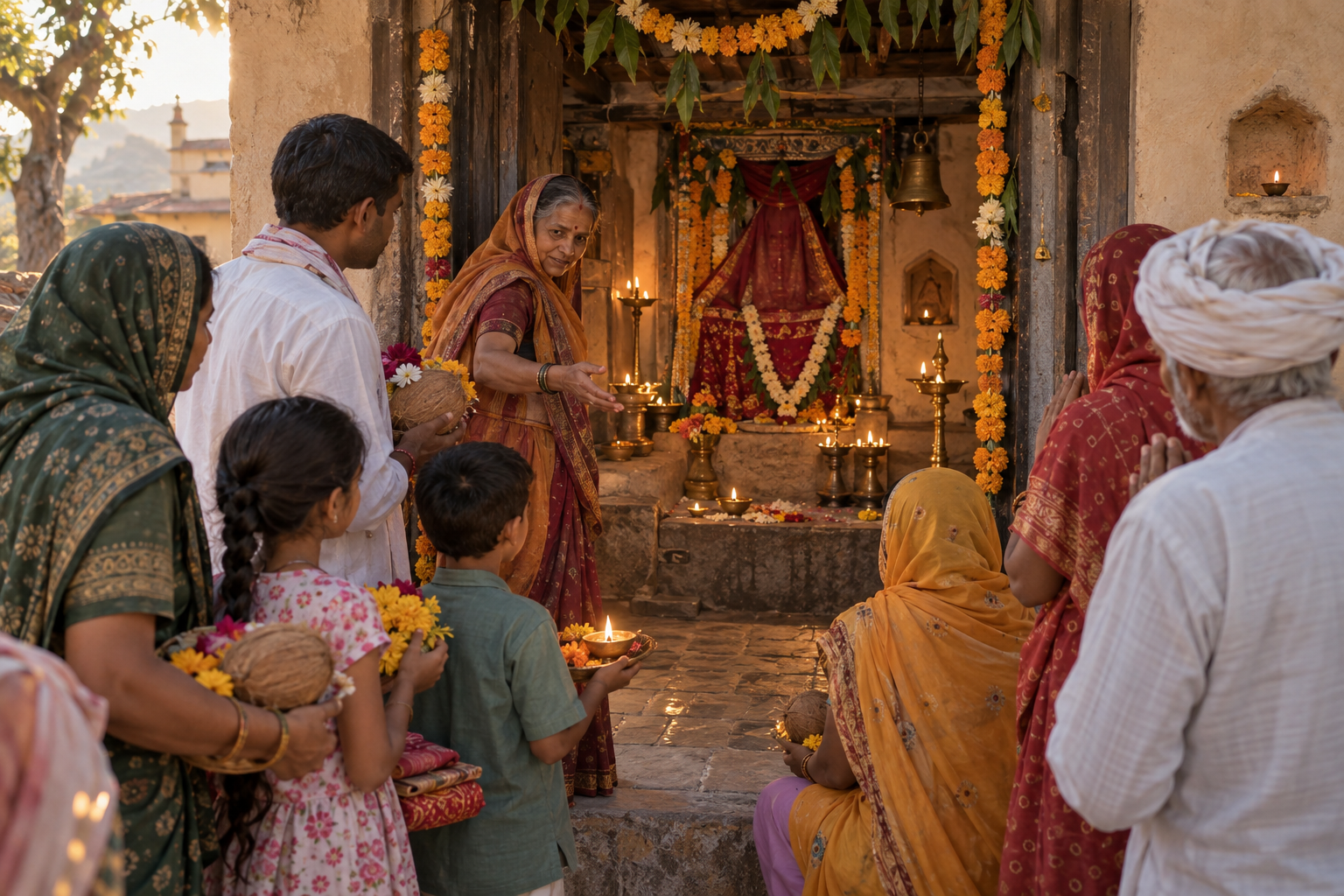
You may have searched the Vedas and Puranas for Kateri Mata, found little or nothing, and wondered whether that makes her worship somehow less authentically Hindu. It does not. The difficulty lies in using a textual test to judge a tradition whose authority is carried through living communities.
If you want to understand Kateri Mata, or approach her worship respectfully, begin with the people who preserve the relationship. Learn the local name, identify the community’s ritual custodians, and resist filling gaps with practices borrowed from another Devi.
Canonical presence and living authority are different questions
Kateri Mata, also called Kateri Amman or Kaateri Maa, belongs to the world of village and folk goddesses within Shakta worship. Her worship is found across South India and Sri Lanka, as well as in Hindu communities in the Caribbean, Mauritius, and elsewhere. Her name does not appear in the Vedas or the classical Puranas.
There is no contradiction here. Hindu sacred life has never depended on every deity appearing in one universal catalogue. A community may encounter the divine through a place, a family inheritance, an oral account, a protective relationship, or a locally maintained ritual tradition. Texts are one means of transmission; they are not the only means by which Hindu memory survives.
The word “folk” therefore describes a social setting and a way of transmitting worship. It does not mean fictional, spiritually inferior, or disposable. Calling Kateri Mata a folk Devi should direct your attention toward the community sustaining her, not away from the seriousness of its devotion.
Keep three questions separate when you assess any village-goddess tradition:
- Canonical status: Is the deity named in a particular textual corpus? For Kateri Mata, the answer is not in the Vedas or classical Puranas.
- Lived status: Is the deity remembered, invoked, and worshipped by identifiable Hindu communities?
- Ritual status: Who within those communities is trusted to explain the practice, its boundaries, and its obligations?
The first question cannot answer the other two. If you stop after searching a scripture index, you have established only that a name is absent from those texts. You have not established that the worship lacks history, meaning, or authority for its practitioners.
A fierce mother is not a contradiction
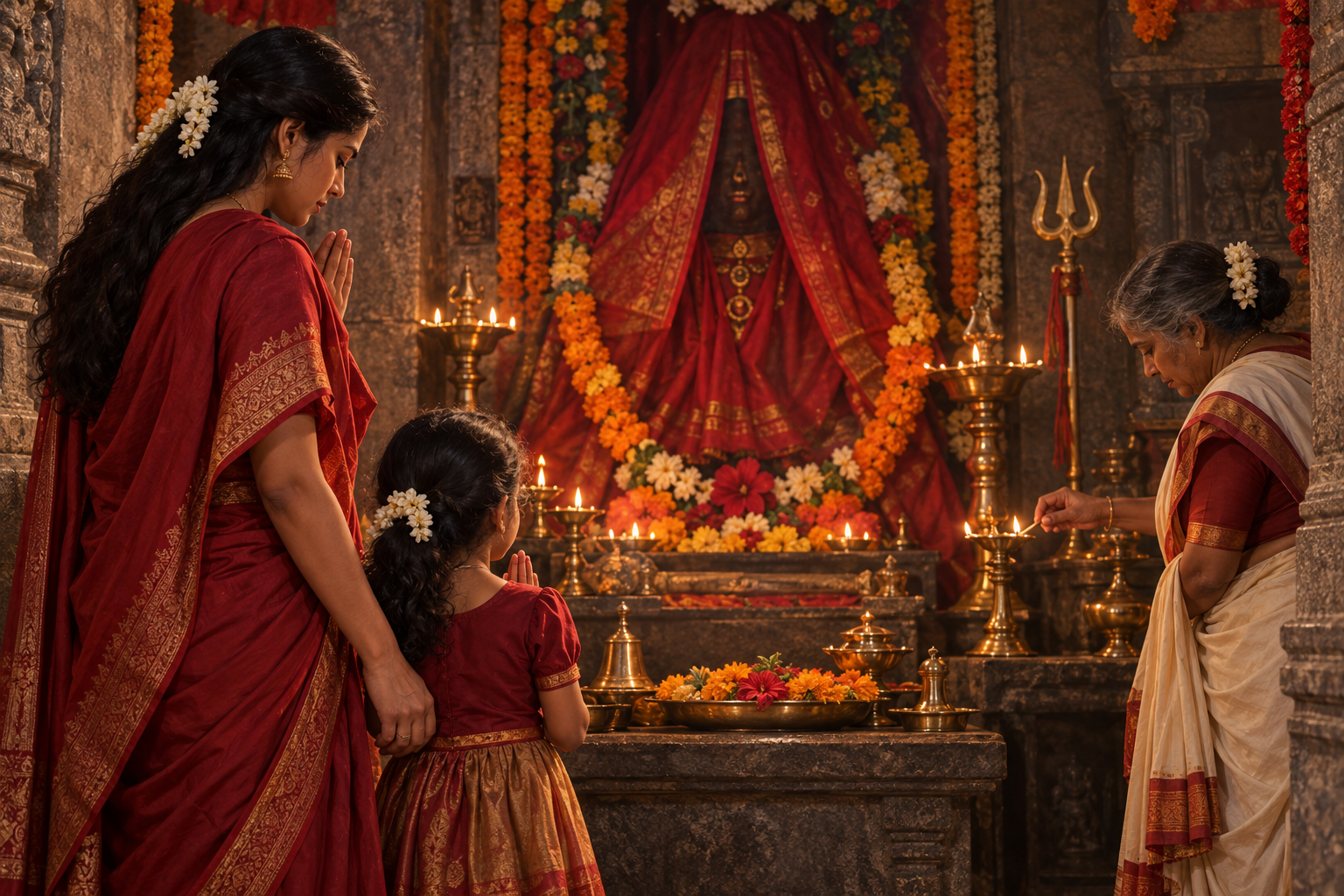
Mata, Maa, and Amman all place the relationship in maternal language. Yet Kateri Mata is also understood as a fierce protector. Those qualities belong together: a protective mother is defined not only by tenderness but by her capacity to confront danger and defend a boundary.
Fierceness in a Shakta setting should not automatically be translated as evil, demonic, or hostile. It can signify power directed against what threatens life, order, or communal well-being. The important question is not whether the form matches a modern preference for gentle religious imagery. The important question is how devotees understand the Devi’s power and what kind of relationship they maintain with her.
Two common readings miss that relationship. One dismisses a fierce local goddess as superstition because she lacks a familiar classical biography. The other turns her into a free-floating symbol and ignores the people for whom she is a present object of worship. Both approaches make the observer’s categories more important than the tradition itself.
When you encounter an image, shrine, name, or account associated with Kateri Mata, notice what the community emphasizes before supplying your own interpretation. Ask what protection means there, which boundaries are treated as important, and whether the Devi is connected with a particular family, place, or inherited practice. Do not assume that her fierceness has the same meaning in every setting.
How to approach Kateri Mata worship respectfully
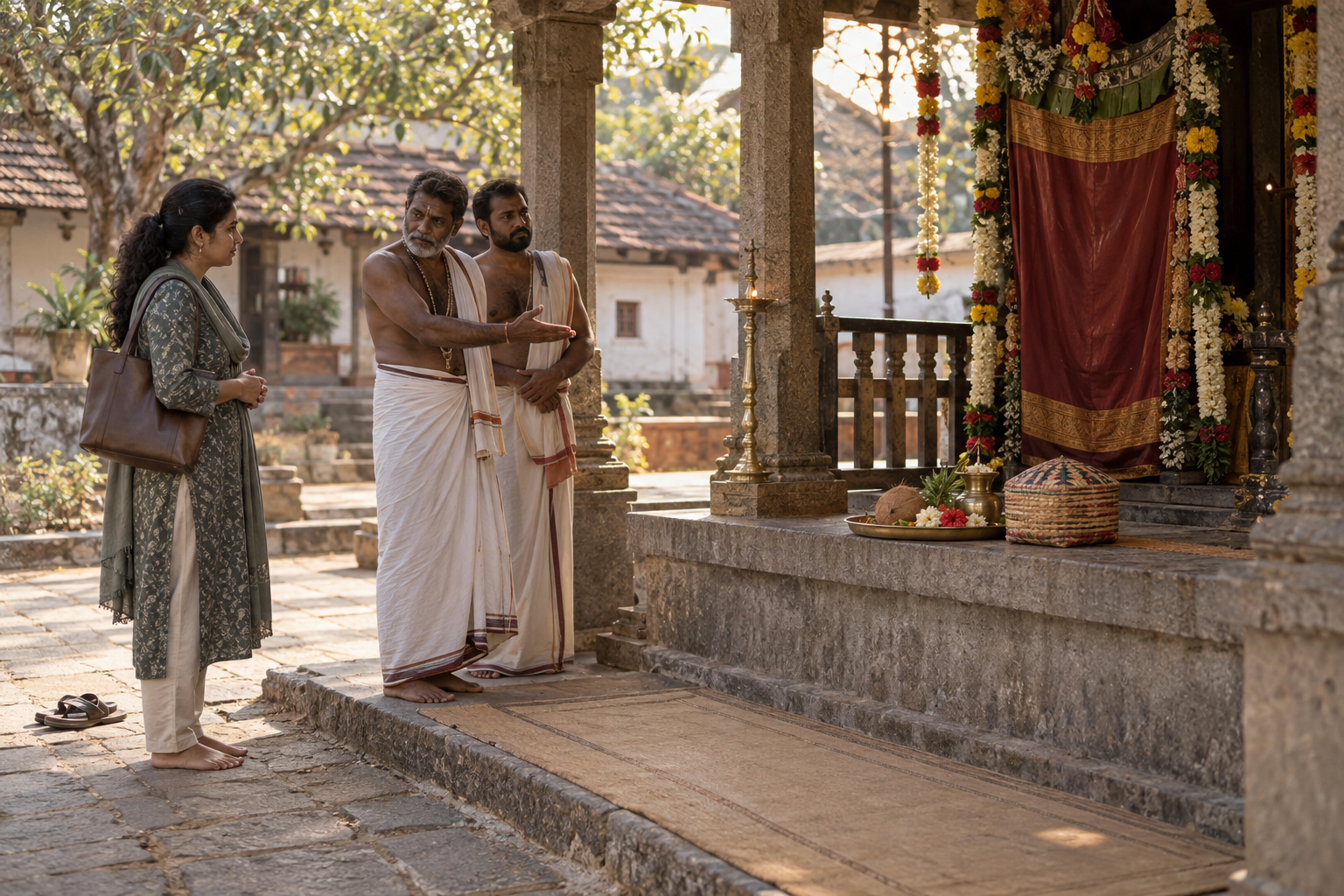
A living tradition cannot be learned responsibly by collecting disconnected ritual details from different communities. If you are visiting a shrine, documenting a family custom, or considering personal worship, use this sequence:
- Learn the name actually used there. Ask whether the community says Kateri Mata, Kateri Amman, Kaateri Maa, or another local form. Preserve its pronunciation and spelling rather than silently standardizing it.
- Find the appropriate custodian. Ask who may explain the practice. That person may be a priest, an elder, a family member, or another locally recognized guide. Do not assume that the most confident outsider is the most reliable authority.
- Observe before participating. Watch the order of actions, who performs them, and where visitors stand. Waiting through one complete observance will teach you more than copying its most visible gesture.
- Confirm before bringing an offering. An item welcomed in one Devi tradition may be irrelevant or inappropriate in another. Ask what is accepted rather than improvising from a generic list of Hindu offerings.
- Ask before photographing or recording. Public access does not automatically make every image, prayer, or family account public material. If permission is limited, respect the limit without bargaining.
- Separate observation from interpretation. Record what participants call an action before assigning it a theological meaning. If an explanation is uncertain or differs among elders, preserve that uncertainty.
- Receive guidance before establishing a home practice. If Kateri Mata belongs to your family or community inheritance, begin with the people who transmitted it. If you are new to the tradition, learning and attending with permission are sounder first steps than constructing a ritual from online fragments.
This approach is not mere etiquette. It prevents a common distortion: taking a name from one community, an image from another, and a ritual from a third, then presenting the mixture as an ancient universal form. Honest restraint protects both the practitioner and the tradition from fabricated certainty.
If access to a knowledgeable community is not available, say plainly what you do and do not know. You can still learn about Kateri Mata’s place within living Shakta devotion. What you should not do is invent precise mantras, offerings, festival dates, origin stories, or promised results and attribute them to all her devotees.
Diaspora continuity does not require ritual uniformity
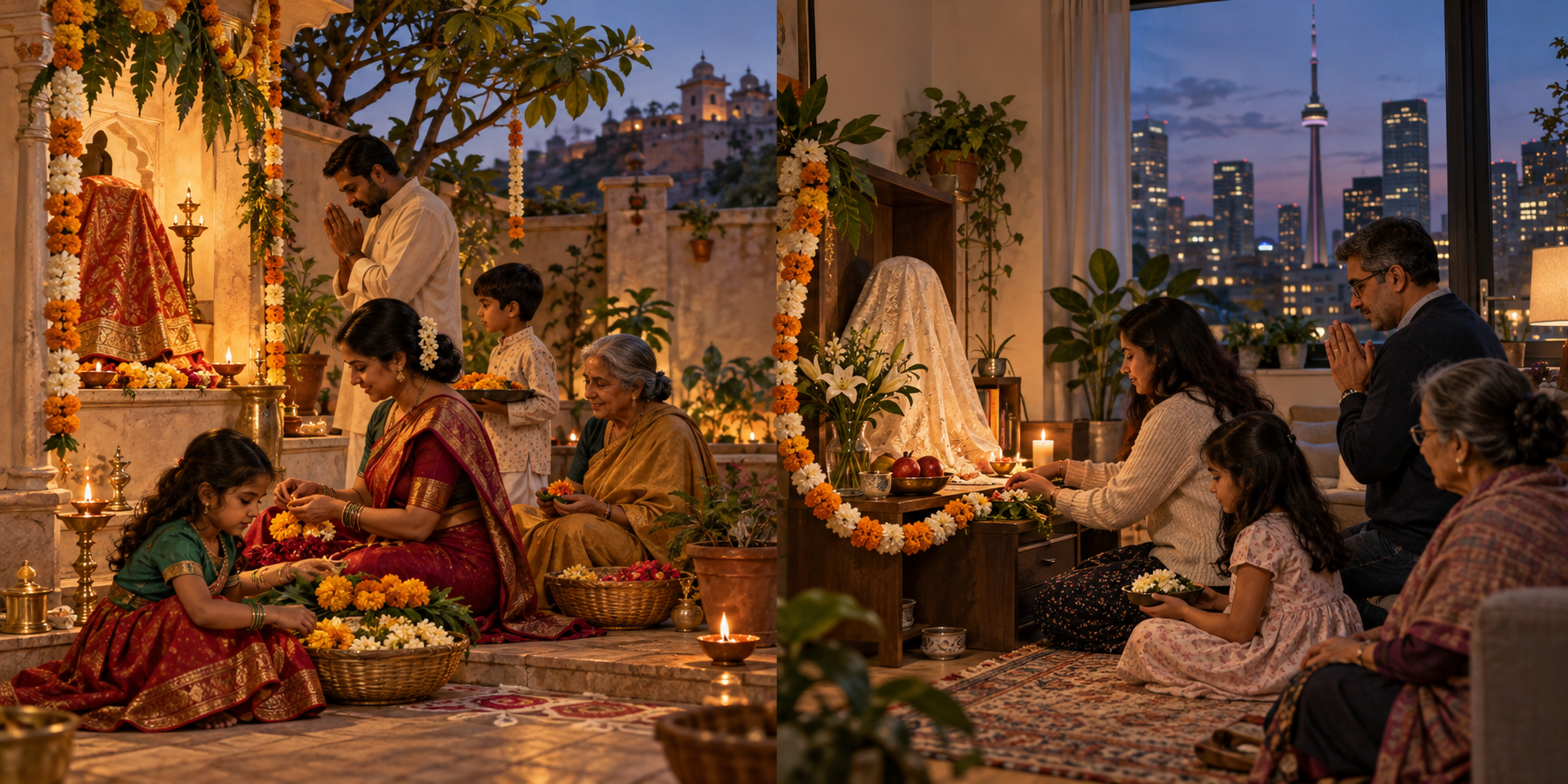
Kateri Mata’s presence in South India, Sri Lanka, the Caribbean, Mauritius, and the wider Hindu diaspora shows why living worship cannot be reduced to a single printed template. Communities separated by language, geography, and generation may preserve a recognizable devotional relationship without expressing every part of it identically.
Difference alone does not prove that one community has corrupted the tradition. Sameness alone does not prove antiquity either. A recently standardized practice can look uniform, while a genuinely inherited practice may contain regional variation. The useful question is how a community understands the chain through which its worship was received.
If you are documenting or comparing Kateri Mata traditions, record these details before drawing conclusions:
- The exact name and pronunciation used by the community.
- The place, family, shrine, or community with which the practice is associated.
- Whom practitioners identify as having transmitted it.
- Which parts are public and which are restricted or private.
- Which elements practitioners regard as essential, and which they describe as adaptable.
- The language in which prayers, names, and explanations are remembered.
- Whether an interpretation comes from a practitioner, an observer, or your own inference.
These distinctions let you honour continuity without freezing a living tradition into a museum specimen. They also allow diaspora Hindus to speak for their own inherited forms rather than being measured against an imagined single version from elsewhere.
Key takeaways
- Kateri Mata is a living folk and village goddess within the broad field of Shakta worship.
- Her absence from the Vedas and classical Puranas answers a textual question; it does not cancel community-based religious authority.
- Her maternal identity and protective fierceness are complementary rather than contradictory.
- Local custodians, not generic lists assembled from unrelated traditions, should guide ritual participation.
- Regional and diaspora differences should be documented carefully, not automatically dismissed as error.
- If you are new to her worship, your first action should be to learn the local name and ask who is authorized to explain the practice.
Your next step can be simple: write down the exact name being used, the community or place connected with it, and the person from whom guidance comes. Those three facts will keep your understanding anchored in a living relationship rather than an invented universal ritual.
References

Leave a Reply
You must be logged in to post a comment.