
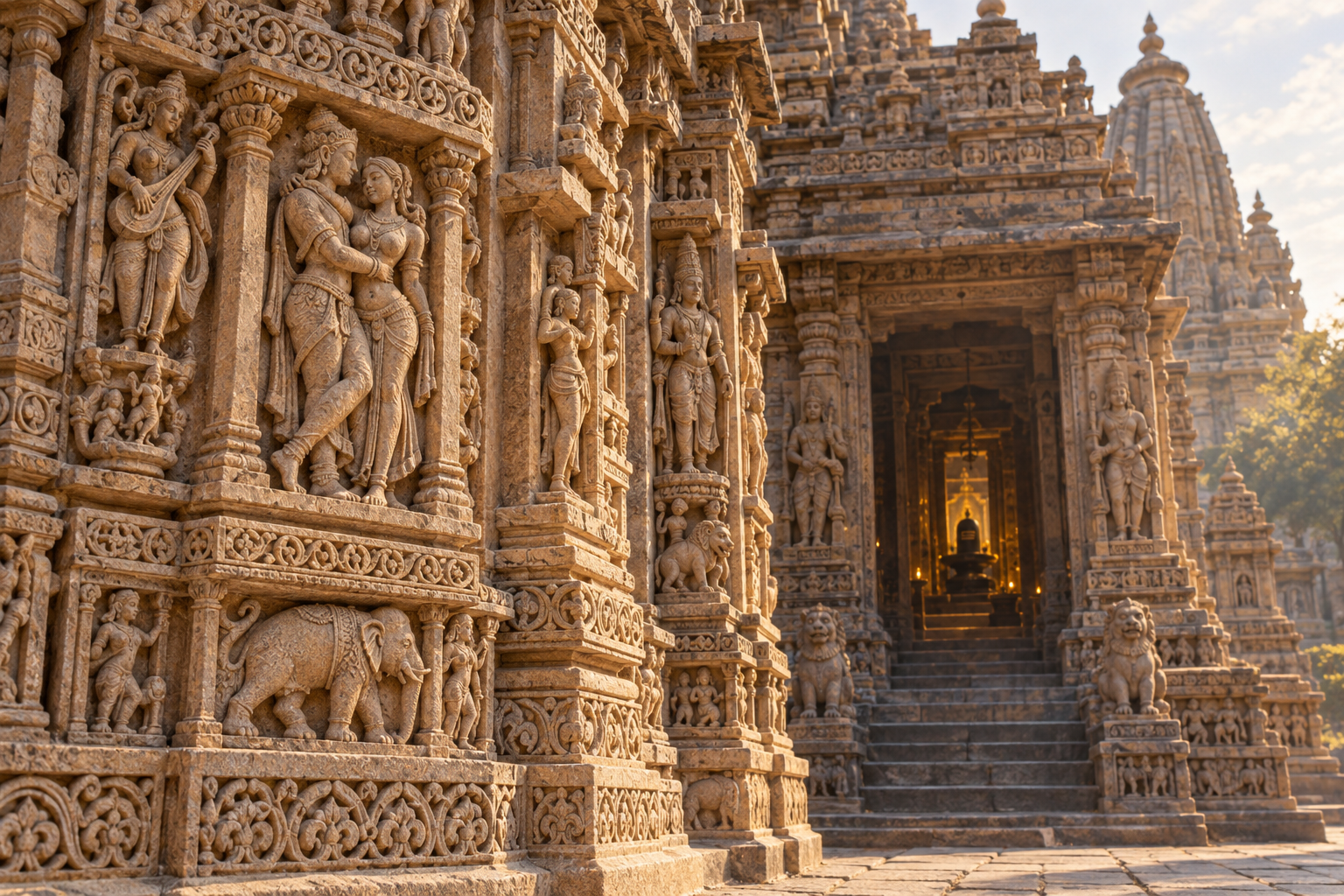
You enter a Hindu temple expecting images of deities and devotees. Then you notice an explicitly erotic couple carved into the stone. If your first response is confusion, the useful question is not, “Why is this allowed in a sacred place?” It is, “What work is this image doing here?”
The answer begins with context. In many temple traditions, nude and erotic figures appear on pillars and outer walls, within a much larger sacred environment. Their presence can acknowledge desire without making desire the purpose of the temple. To read them well, you have to look at where they stand, what surrounds them and where the devotee is going next.
Begin with placement, not shock
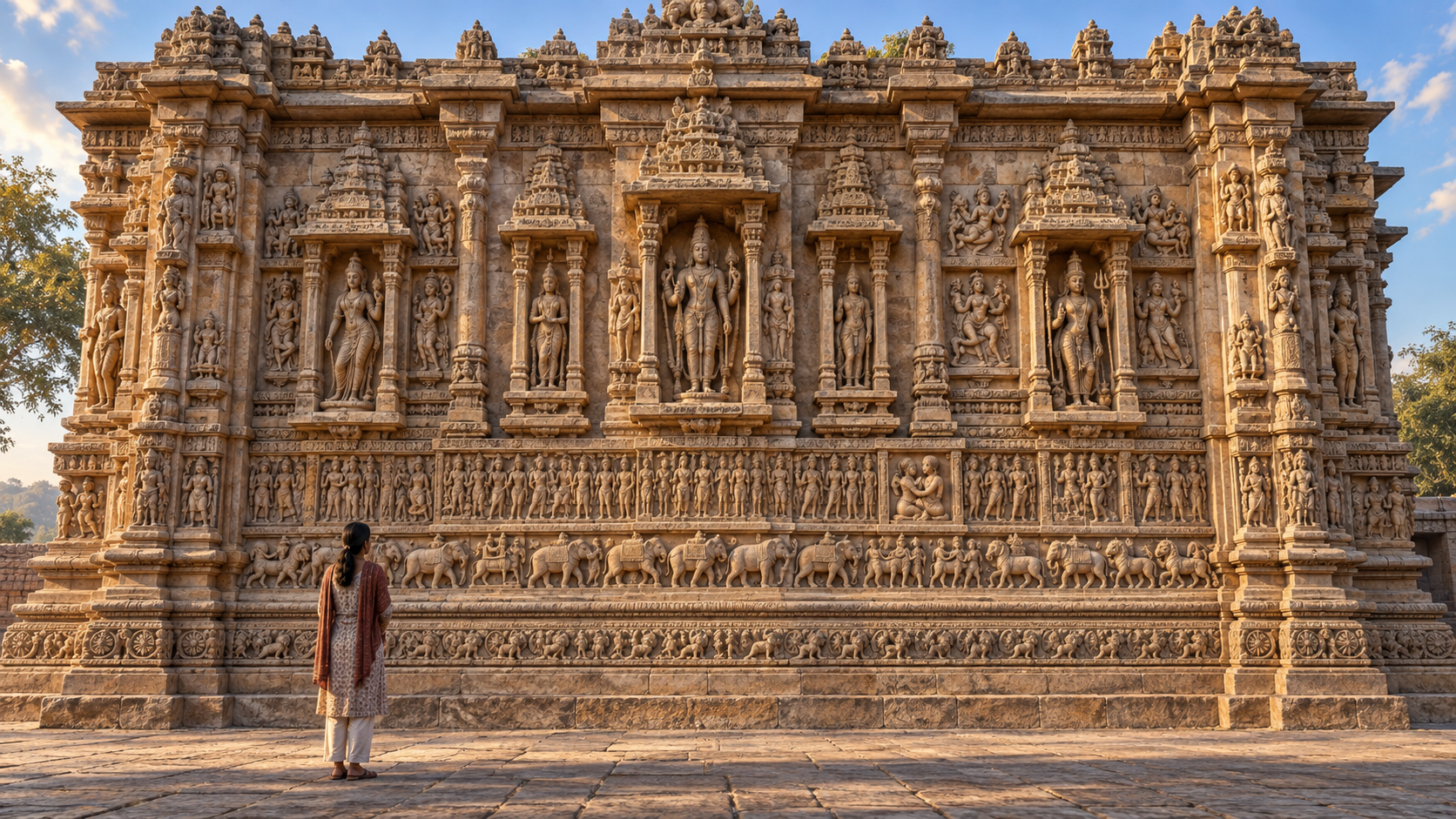
An erotic carving isolated in a photograph becomes an object detached from its architectural grammar. At the temple, it occupies a particular surface, height and position in relation to other figures. That setting is part of its meaning.
Start by locating the image precisely. Is it on an outer wall, a pillar, a transitional space or near the sacred centre? Then widen your view. Look for deities, guardians, musicians, dancers, household scenes, animals, vegetation and ornamental forms around it. Do not assume that one conspicuous figure explains the entire sculptural programme.
Next, distinguish observation from interpretation. “Two bodies are shown in an erotic embrace” is an observation. “The temple teaches unrestricted sexual freedom” is an interpretation, and a very large one. So is the opposite claim that the figure must be an embarrassing intrusion with no religious significance. Neither conclusion follows from the image alone.
Finally, notice the direction of worship. Where the devotee moves from an image-bearing exterior toward a sanctum, that movement matters. The exterior can confront you with embodied life in its variety, while the inward journey gathers attention around the divine. This does not provide a universal code for every carving, but it gives you a disciplined place to begin.
Desire can be present without becoming the destination
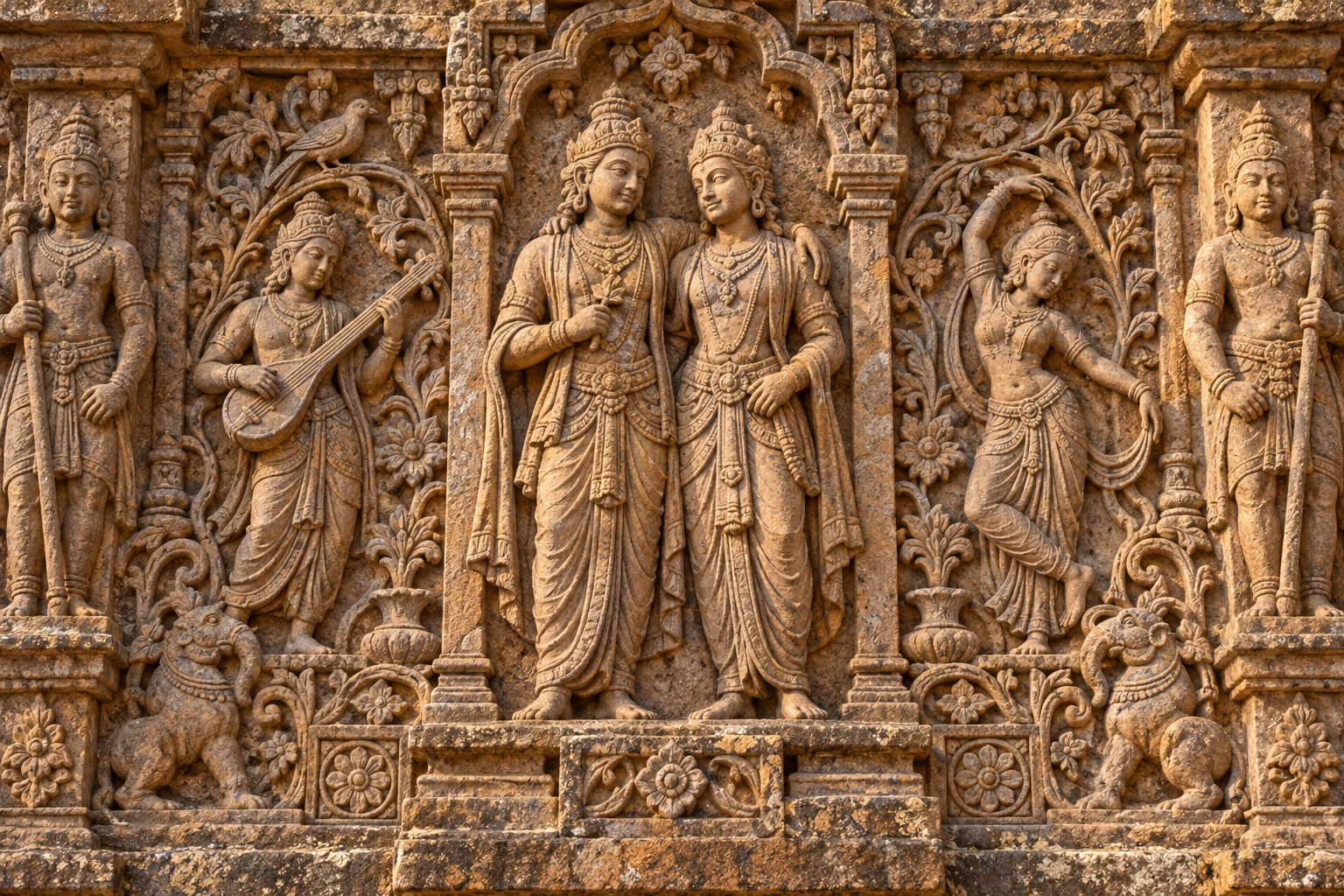
A common modern assumption treats sexuality and sanctity as natural enemies. Under that assumption, an erotic image in a temple must be either a contradiction or evidence that the temple is not really concerned with spiritual discipline. Hindu thought allows a more demanding reading: embodied desire is real, powerful and part of human life, yet it need not be the final measure of life.
The purushartha framework makes this distinction especially clear. Kama – desire, affection and pleasure – has a legitimate place alongside dharma, artha and moksha. Its recognition is not the same as its enthronement. Dharma asks how desire is ordered. Moksha prevents any finite pleasure from being mistaken for complete freedom.
This helps you avoid two shallow reactions. Prudery tries to erase desire from the sacred landscape. Indulgence sees the image and concludes that desire requires no discipline. The carving can resist both. It may present the force that binds attention to the sensory world while also placing that force inside a path oriented toward something greater than appetite.
The image can therefore act as a mirror. Are you able to see the body without contempt? Can you acknowledge attraction without being ruled by it? Can you encounter an unsettling image without reducing an entire tradition to that reaction? In this reading, the spiritual task is neither disgust nor fixation. It is awareness followed by freedom.
Use “can” and “may” carefully here. Hindu temples arose within different regions, communities and ritual settings. No single metaphysical explanation should be imposed automatically on every nude figure or erotic scene. A spiritual interpretation becomes stronger when the image’s placement, neighbouring motifs and the temple’s larger sacred movement support it.
What the carvings do not prove
Temple eroticism attracts sweeping claims because a provocative detail is easier to circulate than a complete sacred setting. You can test those claims by asking what the visible evidence actually establishes.
First, an erotic representation is not automatically a behavioural command. Sacred art routinely depicts forces, conditions and conflicts that a viewer is meant to understand rather than imitate. Calling an image sacred describes its place within a sacred world; it does not turn every depicted act into a ritual prescription.
Second, a carving does not by itself prove that Hindu traditions endorsed every possible expression of sexuality. A civilisation can recognise kama while still asking how desire relates to duty, relationship, restraint and liberation. Representation is evidence of recognition, not a blank ethical permission slip.
Third, not every erotic figure should be labelled Tantric. Tantra contains serious and varied traditions, but using the word as a universal explanation often replaces interpretation with mystery. Unless the temple’s iconography, ritual identity or historical context supports that identification, treat it as a possibility to investigate rather than a fact already established.
Fourth, the imagery does not prove that temple builders were merely decorating a religious structure with unrelated sensual entertainment. Placement within pillars, walls and an ordered sacred environment invites a larger reading. The human body, worldly fertility, attraction, creative energy and the problem of attachment can all enter religious reflection without becoming identical ideas.
These limits matter in both apologetics and criticism. A defender weakens the case by inventing one secret meaning for every figure. A critic weakens it by treating an isolated photograph as a complete account of Hindu theology. The honest position is firmer: read the particular image within the particular temple, and make no claim larger than the setting can carry.
A practical method for your next temple visit
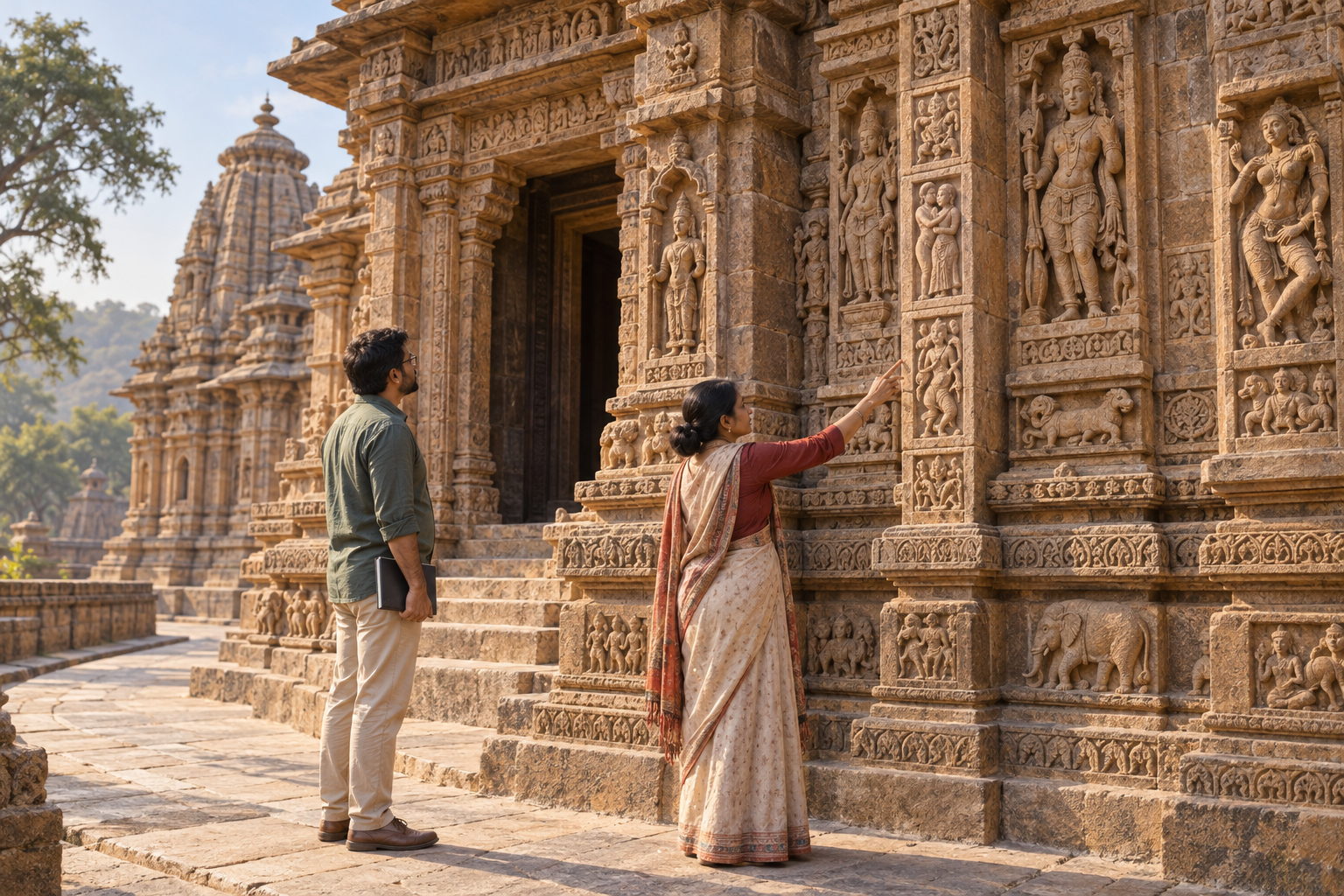
When you encounter erotic sculpture, pause before photographing it or explaining it. Take one slow circuit of the relevant wall or pillar. The goal is to restore the visual relationships that a close-up would remove.
- Describe only what you can see. Note the figures, gestures, objects and surrounding motifs without assigning a doctrine yet.
- Record the location. Distinguish an exterior wall or pillar from a threshold, hall or sanctum-facing surface.
- Look for repetition and contrast. One figure may be incidental; a recurring arrangement may belong to a deliberate visual pattern.
- Ask how a worshipper encounters it. Consider whether the image is passed on the way inward, viewed during circumambulation or placed within a broader sequence.
- Test more than one interpretation. Ask whether the scene concerns pleasure, fertility, worldly life, creative union, attachment, transcendence or some combination. Retain only what the setting supports.
- State the limit of your conclusion. Say, “This placement may suggest…” when you do not possess the temple-specific context needed for “This means….”
If you are explaining the carving to another person, begin with the tension instead of hiding it: “The temple includes desire within its account of human life, but it does not make desire the endpoint of worship.” Then point to the image’s actual location and the movement toward the sacred centre. This gives the listener something visible to examine rather than asking for blind acceptance of a symbolic claim.
It is also acceptable to leave a figure partly unresolved. Temple art does not become more honourable when every difficult image receives an instant mystical explanation. Intellectual restraint protects the tradition from confident but unsupported stories.
Key takeaways
- Read an erotic carving in its architectural setting, not as an isolated image.
- Distinguish the recognition of kama from an instruction to pursue desire without limits.
- Let placement, neighbouring motifs and the devotee’s movement guide interpretation.
- Do not label every erotic figure Tantric or force one explanation onto every temple.
- Treat attraction and aversion alike as reactions to observe, not as substitutes for understanding.
- Use qualified language when temple-specific evidence is unavailable.
On your next visit, do not stop at the carving that first arrests your attention. See the wall, follow the path and enter the sanctum with the question still alive. The temple’s strongest answer may lie in that movement: embodied life is acknowledged fully, but you are not asked to remain imprisoned within any one of its forms.
References

Leave a Reply
You must be logged in to post a comment.