
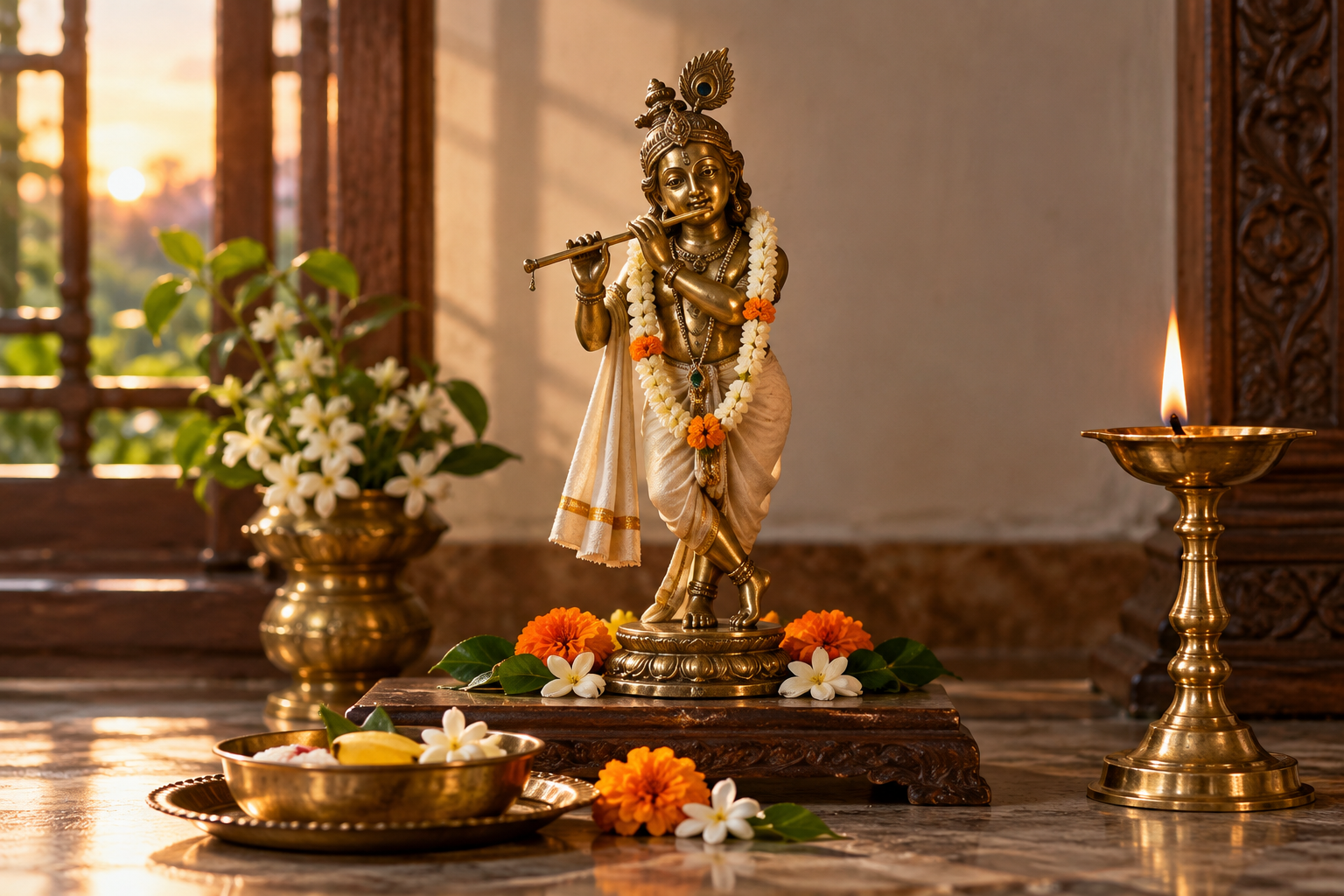
You want your home shrine to look beautiful, but you do not want worship to become a contest of expense or a collection of ornaments with no devotional purpose. The right question is not, “How much should I put on the deity?” It is, “What form of care can I offer reverently, safely, and consistently?”
A simple arrangement done with attention can be more fitting than an elaborate one assembled in haste. Let your family tradition determine what is appropriate, your means determine the scale, and the needs of the murti determine which materials are safe.
Key takeaways
- Treat adornment as seva, not as interior decoration. Cleanliness, suitability, and attention matter before cost.
- Do not use a temple’s ornamentation as the minimum standard for your home. Offer what is comfortably within your means.
- Check your household or sampradaya practice before introducing unfamiliar clothing, substances, symbols, or ornaments.
- Protect the murti. Avoid tight garments, unstable jewellery, sharp fasteners, unsuitable adhesives, trapped moisture, and anything placed too close to a flame.
- Remove faded flowers and damaged or soiled items. Reverent simplicity is preferable to neglected abundance.
Adornment is an act of relationship, not display
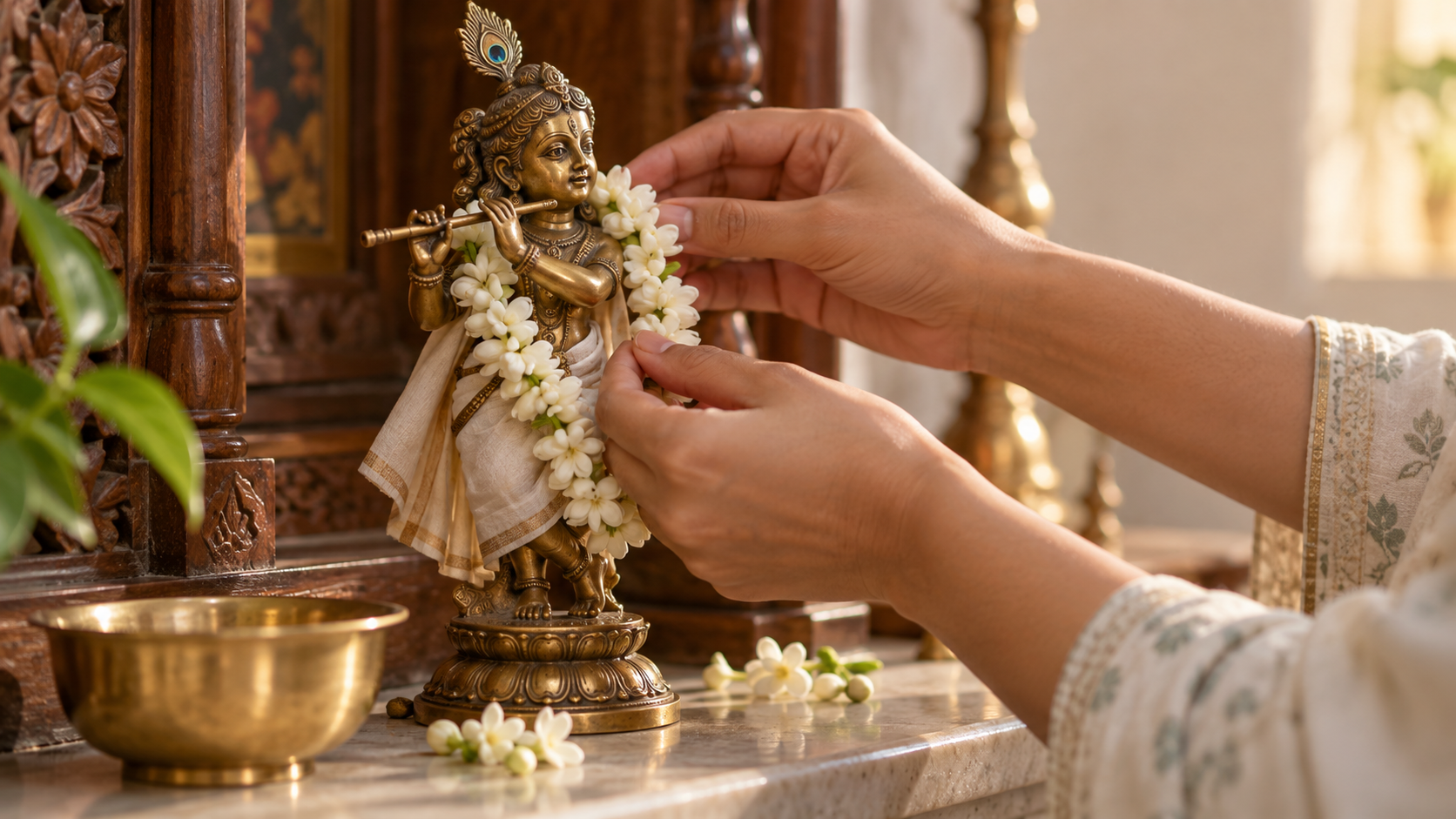
Many Hindu households approach deity adornment as seva: attentive service offered to the divine presence. Clothing, flowers, garlands, and ornaments therefore belong to worship rather than merely to the visual styling of a room. The shrine may be beautiful, but its beauty should help turn your attention toward the deity.
A useful devotional intuition is to offer the deity the same kind of thoughtful care that you would extend to an honoured and beloved member of the household. Hindu temples may use fine clothing, necklaces, flowers, and garlands, but that does not make costly decoration a universal obligation. A temple’s resources, customs, and ritual responsibilities are different from those of a family shrine.
This distinction protects you from two opposite mistakes. The first is treating the murti as a decorative object whose appearance can be changed according to fashion alone. The second is assuming that devotion is inadequate unless the shrine looks opulent. In both cases, attention shifts away from worship and toward display.
Before adding an item, ask three questions: Is it consistent with our practice? Is it suitable for this murti? Will it help me offer worship with greater attention? If the answer to any of them is unclear, pause. More decoration is not automatically more devotion.
A careful sequence for adorning a home murti
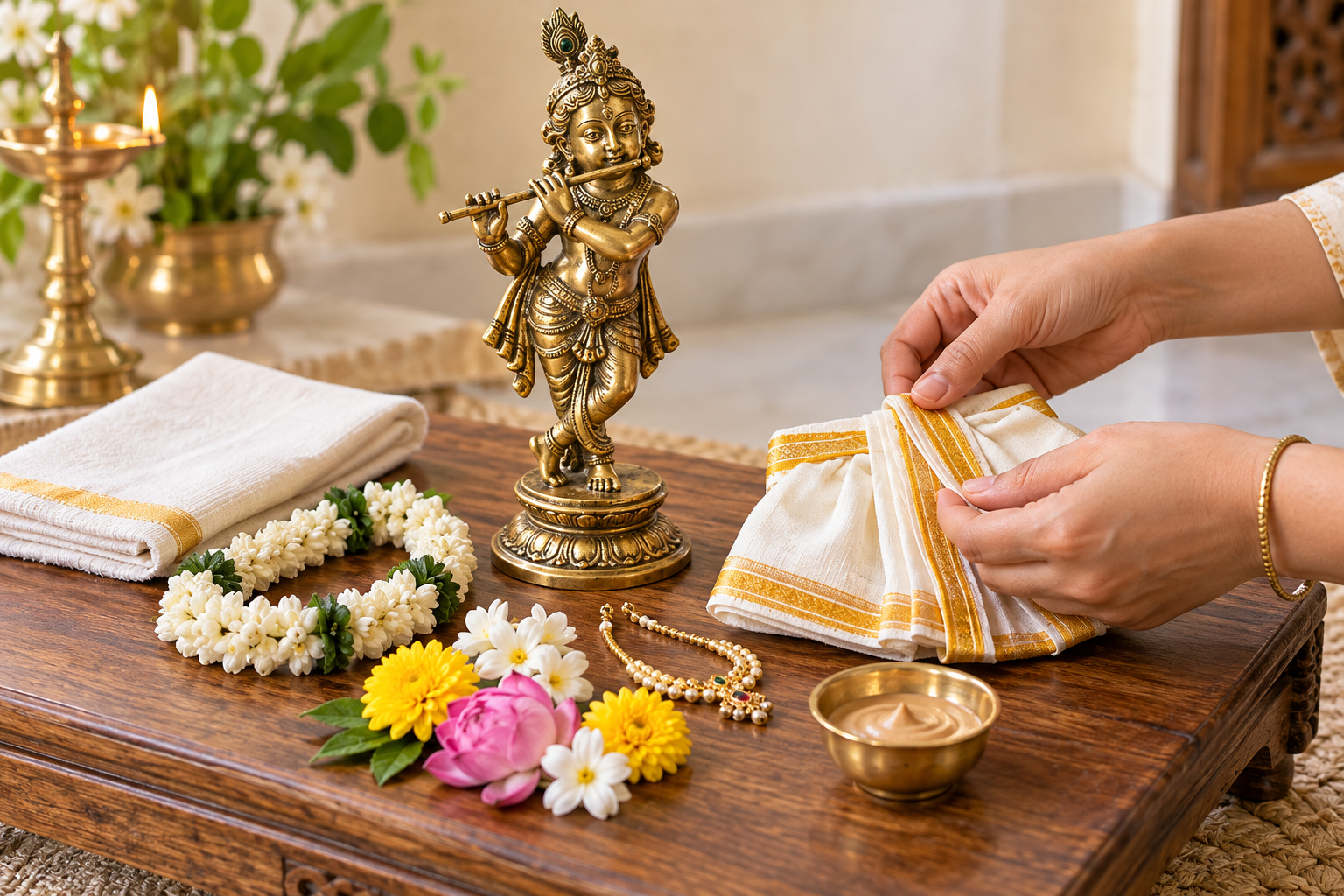
The details differ across families, regions, sects, and forms of worship. The following sequence is therefore a practical framework, not a replacement for instructions received from your family, guru, priest, or established tradition.
- Confirm what belongs in your practice. If the murti is normally dressed or ornamented in a particular way, begin there. Do not add a ritual substance, symbol, garment, or ornament merely because you saw it in another shrine.
- Prepare everything before you begin. Place the clean cloth, flowers, garland, ornaments, and other permitted items on a clean surface. This prevents you from leaving the shrine half-finished while searching for a missing piece.
- Inspect each item. Look for sharp edges, loose hooks, tangled threads, unstable clasps, damp fabric, fading dye, or old flower matter. Set aside anything that could scratch, stain, pull, or topple the murti.
- Work from the base layer outward. If your practice includes clothing, place it without pulling against delicate limbs, projections, paint, or attached features. Add ornaments only after the cloth is sitting securely.
- Add fresh flowers near the end. This keeps them from being crushed while you arrange other items. Place them so that they do not obscure the face or make the murti unstable.
- Check the whole shrine. Look for slipping jewellery, bunched cloth, trapped moisture, loose threads, leaning objects, or garlands that could fall into a lamp. Correct these before lighting an open flame.
- Pause for darshan. Once the arrangement is complete, stop adjusting it. Offer your prayer, mantra, aarti, or silent attention according to your practice. Adornment has reached its purpose when it supports worship.
Do not wash, oil, polish, or apply paste to a murti unless you know that both your tradition and the material permit it. Stone, metal, wood, painted clay, and composite materials do not respond to moisture or cleaning products in the same way. If you do not know what the murti is made from, gentle dust removal with an appropriate dry, soft item is safer than experimenting.
Let your means and rhythm determine the scale
Adornment should reflect financial capacity rather than create embarrassment, competition, or debt. The principle is straightforward: offer the best care that is reasonably available to you, not the most expensive arrangement you can imitate.
For regular worship, this may mean an orderly shrine, a clean garment where dressing is customary, and a modest flower offering. A festival or family observance may call for a more elaborate arrangement if your tradition, time, and means support it. The difference should be one of occasion and loving attention, not a judgement on the worth of the worshipper.
If your budget is limited, begin with maintenance rather than acquisition. Clean the shrine area, mend or retire damaged cloth, untangle the ornaments you already have, and remove old flowers. Do not buy several inexpensive items merely to fill space. One suitable, well-kept item usually serves worship better than a crowded collection that cannot be maintained.
If you are considering a costly ornament, decide where it will be stored, how it will be secured, who will maintain it, and whether its weight is suitable before buying it. An item that spends most of its life tangled, tarnished, or at risk of falling is not automatically a better offering because it cost more.
Flowers deserve the same discipline. Use what you can obtain and maintain respectfully. Do not leave wilted garlands in place to preserve an appearance of abundance. When fresh flowers are unavailable or not part of your practice, a clean and uncluttered shrine remains preferable to neglected decoration.
Avoid the mistakes that turn seva into strain
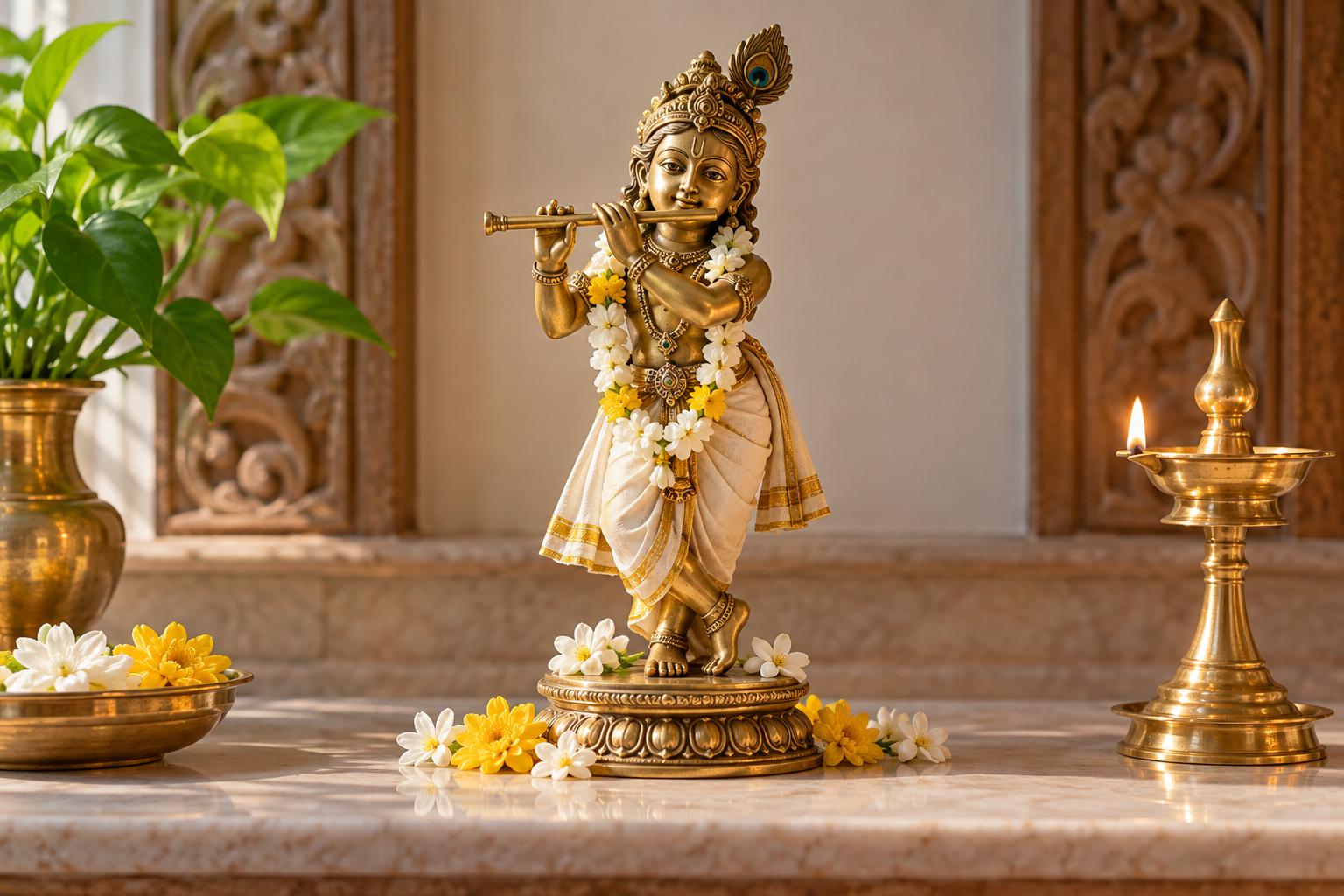
Most problems arise when appearance is allowed to outrun attention. You can prevent them by noticing the following patterns early.
- Copying a temple without its ritual context: A public temple may have trained attendants, purpose-made garments, secure ornaments, and an established schedule. At home, reproduce the spirit of care rather than the physical scale.
- Forcing a poor fit: If a garment pulls, an ornament will not sit securely, or a garland makes the murti lean, remove it. Never force an item into place merely because it was purchased for that purpose.
- Using damaging fasteners: Do not push pins into the murti or place sharp wire against its surface. Be cautious with tape, glue, and adhesive hooks, which can leave residue or lift paint and finishes.
- Ignoring fire clearance: Loose cloth, dry flowers, cotton thread, and hanging garlands must be kept away from an open lamp. Move the lamp or simplify the arrangement if you cannot maintain clear separation.
- Leaving damp or fading material in contact: Moist flowers and colour-bleeding cloth can stain some surfaces. Remove them promptly and ask someone familiar with the murti’s material before attempting stain removal.
- Decorating for the photograph: If the arrangement looks impressive but makes worship awkward, hides the deity’s face, or creates anxiety about breakage, reduce it.
Public and formally maintained temple murtis require a firmer boundary. Do not place, remove, dress, or rearrange anything unless the temple has authorised you to do so. An offering may be sincere and still be unsuitable for that temple’s established seva. Give it to the designated priest or attendant and allow them to decide how it should be used.
At home, ask for guidance when you inherit an unfamiliar murti, receive conflicting family instructions, notice damage, or want to introduce a practice from another tradition. A knowledgeable family elder, priest, guru, or caretaker from an established temple in your lineage can answer the question that a generic checklist cannot: what is appropriate for this particular form of worship?
For your next worship, make one deliberate improvement rather than buying an entire new set. Replace the faded flowers, repair the loose thread, move the lamp to a safer position, or set aside one clean cloth for the deity. When that act is offered with steadiness and bhava, adornment becomes what it was meant to be: care made visible.
References

Leave a Reply
You must be logged in to post a comment.