
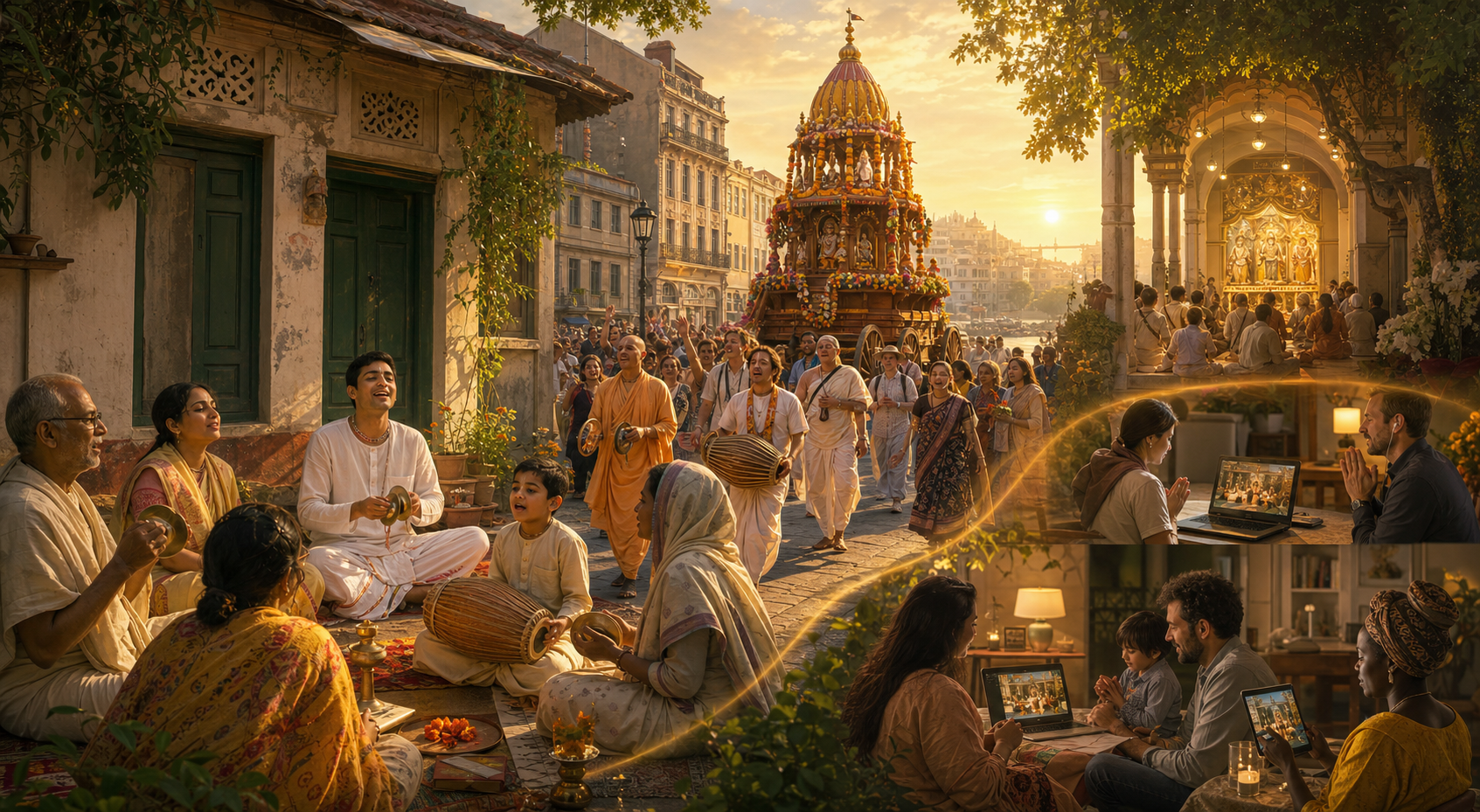
Four reports place Gaudiya Vaishnava devotion in settings separated by centuries and geography: the remembered courtyard of Srivasa Pandita in Navadvipa, a Sanskrit theological work discussed in Hungary, a Ratha Yatra procession in Vienna, and an ISKCON temple livestream serving viewers beyond Washington, D.C. Read together, they present not four disconnected expressions but a devotional ecology carried by homes, texts, festivals, temples, and digital networks.
The central question is therefore not whether an old tradition has simply become modern. It is what remains constant as the setting changes, what each medium makes possible, and what may be lost when embodied practice becomes public spectacle or online content. The sources suggest that continuity rests less in preserving one historical format than in maintaining a recognizable grammar of sacred sound, loving service, scriptural reflection, humility, hospitality, and communal responsibility.
The sacred center comes before the global network
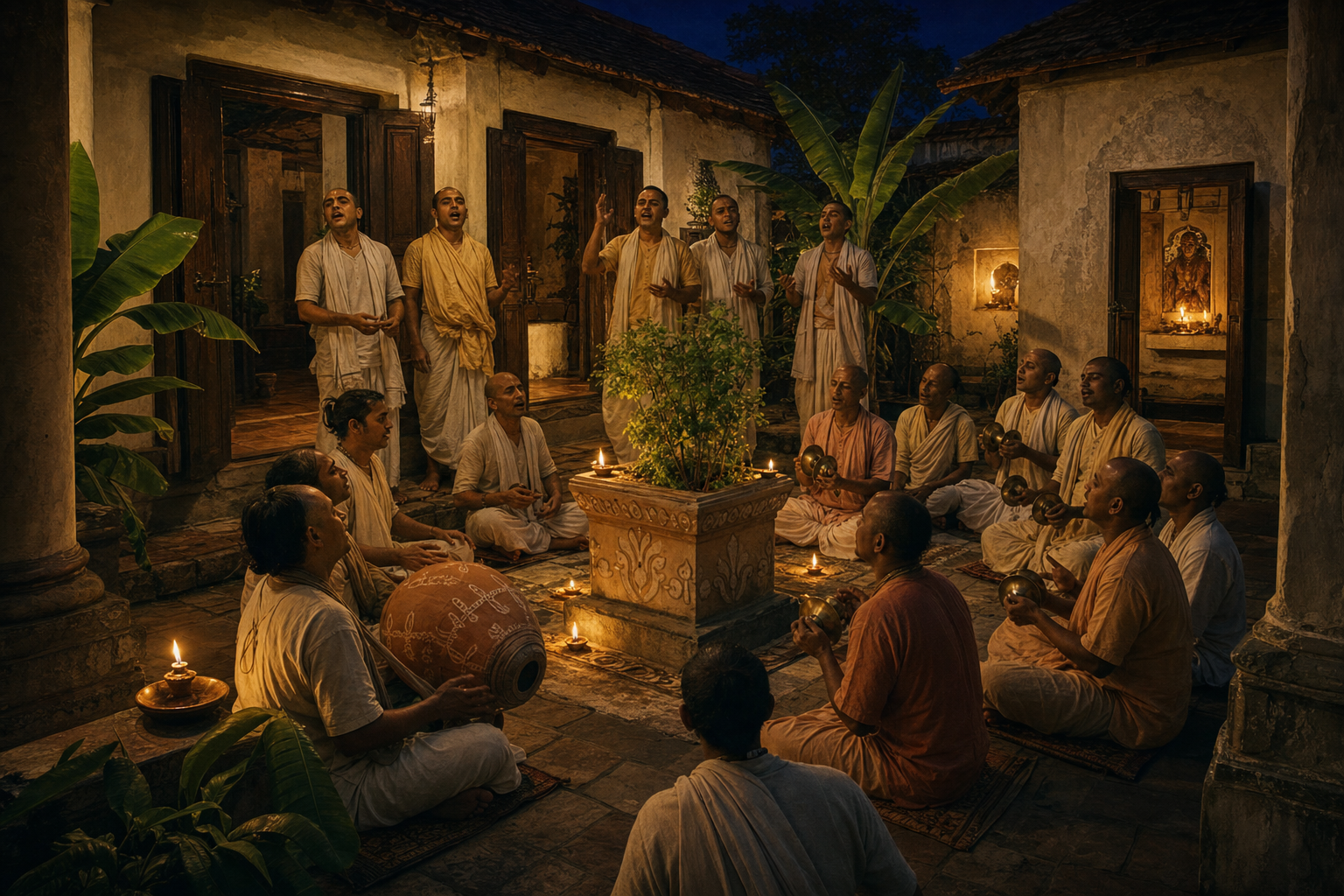
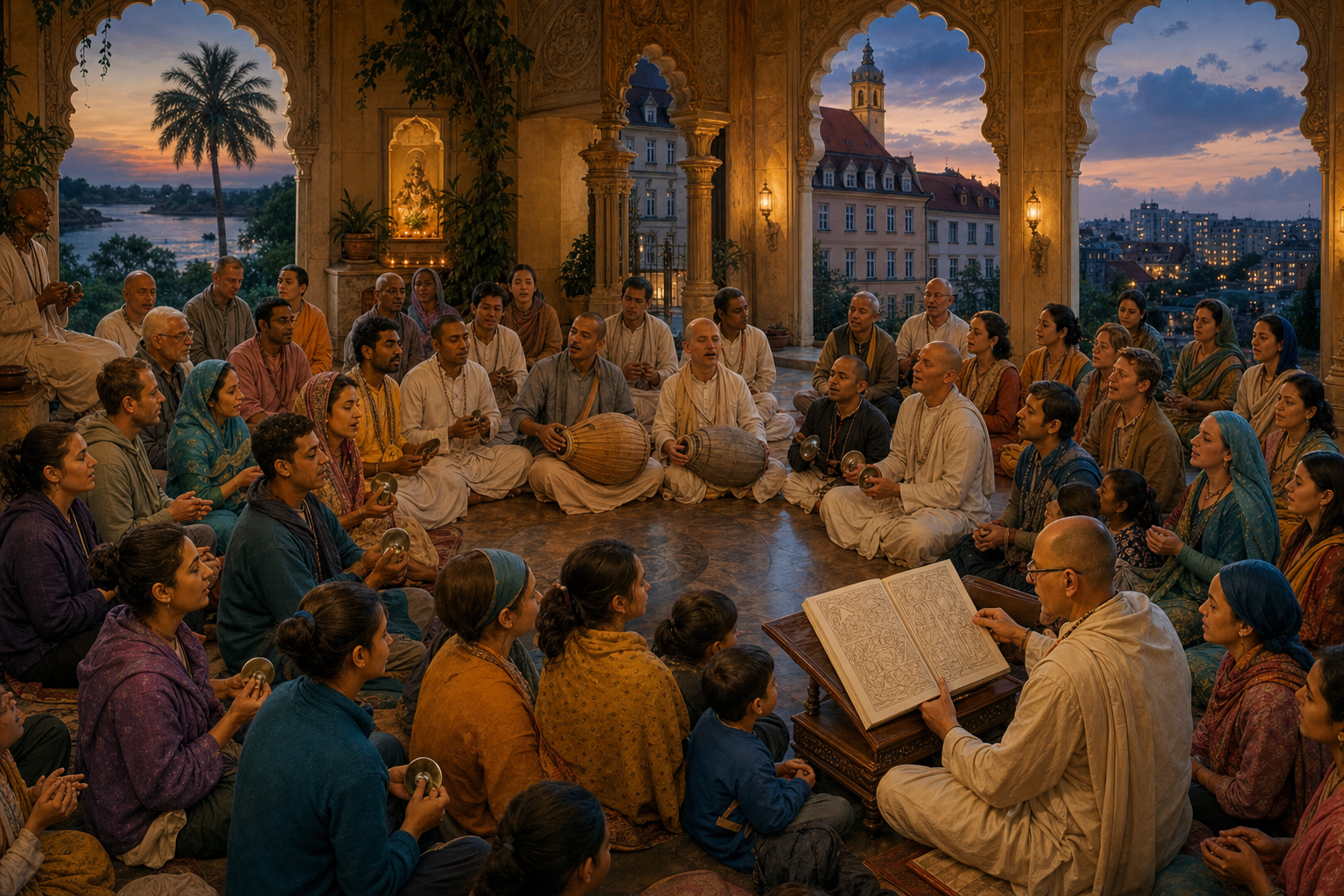
Across the four accounts, bhakti is presented as disciplined relationship rather than belief or emotion alone. The Srivasa profile locates that relationship in a household community. It reports that Srivasa lived in late fifteenth- and early sixteenth-century Bengal, became a close associate of Sri Chaitanya Mahaprabhu, and opened his Navadvipa home for nocturnal kirtan. His courtyard, remembered as Srivasa Angan, became a place where domestic hospitality, collective worship, and the emerging sankirtana movement met.
The same profile presents Srivasa as part of the Pancha Tattva and as a representative of the community of devotees. That theological role gives his household more than biographical interest. The home becomes an institution of transmission: a family dwelling organized around remembrance and service can support a movement before that movement possesses broad public visibility. The reported participation of his wife, Malini Devi, and the association of his brothers with this devotional environment further situate the early community within shared household life rather than outside it.
The account of Brihad Bhagavatamrita 1.2.53-62 approaches the same center through theology. It reports on a July 5, 2026 discourse in Hungary concerning Sanatana Goswami’s work and its narrative search, led by Narada Muni, for the recipient of Bhagavan’s fullest mercy. According to that article, the work advances through praise, humility, and redirection: a devotee may be honored yet point toward another expression of intimacy with Krishna. Spiritual depth is consequently not equated with wealth, rank, institutional authority, learning, or visibility.
The courtyard and the theological text perform complementary tasks. Srivasa Angan gives devotion a social body, while Brihad Bhagavatamrita supplies criteria by which devotional life can examine itself. One shows how a community gathers; the other asks what makes that gathering spiritually meaningful. Global expansion without the first would lack durable relationships, while expansion without the second could mistake prominence for realization.
Sacred sound moves from the courtyard into streets and screens
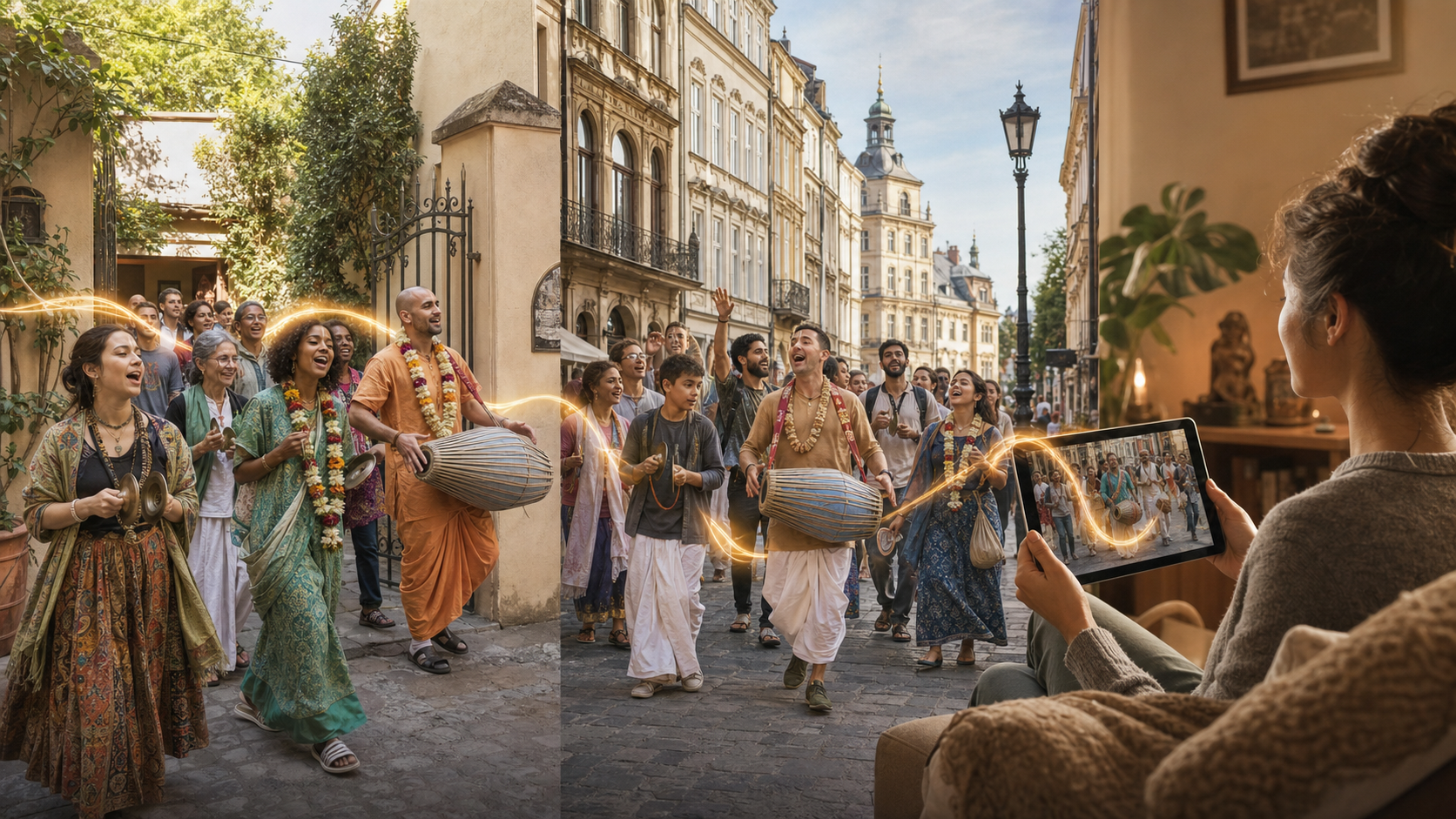
Kirtan is the clearest thread connecting the sources. The Srivasa article describes intimate chanting in a household courtyard that eventually contributed to a wider public sankirtana culture. The movement from home to street did not abandon the holy name; it altered who could encounter and participate in its recitation. Sacred sound became a way for personal devotion to take collective and public form.
The Vienna report depicts a contemporary extension of that outward movement. It presents Ratha Yatra 2026, associated with Vedisches Zentrum Wien – ISKCON Vienna, as a public celebration centered on Lord Jagannath, accompanied by Baladeva and Subhadra. In its interpretation, the chariot’s passage through the city carries sacred presence beyond temple walls. Kirtan, the participation of volunteers, the pulling of the chariot, and the customary culture of prasadam turn an urban route into a temporary devotional landscape open to both practitioners and passersby.
The Washington-area livestream carries sacred sound across a different boundary. Its source describes the broadcast as access to arati, bhajans, mantra recitation, scriptural teaching, and the recurring discipline of deity worship. It particularly identifies value for people separated from a temple by illness, age, travel, isolation, or geography. Unlike a procession, the stream does not transform a shared street; it brings selected sights and sounds of the temple to dispersed viewers.
These modes are related but not interchangeable. A courtyard creates sustained intimacy among a committed group. A public festival offers embodied congregation and an unplanned encounter with the wider city. A livestream provides accessibility, continuity, and replay across distance. The digital-darshan article explicitly acknowledges that video cannot reproduce the complete sensory and participatory experience of temple life. Its devotional value instead depends on whether viewers use the stream for attentive remembrance, chanting, study, or home practice rather than consuming it as ordinary entertainment.
Seva is the infrastructure that makes transmission possible
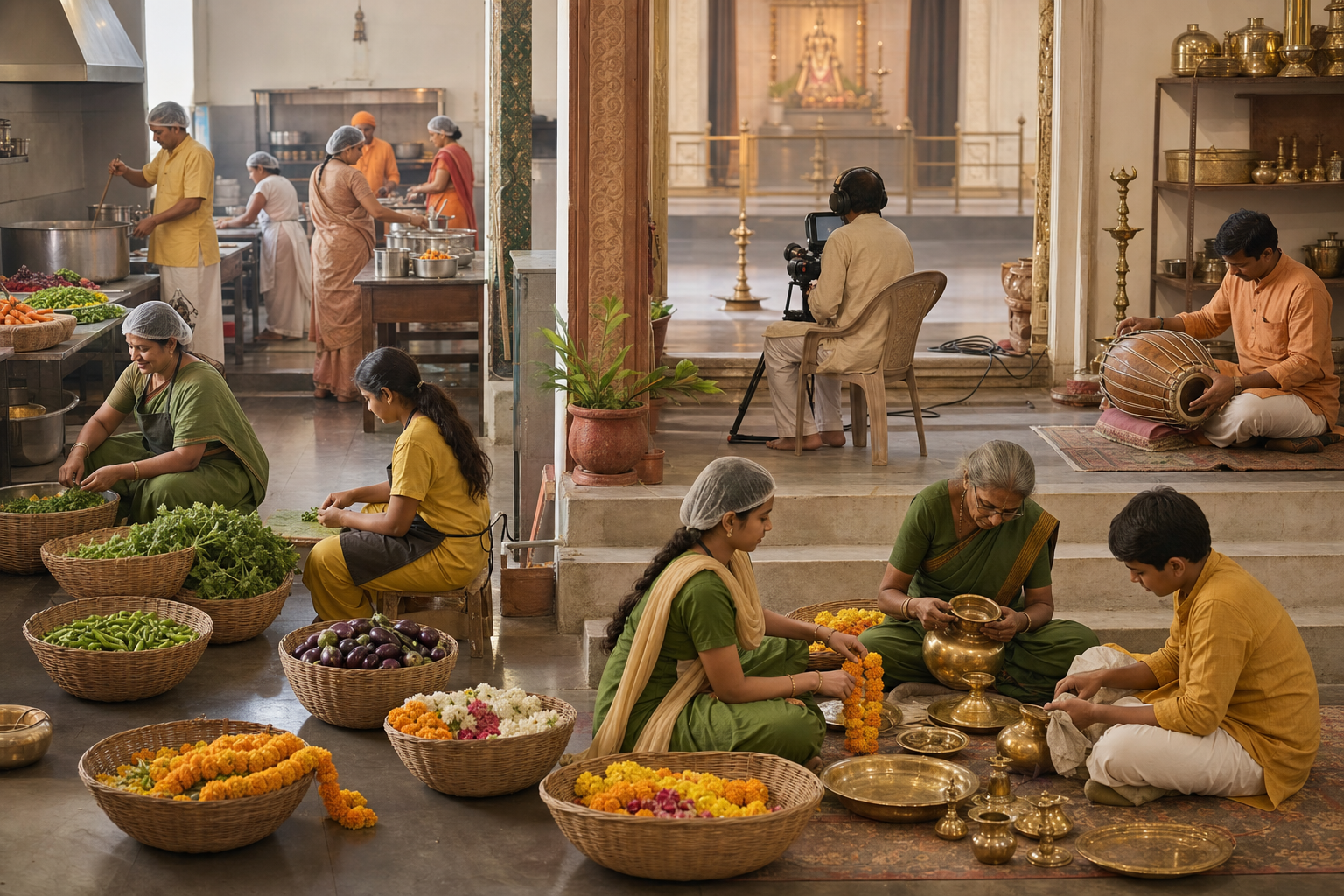
The visible forms of global bhakti depend on largely invisible labor. In the Srivasa narrative, that infrastructure consists of an opened home, family participation, hospitality, discipline, and the willingness to sustain worship amid social pressure and personal grief. The story of his son’s death during kirtan, as reported in the devotional tradition, is presented as an account of trust that holds sorrow within a larger understanding of the soul and divine relationship. The source also cautions against reading it as approval of emotional suppression or indifference to family suffering.
In Vienna, seva takes an organizational form. The festival article identifies route planning, permissions, chariot decoration, volunteer coordination, musical support, safety, cleanliness, transport, and food-related care among the practical responsibilities behind a public event. Such tasks are not external to devotion. They translate hospitality and responsibility into civic conditions, allowing a specifically Vaishnava celebration to welcome a wider public without neglecting local norms.
Digital practice requires its own service ethic. The livestream account emphasizes dignified camera placement, intelligible audio, platform stability, and respect for the altar. These technical decisions shape whether the broadcast supports worship or distracts from it. The device also presents a discipline for the viewer: the same screen that carries kirtan invites interruption, comparison, and rapid switching. Attentive participation therefore becomes part of the practice, not merely a preference about media use.
The Hungary discourse adds a fourth layer of infrastructure: oral teaching within parampara. A text survives globally not simply because a recording is available, but because teachers interpret it, listeners hear and reflect, and communities connect doctrine with conduct. Household hospitality, festival logistics, media stewardship, and lineage-based teaching may look unrelated, yet each converts devotional intention into a repeatable social form.
Global practice changes scale without requiring a new theology
The livestream source situates contemporary ISKCON within the Gaudiya Vaishnava tradition shaped by Sri Chaitanya Mahaprabhu and reports that A. C. Bhaktivedanta Swami Prabhupada founded ISKCON in New York in 1966. The other contemporary reports show elements of this tradition operating in European settings in 2026: public Ratha Yatra in Vienna and study of Sanatana Goswami’s Sanskrit theology in Hungary. Together with the Washington-area broadcast, they illustrate several kinds of globalization at once: institutional expansion, public cultural presence, textual transmission, and technologically mediated worship.
The continuity is not a claim that every setting is identical. The venue, audience, language of explanation, civic obligations, and available technology all change. What persists across the reports is an organizing relationship with Krishna expressed through the holy name, scripture, deity-centered worship, seva, prasadam culture, and the association of devotees. Adaptation occurs around this center: a courtyard becomes a prototype for household sangha, a procession makes devotion publicly accessible, a recorded discourse carries theological study across languages and borders, and a livestream helps a temple accompany people who cannot be physically present.
This pattern also clarifies the relationship between particularity and openness. The Vienna festival can welcome unfamiliar observers without ceasing to be centered on Jagannath. A temple stream can improve religious literacy without reducing worship to an explanatory demonstration. A discussion of Brihad Bhagavatamrita can address universal questions of humility and grace while retaining its distinctly Gaudiya account of intimacy with Krishna. Intercultural accessibility is strongest when hospitality expands but the tradition’s own theological vocabulary remains legible.
The sources should nevertheless be read according to their genre. The Srivasa article itself notes that the Chaitanya biographies preserving his memory are devotional and hagiographical works rather than modern academic biographies. The contemporary pieces similarly offer devotional interpretations of a festival, a discourse, and a livestream; they do not provide independent measurements of participation or social impact. They are most useful as evidence of how Gaudiya Vaishnava communities understand the meaning of their practices, while their event-specific claims remain attributed to the reporting supplied.
Key takeaways for understanding global bhakti
- Continuity resides in a devotional grammar rather than in one venue: sacred sound, service, scripture, worship, hospitality, and community remain mutually reinforcing.
- Kirtan is portable, but its settings are not equivalent. The household, public procession, temple hall, recorded class, and livestream each enable a different quality of participation.
- Householders are not peripheral to transmission. The Srivasa account presents domestic space and family-supported hospitality as foundations of collective devotional life.
- Adaptation requires practical competence. Civic planning, volunteer care, responsible broadcasting, and sustained teaching are forms of seva when directed toward spiritual access and community integrity.
- Reach is an incomplete measure of success. The theological standard emphasized in the Brihad Bhagavatamrita account is depth of loving dependence and humility, not public recognition alone.
The future of Gaudiya Vaishnava practice will likely be increasingly hybrid: embodied congregations will coexist with public festivals, household devotion, recorded teaching, and digital darshan. Its coherence will depend on keeping theological depth, responsible service, and genuine participation together as new channels of transmission emerge.
References
- DharmaRenaissance Blog / YouTube — ISKCON of DC Live Stream: A Powerful Window into Krishna Bhakti and Digital Darshan
- Dandavats 108 — Srivasa Pandita’s Powerful Bhakti Legacy: Courage, Kirtan, and Sacred Home
- Dandavats — Ratha Yatra 2026 in Vienna: A Powerful Celebration of Devotion and Unity
- Dandavats — Brihad Bhagavatamrita 1.2.53-62: Powerful Lessons in Devotion and Grace