
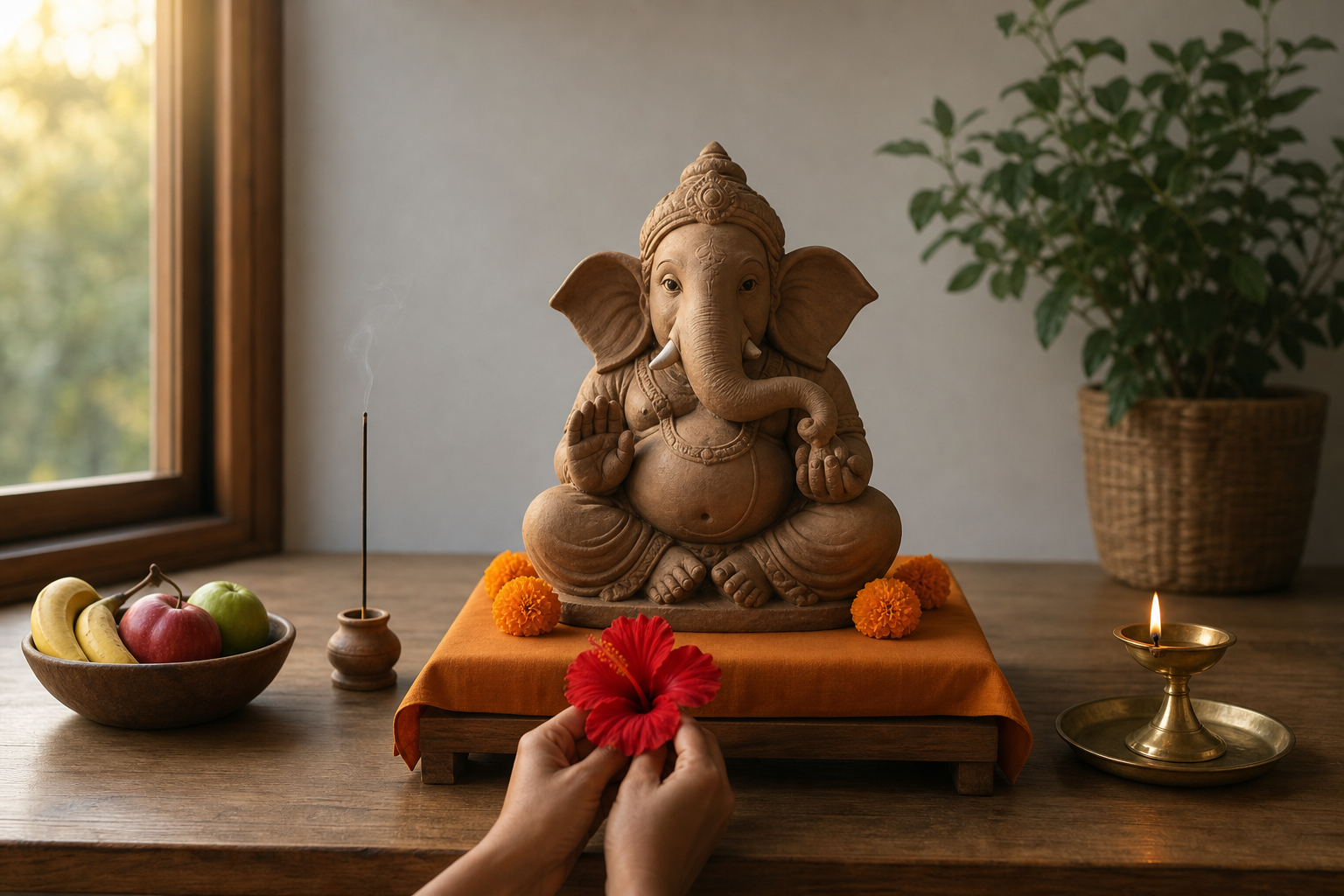
You want to bring Ganesha into your home, but the choices can quickly become confusing. Which way should the trunk turn? Does the murti need to be red? Must the shrine face a particular direction? And what happens if your daily worship is brief rather than elaborate?
For most households, the sound starting point is a modest left-coiled Ganesha, a clean and stable shrine, and a simple practice you can sustain. The iconography should help you understand the form before you; it should not turn devotion into anxiety.
Start with the murti’s visual grammar
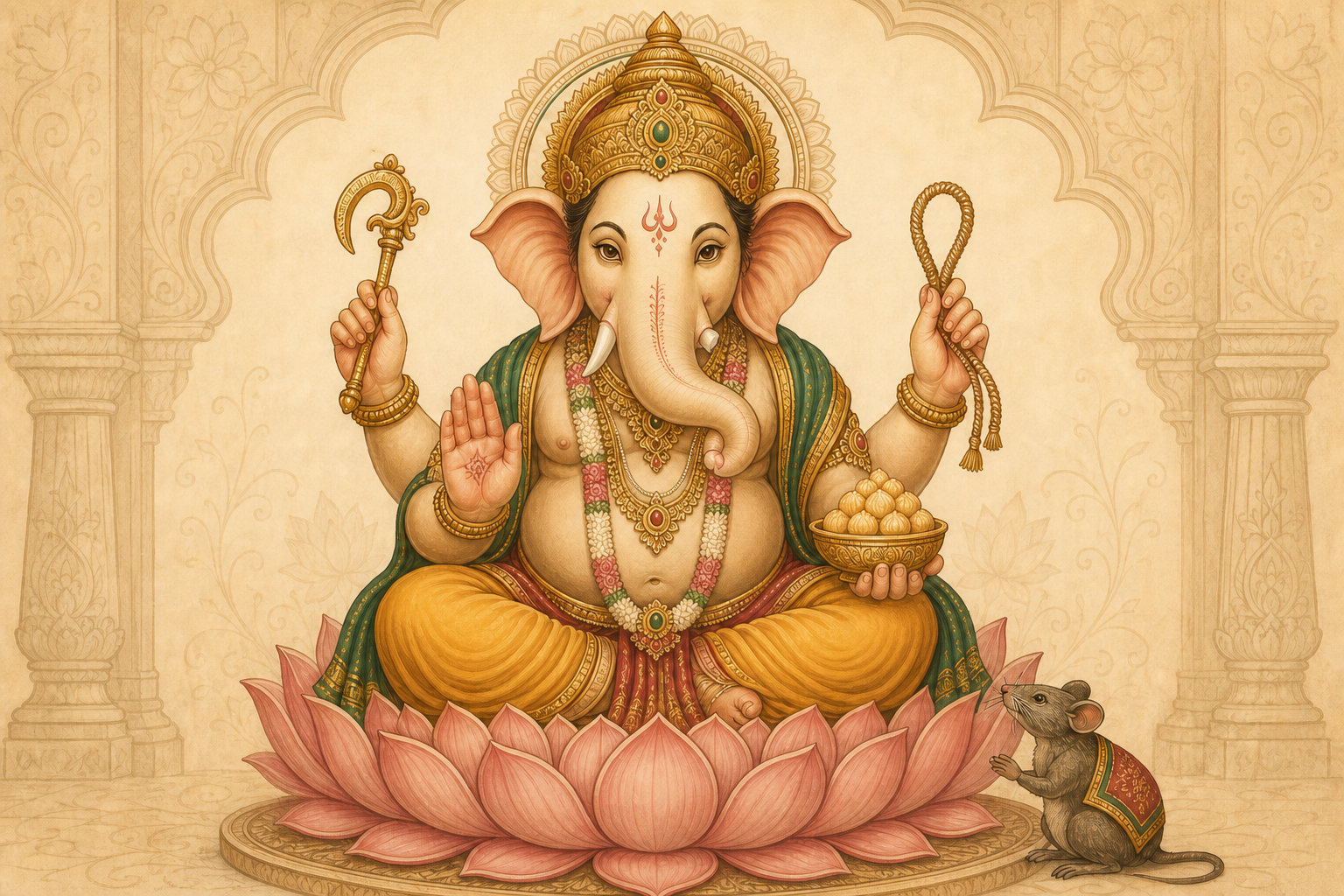
A Ganesha murti does more than identify the deity. Its trunk, color, adornment, material, and setting communicate how the form is approached in worship. You do not need to decode every ornamental detail before beginning puja, but two features deserve attention in a household shrine: the trunk’s orientation and the deliberate use of red.
The trunk indicates a mode of worship. A left-coiled form is commonly associated with a peaceful and approachable current, while a right-coiled form is treated in several traditions as more exacting. A centered trunk has its own contemplative meaning. These distinctions help you match the murti to the rhythm of your home; they are not a ranking of one sacred form above another.
Red communicates a different layer of meaning. In Hindu sacred symbolism, it carries the sense of Shakti, dynamic activity, and mangala: vital force, the capacity to act, and auspiciousness. These qualities suit Ganesha’s place at beginnings, transitions, and moments when an obstacle must be faced clearly.
Some traditions also relate Ganesha’s warm red presence to the Muladhara chakra, the foundational energy center associated with grounding and stability. The practical lesson is easy to miss: invoking Ganesha is not merely asking for an external difficulty to disappear. It is also a way of steadying yourself so that you can take the next right action.
You do not need an entirely red murti to express this symbolism. A red flower, a small amount of kumkum, a red vastra, or raktachandana can carry the same ritual intention. Choose one meaningful accent rather than crowding the shrine with every possible red object.
Choose the trunk orientation for the practice you can keep
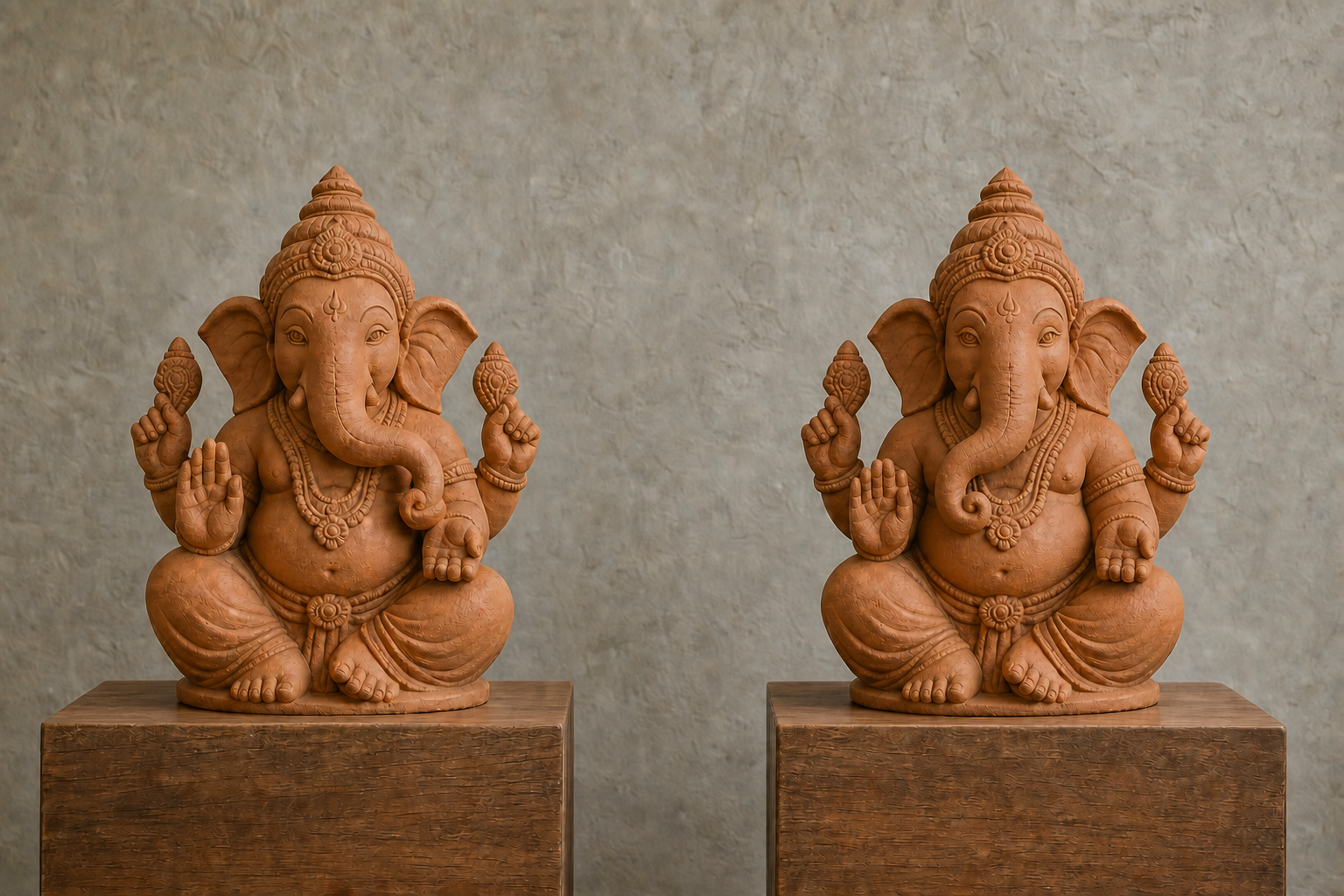
The familiar advice to choose a left-coiled Ganesha for the home rests on a practical principle: household worship should fit household life. Work, study, care for children or elders, meals, travel, and unexpected demands all affect the regularity of domestic puja.
| Form | Traditional association | What it means for your household |
|---|---|---|
| Left-coiled, or Vamavarta | Ida nadi, the lunar or cooling current, and Ganesha’s shanta or peaceful aspect | The customary default for accessible, steady domestic worship |
| Right-coiled, or Dakshinavarta | Pingala nadi, the solar or heating current, with a more intense ritual character | Better chosen when your lineage provides guidance and its observances can be maintained |
| Centered trunk | Sushumna nadi, inner balance, and meditative equipoise in certain schools | A meaningful but less common household choice, especially for a contemplative setting |
This table describes interpretations preserved in several lineages, not a universal mechanical law. Parampara matters. If your family already has a customary Ganesha form and a stable way of worshipping it, inherited practice carries more weight than a generalized shopping rule.
When buying a murti, do not rely on the word “left” alone. A seller may describe direction from the viewer’s position or from the murti’s position. Ask whether the form is specifically identified as Vamavarta and request a clear front-facing image. That small check prevents you from making an important choice from an ambiguous photograph.
If you already have a right-coiled Ganesha, do not respond with fear or discard the murti. All these forms are sacred. Ask a knowledgeable elder, priest, or teacher within your parampara what observance accompanies the form you have. The distinction calls for informed care, not panic.
If you are choosing without an inherited instruction, Vamavarta is the sensible household default. It is associated with approachable grace, family concord, and easeful upasana, which aligns with the purpose of a domestic shrine.
Build the shrine around steadiness, not display
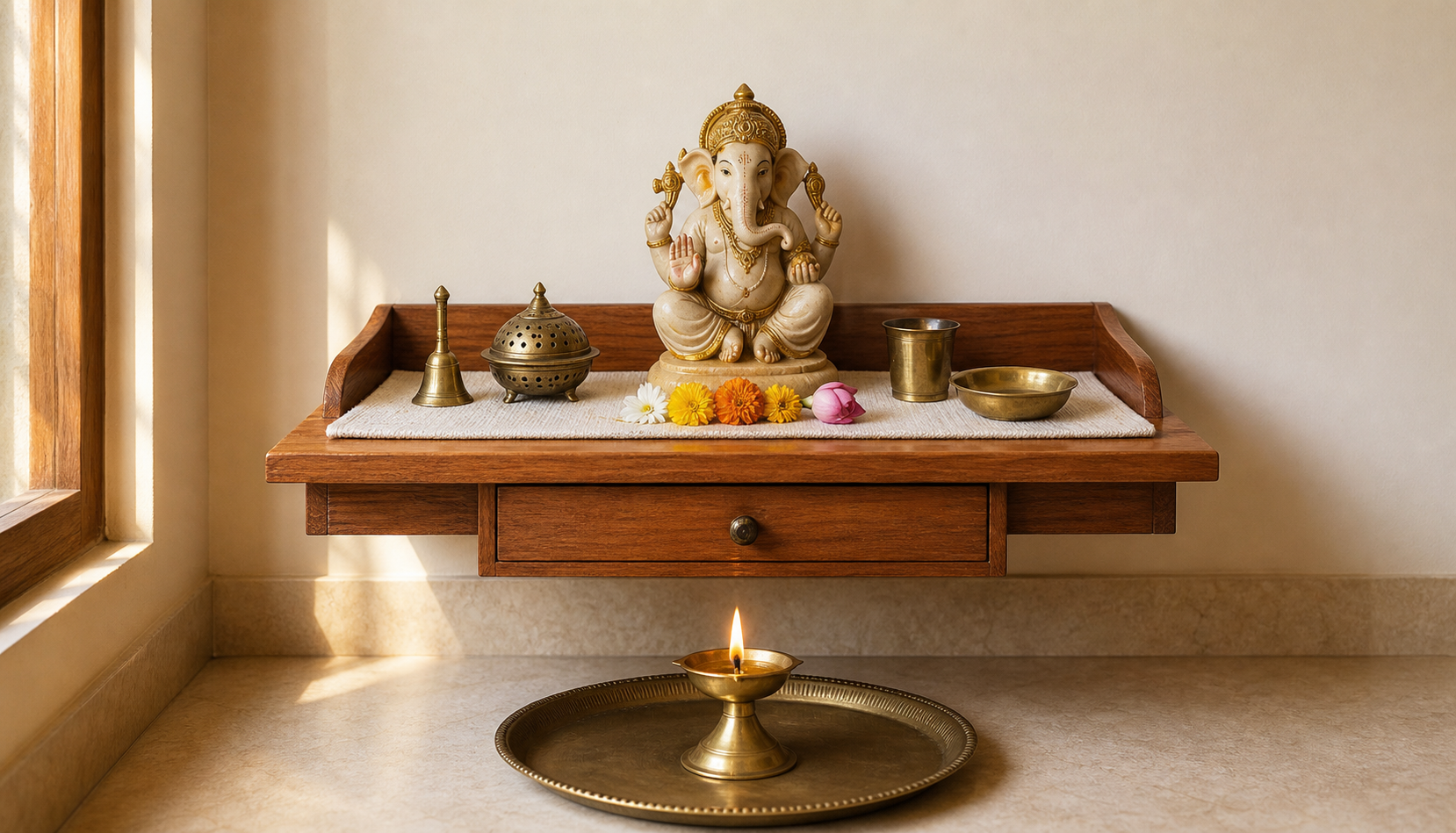
A home altar succeeds when you can approach it regularly, keep it clean, and give it undivided attention. An impressive arrangement that becomes difficult to maintain works against that purpose.
- Choose a manageable murti. Clay, stone, and metal are all established choices. Select a modest size and a material you can care for without repeatedly moving or disturbing the form.
- Give the murti a stable seat. Use a secure surface at a comfortable, approximately eye-level height. Stability matters more than decorative complexity.
- Use the northeast when it is genuinely available. The Ishana or northeast part of the home is widely preferred for a shrine, but it is not an absolute condition. Do not postpone worship or disrupt a functional home because that quadrant is unavailable.
- Clear visual clutter. Keep unrelated storage, loose packaging, and neglected decorations away from the altar. A small, ordered space supports attention better than a crowded one.
- Add one intentional red element. A flower, cloth, or modest offering of kumkum is enough to express auspicious energy. If the murti’s surface is delicate or you do not know how its finish will react, place the offering before the murti instead of applying it directly.
The red element is not an interior-design requirement. Sindoor, kumkum, raktachandana, red flowers, and red vastra belong to a ritual language of energy, protection, and auspicious action. Use what accords with your family’s practice and what you can offer respectfully.
The same principle applies to location. If the northeast is impractical but another clean and quiet place lets the family gather consistently, use the workable place. Direction can support worship; it cannot replace attention, reverence, or right conduct.
Keep daily puja simple enough to remain daily
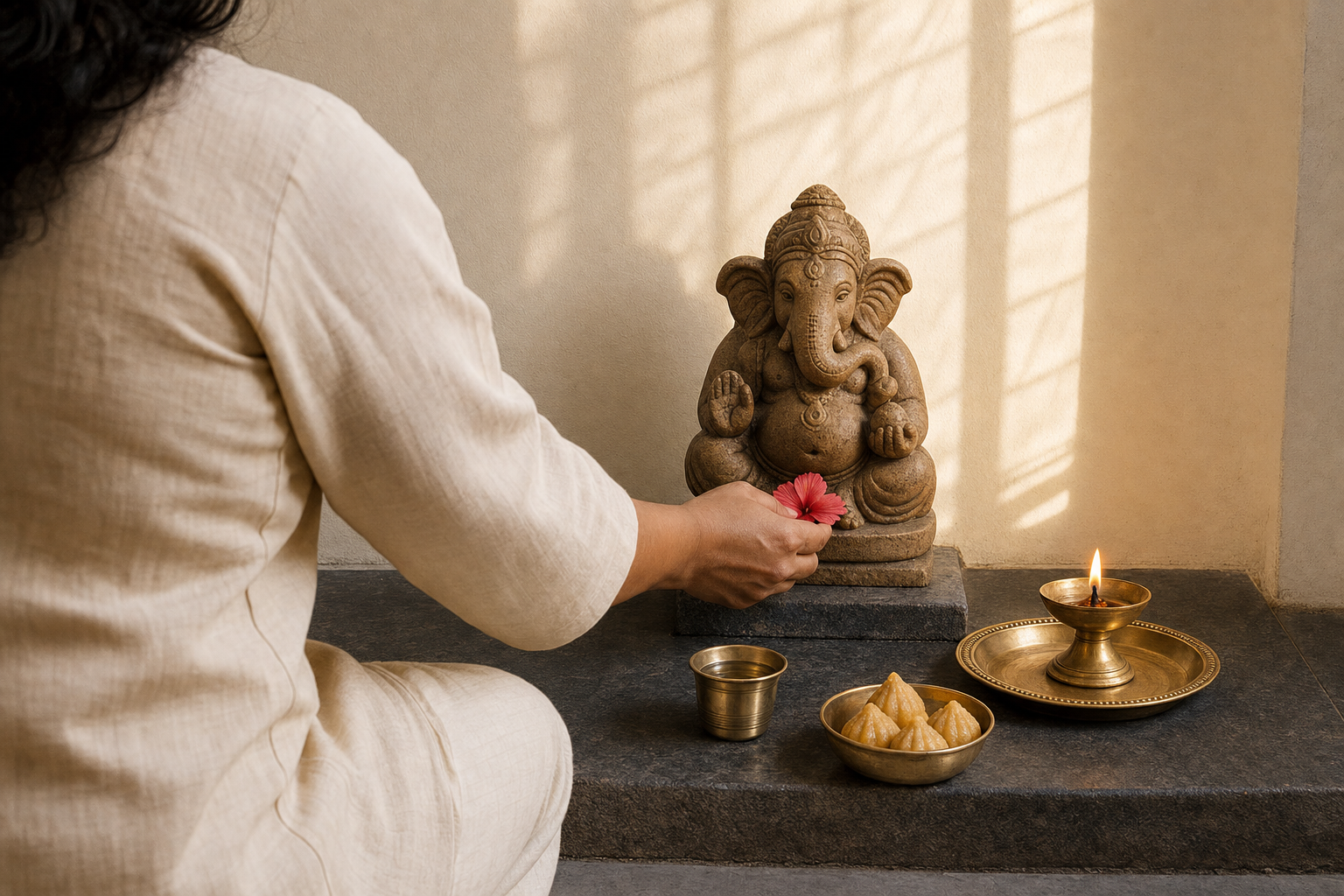
A household practice does not become shallow because it is brief. Its strength comes from regularity and attention. Begin with a compact sequence, then add observances during festivals or as your parampara directs.
- Prepare yourself and the space. Wash your hands, straighten the shrine, and remove yesterday’s faded or unsuitable offerings according to your household custom.
- Light a lamp when it is safe to do so. Place it securely and never leave a flame unattended. If a lamp is not practical at that moment, continue with the rest of the worship rather than abandoning the routine.
- Make a simple offering. Flowers and Durva grass are customary. A red hibiscus or rose can unite the offering with Ganesha’s auspicious red symbolism.
- Offer a red sacred substance if it belongs to your practice. Use a modest amount of kumkum, sindoor, or raktachandana rather than treating quantity as a measure of devotion.
- Recite what you know with attention. A familiar Ganesha stotra, a mantra received through your tradition, or a short period of quiet meditation is enough for an ordinary daily observance.
- Connect prayer to conduct. Name the beginning or obstacle before you, then identify the next dharmic action: study, make the difficult call, correct an error, keep a promise, or begin the work you have delayed.
This last step protects Ganesha worship from becoming transactional. Vighneshwara’s grace is sought at the threshold, but you still have to cross it. The red of dynamic energy should appear in your conduct as focused effort, courage, and clarity.
Before work, study, a journey, or a new family undertaking, use the same sequence rather than inventing a completely different ritual each time. Familiarity settles the mind. It lets the murti, offering, recitation, and intended action point in one direction.
Ganesh Chaturthi can expand the scale of worship without changing its foundation. Add the offerings and observances your family can maintain respectfully. Families with children can also share a narrative connected with Ganesha’s qualities; the eight forms described in the Mudgala Purana provide a traditional framework for discussing wisdom, courage, and compassionate strength.
Ganesha puja remains a specifically Hindu practice. Its wider Dharmic resonance lies not in treating different religions’ rites as interchangeable, but in recognizable commitments to disciplined attention, ethical livelihood, compassion, family harmony, and spiritual courage.
Key takeaways
- For an ordinary home shrine, a modest Vamavarta or left-coiled Ganesha is the customary and accessible default.
- A right-coiled form is not inferior or dangerous, but several lineages associate it with more exacting observance; seek guidance instead of acting from fear.
- Red signifies Shakti, dynamic action, and auspiciousness. One red flower, cloth, or careful offering of kumkum can express that meaning.
- A clean, stable, approximately eye-level shrine matters more than ornamental abundance. Use the northeast when feasible, not as a reason to delay worship.
- A sustainable daily puja can consist of a lamp, flowers or Durva, a brief recitation or meditation, and one clearly chosen dharmic action.
- Let family parampara govern details that differ among regions and lineages.
If you are establishing your shrine now, make one sound decision at a time. Confirm the trunk form, prepare a stable place, choose one meaningful offering, and begin a routine you can repeat. Allow the practice to become steady before making it elaborate.
References
- DharmaRenaissance Blog – Why Ganesha Wears Red: Auspicious Energy, Shakti, and Victory Over Darkness
- DharmaRenaissance Blog – Why a Left-Coiled Ganesha Belongs at Home: Auspicious Energy and Easeful Worship
