

You may have paused before an image of Sri Radha and wondered why Vrindavan’s songs, paintings, and meditations return so often to her eyes. Are they simply a beautiful feature, or are devotees meant to learn something from the way she looks?
The answer matters when your japa has become mechanical or your attention keeps scattering. Contemplating Radha’s gaze offers a practical discipline: receive beauty without trying to possess it, carry that attentive mood into the holy name, and then test your devotion in the way you look at other people.
Radha’s gaze turns beauty into relationship

Eyes matter in bhakti because devotion is relational. A carved or painted eye is a visible form, but the devotee does not approach it as a collector inspecting an object. During darshan, you allow yourself to be addressed. The important movement is from looking at Radha to remembering that you stand before her as a servant, dependent on grace.
This changes the question you bring to sacred beauty. The consuming eye asks, “What pleasure can this image give me?” The devotional eye asks, “What response does this beauty call from me?” The first movement ends in acquisition. The second can mature into remembrance, gratitude, chanting, and seva.
Radha’s eyes should therefore not be reduced to a symbol for your own mental state. She is not an illustration of calmness or a decorative aid to concentration. Within Vrindavan devotion, her beauty belongs to the divine beloved whose love is exemplary. Symbolism serves remembrance of her; it does not replace the person being remembered.
When you take darshan, notice the sequence within yourself. Where does your attention go first? Does beauty awaken reverence, longing for praise, visual curiosity, or distraction? What act of service follows? You do not need to manufacture a devotional emotion. Simply seeing your actual response is already more honest than imitating the language of an advanced bhava.
The motif also belongs to a larger devotional culture. Radha’s eyes are honored through poetry, music, ritual, private japa, shared nama-sankirtana, meditation, and guru-seva. If contemplation remains an isolated aesthetic experience and never returns you to the name or to service, it has stopped short of the tradition’s practical center.
What the dark line of kajal asks you to notice

Before searching for a hidden meaning in kajal, attend to what it visibly does. The dark line defines the eyes, strengthens their contour, and makes their expression more vivid. It does not compete with their luminosity. It gives that luminosity a boundary through which it becomes easier to perceive.
Vrindavan’s devotional reading can then unfold through several connected layers:
- Aesthetic: kajal intensifies the visible expression of Radha’s gaze and draws the devotee’s attention toward it.
- Contemplative: the defined border evokes attention that has been gathered rather than allowed to spill into every passing stimulus.
- Protective: the image suggests guarding the inner gaze from habits that make perception careless, possessive, or agitated.
- Devotional: the dark-lined eyes convey the attractive force of compassion, drawing attention toward Radha rather than back toward the devotee’s self-image.
These meanings are expressed through the aesthetic and contemplative symbolism of Radha’s kajal-lined eyes. They should not be turned into a rigid code in which every visual detail has one compulsory translation. A devotional image can carry several resonant meanings without becoming a puzzle that you must solve.
Do not impose a crude opposition in which light means purity and darkness means impurity. Here the dark border serves the luminous gaze. That is precisely why kajal offers such a useful image for discipline: a boundary need not suppress love. Rightly placed, it can keep attention from dispersing and allow tenderness to become clearer.
Try a modest exercise during darshan. Notice the relation between the dark contour and the brightness or expression of the eyes. Then stop analyzing the visual detail. Carry one quality into your chanting: attentiveness, tenderness, compassion, or readiness to serve. If you cannot retain a mental picture, do not strain. Remembering the quality of the gaze is enough to guide attention back toward Radha.
A japa-and-dhyana practice you can actually sustain
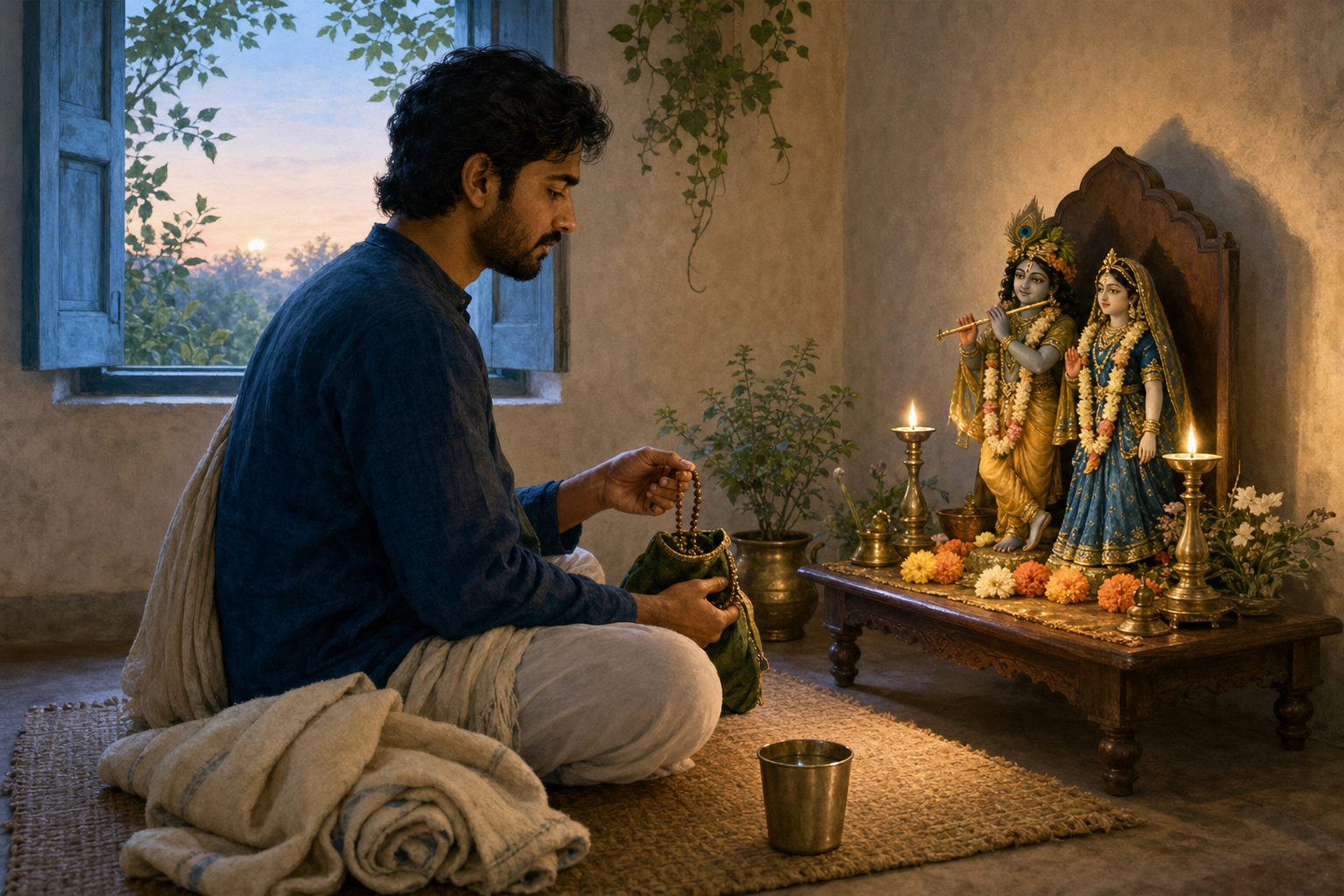
If you try to chant, construct an elaborate inner scene, monitor your concentration, and judge your spiritual feeling at the same time, each task competes with the others. Use a simpler sequence. Let dhyana gather the heart before japa, and let the sacred name become the place to which scattered attention returns.
- Arrive deliberately. Put aside the distractions you can control. Sit or stand with enough steadiness that you are not constantly rearranging yourself.
- Begin within your actual lineage. If your guru has given you prayers or a prescribed order of remembrance, follow those instructions. The Gaudiya pattern of honoring guru and Gauranga places meditation inside received devotion, not private invention.
- Receive the gaze. Look reverently at Radha’s eyes and kajal without trying to extract an extraordinary experience. Let the image collect your attention.
- Move into japa. Give priority to hearing the holy name. When attention wanders, return without self-dramatization. Let the remembered tenderness and focus of Radha’s gaze shape how you return.
- Seal remembrance in seva. Before moving on, identify one duty you will perform with greater care. Make it concrete: listen without interrupting, complete neglected temple service, speak truth without contempt, or give someone your undivided attention.
This is not a technique for manufacturing visions. Nor is Radha’s gaze a concentration trick detached from devotion. Dhyana refines how you attend; japa anchors attention in sacred remembrance; seva gives that remembrance a bodily and ethical expression. Each corrects a weakness that can arise when the others are isolated.
Calm, tenderness, or clarity may arise, but none should become your scoreboard. A restless period of japa followed by a more patient response to another person may reveal more genuine movement than a sweet meditation followed by needless harshness. Judge the practice less by the intensity of a passing mood and more by the direction in which it turns you.
If you have formal guidance from a guru, that guidance takes precedence over a general exercise. The purpose here is not to invent a private form of lila-smarana. It is to keep attention, name, remembrance, and service connected at the level where you can practice honestly.
The proof is in how you look at people
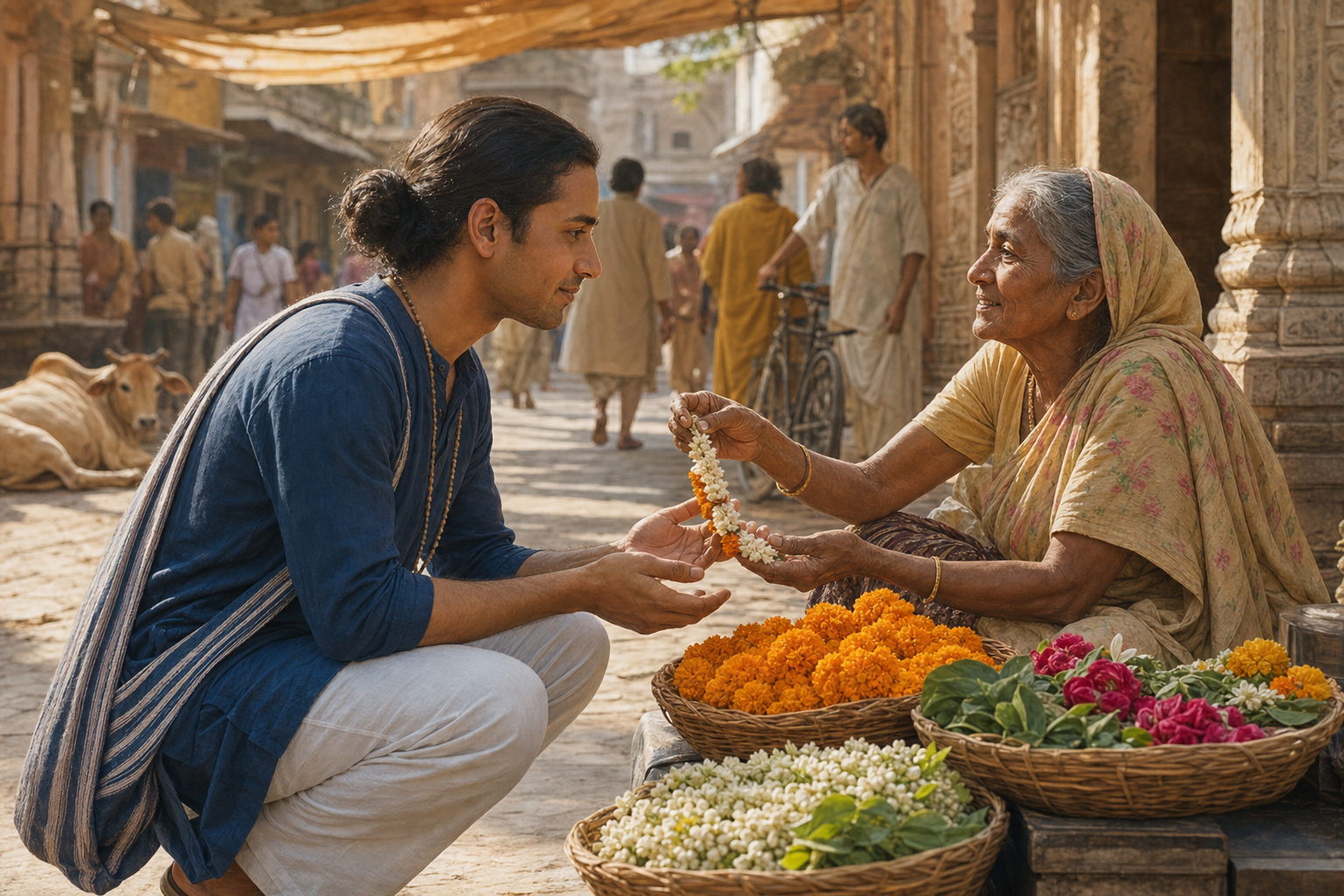
Sacred seeing becomes ethically meaningful when it changes ordinary seeing. The colleague who delays you, the family member who repeats a complaint, the stranger serving you, and the devotee with whom you disagree all reveal whether attention has become more reverent or merely more refined as an aesthetic taste.
Look for several practical signs:
- You notice a person before reducing that person to an inconvenience, opinion, role, or appearance.
- You listen long enough to understand what was actually said before preparing your answer.
- You distinguish compassion from approval. A tender gaze can still recognize adharma and maintain a necessary boundary.
- You become less willing to look possessively, mockingly, or voyeuristically at another person’s body or vulnerability.
- You notice opportunities for service that impatience would normally hide.
Use a brief review after your daily practice. Recall one encounter in which your vision narrowed. Ask: What did I reduce this person to? What truth did I fail to notice? What duty now follows? The last question prevents introspection from becoming self-absorption. Purified perception should move toward repair, restraint, courage, or service.
This discipline has recognizable resonances across the Dharmic family. Buddhist dhyana trains contemplative attention; Jain samayik cultivates disciplined equanimity and ethical self-observation; Sikh nam-simran centers remembrance through the sacred name. These are meaningful parallels in the work of steadying the mind and orienting conduct toward truth and compassion.
The parallels do not make the traditions interchangeable. Radha’s gaze belongs to the particular theology, affection, and devotional culture of Vrindavan. You honor the wider Dharmic kinship by recognizing a shared seriousness about attention while preserving the distinct object, language, and commitments of each path. Respect does not require flattening difference.
Key takeaways
- Radha’s eyes are not merely an ornament; they draw visual beauty into a relationship of remembrance and service.
- Kajal heightens expression and can symbolize collected attention, guarded perception, and the attractive force of divine compassion.
- During darshan, receive the gaze first. Do not rush to decode every artistic detail or force a devotional emotion.
- Let dhyana gather attention, let japa return it to the sacred name, and let seva show whether remembrance has entered your conduct.
- Do not measure the practice by visions or emotional intensity. Look for greater steadiness, truthful compassion, and care in the way you treat people.
- Recognize parallels with other Dharmic disciplines without turning Radha or Vrindavan bhakti into generic mindfulness.
At your next japa, make one modest experiment. Receive Radha’s gaze, carry one quality of it into the holy name, and choose one person whom you will see more carefully afterward. That small movement from darshan to attention to seva is where the meditation begins to become a way of life.
References
