
If you are deciding whether to keep April 16 as Māsa Shivaratri, begin Amavasya observances that evening, or arrange Pitṛ rites for the next morning, do not treat the date as one unchanging lunar day. Its meaning shifts in the early evening.
For most Indian regions, Krishna Paksha Chaturdashi continues until 6:54 PM IST on Thursday, April 16, 2026, and Amavasya begins immediately afterward. Use that time as an Indian reference point. Your city, family tradition, and local temple Panchang should determine the final ritual schedule.
The calendar changes character at 6:54 PM IST
A civil date begins at midnight, but a Tithi does not. Tithi follows the changing angular relationship between the Sun and Moon. Each Tithi represents a 12-degree step in that relationship, and the Moon’s variable motion means the step can end at any clock time. One civil date can therefore contain two Tithis without any contradiction.
| India reference time | Operative Tithi | Practical use |
|---|---|---|
| Before 6:54 PM IST on April 16 | Krishna Paksha Chaturdashi | Complete Chaturdashi observances and any Māsa Shivaratri-oriented sādhana prescribed by your tradition. |
| From 6:54 PM IST onward | Amavasya | Move into quieter Amavasya practices such as prayer, lamp offering, reflection, and preparation for dāna or ancestral observances. |
| Morning of April 17, while Amavasya remains locally | Amavasya | Perform Pitṛ-tarpaṇa or related family rites if your local Panchang and paramparā assign them to this morning. |
The transition time is a boundary, not an auspicious Muhurat by itself. Finishing a Chaturdashi practice before 6:54 PM and beginning an Amavasya practice afterward respects the Tithi sequence, but the suitability of a formal ceremony still depends on local sunrise, Nakshatra, Yoga, Karana, and customary rules.
Build the observance around the two Tithis
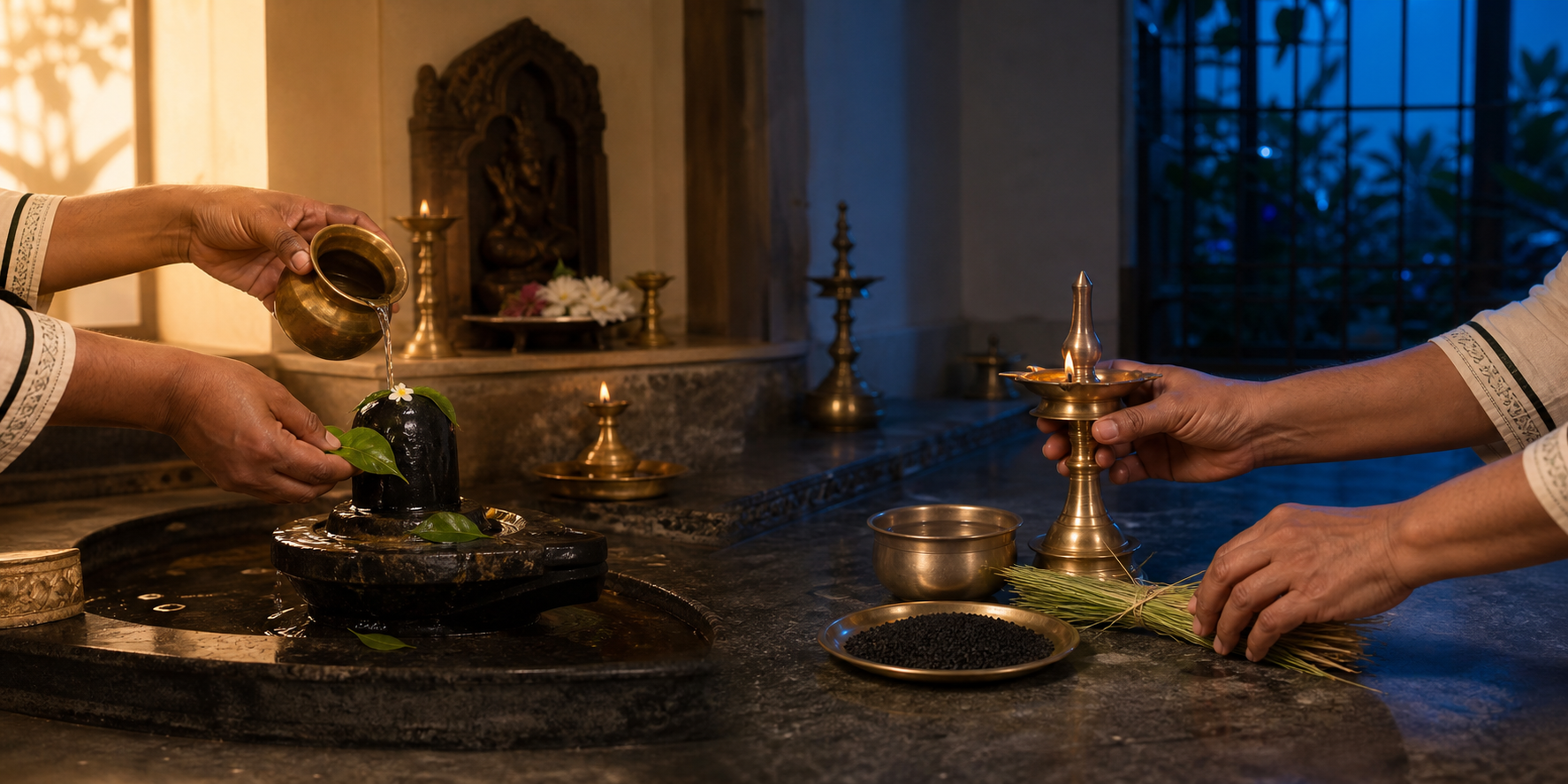
Krishna Paksha Chaturdashi has an inward, restrained character. In many Shaiva traditions, the monthly Krishna Chaturdashi is observed as Māsa Shivaratri, with practices such as japa, upavāsa, abhishekam, and svādhyāya. Amavasya turns attention toward ancestors, charity, quiet contemplation, and ethical renewal.
If your family or sampradāya has no more specific instruction, this is a cautious way to organize the date:
- Choose one local authority before making the schedule. Use a Panchang calculated for your city, a temple notice, or the instruction of the purohit who will conduct the rite. Do not combine the Tithi from one city with sunrise and Rahu Kaal from another.
- Reserve the Chaturdashi portion for Shiva-oriented sādhana. Complete your regular pūjā, mantra-japa, abhishekam, or scriptural study before the evening change when that is consistent with your practice.
- Keep fasting proportionate to your capacity. Upavāsa can express restraint without requiring you to disregard medical guidance or necessary dietary restrictions. When strict abstinence is unsuitable, choose a simpler meal, disciplined speech, japa, or another form of self-restraint.
- Let the evening become quieter after Amavasya begins. A lamp offering, meditation, prayer for departed family members, or preparation for the next morning’s dāna is more aligned with the transition than treating the evening as an ordinary social occasion.
- Confirm that Amavasya is still operative before a morning Pitṛ rite. Amavasya extends into April 17, but its exact ending varies by location. Many households prefer the following morning for tarpaṇa when local rules support it; others follow a different inherited procedure.
- Ask before improvising a formal ancestral ceremony. If you do not know your family’s mantras, offerings, or eligibility rules, a temple or trusted purohit can tell you what your paramparā requires. Simple remembrance and charity are better than presenting an invented procedure as inherited tradition.
This sequence also prevents a common mistake: assuming that every Amavasya-related act must wait until the next civil date. Quiet observances can begin after the Tithi changes on April 16, while rites governed by sunrise or family custom may belong on April 17.
Calculate local Rahu Kaal instead of copying a clock time
A daily Panchang has five principal limbs: Vara, Tithi, Nakshatra, Yoga, and Karana. Rashi, especially the Moon’s Rashi, is also commonly consulted when refining a Saṅkalpa, choosing a mantra practice, or judging a proposed undertaking. Tithi alone tells you which lunar observance is active; it does not establish every good or unsuitable period within the day.
April 16 falls on a Thursday. For Thursday, Rahu Kaal occupies the sixth of eight equal divisions of local daylight. You can calculate it without relying on a generic chart:
- Find the local sunrise and sunset for April 16, 2026.
- Calculate the total interval from sunrise to sunset.
- Divide that daylight interval into eight equal segments.
- Count from sunrise. The sixth segment begins after five complete segments and ends after the sixth.
- Avoid using that interval to launch a new venture when your tradition observes Rahu Kaal restrictions.
This method matters because Rahu Kaal is a fraction of daylight, not a permanent Thursday clock slot. A time copied from another city can be wrong even when both places use IST, because their sunrise and sunset are different.
Abhijit Muhurat is generally placed around the midpoint of local daylight and is often treated as favorable. It should still be checked against the day’s exclusions rather than used mechanically. A location-specific Panchang may also mark Yamaganda, Gulika Kaal, and Durmuhurta. If you are planning a wedding, Gṛha Praveśa, major purchase, initiation, or another consequential Saṃskāra, a broad daily Panchang is only the first filter; personal and ceremonial rules may be stricter.
The same location rule applies to Nakshatra and the Moon’s Rashi. Either can change during April 16, and their operative times may differ slightly by place. If your Saṅkalpa requires them, take the values from the same local Panchang that supplied your sunrise and Tithi ending time.
Different month names do not mean different lunar events
You may see this observance called Chaitra Amavasya 2026 in one calendar and described under a different month arrangement in another. That difference usually comes from regional month-counting systems rather than a disagreement about the new moon.
In the Amānta system common in peninsular India, this Amavasya typically concludes Chaitra. Amānta months end with Amavasya. Pūrṇimānta calendars, used in parts of North India, organize month boundaries around the full moon, so the month label attached to the same Tithi can differ.
For general planning, the Tithi sequence is the essential fact: Chaturdashi first, Amavasya afterward. For a formal Saṅkalpa, use the month name, Paksha, Tithi, Nakshatra, and other details prescribed by your own regional calendar. Do not silently replace your family’s convention with the first label found in a national calendar.
Questions that prevent the most common timing mistakes
Is April 16, 2026 Chaturdashi or Amavasya?
It is both. Krishna Paksha Chaturdashi occupies the earlier part of the date and ends at about 6:54 PM IST for most Indian regions. Amavasya begins after that and continues into April 17. When someone gives the date only one label, ask whether the label refers to sunrise, the evening, or the observance being scheduled.
Should Pitṛ-tarpaṇa be performed on April 16 evening or April 17 morning?
There is no single household rule that overrides regional and lineage practice. Many families perform the rite on the following morning while Amavasya continues, especially when the Tithi begins in the evening. Confirm the April 17 ending time and follow your family, temple, or purohit’s rule. You can still mark the beginning of Amavasya on April 16 with quiet remembrance, prayer, or a lamp offering.
Can one India-wide Panchang supply the exact Nakshatra, Rashi, and Muhurat?
Not with the precision needed for a formal rite. Tithi, Nakshatra, Rashi transitions, sunrise-based intervals, and the end of Amavasya all depend on location. Use the India-wide 6:54 PM IST transition as an orientation, then verify your city’s data. The more specific the ceremony, the less safely a generic calendar can substitute for local calculation.
Before April 16 arrives, save one trusted local Panchang, mark the Chaturdashi-to-Amavasya transition and your calculated Rahu Kaal, and decide which observances belong before the change, after it, and on the following morning. That small preparation will let you observe the day with attention rather than settle timing questions in the middle of the rite.