
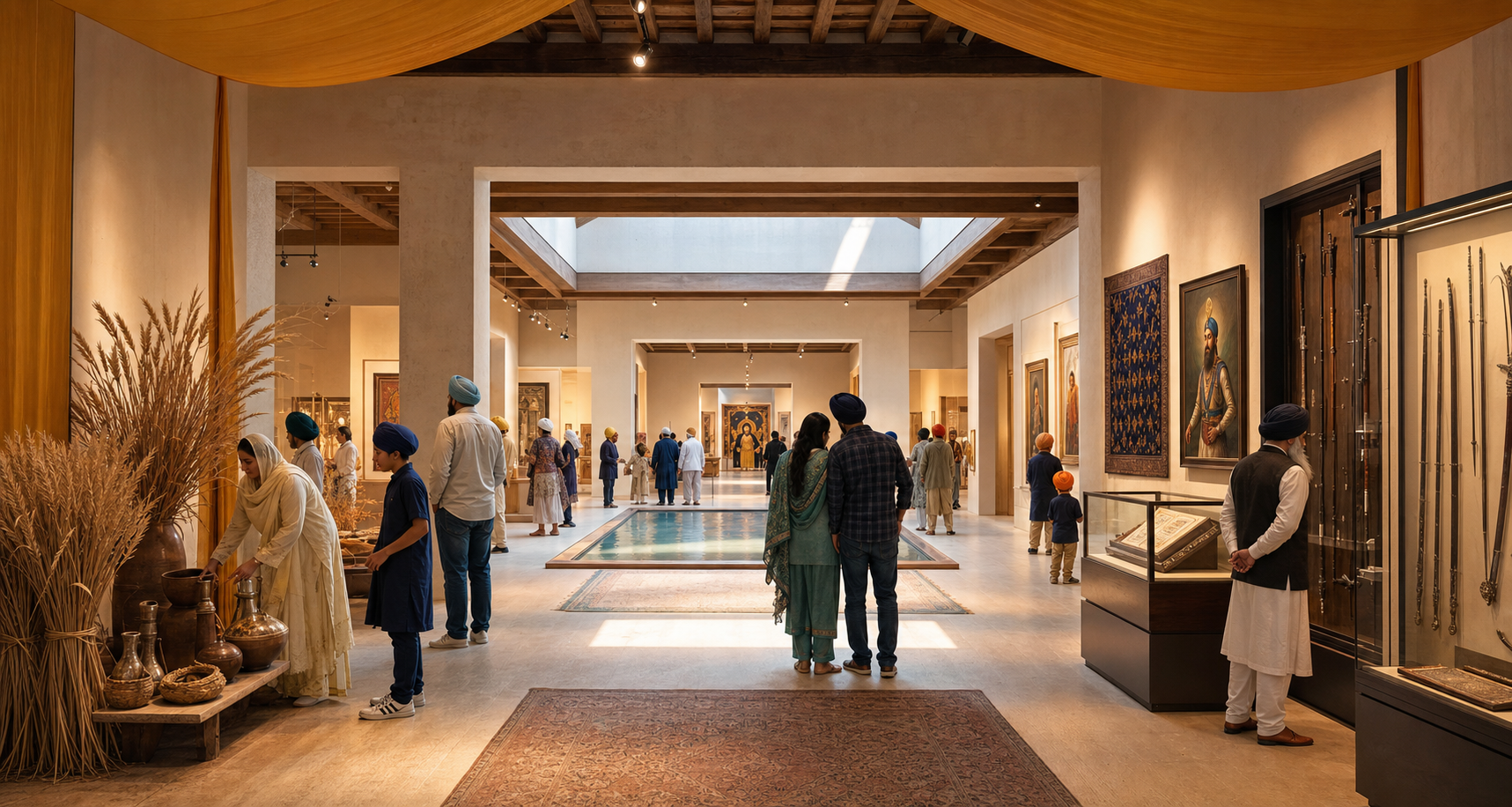
You have a Vaisakhi date, a venue, and perhaps access to paintings, textiles, manuscripts, or historic arms. The difficult part is not making the room look festive. It is creating an exhibition in which harvest gratitude, Sikh history, sacred language, artistic achievement, and living community practice remain connected without becoming a crowded survey.
The most useful design principle is to treat the venue as an invitation rather than a container. Whether you have a villa, museum, school, gurdwara complex, or community hall, lead the visitor through a human-scaled journey: welcome, gratitude, remembrance, courage, and renewed responsibility. That sequence gives every object and program a job.
Write one curatorial promise before choosing objects
Begin with a single sentence that your planning team can use to accept or reject every proposed object, graphic, performance, and activity. A workable version is: This exhibition follows Vaisakhi from Punjab’s agrarian renewal through the formation of the Khalsa to a living commitment to truth, courage, service, and collective responsibility.
That sentence holds together the festival’s three essential dimensions: harvest, historical memory, and the establishment of the Khalsa at Anandpur Sahib in 1699. It also prevents two common failures. One is a harvest celebration in which Sikh history becomes a small timeline on the wall. The other is a military history display in which Vaisakhi’s gratitude, devotion, and communal life disappear behind weapons and battle scenes.
Test each proposed element with three questions:
- What part of the Vaisakhi journey does this element reveal?
- What can the visitor understand from it that another object or label does not already explain?
- Does its presentation deepen respect, or does it reduce a sacred symbol, textile, or martial object to decoration?
If your team cannot answer the first two questions in plain language, leave the element out. A smaller selection with clear relationships will teach more than a room filled to demonstrate abundance.
Keep the historical spine equally disciplined. Guru Nanak’s birth in 1469 can anchor the beginning. The succeeding Gurus can be represented through the development of scripture, institutions, and community practice. Anandpur Sahib in 1699 should receive enough space to explain why the Khalsa was formed, not merely mark the date. The 18th and 19th centuries can then show mobility, conflict, patronage, courtly culture, and the artistic life associated with Sikh power. A map and a few carefully chosen dates will orient visitors more effectively than a wall of compressed chronology.
If you want to include a wider dharmic frame, define its limits before writing labels. Vaisakhi falls near several Indic new-year observances, while seva and dana, compassion, the pursuit of knowledge, non-harm, justice, and responsibility create meaningful points of conversation among Sikh, Hindu, Buddhist, and Jain traditions. Present these as relationships, not proof that the traditions are interchangeable. Unity becomes credible when distinct histories and vocabularies remain visible.
Turn the building into a five-stage visitor journey
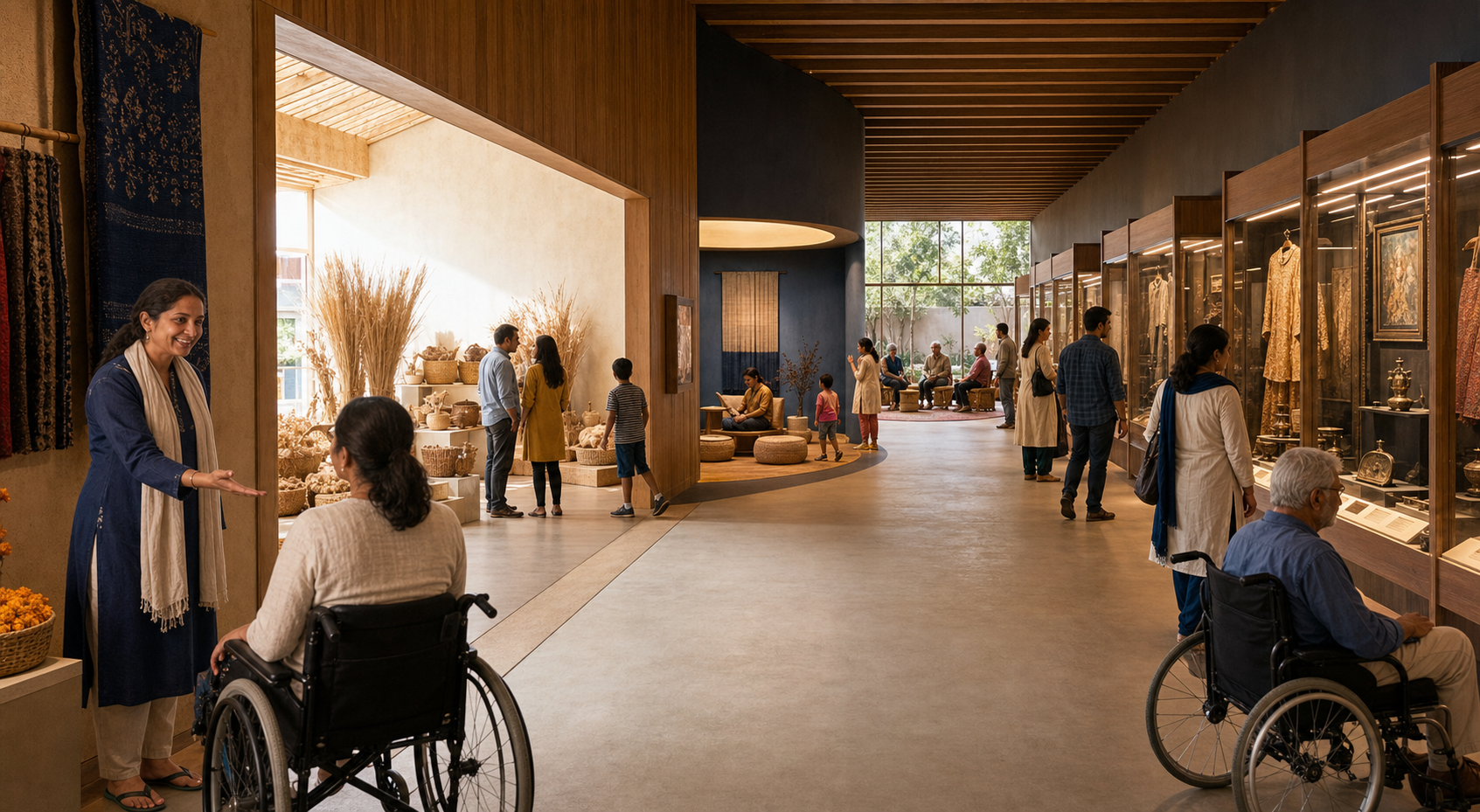
A villa offers courtyards, salons, gardens, and thresholds almost naturally, but you can reproduce the same rhythm with partitions, lighting, sound control, and seating. Think in stages rather than rooms.
- Mark the threshold. Use a community-reviewed, Nishan Sahib-inspired installation or another clear visual cue to tell visitors they are entering a space of attention. A restrained kirtan soundscape can slow the transition from the street or lobby. Do not use sacred words or symbols as an unexplained pattern simply to create atmosphere.
- Open with harvest and gratitude. Place the most welcoming, tactile, and domestic material here. Phulkari imagery, agricultural references, photographs of making, and intergenerational voices can connect Vaisakhi to Punjabi land, labour, women’s artistry, and the passing of skill through families.
- Move from the season to the Word. Introduce Gurmukhi, Gurbani, Ik Onkar, manuscript culture, and the institutions formed by the Gurus. This is where the timeline and map should begin doing real interpretive work.
- Enter the history of resilience and sovereignty. Bring paintings, portraits, courtly commissions, coins, medals, and martial objects into dialogue. Lower light levels may also make this the natural location for vulnerable paper and textile material.
- End in a place of renewal. Give visitors somewhere to sit, ask questions, meet artists or community educators, and decide what service, learning, or further inquiry follows their visit. A salon, terrace, garden, or simply a well-designed final room can fulfil this purpose.
Control what visitors hear and see between stages. Kirtan bleeding into a recorded oral history can make both unintelligible. A dance workshop visible behind a case of fragile manuscripts can pull attention away from the material. Use directional audio, captions, doors, curtains, or scheduling to keep each zone legible.
Give visitors a clear route but do not trap them in it. Families may need a shorter path, older visitors may need seating, and a Sikh visitor coming for one specific object may not want to follow the full chronology. A printed map, visible section titles, and repeated visual markers should make both the complete journey and a selective visit possible.
Let the Word govern the design, then use objects as evidence
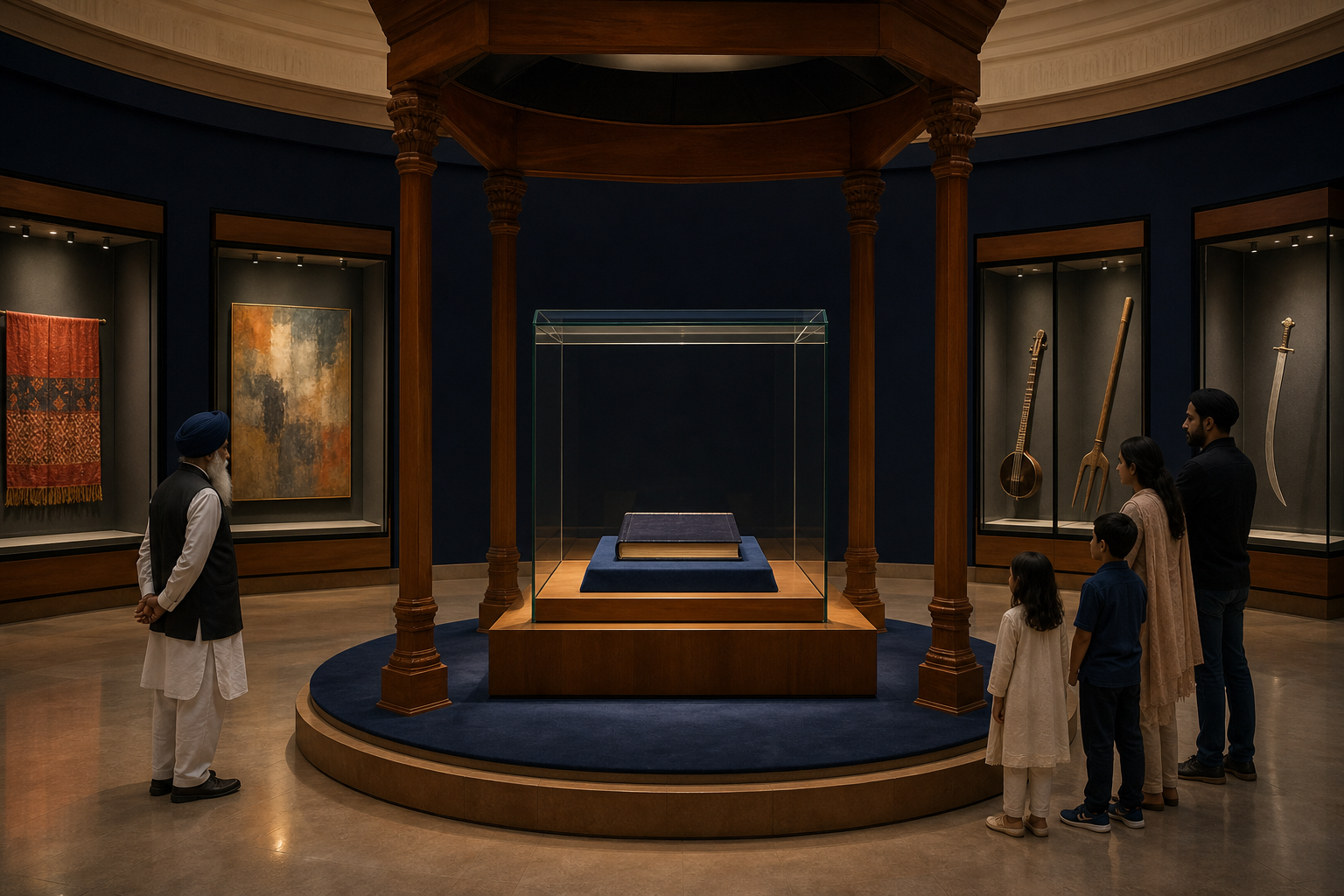
Sikh visual culture cannot be designed responsibly as a sequence of images alone. Gurbani, Gurmukhi calligraphy, and Ik Onkar give the exhibition a script-centred foundation. Let that foundation determine the hierarchy of your typography, interpretation, audio, and digital material.
This does not mean enlarging sacred script until it becomes wallpaper. Use Gurmukhi with purpose and have its spelling, orientation, line breaks, cropping, translation, and placement reviewed by a knowledgeable Sikh reader. Pair Gurmukhi and English consistently. Where an audience needs help pronouncing or following a passage, add transliteration as a third layer rather than asking English to stand in for the original.
Guru Granth Sahib must not be treated as a collectible art object. If you want visitors to study calligraphy, page architecture, musical organization, or linguistic richness, use an appropriate facsimile folio or digital surrogate. Explain what the visitor is seeing and why a surrogate was chosen. That decision can itself teach satkar: public access and scholarly attention do not require reducing the Guru to an exhibit.
Sound should provide meaning rather than ambient piety. Raag-based renditions can show that Gurbani has a musical framework, while translations and captions let visitors who do not understand Gurmukhi follow the passage. A short, intelligible selection placed near the relevant interpretation is more effective than continuous audio across the whole venue.
Choose object groups that answer different questions
- Janamsakhi scenes and portraits: What qualities, journeys, encounters, and ethical decisions did artists choose to remember? Explain that depictions of the Gurus honour teachers and significant moments rather than presenting the Divine in anthropomorphic form.
- Courtly and historical painting: How did Sikh identity, patronage, diplomacy, and statecraft become visible? Works associated with Patiala, Lahore, and Amritsar during the 18th and 19th centuries can also reveal exchanges with Mughal, Rajput, and Pahari ateliers.
- Phulkari textiles: What can women’s artistry, repeated stitch, colour, cloth, and domestic transmission tell us that court painting cannot? Connect the textile to agrarian rhythm and family knowledge instead of using it merely as a colourful background.
- Arms and armour: How were courage, discipline, community protection, and defence of religious freedom understood? A khanda or kirpan blade, chakkar, shield, or armour should be interpreted through the ethics of Kshatra, not staged as an exotic weapon.
- Coins, medals, rumalas, and chauris: How did authority, devotion, ceremony, and material skill take form in daily and public life? Display devotional objects only in contexts that respect their use.
Juxtaposition can make the argument visible before a visitor reads a label. Place a martial object in dialogue with a calligraphic panel or manuscript surrogate, for example, to show why scripture and disciplined force cannot be separated from justice and truth in the exhibition’s historical frame. Keep enough physical space between the objects that neither becomes a prop for the other.
Make every label perform five jobs
- Identify the object, medium, approximate date where appropriate, region, and technique.
- Direct attention to one visual or material feature the visitor can actually find.
- Give the minimum historical context needed to understand that feature.
- Connect the object to the exhibition’s Vaisakhi argument without forcing a connection it cannot support.
- State uncertainties, gaps in provenance, or disputed identifications openly.
Write for a visitor standing in front of the object, not for a catalogue reader who can hold several pages of context at once. Put the essential point first. Reserve detailed discussion of workshop lineages, paleography, metallurgy, and conservation history for extended labels, seminars, or the online catalogue.
Protect sacred meaning and the physical collection together
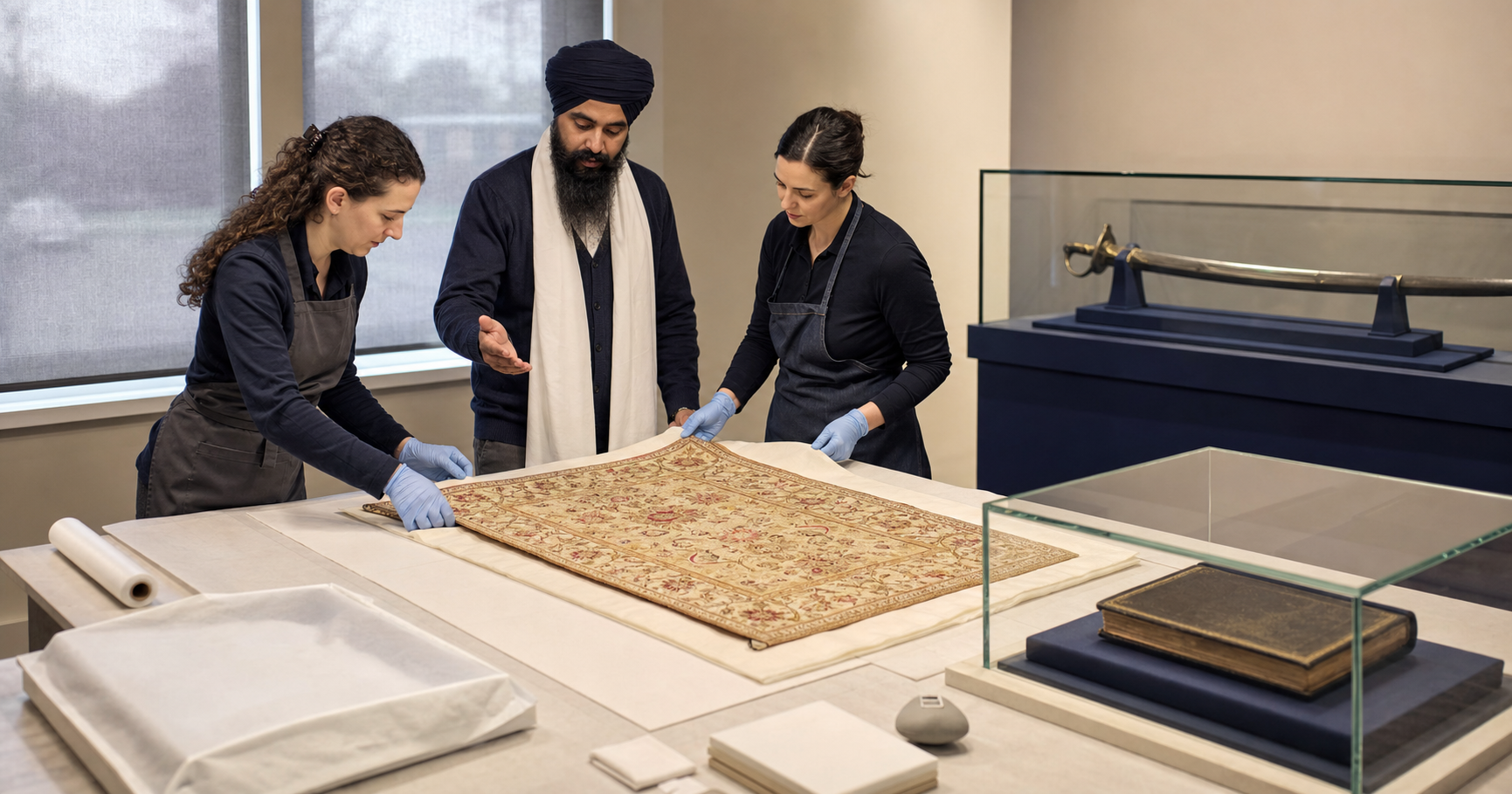
Respectful interpretation and preventive conservation are not separate workstreams. Both ask what an object is, how it should be encountered, and what must be preserved for the next generation.
For paper and textiles, use 45-55% relative humidity with minimal fluctuation, temperatures near 18-22 degrees Celsius, light below approximately 50 lux, and effective ultraviolet filtering as planning parameters. These figures are not permission to install an object automatically. Its condition, previous exposure, pigments, supports, loan terms, and display duration still require review by the responsible conservator.
Measure light at the object, not by judging whether the room looks dim. Light damage is cumulative, so intensity and display duration belong in the same decision. If a manuscript or textile cannot safely tolerate the proposed run, use a high-quality facsimile or rotate vulnerable material rather than compromising preservation.
Build mounts from inert, archival materials and distribute support across fragile substrates. A textile should not carry its own weight from a few stressed points. An open manuscript facsimile needs a cradle suited to its opening angle. Arms, armour, coins, and medals require stable mounts, appropriate case security, and handling plans suited to their material and weight.
Prepare the movement plan before the objects arrive. Confirm the route from receiving to storage and gallery, identify narrow doors and changes in level, assign who directs each move, and keep the path clear. Follow the object’s approved handling procedure and glove requirements rather than improvising when installation is already under pressure.
Use a separate sacred-respect review alongside the conservation check. It should verify that scripture has not been objectified, sacred script has not been cropped or placed carelessly, devotional material is not positioned as décor, and martial objects are not sensationalized. The same review should catch apparently minor choices – a floor graphic, merchandise placement, or photo backdrop – that can undermine an otherwise careful exhibition.
Live programs need their own safety boundary. Gatka can illuminate martial discipline and ethical restraint, but only when the performance area has clear barriers, controlled access, and interpretation that explains what visitors are seeing. If your venue cannot separate performers from the audience and the collection, use a recorded demonstration or schedule the program elsewhere. Do not place active demonstrations in gallery circulation or exit routes.
Build the exhibition with the community, not merely for it
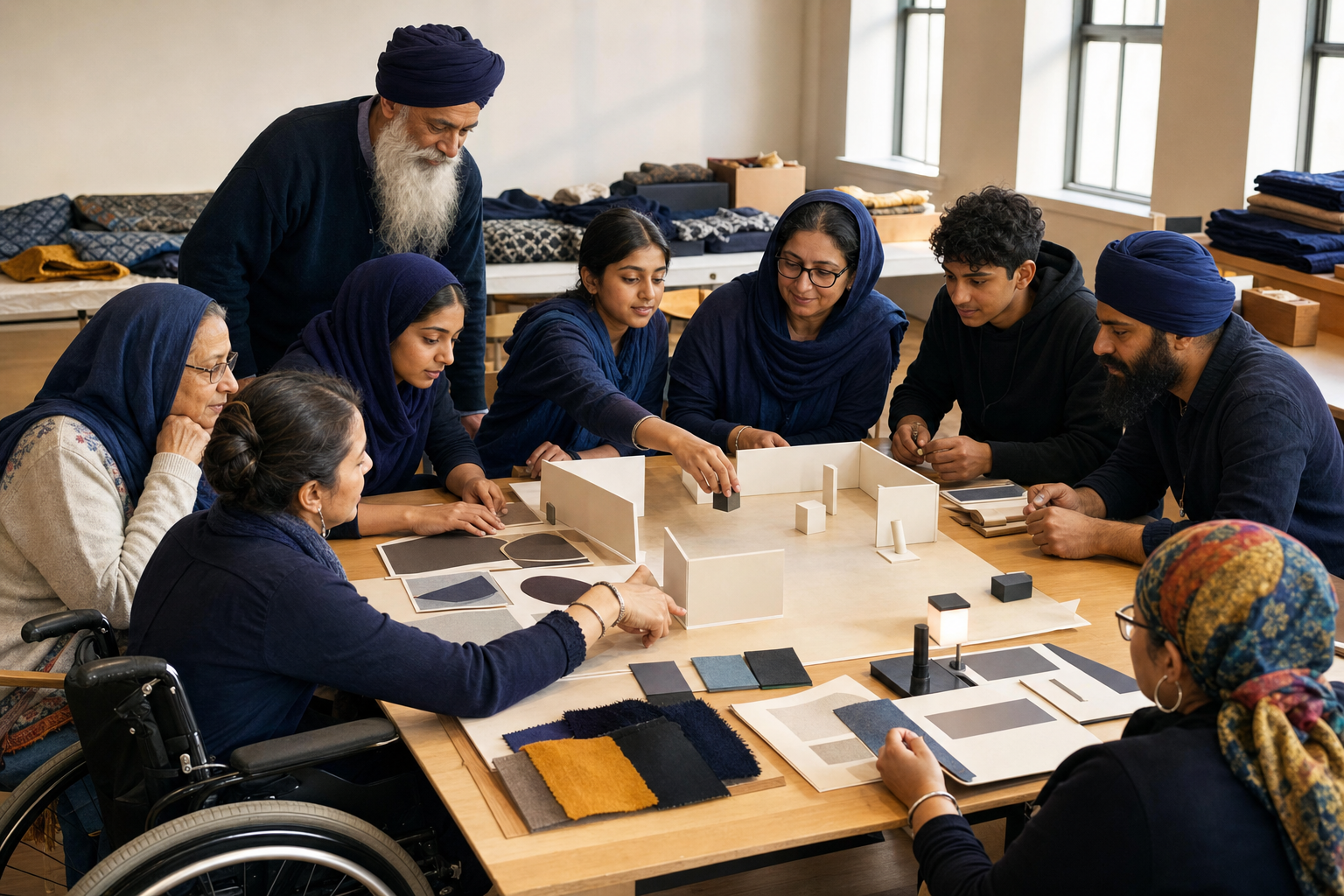
Invite elders, scholars, artists, educators, and people who know the histories of proposed objects before the checklist is fixed. Community participation is not a ceremonial endorsement at the end. It can correct vocabulary, recover object memories, identify gaps in provenance, clarify religious protocol, and expose interpretations that appear reasonable on paper but fail in lived Sikh practice.
A manageable co-curation process can use four working sessions:
- Review the one-sentence promise, the scope, the historical spine, and the sacred protocols.
- Examine the proposed object list, flag missing perspectives, and assign label and translation review.
- Walk through the spatial plan to test sightlines, sound, accessibility, program locations, and the emotional transition between sections.
- Proof names, dates, Gurmukhi, translations, uncertainties, credits, and community acknowledgements before production.
Train youth docents as interpreters, not as people who memorize label text. Give them the exhibition’s central questions, object evidence, pronunciation support, and a clear method for saying when they do not know an answer. Their tours can connect historical material to contemporary identity without pretending that one young person speaks for the entire Sikh community.
Public programs should extend a gallery theme rather than compete with it. Gatka belongs with disciplined courage and protection. Bhangra and Giddha workshops can connect celebration to Punjabi agrarian and intergenerational culture. Family stations can introduce Phulkari motifs, basic Gurmukhi strokes, or the geometry of the Khanda. Advanced seminars can address painting lineages, manuscript paleography, arms metallurgy, and conservation ethics.
Cross-dharmic conversations work best when they begin with a precise pair of ideas. A session might consider seva and dana as distinct languages of generosity, or examine how non-harm and the duty to resist injustice are reasoned about across traditions. Avoid panels on generic unity. Specific concepts give participants enough structure to notice both kinship and difference.
Extend the useful parts of the exhibition online. Prioritize searchable bilingual object records, high-resolution images, accurate captions, transcripts, and translations. Add 3D views where an object’s form genuinely benefits from rotation. Short videos on mount-making or conservation can reveal otherwise invisible care, while focused audio can explain raag structures and poetic metre. If resources are limited, accurate bilingual records and accessible media are more valuable than an elaborate digital effect with little interpretive content.
Key takeaways for your design brief
- Unite harvest gratitude, the 1699 formation of the Khalsa, and living responsibility in one curatorial promise.
- Organize the venue as a journey from welcome and gratitude through the Word and historical resilience to renewed community engagement.
- Let Gurbani and Gurmukhi shape the interpretive system without turning sacred language into ornament.
- Select paintings, textiles, manuscripts, and martial objects as complementary evidence, not as decorative categories.
- Build conservation limits, sacred protocols, movement planning, and program safety into the design before requesting loans.
- Give Sikh community reviewers authority to change labels, object choices, spatial decisions, and programs while revision is still possible.
Your next step is a one-page brief containing the curatorial promise, five-stage journey, proposed object groups, sacred-respect rules, conservation requirements, and named community reviewers. Circulate that page before you design graphics or confirm loans. If the team agrees on it, the exhibition can grow without losing its centre.