

If you have ever challenged a relative, leader, or community you still care about, you know how quickly disagreement can be renamed betrayal. The accusation becomes especially powerful when the group feels threatened: support us without qualification, or prove that you were never one of us.
Vibhishana’s choice in the Ramayana gives you a better way to judge such a conflict. The decisive question is not simply whether he left his brother. You have to ask what he tried before leaving, what he refused to support, and whether his final action served private ambition or the restoration of a just order.
Key takeaways
- Family and institutional loyalty remain virtues only while they are directed by dharma; they cannot turn wrongdoing into a duty.
- Vibhishana tried correction before separation. His departure came after Ravana rejected repeated counsel to return Sita and end an unjust war.
- Kumbhakarna recognized Ravana’s error but still fought for him, showing that moral insight without moral refusal can become complicity.
- Rama’s acceptance of Vibhishana joined sharanagati, the protection of one who sincerely seeks refuge, with prudent consideration of risk.
- Before invoking Vibhishana in a modern dispute, test the seriousness of the wrong, your efforts at correction, your motives, the proportionality of your response, and its effect on the common good.
The first test is the object of your loyalty
The Bengali expression “gharer shotru Vibhishana” turns Vibhishana into the enemy within the home. It captures a real fear: a group can be harmed by someone who knows it intimately. But the expression does not tell you whether the group itself is defending justice. That missing question changes the moral verdict.
A traitor abandons a rightful trust for private advantage or helps to destroy a just order. Vibhishana does nearly the reverse. He gives up the security of kinship when Ravana makes kinship an instrument of adharma. He does not betray Lanka’s legitimate welfare; he refuses to identify that welfare with one ruler’s destructive desire.
This distinction matters because dharma recognizes more than one kind of obligation. Kuladharma and bandhu-bhakti concern duties toward family and kin. Rajadharma concerns the responsibilities of rule, while samanya-dharma points toward moral duties that cannot be confined to a faction. These obligations usually support one another. A good ruler protects families, and good relatives help one another remain on a righteous path. The crisis begins when a lower, partial loyalty is used to violate the order that makes loyalty worthy in the first place.
That does not make family ties disposable. It establishes a demanding threshold. A preference, wounded pride, policy disagreement, or competition for status is not enough to justify presenting yourself as Vibhishana. The wrong must be identifiable and serious; continued obedience must help sustain it; and your response must aim at correction or protection rather than humiliation.
When someone demands loyalty from you, ask four questions before accepting either the demand or the label of betrayal:
- What specific act am I being asked to defend, conceal, enable, or ignore? Name conduct, not merely a disliked personality.
- Which duty would compliance violate? Identify the person, institution, promise, or public good that would bear the harm.
- Have I sought a remedy that would preserve the relationship without preserving the wrong? Dharma-first dissent begins with restoration where restoration remains possible.
- Would I take the same position if no praise, promotion, inheritance, or political advantage followed? A principle that disappears when reward disappears was probably a strategy.
These questions prevent two opposite errors. The first is blind obedience, in which belonging excuses anything. The second is self-righteous desertion, in which every quarrel is elevated into a moral emergency. Vibhishana’s example supports neither. It asks you to place loyalty inside a hierarchy of duties and to defend the higher obligation only when the conflict is real.
Vibhishana tried correction before changing sides
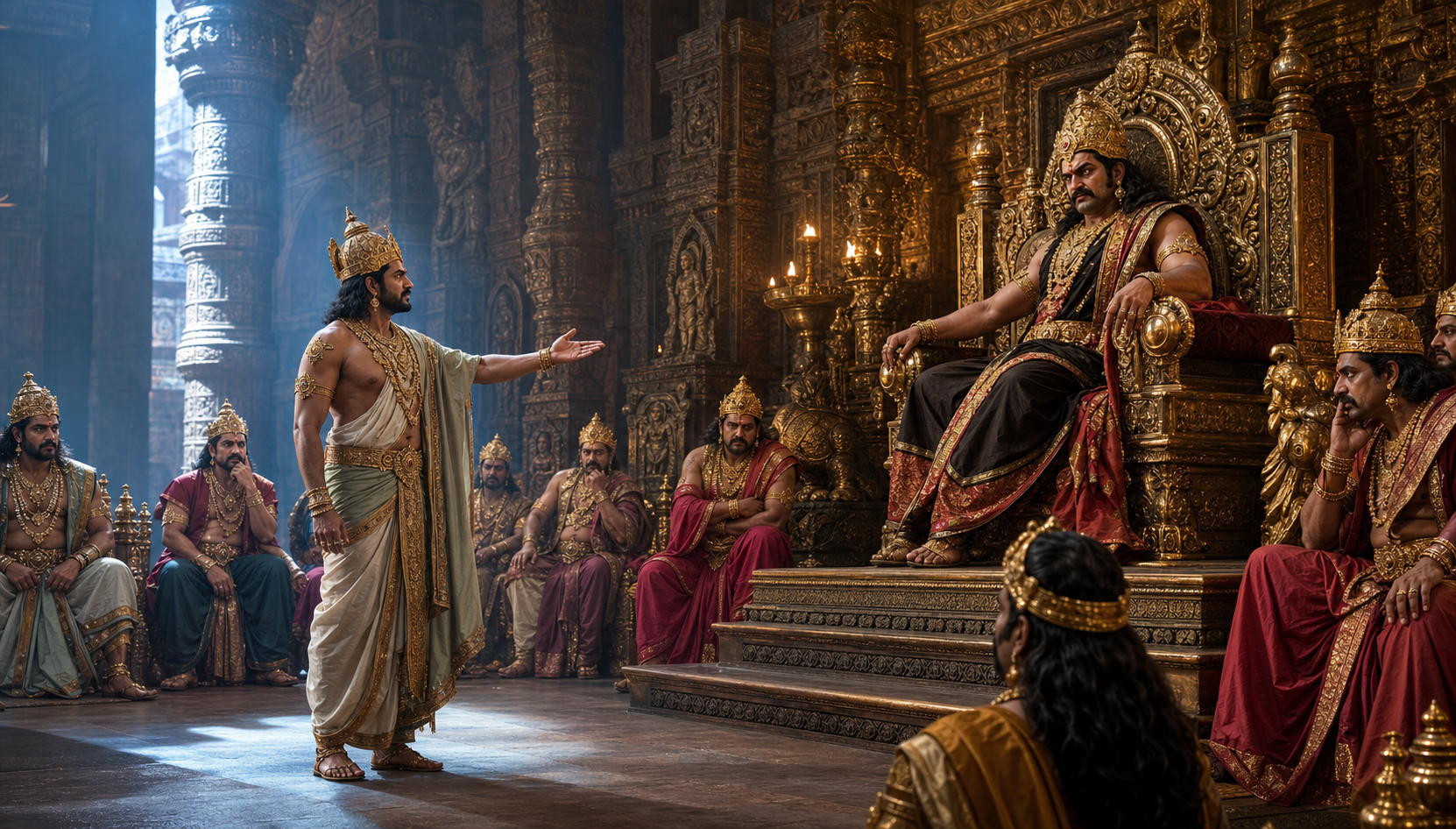
The sequence in the Valmiki Ramayana’s Yuddha Kanda is essential. Vibhishana does not begin by seeking Rama’s favour. He repeatedly advises Ravana to return Sita, end the unjust conflict, and choose the peace still available to Lanka. His counsel combines morality with nīti, or sound statecraft: the abduction is wrong, but persisting in that wrong will also bring ruin upon the kingdom Ravana is supposed to protect.
This is what loyal counsel looks like when a ruler has gone astray. It does not flatter. It names the wrong, explains its consequences, and offers a path back. A minister who warns a sovereign against destructive conduct may be more loyal to the throne’s proper purpose than courtiers who applaud whatever the person occupying it desires.
Vibhishana’s course can be understood as an ethical progression:
- Recognize the wrong. Sita’s abduction cannot become righteous merely because the abductor is powerful or related to him.
- Speak before withdrawing. Vibhishana gives Ravana counsel rather than silently waiting for disaster.
- Offer a restorative remedy. Returning Sita would end the originating injustice and make peace possible.
- Refuse complicity when counsel is rejected. Once Ravana binds his rule to the wrong, continued service would help sustain that choice.
- Seek alignment with the just cause. Vibhishana approaches Rama for refuge instead of remaining neutral while Lanka is carried into ruin.
The progression also answers the charge that he was merely opportunistic. Opportunism searches for the winning side first and invents its principle later. Vibhishana’s stated position precedes his departure: return Sita and prevent the war. His conduct remains organized around that remedy even when Ravana rejects it.
His later installation as king of Lanka does not retroactively prove a selfish motive. Outcomes can raise reasonable questions, but motive must be judged from the choice as it was made. Did he bargain away justice for office, or did he demand that the originating wrong be corrected before he crossed over? Within the Ramayana’s moral architecture, kingship follows his alignment with dharma; it is not presented as the price for abandoning it.
You can apply the same chronological test to a contemporary dissenter. Examine what the person said while correction was still possible, what remedy was proposed, what personal cost was accepted, and whether the moral explanation appeared before or after advantage became visible. Sequence cannot reveal every hidden motive, but it is more reliable than judging solely by who benefited at the end.
Kumbhakarna shows why courage and loyalty are not enough
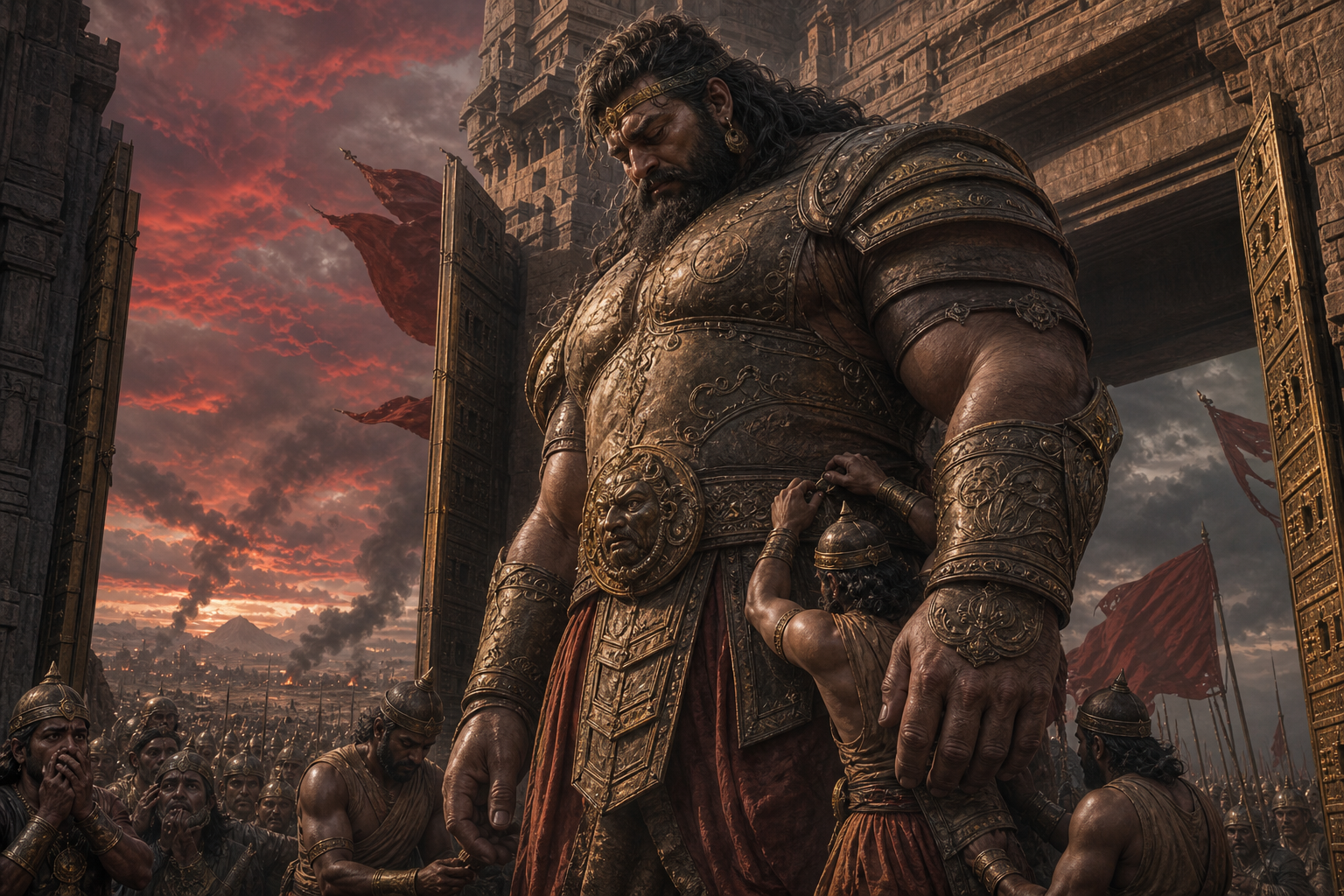
Kumbhakarna makes the dilemma harder and therefore more useful. He too recognizes that Ravana has committed a grave error. Yet after criticizing the decision, he fights for his brother. His courage is real, and the Ramayana treats his fate with tragic force. But bravery cannot correct the moral direction of the cause it serves.
The contrast exposes a common evasion: “I told them they were wrong, so I have done my duty.” Advice matters, but there comes a point when your material support outweighs your verbal objection. Kumbhakarna’s criticism does not stop his strength from being used in defence of the very adharma he identified.
Vibhishana accepts the opposite burden. He makes his conduct agree with his counsel. That choice costs him the immediate solidarity of family and exposes him to suspicion in Rama’s camp. Dharma-first loyalty is therefore not the easier form of loyalty. It is often the one that removes the emotional shelter offered by both sides: your former group condemns you for leaving, while your new allies have reason to doubt you.
When you evaluate a disputed act of loyalty, count the final material act. Who received the person’s labour, weapons, vote, silence, money, authority, or institutional protection? A person may speak against wrongdoing and still make that wrongdoing possible. Conversely, a person may cause pain to relatives while preventing a greater injury to the people for whom those relatives are responsible.
This is also why clan solidarity is not the same as dharmic solidarity. Clan solidarity asks, “Who is ours?” Dharmic solidarity asks, “What are we sustaining together?” The first can be noble when the shared cause is righteous. Detached from dharma, it becomes a mechanism by which the powerful distribute responsibility for their own misconduct across everyone who loves them.
Rama joins refuge with responsible statecraft

Vibhishana’s arrival creates a second ethical test. Sugriva, Angada, and other members of Rama’s alliance worry that he may be a spy. Their concern is not irrational. A close relative of the opposing ruler has crossed into their camp during war, and accepting his words without examination could place everyone at risk.
Rama listens to that concern but anchors his decision in sharanagati: a sincere seeker of refuge is to be protected, even if that person comes from the enemy’s side. The result is neither careless trust nor cynical calculation. Prudence is allowed to raise the risk; dharma determines what may be done to a person who has renounced the wrong and sought protection.
This matters because Vibhishana’s moral choice would be incomplete without a righteous place to go. A community that praises conscience but offers no refuge to the conscientious makes reform needlessly dangerous. Rama’s response establishes a corresponding duty for the just side: if someone genuinely leaves adharma, do not keep that person imprisoned forever in a former affiliation.
Refuge, however, does not require the abandonment of judgment. Rama’s allies discuss the danger. The decision therefore gives you two duties to hold together:
- Protect sincere repentance. A person must be able to stop participating in wrongdoing without being denied every path back into moral community.
- Take responsibility for those already under your care. Compassion toward a newcomer does not require pretending that espionage, manipulation, or divided purpose is impossible.
After Ravana’s fall, Vibhishana’s accession represents the same synthesis at the level of government. Lanka does not cease to matter because its ruler chose adharma. Its people still need protection, lawful order, and peace. Rajadharma measures kingship by its function: the ruler must safeguard subjects and direct power toward justice and prosperity. In that frame, installing Vibhishana is not the distribution of spoils but an attempt to restore legitimate governance.
Lokasangraha, the sustaining of the common good, supplies the larger measure. Ravana treats the kingdom as an extension of his will and brings its people into the consequences of his act. Vibhishana distinguishes Lanka from Ravana’s misconduct. He can oppose his brother precisely because he remains loyal to the people and order that the king has endangered.
The common Dharmic thread
The same priority appears in different forms across Dharmic traditions. Buddhist thought places Dhamma above attachment to personalities. Jain anekantavada disciplines narrow partisanship by requiring attention to more than one standpoint. Sikh commitment to justice and sarbat da bhala directs courage toward the welfare of all. The doctrines are not interchangeable, but they resist the same moral reduction: righteousness cannot be defined as whatever benefits our faction.
Use a dharma-first test before you dissent
Invoking Vibhishana should make your decision more disciplined, not more dramatic. Before breaking with a person or institution, work through the following test in order:
- Describe the act without an insult. “This person is evil” gives you little to evaluate. “This decision harms these people and violates this duty” creates a claim that can be examined.
- Identify your own role. Distinguish witnessing a wrong from materially enabling it. Be precise about what your continued obedience, labour, silence, or public endorsement would contribute.
- Name the rightful remedy. Vibhishana does not merely condemn Ravana; he urges him to return Sita. Your objection should include the concrete act that would stop or repair the wrong.
- Give correction a real opportunity where it is safe to do so. State the concern clearly enough that the other person can respond. Repeated hints followed by sudden rupture do not carry the same moral weight as intelligible counsel.
- Audit your incentives. List what you stand to gain from leaving as carefully as what you stand to lose. Material benefit does not automatically invalidate a righteous choice, but concealed self-interest weakens a claim of principle.
- Choose a proportionate response. Correction, refusal, withdrawal, disclosure, and active opposition are different steps. Take the least destructive step that can actually end your complicity and protect those facing harm.
- Preserve the common good after the break. Do not confuse stopping wrongdoing with seeking the ruin of everyone associated with the wrongdoer. Vibhishana opposes Ravana without treating Lanka’s welfare as expendable.
- Accept examination from both sides. A conscientious dissenter should be able to explain the wrong, the attempted remedy, the reason for escalation, and the limits placed on retaliation.
In a family conflict, this framework prevents the epic from becoming a licence for impulsive estrangement. Begin with the specific conduct and the duty at stake. If the situation involves violence, coercion, or a credible threat, safety comes before confrontation; seek appropriate professional or local support rather than using an epic analogy as a safety plan.
In a workplace or public institution, Vibhishana’s example supports measured, evidence-based refusal to enable wrongdoing. It does not supply a legal procedure. Disclosure can affect employment, privacy duties, investigations, and the safety of other people, so obtain qualified legal or professional guidance before taking a step with irreversible consequences. The ethical lesson tells you why complicity may need to end; applicable law helps determine how to act responsibly.
In political and community life, look beyond the slogan of unity. Unity around what? If criticism seeks the correction of a defined injustice and the protection of the wider community, it may be an act of fidelity. If it fabricates charges, courts an enemy for personal reward, or treats collective destruction as vindication, the Vibhishana comparison fails.
The next time someone asks for unconditional loyalty, do not begin by choosing between affection and hostility. Write down the act you are being asked to support, the dharmic duty it affects, and the remedy that would set it right. Offer that remedy where doing so is safe. If it is refused, choose the most restrained action that ends your complicity and protects the common good. That is the demanding loyalty Vibhishana represents: not loyalty abandoned, but loyalty purified of adharma.