

You may feel drawn toward Amrit Sanchar while still wondering whether you are ready for everything that follows it. That is the right question to examine. The ceremony is not a reward for having become spiritually complete. It is an initiation into a defined discipline that will shape your worship, appearance, habits, relationships, and responsibilities toward other people.
So do not judge readiness only by the intensity of your feeling on a special day. Ask whether you are prepared to carry the Guru’s discipline through an early morning, a demanding workday, a family disagreement, a journey, and a moment when keeping your word is inconvenient. Amrit gives spiritual longing a durable form; rehat is how that form enters ordinary life.
Begin with the life that follows the ceremony
The most useful preparation begins with the commitments, not the event date. Amrit Sanchar joins you to the Khalsa discipline established by Guru Gobind Singh at Anandpur Sahib on Vaisakhi in 1699. It therefore asks for more than admiration for Sikh history or affection for Sikh identity. It asks whether the founding union of spiritual devotion and temporal responsibility can govern your own conduct.
Start by learning what you will actually promise. The discipline includes maintaining the Five Ks and avoiding the major violations of rehat. The commitments described in the Sikh Rehat Maryada include preserving kesh, refraining from intoxicants including tobacco, maintaining sexual fidelity, and avoiding kutha, or ritually slaughtered meat. Do not silently narrow these commitments to whatever already suits you. Do not broaden one rule into a different rule and then treat that interpretation as the vow itself. If a point is unclear, ask the Panj Piare or knowledgeable gurdwara leadership before the ceremony.
Aspirants sometimes focus on whether they feel sufficiently inspired. Inspiration matters, but it is an unreliable timetable. A more revealing test is whether you have begun making room for the practices that will remain after the emotion of the ceremony settles. Use an ordinary week, not a holiday or retreat, to examine that question.
- Map the daily Nitnem cycle. Identify when you can recite the morning, evening, and night banis without treating them as leftover tasks.
- Learn the Five Ks as responsibilities. Make sure you understand the care, conduct, and ethical demand connected with each one. Visible form and disciplined behavior belong together.
- State the commitments in your own words. If you cannot clearly explain what you are promising regarding kesh, intoxicants, fidelity, and kutha, seek instruction before choosing a date.
- Test your plan on difficult days. Notice what happens when you wake late, work longer than expected, travel, or lose motivation. Those points of friction deserve a plan, not denial.
- Ask about local preparation. Confirm the required attire, head covering, kachhera, conduct, arrival arrangements, and any other instructions with the gurdwara organizing the Amrit Sanchar.
This preparation is not an attempt to simulate initiation privately. Amrit Sanchar belongs to the Guru-centered life of the sangat and is administered by the Panj Piare. The purpose of advance practice is simpler: it exposes the gap between sincere desire and a workable daily rule. Once you can see that gap, you can address it honestly.
What happens during Amrit Sanchar, and why its form matters
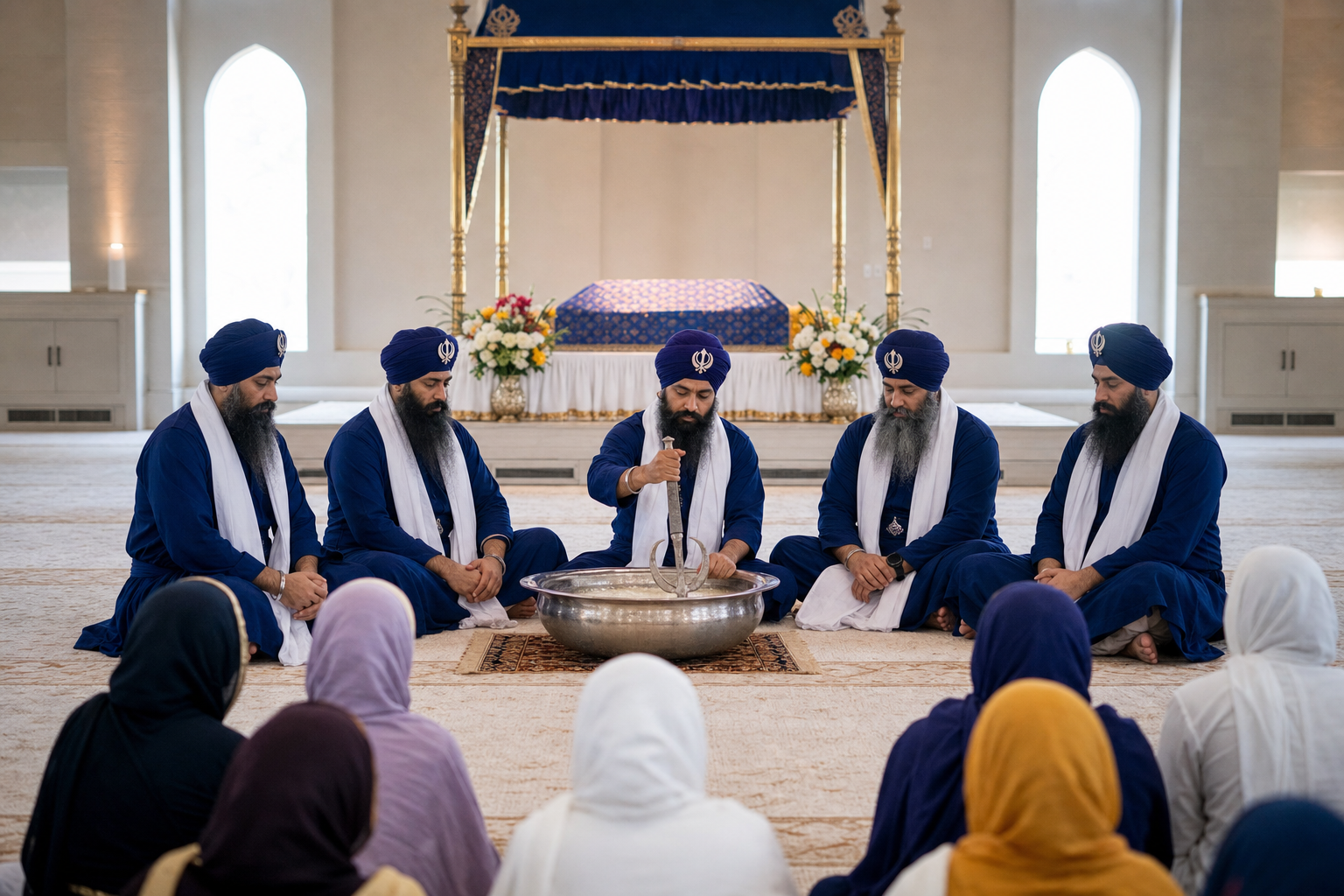
Amrit Sanchar takes place in a sanctified setting before Sri Guru Granth Sahib. The sangat gathers in reverence, and the Panj Piare conduct the initiation collectively. Their role matters because authority is vested in disciplined service to the Guru, not in the personality or private preferences of a single officiant.
Amrit is prepared in a steel or iron vessel called a bata. Clean water and patase, or sugar crystals, are stirred with a double-edged khanda while five banis are recited: Japji Sahib, Jaap Sahib, Tav-Prasad Savaiye, Benti Chaupai, and Anand Sahib. This joining of shabad, steel, water, and sweetness expresses the balance the Khalsa is expected to embody. Courage must not become cruelty. Tenderness must not become helplessness. Spiritual inwardness must not become withdrawal from duty.
Each initiate receives five palmfuls of Amrit to drink. Amrit is also applied to the eyes and kesh. The aspirants affirm the discipline of the Khalsa, including the Five Ks and the avoidance of the kurehits that violate rehat. Women and men receive the same initiation and the same discipline, commonly taking the sovereign identities Kaur and Singh. The ceremony concludes within the shared life of Ardas and hukamnama, placing the initiate’s personal vow under the Guru’s ordinance and within the welfare of the whole community.
Knowing this sequence helps you attend properly. You are not there to collect an unusual religious experience or watch an elaborate performance. Listen to the banis. Follow the instructions of the Panj Piare. Let the equality of the initiates correct any instinct to bring caste, status, wealth, gender, or social prestige into the space. The precision of the ceremony protects its meaning; it is not empty formality.
The presence of patase alongside the khanda is especially instructive. Khalsa discipline is sometimes misread as hardness, while devotion is sometimes misread as softness. Amrit Sanchar refuses that division. The initiate is called to firmness without domination, compassion without passivity, humility without surrendering the duty to defend dignity.
Read the Five Ks as daily instructions, not accessories
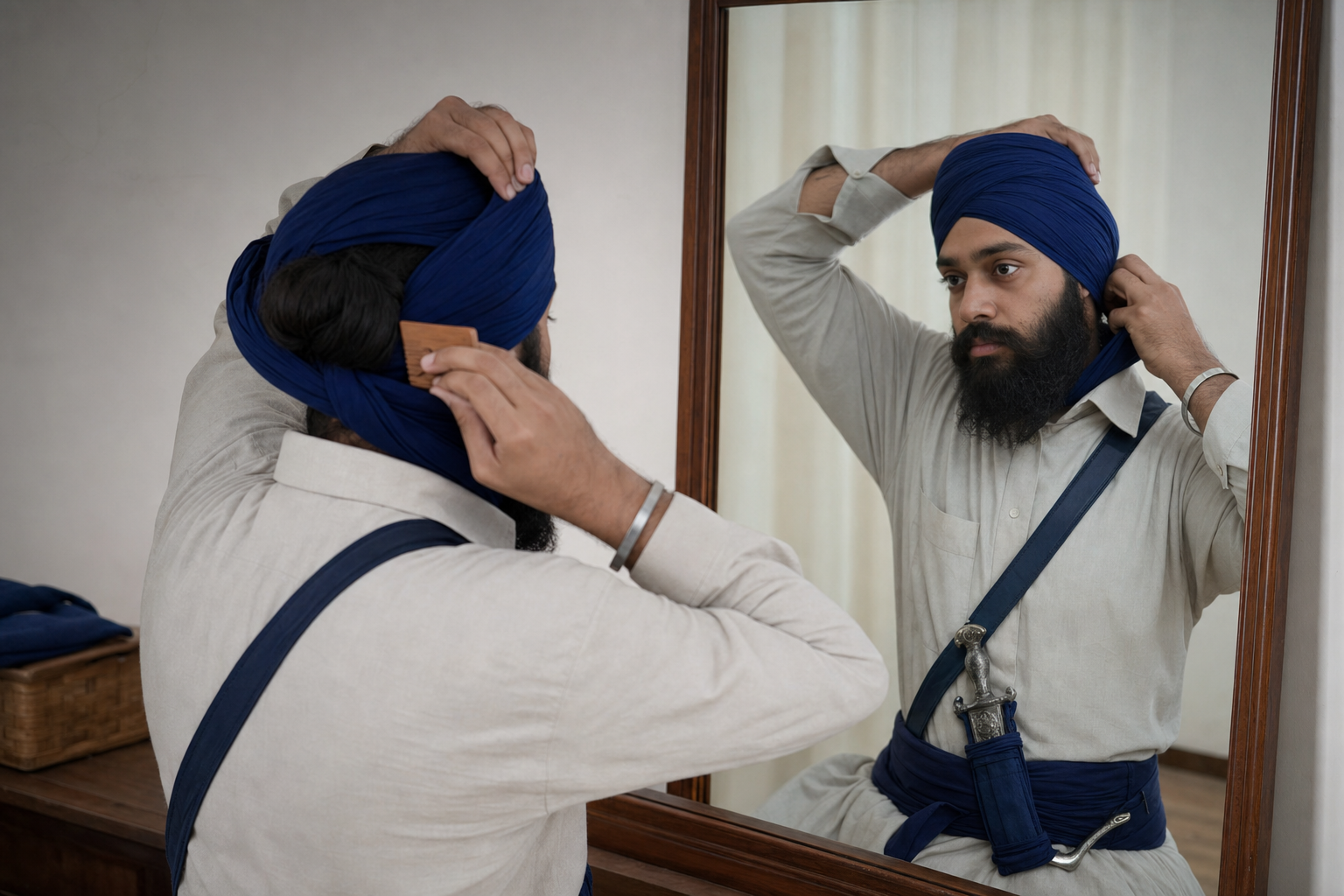
The Five Ks make an inward commitment visible. They are neither decorative symbols nor a substitute for ethical conduct. Each one places a recurring instruction close to the body, where it can interrupt forgetfulness at the moment a choice is being made.
| Article of faith | Discipline it embodies | A question it places before you |
|---|---|---|
| Kesh | Acceptance of the natural form and trust in hukam | Am I allowing convenience or social pressure to overrule the commitment I accepted? |
| Kangha | Order, cleanliness, and responsible care | Does my outward discipline show care rather than neglect? |
| Kara | Restraint and continuing remembrance | Would this action remain honorable if I remembered the Guru before doing it? |
| Kachhera | Modesty, readiness, and disciplined conduct | Does my behavior protect dignity and self-command? |
| Kirpan | The duty to defend dignity and protect the vulnerable | When someone is mistreated, will I act with courage and restraint? |
This reading prevents two opposite mistakes. The first is to treat the Five Ks as optional metaphors whose physical form no longer matters. The second is to wear them while ignoring the discipline they signify. Khalsa practice holds form and conduct together. Kesh without acceptance, a Kangha without care, a Kara without restraint, a Kachhera without modesty, or a Kirpan without responsibility leaves the instruction incomplete.
Use the Five Ks as checkpoints during the day. When anger rises, the Kara can call attention back to restraint. When disorder is becoming habitual, the Kangha can recall the connection between cleanliness and discipline. When witnessing humiliation or abuse, the Kirpan can recall that protecting the vulnerable is not someone else’s moral burden. These reminders are effective only when you consciously connect the visible article to the conduct it requires.
The Kirpan deserves particular clarity. It represents neither aggression nor private vengeance. Its ethical direction is protective: the defense of dignity and the vulnerable. The standard is therefore not merely whether you possess it, but whether your courage remains governed by compassion, proportion, and responsibility.
Build Nitnem, sangat, kirtan, and seva into one rule of life
Nitnem gives the day a devotional structure. The morning discipline includes Japji Sahib, Jaap Sahib, and Tav-Prasad Savaiye. Rehras Sahib belongs to the evening, and Kirtan Sohila closes the night. This daily sequence of morning, evening, and night recitation turns remembrance into a rhythm rather than leaving it dependent on mood.
- Morning: Japji Sahib, Jaap Sahib, and Tav-Prasad Savaiye establish the direction of the day before competing demands take over.
- Evening: Rehras Sahib gathers attention again after work, responsibility, and distraction have exerted their pull.
- Night: Kirtan Sohila closes the day in remembrance rather than allowing noise or agitation to have the final word.
Before initiation, place these periods into your actual schedule. Decide what waking time the morning practice requires. Identify the point in the evening when Rehras Sahib will happen. Connect Kirtan Sohila with a stable night routine. If your work, caregiving, or travel pattern creates a genuine difficulty, raise it with knowledgeable Sikh guidance before Amrit instead of quietly inventing a private replacement afterward.
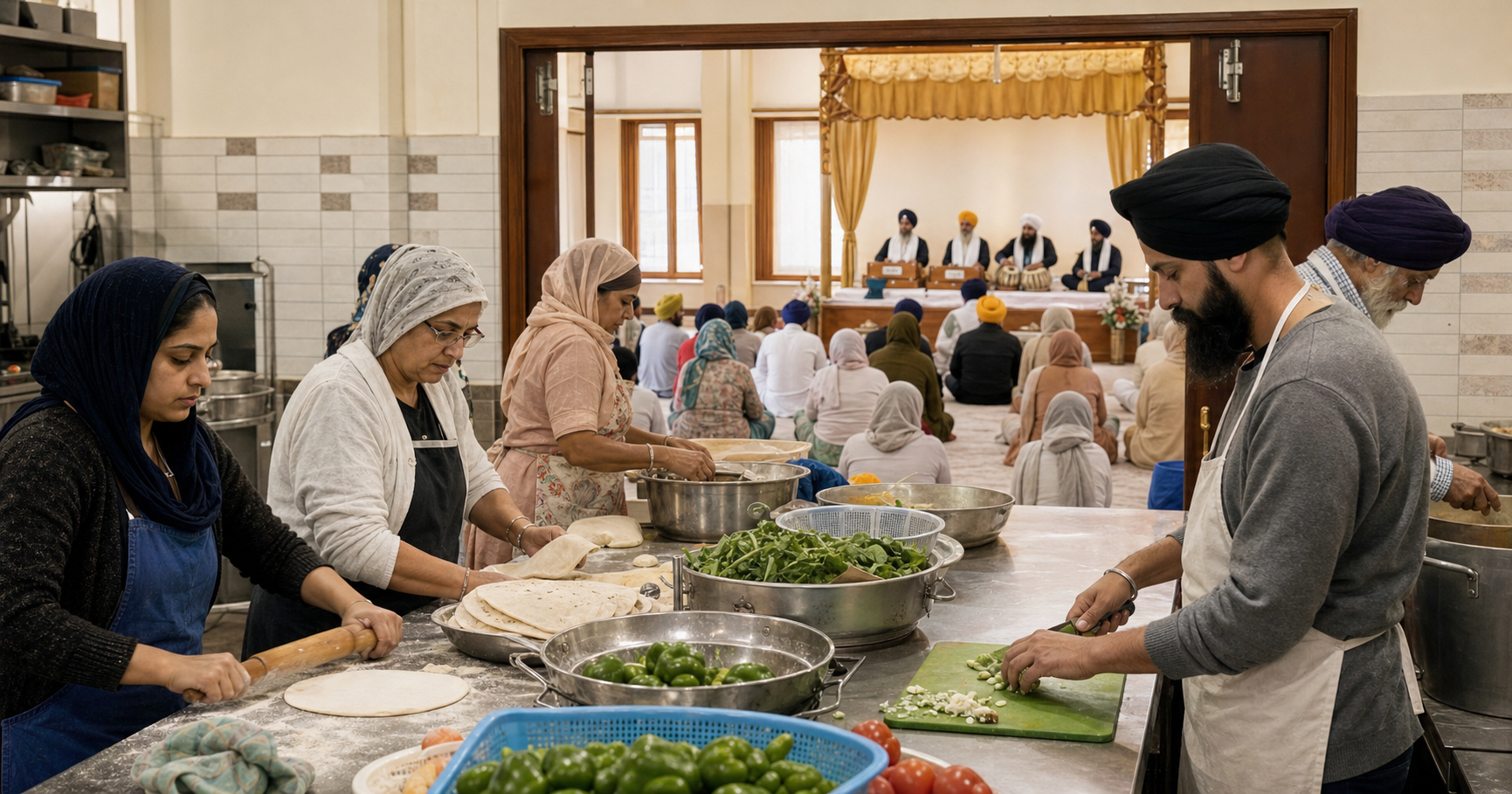
Nitnem is central, but Khalsa discipline is not a solitary optimization routine. Sangat keeps private interpretation from becoming the only authority. Kirtan brings shabad into voice, breath, attention, and emotion. Seva converts compassion from a feeling into repeated work. Langar gives equality a material form: people sit and eat without caste, class, gender, or status determining their worth.
Build these practices together. If you recite but never serve, examine whether devotion has become enclosed within the self. If you serve constantly but neglect bani, examine whether activity has lost its spiritual center. If you display Sikh identity but avoid the equality practiced in langar, examine whether status has entered through a side door. The elements support and correct one another.
This is also where the Khalsa ideal reaches beyond personal salvation. Sarbat da Bhala directs prayer and action toward the welfare of all. It asks whether your discipline makes you more dependable, more willing to serve, and more ready to defend another person’s dignity. Private restraint becomes public trust.
Other Dharmic traditions also use vows and disciplined practice to orient life toward truth: Hindu upanayana, Buddhist upasampada, and Jain diksha offer points of comparison. Shared concern for truthfulness, self-restraint, non-harm, service, and inner cultivation can support mutual respect. But comparison should clarify rather than flatten. Amrit Sanchar has its own Guru-centered history, liturgy, articles of faith, and Khalsa obligations. You honor Dharmic kinship best by understanding those distinctions accurately.
Key takeaways: test readiness in an ordinary week
- Approach Amrit Sanchar as entry into a continuing rehat, not as the completion of a spiritual journey.
- Learn the commitments before choosing a date: the Five Ks, Nitnem, preservation of kesh, restraint from intoxicants including tobacco, sexual fidelity, and avoidance of kutha.
- Confirm ceremonial preparation, attire, and conduct with the organizing gurdwara or Panj Piare rather than relying on assumption.
- Understand each of the Five Ks as both a physical article of faith and a daily ethical instruction.
- Plan the morning, evening, and night Nitnem periods around your real responsibilities, including the days when motivation is low.
- Look for the social fruit of discipline in sangat, kirtan, langar, seva, protection of the vulnerable, and Sarbat da Bhala.
If you are considering Amrit, use the next seven ordinary days to write down where the discipline fits naturally and where it collides with your present habits. Take the unresolved points to knowledgeable gurdwara leadership. A sincere pause for instruction is more faithful than a hurried promise made without understanding.
Then make the decision on its proper ground. The question is not whether you can preserve one elevated feeling forever. It is whether your longing for the Divine is ready to accept a form: bani at set points of the day, visible articles of faith, disciplined restraint, equality in the sangat, and service directed toward the good of all.