

You keep meeting the number sixteen: in the name Śoḍaśī, in Śrīvidyā worship, around the lotus of the throat chakra, and in accounts of sacred cities built for Shakti. The tempting answer is that sixteen carries one secret meaning wherever it appears. That answer is tidy, but it is not very useful.
A better way to read sixteen is as a recurring pattern of ordered fullness. It can organize a divine form, a sacred diagram, the powers of sound, or a consecrated landscape. The pattern connects those settings without making them interchangeable. Once you know which role sixteen is performing, the symbolism becomes something you can contemplate and practise rather than merely count.
One sacred number can perform four different jobs

A number becomes sacred through its relationship to a deity, teaching, ritual structure, or contemplative discipline. Context does the interpretive work. Sixteen petals, sixteen divine dimensions, and sixteen cities therefore should not be treated as three versions of a single coded list.
- Divine identity: Śoḍaśī is Lalita Tripurasundari, the form of the Divine Mother whose very name carries the association with sixteen.
- Cosmic order: Śrīvidyā connects sixteen with the Śrī Chakra and with sixteen nityā dimensions celebrated in esoteric worship.
- Embodied sound: Vishuddha is represented by a lotus of sixteen petals associated with the Sanskrit vowels.
- Sacred geography: a Shakta narrative remembers sixteen urban sanctuaries called Srinagar, devoted to Lalithambika and Kameshwara.
This distinction gives you a practical rule. Whenever you encounter sixteen in a temple, yantra, hymn, or teaching, do not begin by asking, “What does sixteen always mean?” Ask, “What is being ordered into sixteen here?” The answer may be a set of sounds, aspects of divinity, parts of a sacred design, or places within a devotional geography.
Śoḍaśī places Shakti at the centre of the pattern
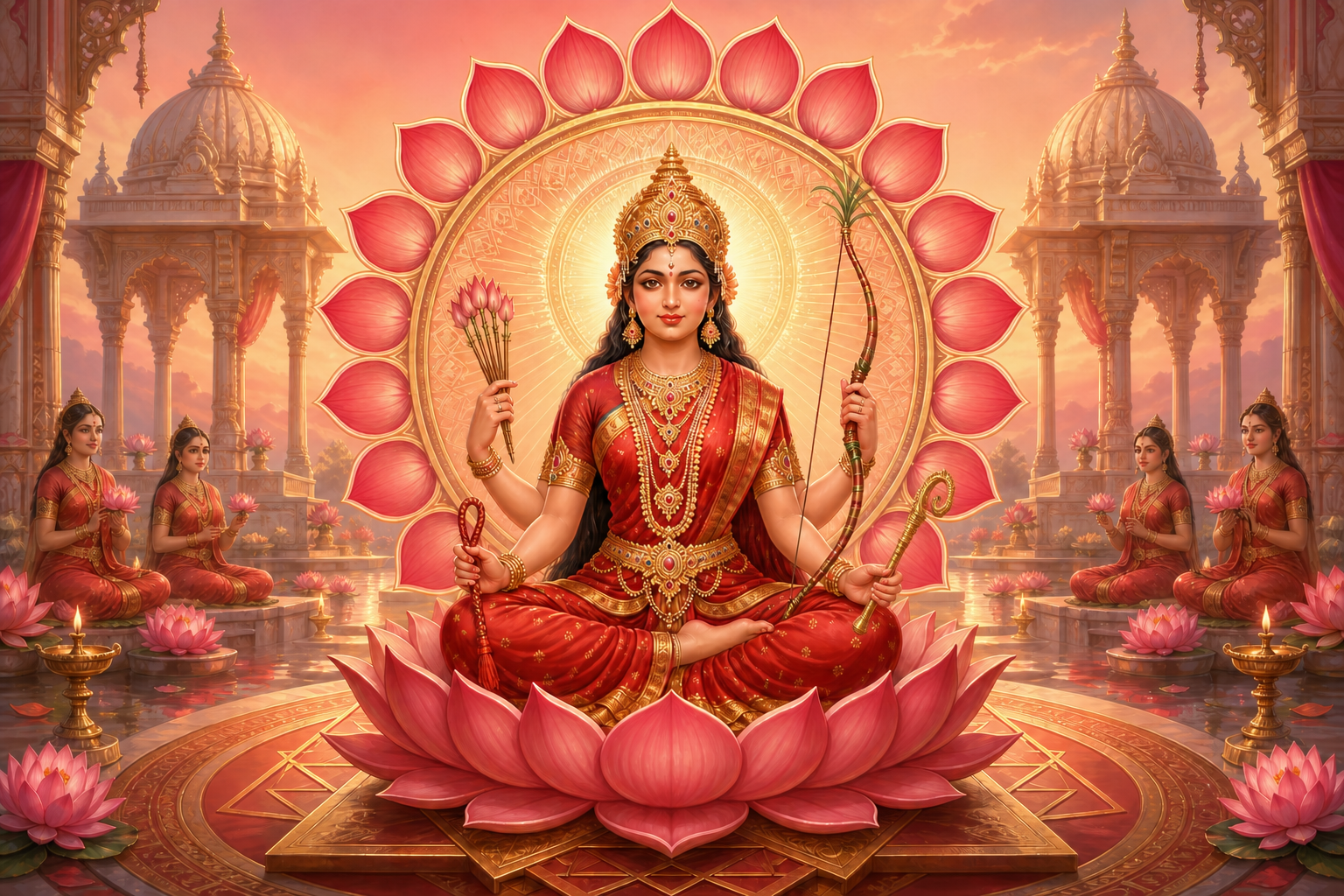
In Śrīvidyā, sixteen is not an abstract puzzle detached from devotion. It points toward Śoḍaśī, Lalita Tripurasundari, also revered as Lalithambika. Her consort is Kameshwara, a form of Shiva within this tradition. The numerical pattern is therefore anchored in a divine relationship, not in arithmetic for its own sake.
The Śrī Chakra carries the same movement from multiplicity toward unity. Its ordered geometry allows the practitioner to approach a reality that is at once richly differentiated and centred. The sixteen-fold motif belongs within that larger sacred architecture. Its purpose is not to encourage a hunt for lucky numbers; it helps the mind perceive harmony among powers that might otherwise seem scattered.
This is also why the symbolism should not be detached from conduct. Lalithambika represents grace, compassion, courage, and clarity. If contemplation of sacred geometry leaves your relationships harsher, your speech less truthful, or your responsibilities neglected, then the outer pattern has not yet become inner order.
You can begin without pretending to possess esoteric knowledge. Recitation of Lalita Sahasranama, reverent contemplation of the Śrī Chakra, and observance of Navaratri are established devotional points of entry. Where a practice belongs to a particular lineage or temple discipline, learn how that community understands it before improvising. This protects the distinction between respectful devotion and collecting ritual fragments without their setting.
Use a simple test after worship: name one quality of Shakti that your next action must embody. Compassion may require listening without interruption. Courage may require a truthful answer. Clarity may require refusing gossip. Responsibility may require completing a neglected duty. The sacred number has done its work when ordered worship produces ordered action.
The sixteen-petalled throat lotus turns symbolism into speech

Vishuddha, the throat chakra, gives sixteen an especially practical expression. The chakra is traditionally shown as a lotus with sixteen petals, commonly correlated with the Sanskrit vowels. It is associated with ākāśa, subtle vibration, communication, listening, and the purification of expression. Its bīja mantra is “ham.”
The symbolism matters because speech joins an inner intention to a shared world. A thought that remains private affects one mind. Once spoken, sung, promised, posted, or repeated, it can steady a family or divide a community. Vishuddha therefore concerns more than confidence in public speaking. It asks whether your words are pure in origin, accurate in content, measured in delivery, and responsible in effect.
Before a consequential conversation or digital post, pass the intended words through three questions:
- Is it true?
- Is it kind?
- Is it necessary?
These questions are not three excuses for avoiding difficult speech. A necessary truth can be uncomfortable. The discipline lies in removing exaggeration, humiliation, and needless noise while keeping the truth intact. If you cannot yet speak without trying to wound, silence gives you time to purify the intention. If silence would enable injustice, compassion may require a clear refusal.
Listening belongs to the same chakra discipline. Notice whether you are hearing the other person or preparing your next reply. Notice whether you use volume to replace precision. Notice whether a promise is specific enough to keep. These ordinary tests reveal more about the condition of speech than an elaborate visualization performed without ethical attention.
Japa of “ham,” visualization of sky-blue light at the throat, kirtan, simran, mindful silence, and gentle practices such as Nadi Shodhana, Ujjayi, or Bhramari can support this work when practised comfortably. Their shared direction is refinement: thought becomes sound without losing truth, and sound reaches another person without abandoning compassion.
The sixteen Srinagars make sacred order geographical

The sixteen-fold pattern also appears in the remembered geography of Shakti. Sixteen magnificent sanctuaries, each called Srinagar, are said to have been established for Lalithambika and Kameshwara. Here śrī conveys auspiciousness, grace, beauty, and prosperity, while nagara means city. Srinagar is consequently more than a place-name in this account: it is the idea of a city ordered around sacred presence.
The cities can be read as terrestrial mandalas. Temple, community, ritual, and public memory form a protected space in which dharma is meant to shape collective life. The city becomes sacred not because every event within its walls is automatically righteous, but because its centre continually calls residents back to worship, service, courage, and restraint.
Details and proposed locations vary across textual and oral traditions. That uncertainty should remain visible. It is not sound practice to turn every remembered identification into a settled archaeological fact, nor is it necessary to discard the spiritual meaning because a single uncontested map is unavailable.
If you investigate a place associated with the Sacred Sixteen, keep three layers separate:
<!– wp:list {