
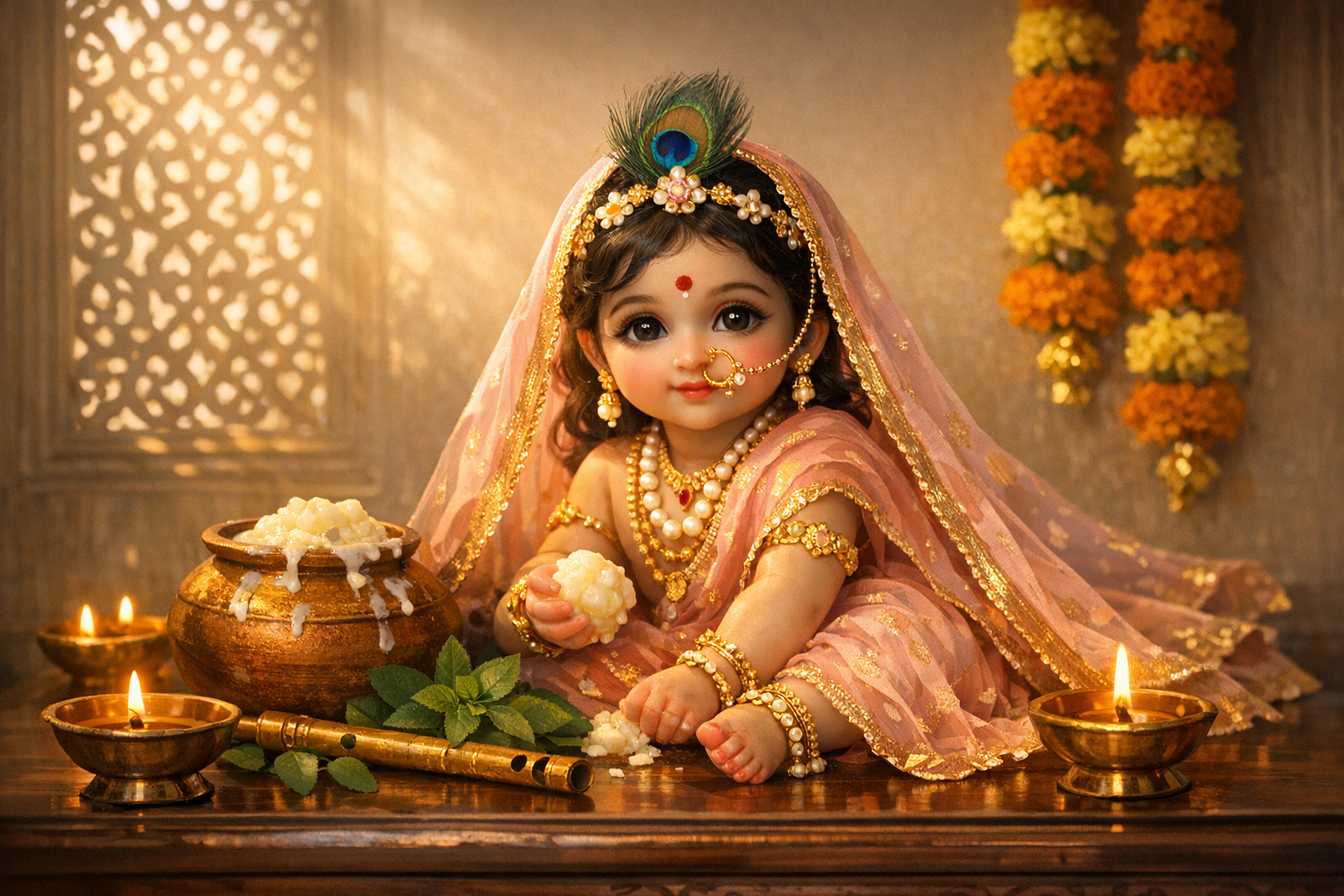
In Braj lore, the image of infant Krishna cradled in Yashoda’s arms emerges with striking tenderness and theological depth. Oral traditions from Vrindavan recall moments when, to shield the child from the gaze of hostile forces and the ill will of “dṛiṣṭi-doṣa,” Yashoda is said to have adorned Krishna in a girl’s attire, even placing a delicate nath (nose ring). This gentle act of maternal protection, remembered as a form of Mohini SwarupaKrishna manifesting in a feminine guisecontinues to resonate in devotional practice, home worship (seva), and cultural memory across North India.
Clarifying terminology is essential. In classical Vaishnavism, Mohini Avatar pertains to Viṣṇu’s female manifestation during the Samudra Manthana (as narrated in the Bhagavata Purana, Skandha 8). Mohini Swarupa, by contrast, denotes an assumable form or veṣa, especially within Krishna-bhakti, where the Supremeunderstood as Svayam Bhagavanfreely reveals diverse modes of appearance (svarūpa-bheda) for līlā. In temple liturgy and domestic arcana rooted in Pāñcarātra and related Vaishnava paddhatis, such veṣa and alaṅkāra belong to the shṛṅgāra of the deity, intended to cultivate rasa and deepen bhakti.
Textual and historical background further frames the practice. The Bhagavata Purana (Skandha 10) recounts Kamsa’s fear of the prophesied slayer born among the Yadus and Gokula, and the repeated threats posed by his agentsfrom Pūtanā to other asuras. Within this setting, Braj oral narratives and kīrtan traditions remember Yashoda’s extraordinary care, including disguising the infant to mislead prying eyes searching explicitly for a male child. The maternal impulse aligns with a pan-South Asian repertoire of apotropaic customs used to avert harm from infants, not least when danger is perceived to be specific to a child’s sex or status.
Ethnographic observation across the Braj region suggests that select temples and many households periodically present Bāla Gopāla in strī-veṣa (also called gopī-veṣa), especially in intimate home-sevā settings. The alaṅkāra may include a small nose ring (nathiyā), bindi, anklets, a dupattā-like drape, and soft fabrics associated with feminine dress; in some homes, a subtle kajra line is drawn to accentuate the eyes. The intention remains devotional, not theatrical: the veṣa expresses maternal love (vātsalya-bhāva) and recognizes the Lord’s capacity to playfully receive every ornament offered by devotees.
The rationale draws on an apotropaic logic widely recognized in Indian folk life. Protective rites to ward off nazarsuch as a black dot on the cheek, amulets, or deliberate mismatching of attirehave analogues throughout the subcontinent. Disguising a boy as a girl to deflect malevolent attention is part of this repertoire. In the Krishna tradition, the practice is sanctified by association with Yashoda and harmonized with theological assurance: the Divine assumes countless forms to nurture devotees’ security and love.
Liturgically, veṣa-alankāra belongs to the broader grammar of arcana. Vaishnava seva cycles often enumerate shṛṅgāra, bhoga, and āratī as essential offerings, and many sampradāyasGaudiya Vaishnavism, Pushtimarg (Vallabhacharya), and related traditionsmaintain exquisite canons of dress and ornamentation for the deity, varying by season and festival. While not universal, localized observances of gopī-veṣa for Krishna occur, especially where Rāsa-līlā sensibilities are prominent. Variations around Gopashtami and other Braj utsavas occasionally incorporate playful inversions of attire, always with the hermeneutic of līlā and bhāva rather than worldly performance.
Related Vaishnava retellings reinforce the theological latitude for feminine manifestation in devotion. Tamil narratives around the Koovagam festival remember Krishna (as Mohini) marrying Iravan (Aravan) before his sacrificial deatha profound meditation on compassion, vow, and the Lord’s readiness to console the marginalized. Such themes historically offered recognition to third-gender communities within a dharmic ethos, demonstrating that sacred narratives can sustain dignity and belonging without polemic.
Philosophically, the strī-veṣa of Krishna carries an inclusive message recognized across dharmic traditions. In Advaita-informed Vaishnava reflections, the Supreme is nirguṇa-saguṇatranscending gender yet freely embracing form for bhakta-anugraha (grace to devotees). Buddhism articulates upāya (skillful means), affirming that the awakened reality appears in diverse forms for the benefit of beings. Jainism’s anekāntavāda underscores the many-sidedness of truth, inviting humility before plurality of perspectives. Sikhism centers Ik Onkar, the One beyond form, known through nām-simran and ethical living. Read together, these lenses highlight a civilizational continuity: the Divine’s truth exceeds gender, and devotion naturally accommodates symbolic plurality.
Aesthetic and textual witnesses complement living practice. North Indian pīchvāī and miniature traditions occasionally intimate playful cross-costuming within Krishna-līlā; Braj bhajans celebrate Śyāma’s ornaments, making affectionate reference to the nathiyā. While core Sanskrit sources like the Gīta Govinda foreground madhura-bhāva without explicit cross-dress detail, later Vaishnava compendia and regional kīrtan traditions expand the imaginative repertoire of Rādhā-Kṛṣṇa līlās, locating strī-veṣa within a continuum of rasa.
For households that choose to observe this seva, three touchstones sustain authenticity. First, alignment with one’s sampradāya and guidance from a guru or community seniors preserves theological coherence. Second, alaṅkāra remains dignified and sattvic, using modest fabrics and simple ornaments that befit Bāla Gopāla. Third, intention is paramount: the practice aims at cultivating vātsalya and surrender, not spectacle. Simple mantras, soft kīrtan, and reflection on Yashoda’s care ensure that the rite remains prayerful.
Occasional concerns arise about historicity or propriety. From a historiographic standpoint, the practice sits at the interface of śāstra, regional itihāsa-purāṇa, and living paramparā. Not every custom seeks validation in a single textual locus; rather, it accrues authority through sustained devotional usage, consonance with Vaishnava theology, and the refinement of rasa. From a cultural standpoint, strī-veṣa in this context does not project modern identity claims; it enacts the timeless grammar of līlā, magnifying maternal love and the Lord’s boundless freedom to accept every devotee’s offering.
Read as Mohini Swarupa, the nose ring on Krishna’s infant face becomes a pedagogical symbol. It conveys how bhakti naturalizes paradoxthe Supreme as child, the Infinite in veṣa, the Protector appearing as the protectedso that remembrance (smaraṇa) and service (seva) deepen into living experience. In a plural, dharmic society, such symbols fortify mutual respect among Hindu, Buddhist, Jain, and Sikh communities by illustrating how sanctity travels through forms without being limited by them.
In sum, the Vrindavan tradition of dressing Krishna as a girl is a sacred synthesis of theology, folklore, and seva. Anchored in the Bhagavata Purana’s narrative world and enriched by Braj paramparā, it teaches that divine love exceeds gender and cultural partitions. By honoring Yashoda’s protective wisdom and Krishna’s playful sovereignty, communities preserve a living heritage that safeguards children, uplifts the vulnerable, and invites seekers across dharmic paths to contemplate the One who wears every ornament of love.
Inspired by this post on Hindu Blog.
