

If your marriage is strained, the urgent question is not simply whether you must preserve it or whether you are permitted to leave. Ask a more useful question: What conduct will reduce harm, restore truth, and honor the duties that still exist? That question can guide you whether reconciliation remains possible or separation becomes necessary.
Hindu tradition gives marriage sacred weight, but sacred weight means responsibility, not denial. You need to identify the kind of conflict you are facing, test whether repair is real, use family and temple institutions wisely, and refuse to call fear, humiliation, or silence harmony.
First, name the kind of marital crisis you are facing

Not every disagreement is a failure of marriage. Two people can disagree about money, relatives, work, worship, parenting, or domestic responsibilities while remaining truthful and safe with each other. The decisive issue is not whether conflict exists. It is whether both people can address it without deception, coercion, or injury.
A practical distinction can help. This is not a scriptural classification; it is a way to choose the next responsible action.
- Ordinary strain exists when both people can speak freely, acknowledge facts, apologize without manipulation, and carry out agreed changes.
- A sustained breach of duty exists when lying, contempt, abandonment of responsibilities, repeated financial secrecy, infidelity, addiction-related conduct, or interference by relatives continues despite clear objections and opportunities to repair it.
- Danger exists when there is physical or sexual violence, a credible threat, stalking, confinement, coercive control, child endangerment, or fear of retaliation for seeking help.
If danger is present, do not begin with a joint family meeting, pilgrimage, or mediation session. A controlling person may use reconciliation language, relatives, money, or religious authority to increase pressure. Prioritize immediate safety and obtain help from appropriate local emergency services, a domestic-violence service, and a qualified lawyer. If disclosing your plans could increase the danger, seek confidential professional guidance before confronting the other person.
Where the situation is safe enough for reflection, write down what actually happened before assigning motives. Record the conduct, the duty it affected, the harm that followed, the repair requested, and what future behavior would demonstrate change. Compare specific facts such as an undisclosed debt or a broken caregiving commitment, not totalizing labels such as selfish, disloyal, or impossible.
Acceptance has a precise role here. It means accepting the facts that are present, including your own mistakes. It never means passively accepting abuse or calling avoidable harm your karma.
Let vivaha define the standard, not imprison the person
Among the shodasha samskaras, vivaha consecrates entry into the grihastha ashrama. It establishes a household directed toward dharma, mutual support, and social continuity. In this classical vision, marriage is more than a private contract. It is a partnership carrying ethical vows and shared obligations.
That sacred status should raise the standard of conduct inside the marriage. It should not protect the reputation of the household at the expense of a spouse or child. A vow cannot be invoked to demand another person’s duty while excusing one’s own adharma.
The absence of a divorce samskara is often misunderstood. Samskaras purify and consecrate constructive transitions: learning, marriage, household responsibility, renunciation, and the final rites of life. They confer a role or spiritual eligibility. Dissolving a relationship does not serve that ritual function, so marital breakdown was handled through legal, ethical, familial, and communal processes rather than through a purificatory rite of ending.
This ritual structure does not by itself establish that separation is forbidden in every circumstance. Manusmriti, Yajnavalkya Smriti, and Narada Smriti address matters such as separation, desertion, maintenance, and, in some settings, remarriage. Regional customs also developed ways to respond to broken households. These materials do not collapse into a single modern legal rule, but they do show that dharmic society recognized marital misconduct and its consequences rather than pretending breakdown could never occur.
If repair is being considered, conduct a duty audit. Each spouse should answer the same questions:
- Truth: What fact have I concealed, minimized, exaggerated, or refused to hear?
- Non-injury: Which words, actions, silences, or pressures have caused avoidable harm?
- Shared duty: Which responsibility for income, expenditure, caregiving, parenting, household work, fidelity, or worship have I neglected?
- Accountability: What repair is mine to make without first demanding that the other person change?
- Evidence of change: What observable conduct would show that my apology is more than a promise made during a crisis?
Prayashchitta can support this work when someone has acted wrongly. Its purpose is ethical and spiritual correction, not performance. An admission without restitution, changed conduct, or protection against repetition leaves the injured person carrying the cost. Repentance becomes credible when the conduct changes and stays changed.
Use the temple to steady the household, not avoid the problem

A temple can give you a quiet setting in which pride loosens and duty becomes easier to see. It cannot make a dishonest conversation truthful or convert an unsafe relationship into a safe one. Darshan should prepare you to act differently after you return home.
At Sri Kalyana Kamakshi Amman Temple in Hosur, the name Kalyana evokes blessings for harmonious relationships, family well-being, and spiritual prosperity. Devotees commonly pray to Ma Kamakshi for marital harmony and health. Fridays and Navaratri have particular devotional significance, with offerings such as kumkum and flowers.
Approach such a visit as a discipline rather than a bargain with the deity. A useful pilgrimage has a before, a during, and an after:
- Before darshan, form a sankalpa concerned with your own dharma: clarity to tell the truth, restraint during conflict, courage to protect dependents, or humility to make amends. Do not frame the prayer as a demand that the deity force your spouse to obey you.
- During the visit, observe modest dress, patient queueing, and quiet participation in aarti. Pradakshina and brief seated meditation can help move the mind from accusation toward discernment.
- After darshan, each person should name the duty they will carry home. Make it observable: disclose the relevant household accounts, stop using an insulting expression, correct a falsehood told to relatives, attend an agreed counseling session, or keep a caregiving commitment.
- At the next discussion, review whether the promised conduct occurred. Do not treat the emotional relief of worship as evidence that the underlying breach has been repaired.
Temple participation is communal, but not every respected elder or priest is equipped to manage marital trauma, mental illness, addiction, domestic violence, or legal rights. Religious counsel can clarify values. A trained counselor can address patterns of communication and behavior. A lawyer can explain rights and obligations. Safety services can help someone leave danger. These roles may cooperate, but they are not interchangeable.
If you invite an elder or community mediator, choose someone who listens to both people, protects confidentiality, distinguishes repentance from repeated promises, and does not excuse injury because of gender, age, wealth, or family status. The mediator must also be willing to refer the matter onward when it exceeds their competence. Family prestige is not a substitute for impartial judgment.
Build harmony through a repeatable household practice
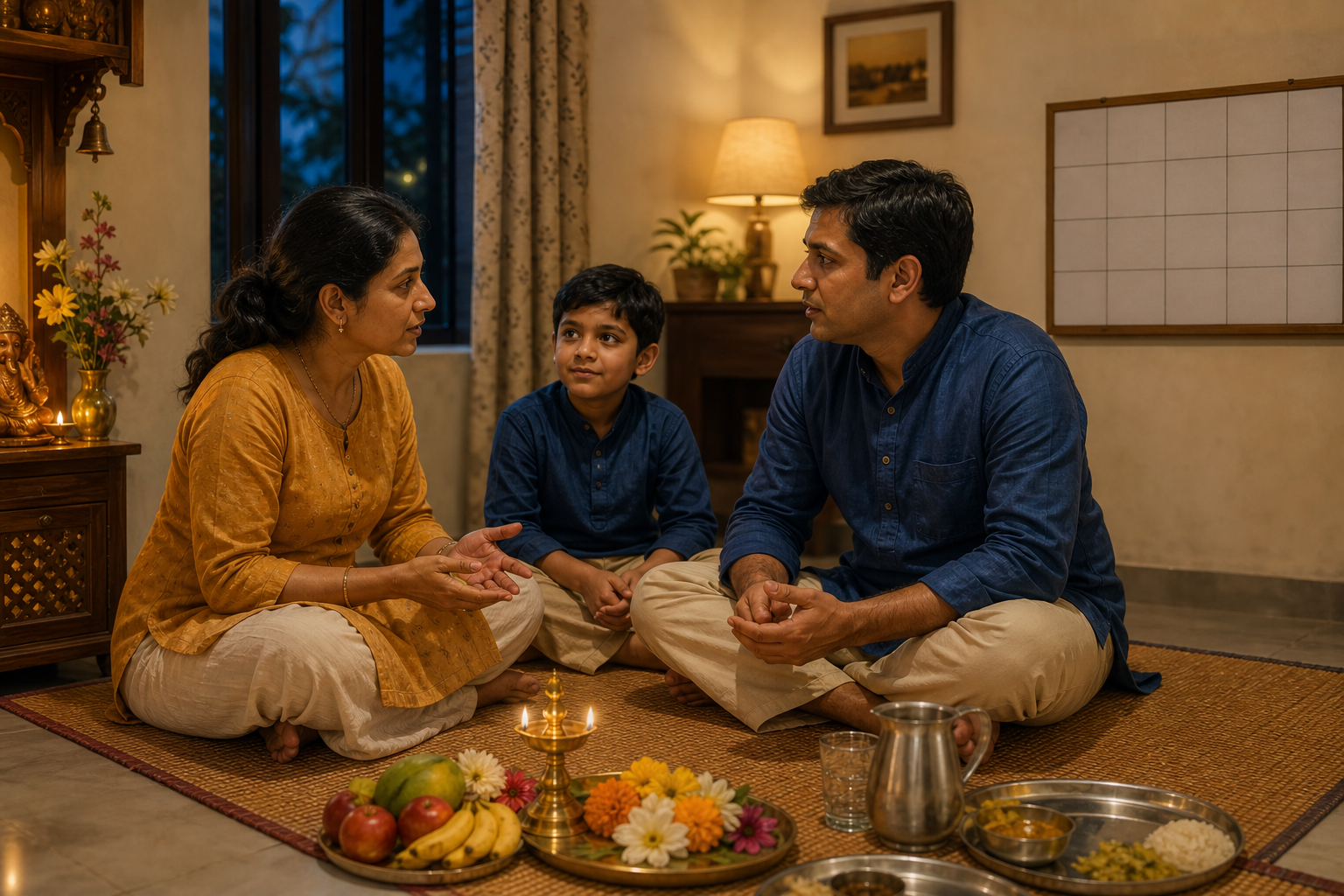
Family harmony is not the absence of difficult speech. It is the household’s capacity to face truth without destroying dignity or belonging. That capacity is built through abhyasa: repeated practice when the home is relatively calm, not only desperate promises after a rupture.
For a safe but strained marriage, establish a household dharma conversation at a predictable interval. Adaptability matters: the arrangement may change with work, caregiving, illness, or the needs of children, but the duty to communicate should not disappear. Use the same agenda each time:
- Begin with a short prayer, shared silence, or seated reflection. The purpose is to reduce reactivity, not to declare one person’s position sacred.
- Review previous commitments using facts. State what was completed, what was missed, and what prevented completion.
- Raise a current problem in terms of conduct and consequence. Describe what happened and whom it affected.
- Let each person state the duty they believe is theirs. Do not begin by assigning the other person’s duty.
- Agree on a narrowly defined repair, the person responsible, and the evidence that will show it happened.
- Record unresolved matters. Refer questions involving safety, mental health, addiction, property, maintenance, or legal status to the appropriate professional.
Set firm rules for the conversation. No threats, contempt, public shaming, selective use of scripture, or recruitment of relatives as a pressure campaign. Do not make children carry messages, gather information, keep adult secrets, or choose between parents. Do not ask elderly parents to adjudicate matters that compromise their health or place them in an impossible loyalty conflict.
Money needs the same moral clarity as speech. Shared obligations require truthful disclosure of information relevant to the household. If one spouse controls all access to money or documents, a family discussion may not be enough; confidential legal or specialist advice may be necessary. Financial dependence should not be exploited to purchase silence.
Small devotional practices can reinforce the household’s orientation. Shared prayer, aarti, or quiet reflection may create a regular pause in which gratitude and restraint are remembered. But ritual must remain connected to conduct. A beautiful puja followed by intimidation, deception, or neglect is not family harmony. The sacred institution is honored when worship reshapes behavior.
If separation becomes necessary, keep dharma in the process

Reconciliation is not established by one apology, one pilgrimage, or a temporary period of calm. Look for sustained truthfulness, voluntary accountability, respect for boundaries, fulfillment of duties, and a willingness to obtain appropriate help. When those conditions remain absent, insisting on togetherness can preserve the appearance of marriage while hollowing out its ethical substance.
Where civil law recognizes divorce, the process and its consequences vary by jurisdiction. Obtain advice from a qualified local lawyer before signing agreements, surrendering property or financial claims, changing a child’s living arrangements, or relying on an informal family settlement. Religious or family pressure should not rush you into an irreversible legal decision you do not understand.
Dharmic conduct remains relevant even when the marriage ends. Truthful communication, non-injury, care for children and elders, fair settlement, and mediation where appropriate preserve dignity and reduce damage to the wider family. Mediation is appropriate only when both parties can participate freely and safely; it should not be used to bargain away protection from abuse.
- Keep necessary communication factual and restrained, especially when direct conversation repeatedly becomes volatile.
- Separate the end of the spousal relationship from continuing parental duties. A child should not become a witness, messenger, ally, or judge.
- Give elders essential information without turning them into instruments of blame or public humiliation.
- Address maintenance, shared property, debts, housing, and caregiving through transparent and legally informed processes.
- Use prayashchitta for your own wrongdoing and inner correction. Never impose it on an injured spouse as proof that they deserve what happened.
- Limit disclosure to people who genuinely need the information. Community gossip is not accountability.
Sannyasa does not provide a spiritual escape hatch from unresolved household responsibilities. It is a positive initiation into a disciplined ashrama directed toward moksha, not a ritual equivalent of deleting a marriage. Nor is there a canonical divorce samskara merely because someone desires ceremonial closure. Separation is handled through ethical repair, lawful process, responsible care, and personal spiritual discipline.
Key takeaways
- The sacredness of vivaha creates mutual responsibility; it does not require the concealment of injury.
- The absence of a divorce samskara reflects the constructive purpose of samskaras. It does not, by itself, prove an unconditional ban on every separation.
- Determine whether you face ordinary strain, a sustained breach, or danger before choosing mediation or reconciliation.
- Use temple worship to gain clarity and restraint, then connect the prayer to observable conduct at home.
- Judge reconciliation by repeated accountability, not promises, family pressure, or temporary calm.
- If separation becomes necessary, truthfulness, non-injury, care for dependents, fair dealing, and lawful process remain dharmic duties.
Your next step should match the reality you have named. If the relationship is safe and repairable, prepare a brief duty audit and arrange a structured conversation with a suitable mediator or counselor if needed. If danger, coercion, or serious legal exposure is present, secure confidential safety and legal guidance before attempting a family or temple intervention. Let prayer do its proper work: steady your mind so that you can see clearly, speak truthfully, and carry the duty that is actually yours.
References
- DharmaRenaissance Blog — Hosur Kalyana Kamakshi Amman Temple: Serenity, Heritage, and Divine Grace in Tamil Nadu
- DharmaRenaissance Blog — Timeless Wisdom: Why the 16 Samskaras Exclude Divorce and What It Reveals about Dharma
