
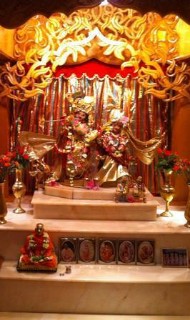
The recurring human desire to see, touch, and converse with the Divine functions as a powerful experiential datum in the study of religion. Across cultures and eras, this longing has not only animated theology but also structured lived practice. Within the dharmic world, it finds coherent expression through bhakti-yoga, where devotion is cultivated through disciplined service, remembrance, and ritual engagement that renders the sacred tangibly present.
In the bhakti tradition, arcana (Deity Worship) provides a methodical pathway from aspiration to experience. The deity is understood not as an inert object but as the archa-avatara, a gracious form in which the Supreme becomes accessible to the senses of embodied practitioners. This view is grounded in Srimad-Bhagavatam and elaborated by acaryas who establish arcana among the nine processes of devotion, positioning it as a structured discipline suited even for beginners while remaining deeply meaningful for the advanced.
Scriptural narratives illustrate that full theophany remains rare even for great souls such as Sri Narada of Srimad-Bhagavatam, thereby underscoring the necessity of practices that stabilize daily remembrance. Arcana meets this need by integrating attention, care, and service in a repeatable form. When approached properly, it nurtures both reverence and intimacy with the Divine, channeling the innate longing into consistent, community-supported realization.
The pragmatic test of spiritual practice is often summarized as “the proof of the pudding is in the eating.” Devotional disciplines, including arcana, invite such verification through lived, repeatable experience rather than abstract conjecture. As devotees serve, adorn, and offer to the deity with mindfulness, the ritual becomes a laboratory of presence where attention, emotion, and meaning align, producing direct conviction rather than second-hand belief.
Historically, Deity Worship in many communities gravitated to an inner circle of elderly pujari-priests. Sustaining and enlivening the practice today, however, requires moving from a specialist-only model to a congregational paradigm that builds skills, participation, and belonging. In settings affiliated with ISKCON (International Society For Krishna Consciousness) and beyond, this shift fosters intergenerational continuity and offers newcomers an immediate, structured way to serve.
A robust congregational model of arcana rests on clear training pathways and service rotation. Competency-based onboarding can include modules on ritual purity, timing, mantra pronunciation, altar etiquette, and coordinated team service. Defined rolesaltar preparation, flower and garland seva, kitchen offerings, conch and bell coordination, post-ritual maintenance, and inventory stewardshipallow many hands to participate without diluting standards.
At the level of technique, Shodashopachara (the sixteen standard offerings) provides a reliable framework: from invitation and seating to bathing, dressing, fragrant substances, lamp offering, naivedya, and arati. Checklists for cleanliness, materials handling, sequencing, and post-offering protocols help translate intention into consistent excellence. In this way, arcana cultivates sattvaclarity, order, and carewhile providing newcomers with confidence and veterans with depth.
Operational planning strengthens devotion. Rostered teams, digital calendars, and inventory logs reduce stress and ensure continuity. Ethical sourcing of flowers, incense, and prasada ingredients, attention to seasonality, and environmentally sensitive disposal of ritual remnants uphold dharmic responsibility. Kitchen standards aligned with the dietary norms of a given sampradaya, along with food-safety awareness for public prasada distribution, protect both sanctity and health.
Risk management preserves the dignity of worship. Fire safety around lamps and camphor, stabilized platforms for abhishekam, secure storage for valuables, and non-slip flooring near sanctums reduce hazards. Child protection norms during volunteer service, basic first-aid readiness, and clear lines of accountability cultivate trust and make the temple a safe learning environment for families.
Arcana is most transformative when integrated with the other limbs of bhakti-yoga. Kirtan and scriptural recitation before and after offerings tune collective attention; guided reflections during darshan focus the mind on the deity’s qualities and pastimes. This multimodal engagementhearing, chanting, seeing, and servinganchors cognition, emotion, and action in a single devotional arc.
Educational layers deepen participation. Brief narratives explaining the meaning of each upachara, the symbolism of altar elements, and the historical continuity of Vedic Traditions provide context without overwhelming. Children can assist with garland-making and lamp offerings under supervision, while adolescents rotate through kitchen, altar, and logistics roles, gaining practical skills alongside devotional literacy.
Guarding against mechanical ritualism is essential. Traditions urge entering worship with sankalpa, a clear inner intention to serve, and closing with gratitude for the opportunity to offer. Short pauses for japa before arati, mindful breath after lamp offering, and a moment of silent prayer before prasada distribution keep the heart of seva at the center of form.
A dharmic lens highlights shared civilizational grammar across Hinduism, Buddhism, Jainism, and Sikhism. While modalities differ, darshanhonoring the sacred with the eyes and heartrecurs. Hindu communities venerate the deity’s murti; Buddhist and Jain communities revere images of the Buddha and Tirthankaras, including abhisheka and alankara; Sikh communities center darshan of the Guru Granth Sahib and collective seva in the gurdwara. These pathways model unity in spiritual diversity while respecting distinct theologies and norms.
Common critiques of Deity Worship often arise from a category error that treats the murti as a mere symbol rather than as an intentional locus of presence. In theistic Vedanta, especially in Gaudiya Vaishnava thought, the deity is welcomed as archa-avatara. This view neither collapses the Infinite into matter nor denies transcendence; rather, it affirms a relational dynamic in which the Supreme freely accepts service through consecrated form. Such a position is philosophically coherent within non-dual and qualified-non-dual frameworks that accommodate both immanence and transcendence.
Psychology of religion research consistently associates communal ritual with prosocial behavior, social bonding, and improved affect regulation. Congregational arcana, accompanied by kirtan, scriptural study, and prasada, creates a rhythm of belonging that supports well-being and altruism. When aligned with inclusive community norms and interfaith goodwill, devotional practice becomes a public good that radiates stability beyond the temple walls.
Measuring impact encourages stewardship. Simple indicatorsvolunteer hours, training completions, cleanliness audits, congregational attendance at darshan and arati, prasada distribution counts, and festival participationtrack growth without reducing devotion to numbers. Qualitative feedback, such as devotees’ reports of increased focus, compassion, and steadiness in daily life, complements quantitative metrics.
Scalable models suit communities of all sizes. Small sanghas can begin with a simple home or mobile altar, weekly kirtan, and shared prasada, adding occasional abhishekam on festival days. Larger temples can implement tiered service teams, festival task forces, and mentoring systems that gradually entrust newcomers with greater responsibility as competence and devotion mature.
Technology can extend but not replace presence. Livestream darshan, digital scheduling, and online education broaden access; nonetheless, in-person servicefolding garlands, offering lamps, and serving prasadaremains the irreplaceable heart of arcana. The tactile, olfactory, visual, and auditory dimensions of worship are themselves pedagogical, training attention toward the sacred through the senses.
The vision advocated by Srila Prabhupada and the acaryasplacing arcana among accessible opportunities for neophytesproves pastorally sound and theologically robust. As congregations move from spectator culture to shared seva, the longing to see God is progressively transmuted into a stable awareness of presence. The path does not depend on extraordinary visions; it matures through ordinary, faithful offerings rendered with care.
In sum, expanding the scope of Deity Worship as a congregational pillar is both practical and profound. It preserves continuity with Vedic Traditions, strengthens community bonds, and offers a verifiable path by which longing ripens into living relationship. Framed within unity in spiritual diversity and supported by thoughtful governance, training, and interfaith respect, arcana becomes not only a devotional discipline but also a model for harmonious, service-centered society.
Inspired by this post on Dandavats.
