
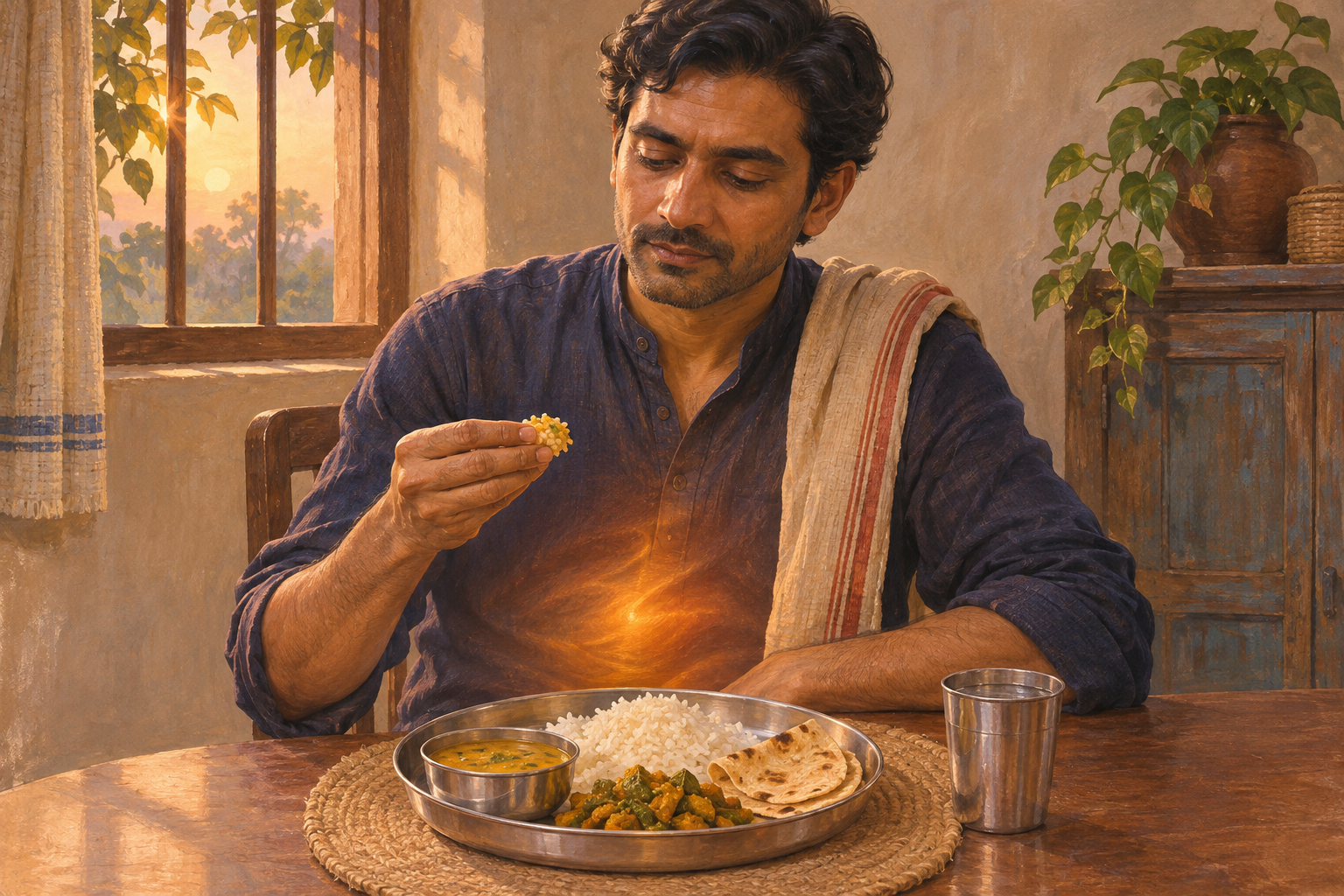
If your meals often disappear between notifications, conversation, and the next obligation, you do not need a more elaborate menu. You need a different relationship with the first mouthful. Pranagnihotra gives you a disciplined way to receive food as an offering, eat with attention, and remember what the meal is meant to sustain.
The practice can be simple enough for an ordinary weekday meal and deep enough to reshape your conduct beyond the table. Its purpose is not to make eating solemn or theatrical. It is to interrupt entitlement: this food is not merely something you acquired and consumed; it has arrived through a web of life, labour, sacrifice, and grace.
See the meal as an inward yajna
Pranagnihotra applies the grammar of yajna to eating. The prepared food becomes the offering. The body’s life-sustaining fire becomes the altar. The vital powers receive nourishment, and the person eating becomes an offerer rather than a mere consumer. This is part of the Vedic movement from external sacrifice toward internalized worship.
The movement inward does not reject the external ritual. It asks you to recognize its pattern within embodied life. The Karmakanda portions of the Vedas give detailed attention to sacrificial action; the Aranyakas and Upanishads turn the same sacrificial vision toward consciousness, breath, food, and the human person. Pranagnihotra stands within that transition.
| In an external yajna | In the inward practice of eating |
|---|---|
| The altar holds the sacred fire | The living body contains the fire that receives and transforms food |
| An oblation is offered | The food is received as an offering rather than seized as a possession |
| The act is performed with intention | The eater pauses, dedicates, and remains attentive |
| The offering serves an order larger than the individual | Nourishment is directed toward dharmic thought, speech, work, and service |
This distinction changes the question you bring to the plate. Instead of asking only whether the food satisfies your preference, ask what you intend to do with the strength it gives you. If the answer is clearer thought, steadier conduct, honest work, care for family, or service to others, the meal has already entered the field of dharma.
A practical Pranagnihotra for your next meal
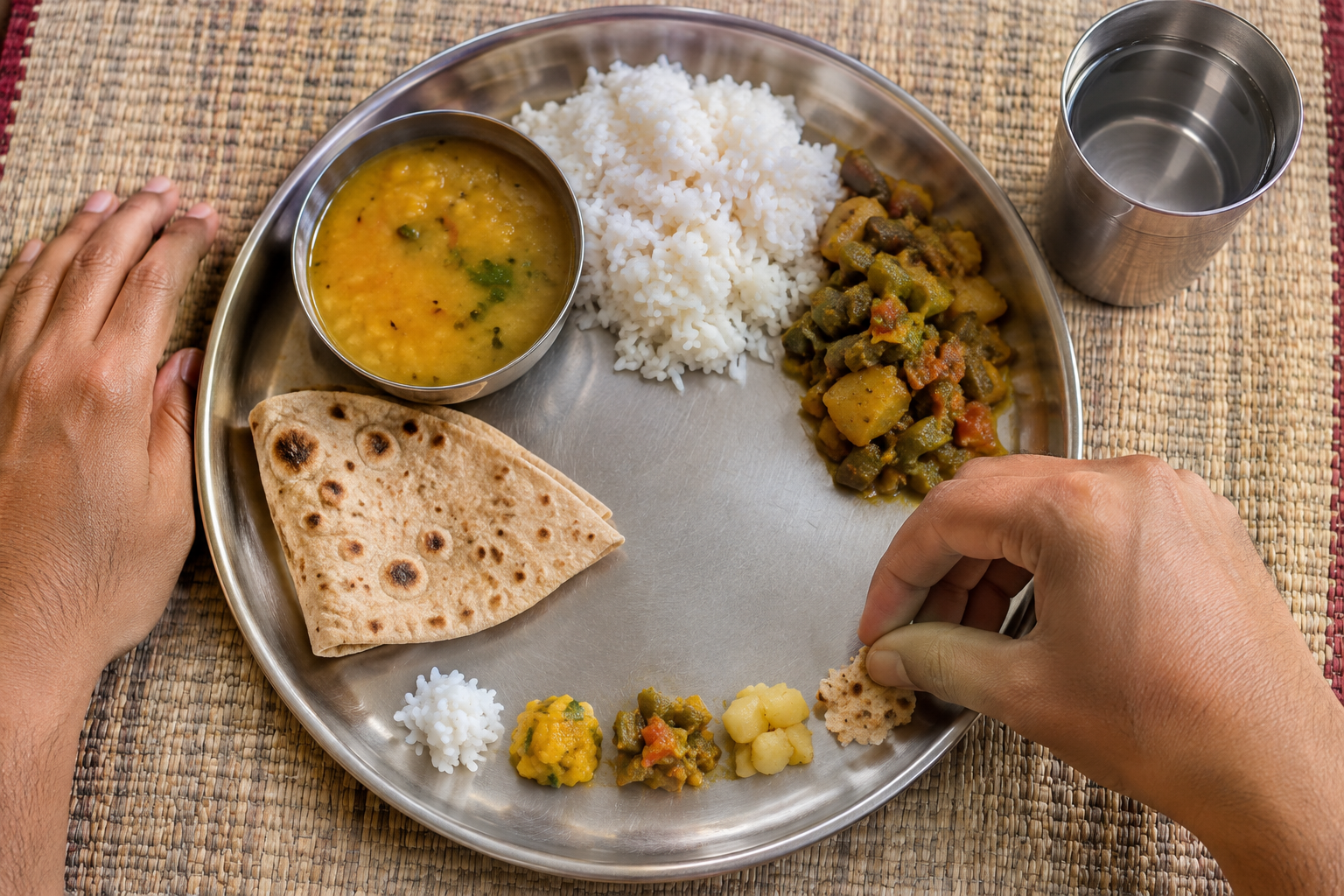
Begin with one meal you can eat while seated. Do not postpone the practice until you have a ritual room, special utensils, or an uninterrupted household. A modest observance performed attentively is a better beginning than an elaborate form performed rarely.
- Remove the immediate distraction. Put the phone away and let the meal be the only task in front of you. If you are eating with others, do not turn the practice into a demand that everyone become silent.
- Look at the food before touching it. Notice that it came through soil, water, sunlight, plants or animals, cultivators, transporters, cooks, and the means by which your household obtained it. You do not need to recite this chain. You need to remember that the meal is not self-created.
- Pause in gratitude. Offer a familiar prayer from your family or sampradaya if you have one. Otherwise, use a plain inward intention: May this food sustain clear thought, right action, and service.
- Consecrate the beginning. Treat the opening morsels as offerings to the vital powers. If you know the traditional mantras, use them. If you do not, begin silently and learn the formal practice from a trustworthy teacher in your tradition.
- Eat as the custodian of an offering. Take manageable mouthfuls, attend to taste and texture, and avoid reaching automatically for the next bite. The point is not forced slowness. It is freedom from mechanical consumption.
- Notice the moment of sufficiency. Pranagnihotra is contradicted when sacred language becomes a cover for heedlessness. Let reverence shape the amount you serve, your willingness to avoid waste, and your response when enough has been received.
- Close the meal deliberately. Before standing up, offer thanks and recall the purpose of the nourishment. Carry that intention into the next action instead of leaving the sacred frame at the plate.
If a full sequence feels unnatural at first, keep only three anchors: pause before the first mouthful, dedicate the nourishment, and give thanks at the end. Once those actions become stable, add the traditional recitation. Simplicity is not carelessness when it preserves the heart of the practice.
How the five vital offerings guide attention

A common form of Pranagnihotra marks the opening of the meal with offerings to five vital currents: prana, apana, vyana, udana, and samana. The mantric pattern is commonly rendered as pranaya svaha, apanaya svaha, vyanaya svaha, udanaya svaha, samanaya svaha. Some practitioners prefix each formula with Om.
- Prana directs attention to receiving life and nourishment. The corresponding attitude is gratitude rather than entitlement.
- Apana recalls the downward and releasing movement of life. Its practical lesson is that receiving and relinquishing belong together.
- Vyana points toward the current that pervades and distributes. It invites you to regard nourishment as serving the whole person, not merely the tongue.
- Udana is associated with upward movement and expression. It turns attention toward the speech and action that will follow the meal.
- Samana concerns balancing and assimilation. It recalls that food must be transformed before it can support meaningful action.
These names should not be reduced to a crude chart of modern organs, and the rite should not be advertised as a medical technique. Their value here is contemplative: they prevent you from treating nourishment as a sensation confined to the mouth. The whole embodied person receives the offering and becomes responsible for its use.
Household and lineage forms can differ in wording, gestures, accompanying verses, and the handling of the opening morsels. If you have inherited a procedure, preserve it rather than replacing it with a generic version from the internet. If you have not inherited one, the sequence above can serve as an informal contemplative beginning while you seek instruction.
Keep the practice sacred without making it performative

The first danger is display. A meal can become another occasion to demonstrate religiosity, correct relatives, or judge someone else’s plate. That reverses the inward movement of Pranagnihotra. At a shared table, practise without inconveniencing others. An inward recitation is sufficient when an audible one would turn devotion into spectacle.
The second danger is separating ritual from conduct. Pronouncing svaha while wasting food, complaining habitually, eating with unchecked distraction, or speaking harshly at the table leaves the central discipline untouched. Test the practice by its visible fruits: greater gratitude, less waste, more restraint, calmer speech, and a clearer dedication of energy after the meal.
The third danger is treating Pranagnihotra as a diet label. It does not erase the dietary disciplines of your family, sampradaya, vrata, or ethical commitments. Nor does it make unsuitable food safe. If you must avoid a food because of an allergy, medical condition, or professional dietary instruction, continue to avoid it. Sacred intention does not cancel material consequences.
The fourth danger is waiting for perfect conditions. Travel, a workplace lunch, or a crowded family meal may prevent the full form. You can still put down the device, pause inwardly, remember the origin of the food, dedicate its strength, and begin without haste. The portable core of Pranagnihotra is conscious offering.
You will know the practice is becoming real when it reaches beyond the opening mantra. It should influence how much you serve, whether you waste what remains, how you treat the person who cooked, and what you do with the energy you receive. The sacred meal is completed in subsequent conduct.
Key takeaways
- Pranagnihotra turns eating into an inward yajna: food is the offering, embodied life is the sacred field, and nourishment is accepted for dharmic use.
- Start with a repeatable core: remove distraction, pause in gratitude, dedicate the food, eat attentively, recognize sufficiency, and close with thanks.
- The five offerings to prana, apana, vyana, udana, and samana direct attention beyond taste toward the whole process of receiving and transforming nourishment.
- Follow your inherited lineage form where one exists; use a quiet, simplified observance when circumstances do not permit formal recitation.
- Judge the practice by conduct rather than atmosphere: less waste, less entitlement, steadier restraint, respectful speech, and purposeful action after eating.
At your next meal, do not attempt to manufacture a special spiritual feeling. Put aside the distraction, look at what has been given, and make the first mouthful an offering. Then let the rest of the meal, and the work that follows it, honour that beginning.
References

Leave a Reply
You must be logged in to post a comment.