

If you have wondered how one avatara of Vishnu can appear to check another, do not resolve the tension by making Parashurama a villain or by treating Rama as an unrelated replacement. Ask a more useful question: what can each form of intervention repair, and what remains unfinished after that intervention?
The answer gives you more than a way to understand their encounter. It helps you distinguish punishment from restoration, righteous anger from disciplined duty, and the removal of corrupt power from the creation of legitimate power.
Why the same dharma requires different forms of action
Dharma is not one tactic applied mechanically to every crisis. It concerns right relation, right conduct, and the duties appropriate to a person’s station and circumstances. When the disorder changes, the form of restoration must change with it.
Parashurama and Rama are both counted among the principal avataras of Vishnu, and both can be understood as responses to adharma spreading through warrior power. Their common purpose, however, does not make their methods interchangeable. Parashurama confronts a ruling class that has ceased to respect its limits. Rama demonstrates how warrior authority can be exercised without escaping those limits.
This gives us two stages of dharmic repair. The first stops power that has become predatory. The second rebuilds power as duty-bound authority. A society may desperately need the first stage, but it cannot live permanently inside it.
The distinction is not violence versus nonviolence. Rama is not defined by an inability to use force, and Parashurama is not merely an image of uncontrolled rage. The deeper distinction is between exceptional correction from outside a corrupted order and disciplined responsibility exercised from within a restored order.
That is the first rule for reading avataric action: identify the disorder, the role being performed, and the intended end. Copying an act while ignoring those three things turns a teaching about dharma into a permission slip for personal impulse.
Parashurama reveals the necessity and limit of punishment
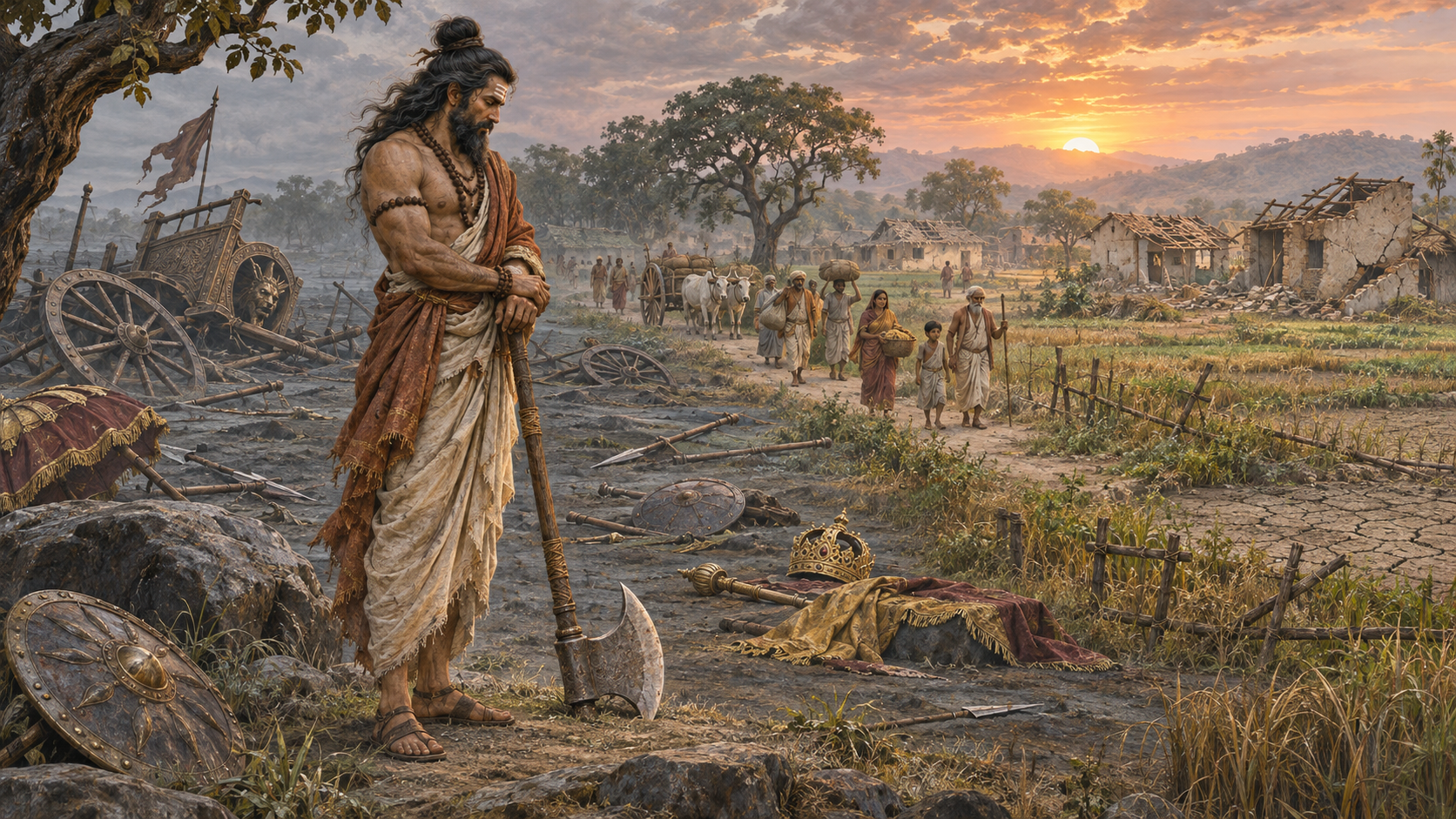
Parashurama represents a severe truth: rank does not place anyone above dharma. Warrior authority exists to protect an ordered life. When it becomes an instrument of oppression, its title cannot make its conduct righteous. Power that has betrayed its purpose may have to be checked by power.
This is why reducing Parashurama to anger misses his significance. His force is directed against the corruption of a function. The problem is not simply that particular rulers are unpleasant. The protective role itself has been inverted: those charged with restraining disorder have become agents of it.
Yet punitive action has an inherent stopping problem. It can defeat an offender, break an abusive concentration of power, and make the cost of transgression unmistakable. It cannot, by destruction alone, teach a future ruler how to govern. Removing unworthy holders of an office does not automatically restore the moral discipline of the office.
This is the limit you should notice in Parashurama’s mode of correction. An emergency response can clear space for order, but it cannot become the permanent form of order. If correction must be repeated without producing a self-regulating authority, it remains trapped in reaction.
That distinction matters whenever anger presents itself as dharmic. Before admiring the severity of a response, ask three concrete questions:
- What precise abuse is being stopped?
- What principle limits the person doing the stopping?
- What rightful arrangement is supposed to exist after the confrontation ends?
If the first question has an answer but the other two do not, you have a theory of punishment, not yet a theory of dharma. An enemy has been named, but neither self-restraint nor restoration has been secured.
Rama restores authority by placing it under discipline
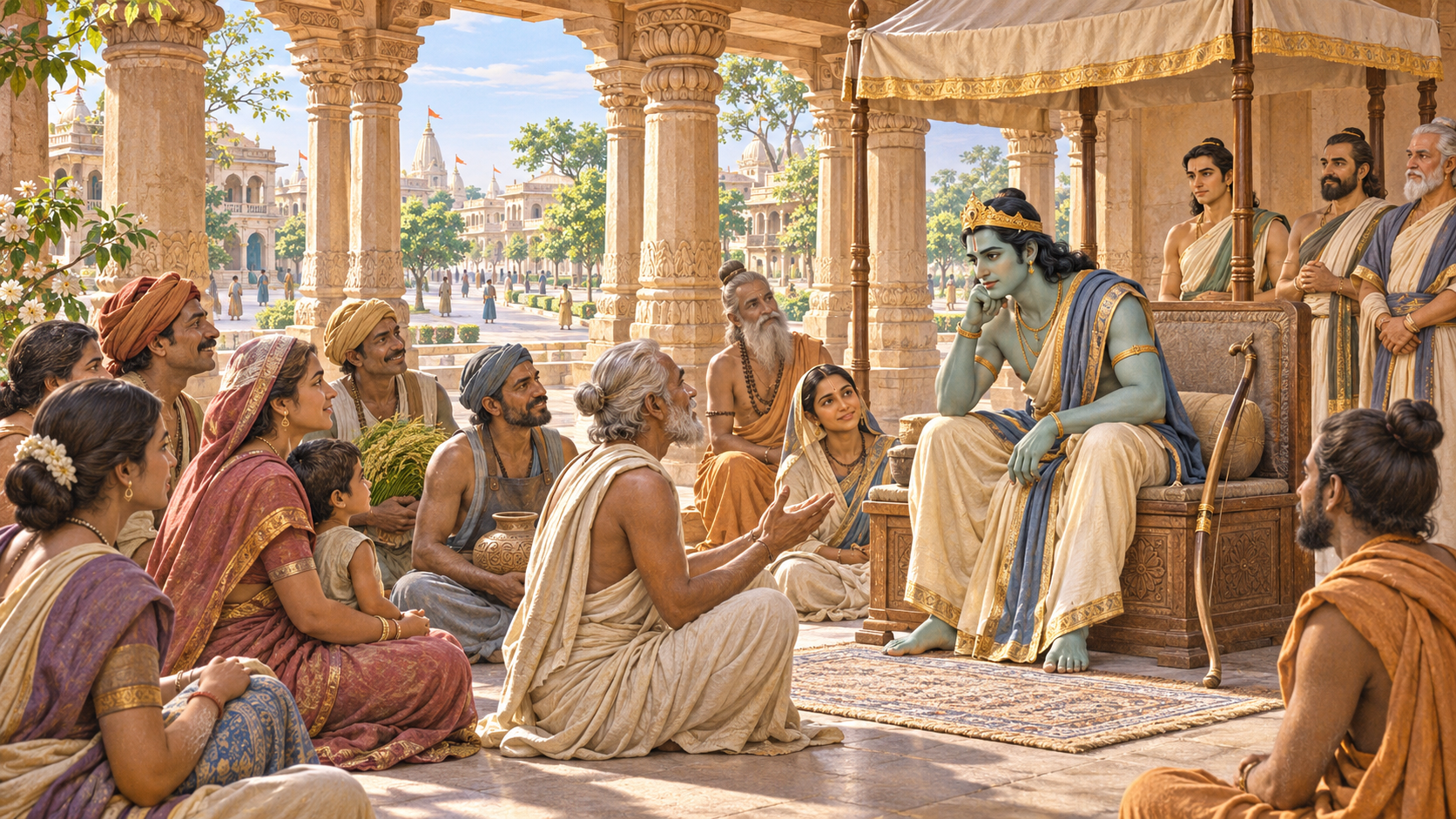
Rama supplies the constructive half of the restoration. His answer to corrupted warrior power is not the disappearance of warrior power. It is warrior power governed from within by obligation, restraint, and fidelity to dharma.
This is a more demanding correction than simply replacing a bad ruler with a strong one. A strong person can defeat opponents and still remain ruled by appetite, pride, fear, or resentment. Dharmic authority requires the victor to accept limits even when no stronger rival can impose them.
Rama therefore corrects the condition exposed by Parashurama at its root. The failure of the warrior class was not that it possessed force. Its failure was that force had become detached from duty. Rama reunites capacity with responsibility. Authority becomes legitimate because the holder treats it as a trust rather than a private possession.
The movement from Parashurama to Rama can be stated in three shifts:
- From removing the unworthy to forming the worthy: punishment clears the field; disciplined character makes rightful rule possible.
- From exceptional intervention to sustainable duty: a crisis may require a rupture, but ordinary life needs offices that function without permanent crisis.
- From power over others to rule over oneself: the decisive restraint is not merely what an opponent can impose, but what dharma requires the powerful person to impose upon himself.
This is also why the encounter should not be flattened into a contest over which avatara is more divine. The theological value lies in the succession of functions. One mode exposes and interrupts the corruption of authority. The other shows authority taking a form that no longer requires endless external correction.
Calling this a rectification does not require saying that Parashurama is simply evil or that his intervention had no place. It means that punitive power is incomplete when treated as a final social principle. Rama does not erase the need to resist adharma. He demonstrates the discipline necessary after resistance succeeds.
How to use this distinction without claiming divine licence
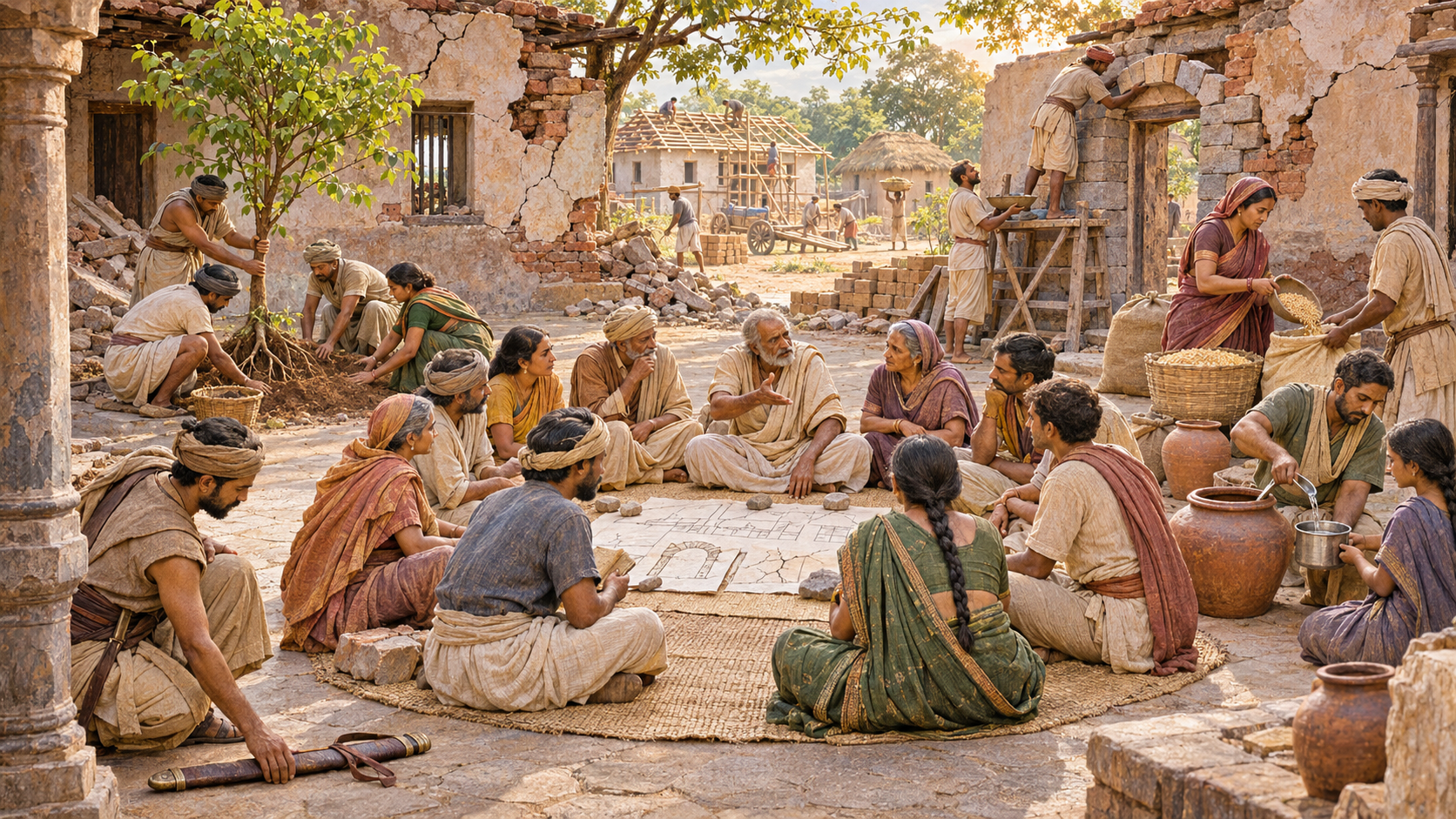
Avataric narratives are not blank authorisations for an individual, faction, or state to imitate whichever dramatic act suits its anger. An avatara acts with a cosmic purpose and an exact relation to dharma. Ordinary people must begin with their actual duties, limited knowledge, and accountability to others.
Use the following test when you encounter a demand for forceful correction in family life, community leadership, religious institutions, or politics:
- Name the role. Ask what duty the actor genuinely holds. Moral conviction does not grant every person every authority.
- Name the violation. Identify the conduct being opposed, not merely the identity of an opponent. Dharma judges acts and uses of power; resentment prefers permanent enemies.
- Name the boundary. State what the corrective actor may not do, even in pursuit of a rightful end. A response without a boundary can reproduce the same unaccountable power it condemns.
- Name the stopping point. Decide what would count as the wrong being corrected. Endless retaliation is not a restoration plan.
- Name the order that follows. Explain who will protect the vulnerable, administer responsibility, resolve disputes, and remain accountable when the emergency ends.
This test prevents three common misreadings. The first makes Parashurama wholly bad and Rama wholly good, losing the necessity of confronting entrenched adharma. The second glorifies Parashurama as more authentic because severity looks uncompromising, losing the harder discipline of constructive rule. The third invokes avatara language to excuse personal aggression, losing the difference between divine restoration and self-appointed vengeance.
The same test sharpens political judgement. Do not evaluate a movement only by the injustice it denounces or the enemies it promises to defeat. Examine the restraints it accepts and the order it is capable of building. A movement that can describe destruction in detail but cannot describe accountable authority remains at the first stage of repair.
For personal practice, the lesson is equally exact. When anger arises in defence of something sacred, do not ask only whether the anger has a valid object. Ask whether your response remains answerable to your role, whether it is proportionate to the wrong, and whether it moves the situation toward a durable good. Righteous purpose does not make every instrument righteous.
The mature reading therefore holds both avataras together. Parashurama prevents dharma from becoming passive before abusive power. Rama prevents resistance to abusive power from becoming a permanent culture of punishment. The transition from one to the other is the transition from breaking domination to making authority worthy of trust.
Key takeaways
- Parashurama and Rama address the same broad corruption of warrior power through different avataric functions.
- Parashurama shows that inherited rank cannot protect conduct that has turned against dharma.
- Punishment can stop abuse, but it cannot by itself produce disciplined and legitimate authority.
- Rama completes the restoration by placing warrior power under duty, restraint, and self-government.
- The practical test of a supposedly dharmic correction is not only what it opposes, but what restrains it and what stable order it leaves behind.
When you next read the encounter between Rama and Parashurama, follow the transfer of responsibility rather than searching for a winner. Then carry the same question into public and personal life: after the wrong is stopped, who will embody the discipline needed to keep it from returning?
References

Leave a Reply
You must be logged in to post a comment.