
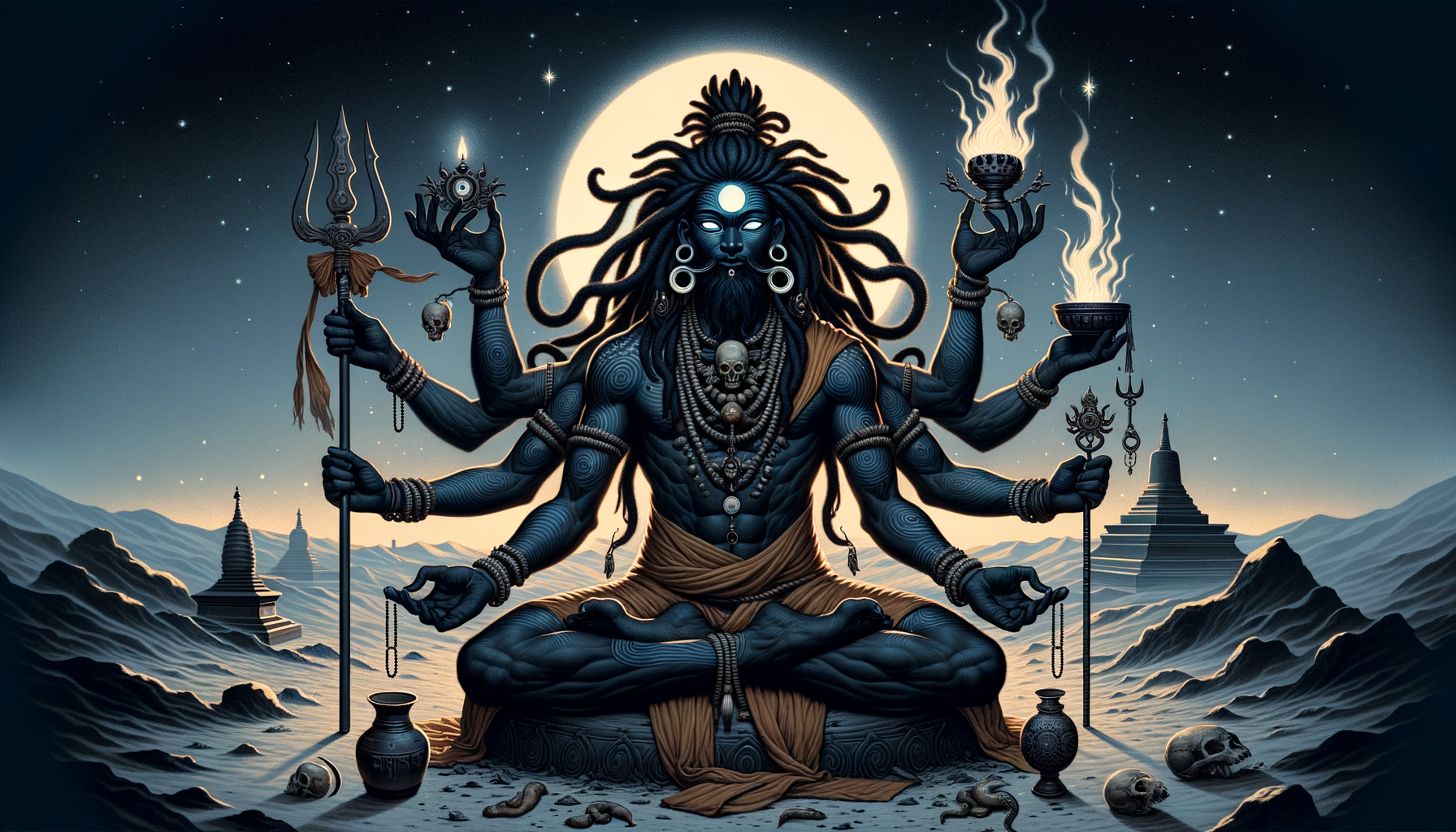
Mahakala is revered as one of the most formidable manifestations of Shiva, embodying time’s inexorable advance and the cosmic dissolution that renews creation. The very name conveys layered meaning: ‘Maha’ signifies great or supreme, while ‘Kala’ denotes timethus Mahakala is the Great Time, the all-consuming principle before which every form must yield. Within the Shaiva tradition and across the broader dharmic world, Mahakala’s murti presents a powerful visual theology that unites metaphysics, ritual practice, and spiritual discipline.
In classical iconography, Mahakala’s complexion appears black or blue-black, absorbing all light like the night sky at its most profound. A fierce visage, blazing third eye, and matted locks suggest the raw, purifying energy of destruction that precedes renewal. Serpents, a garland of skulls, and the tiger skin convey fearlessness, mastery over primal forces, and sovereignty beyond death. Variations of the murti show two, four, or multiple arms holding the trishula (trident), damaru (drum), kapala (skull cup), khatvanga (staff), and sometimes a choppereach symbol articulating the cutting of ignorance, the beat of cosmic rhythm, the transformation of mortality, and the support of ascetic power.
Mahakala is often depicted in cremation-ground settings, encircled by a ring of flame, or standing in a dynamic warrior stance. The cremation ground does not merely startle; it trains the gaze to contemplate impermanence. When Mahakala stands or sits upon a prostrate figure, the symbol points to the subjugation of ego and the transmutation of fear. In this visual grammar, awe and assurance are taught togethertime is devourer, yet Shiva as Mahakala is also the transcendence beyond time.
Philosophically, Mahakala’s murti communicates two simultaneous insights. First, kala as time pervades all phenomena; what arises must pass. Second, Shiva as Mahakala abides as the timeless ground in which arising and passing occur. The icon thus becomes a contemplative map: facing the fierce face of reality enables steadfastness, detachment from clinging, and a deeper intimacy with life as it flows.
Ritually, devotees honor Mahakala with bilva leaves, incense, lamps, and mantras such as “Om Mahakalaya Namah,” particularly on nocturnal observances like Maha Shivaratri. Temples such as the famed Mahakaleshwar in Ujjain sustain the living tradition of this worship, where rhythmic bells and conch blasts echo the damaru’s primordial beat. The murti, when approached with reverence, becomes a practical guide to courage, clarity, and the acceptance of change.
Mahakala’s iconographic vocabulary also resonates across dharmic traditions in ways that strengthen interfaith understanding. In Vajrayana Buddhism, for example, Mahakala appears as a dharmapalaprotector of the pathsharing the fierce compassion and boundary-dissolving symbolism that disciplines the mind. In Sikh tradition, the affirmation of Akal (the Timeless) offers a cognate insight: what is timeless grounds ethical action amid time-bound change. Such convergences cultivate mutual respect and deepen appreciation for the shared quest to face impermanence with wisdom.
For practitioners and observers alike, the emotional register of Mahakala’s murti often begins with awe and matures into steadiness. The fierce countenance becomes a mirror: fear softens into vigilance, agitation into disciplined effort, and despair into trust in the larger rhythm of dissolution and renewal. The icon’s heat (tapas) is not punitive; it is cleansingburning what obstructs clear seeing.
Art historically, regional schools adapt Mahakala’s features while preserving core symbols. South Asian bronzes may emphasize dynamic posture and flame halos; Himalayan paintings may elaborate protective gestures and ritual implements; temple sculpture highlights the vitality of stance and the tactile weight of ornaments. These variations reinforce a unifying principle: the murti is a teaching in stone, metal, or pigment, crafted to train perception as much as to inspire devotion.
Ethically, Mahakala’s symbolism supports a life of responsibility grounded in realism. Recognizing that time consumes all, communities can prioritize what endurestruthfulness, compassion, and serviceover fleeting gains. In this way, the iconography informs both inner cultivation and outer conduct, aligning personal practice with social harmony.
Viewed through this integrated lens, Mahakala’s idol form is both map and mirroran invitation to meet time without fear, to embrace change without confusion, and to realize the stillness that outlasts every cycle. The murti’s fierce grace teaches that dissolution is not negation but transformation, an opening to wisdom shared across Hinduism, Buddhism, Jainism, and Sikhism: unity in the face of impermanence, and dignity before the Great Time that moves all things.
Inspired by this post on Hindu Blog.
