
If someone has told you that your birth chart contains Mahabhagya Yoga, do not stop at the auspicious name. You can test the claim directly by checking the birth period and the signs occupied by the Lagna, Surya, and Chandra.
The test is simple, but it is strict. All of its conditions must be satisfied at the same time. Once you have verified that, the more important question is how much weight the yoga deserves within the rest of your horoscope.
The exact conditions for Mahabhagya Yoga
In Jyotisha, Mahabhagya Yoga is regarded as a rare planetary combination associated with wealth, happiness, and success. Here, the word yoga means a defined astrological combination, not a physical or meditative practice.
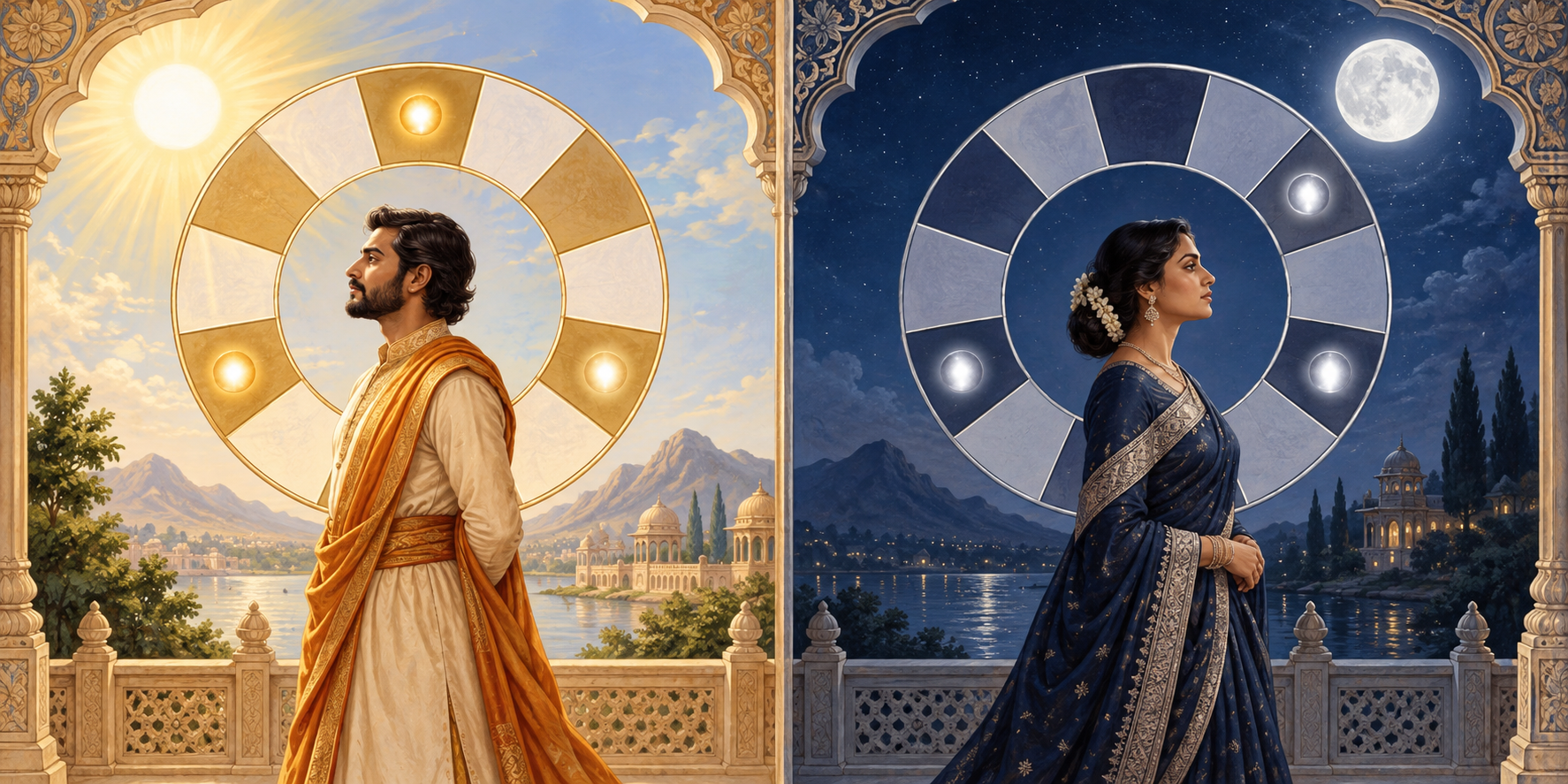
The classical rule uses four pieces of information: whether the native is male or female, whether the birth occurred during the day or night, the Lagna or rising sign, and the signs occupied by the Sun and Moon.
| Traditional classification | Required birth period | Required signs for Lagna, Sun, and Moon |
|---|---|---|
| Male native | Day birth | All three must be in odd-numbered signs |
| Female native | Night birth | All three must be in even-numbered signs |
The odd-numbered signs are Mesha (Aries), Mithuna (Gemini), Simha (Leo), Tula (Libra), Dhanu (Sagittarius), and Kumbha (Aquarius). The even-numbered signs are Vrishabha (Taurus), Karka (Cancer), Kanya (Virgo), Vrischika (Scorpio), Makara (Capricorn), and Meena (Pisces).
The three chart factors do not have to occupy the same sign. For a daytime male birth, for example, the Lagna could be in Mesha, the Sun in Mithuna, and the Moon in Kumbha. The parity requirement is satisfied because all three signs are odd-numbered. If even one factor occupies an even-numbered sign, the full yoga is absent under the strict rule.
Day and night should be determined from the actual sunrise and sunset at the birthplace, not from a casual impression of what counts as morning or evening. A birth close to sunrise or sunset needs particular care because the civil clock alone may not settle the classification.
The traditional formulation is explicitly sex-specific and binary. If a contemporary astrologer adapts that rule for gender identity or another interpretive framework, ask the astrologer to distinguish the adaptation from the classical test. Otherwise, two people may use the same name while applying different rules.
How to verify the yoga in your own chart
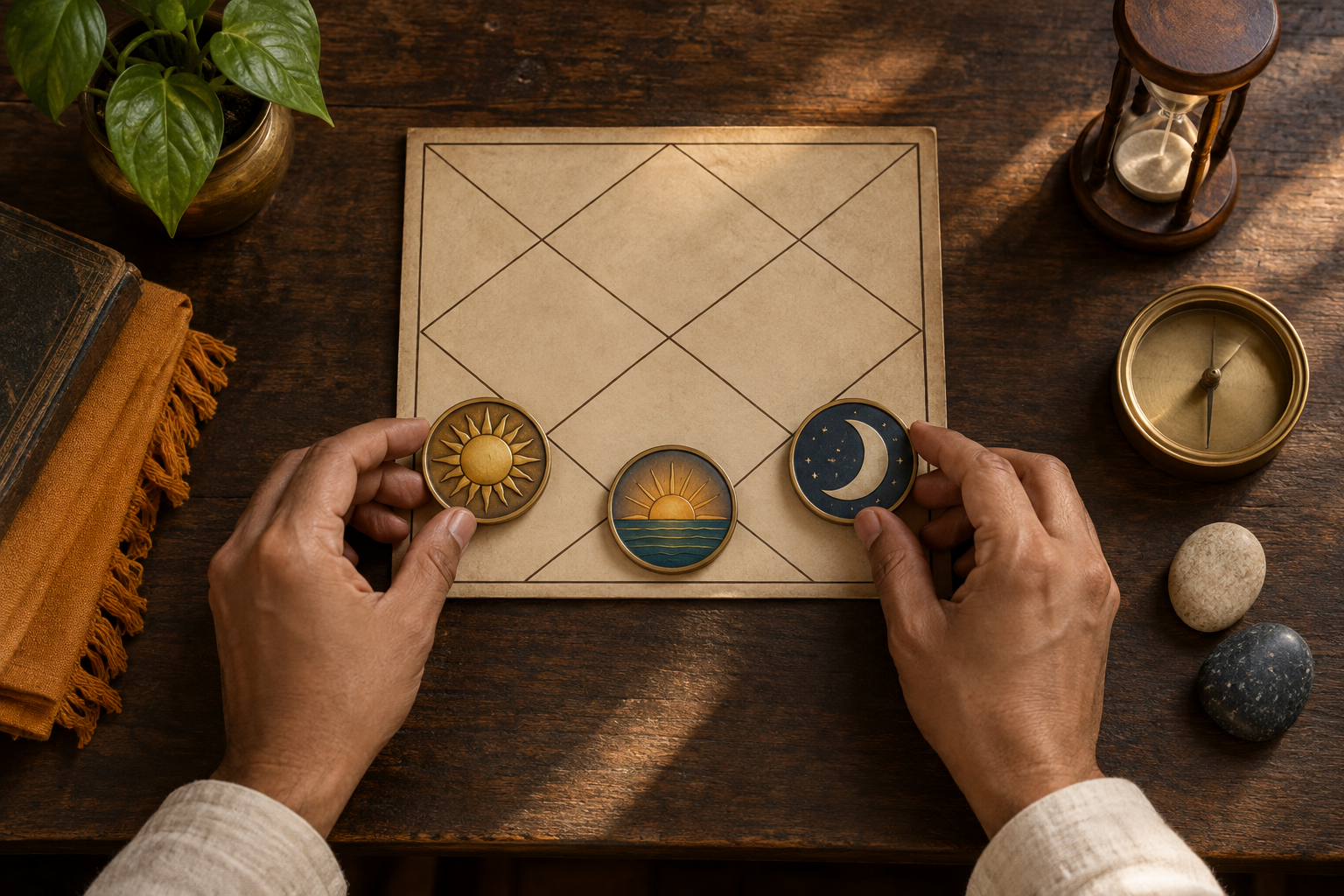
You do not need to accept a software badge or a one-line horoscope report. Use the following audit and record each answer.
- Confirm the birth data. Use the most reliable date, recorded time, and birthplace available. The birthplace is needed to calculate both the Lagna and local sunrise or sunset.
- Cast a Vedic birth chart. Record the sidereal zodiac and ayanamsha setting used. A result near a sign boundary can depend on these calculation settings.
- Write down three signs. Identify the Lagna, the Sun sign, and the Moon sign. Do not substitute the Moon sign alone for the complete test.
- Establish the birth period. Compare the recorded birth time with local sunrise and sunset at the birthplace.
- Check the appropriate parity. For the traditional male rule, confirm a day birth and three odd signs. For the traditional female rule, confirm a night birth and three even signs.
- Recalculate any boundary case. Verify a birth close to sunrise, sunset, an Ascendant change, or a planetary sign change before declaring the yoga present or absent.
The Lagna deserves the closest attention because it depends strongly on birth time and location. If the recorded time is approximate, a claimed Mahabhagya Yoga may be less secure than it first appears. Ask for the actual calculated Ascendant rather than relying on a remembered Sun sign or Moon sign.
A useful written check contains nine fields: birth date, birth time, birthplace, local sunrise, local sunset, Lagna sign, Sun sign, Moon sign, and the parity result. That turns a vague claim into one you or another astrologer can reproduce.
What the yoga promises, and what it cannot guarantee
Mahabhagya means great fortune. Its traditional promise concerns favorable potential for prosperity, happiness, and success. That promise should be read as a predisposition within the horoscope, not as a guaranteed bank balance, profession, social position, or uninterrupted life of ease.
A yoga tells you that a particular pattern exists. It does not cancel everything else in the chart. The condition of the Lagna, Sun, and Moon still matters, as do the houses they occupy and rule, their associations with other grahas, and the planetary periods through which the native is living.
After verifying the yoga, ask an astrologer four concrete questions:
- How strong are the Lagna, Sun, and Moon in this specific horoscope?
- Which areas of life do their house positions and lordships connect to the yoga?
- Are there other combinations that support, redirect, or obstruct its promised results?
- During which dashas or sub-periods might the relevant grahas become more prominent?
A competent reading should answer those questions from visible chart factors. Repeating that you are fortunate because the yoga has an impressive name is not a complete interpretation.
Do not use Mahabhagya Yoga by itself to justify an investment, debt, resignation, or other consequential financial decision. Jyotisha may inform your reflection, but it does not remove ordinary risk or replace qualified financial advice. An auspicious combination is not immunity from poor timing, weak planning, or avoidable loss.
Where Mahabhagya Yoga readings commonly go wrong
Counting a partial match as the complete yoga
Two qualifying placements are not enough. A daytime male chart with an odd Lagna and odd Sun but an even Moon does not meet the full condition. Neither does a female night birth with an even Lagna and Moon but an odd Sun. Record all three placements before reaching a conclusion.
Confusing sign numbers with planetary degrees
Odd and even refer to the signs’ order in the zodiac, not to whether a planet occupies an odd or even degree. A Sun at an even-numbered degree of Mesha is still in an odd-numbered sign. Check the sign first; the degree does not determine parity for this yoga.
Ignoring the day-or-night requirement
Correct sign parity without the required birth period is not the same combination. A male native with all three factors in odd signs but born at night does not satisfy the strict rule. The same applies to a female native with three even signs who was born during the day.
Trusting an automated label without checking its method
Astrology programs may use different calculation settings or omit the day-night test. Some may also apply a modified gender rule. If an application reports Mahabhagya Yoga, inspect the three placements and its calculation settings before treating the label as established.
Turning auspicious potential into a prediction of certainty
The presence of the yoga answers one question: whether the defined pattern exists. It does not answer every question about livelihood, relationships, health, reputation, or spiritual development. Those require a whole-chart judgement rather than an isolated combination.
Quick answers before you rely on the result
Must the Lagna, Sun, and Moon be in one sign?
No. They may occupy three different signs. What matters is that all three belong to the required odd or even group and that the day-or-night condition is also fulfilled.
Does an approximate birth time matter?
Yes. An uncertain time can change the calculated Lagna, and a birth near sunrise or sunset can also affect whether the chart qualifies as a day or night birth. Treat the result as provisional until those points are checked.
Is a near match still Mahabhagya Yoga?
Not under the strict classical test. A near match may still contain individually favorable placements, but it should not be relabelled as the complete yoga. Interpret what is actually present.
Is the yoga enough for a positive life prediction?
No. It is one auspicious indicator. Its practical expression depends on the wider horoscope and the periods in which relevant grahas operate.
Before accepting any Mahabhagya Yoga reading, write down the birth period and the three qualifying signs. If the astrologer can show you those four facts and then connect them coherently to the rest of the chart, you have a reading you can examine rather than a flattering label you are expected to trust.
References

Leave a Reply
You must be logged in to post a comment.