
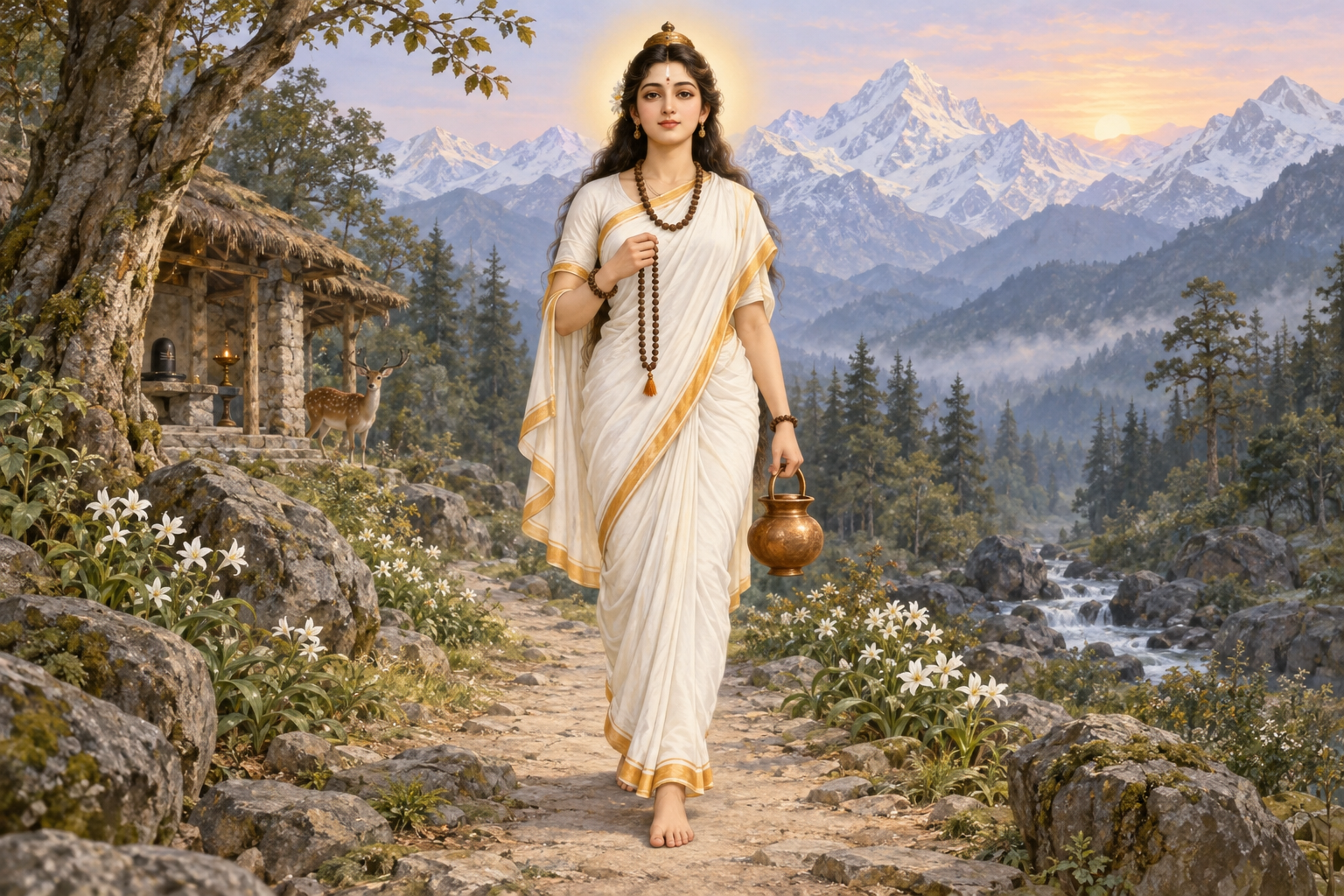
If Navratri’s second day has arrived and you do not have an elaborate family paddhati to follow, you can still worship Maa Brahmacharini with clarity and reverence. The heart of the observance is not ritual display. It is a steady sankalpa: one worthy discipline that you are prepared to carry beyond the time spent at the altar.
Brahmacharini is the second form of the Navadurga and the Devi worshipped on Navratri’s second day. Her worship gives you a practical question to answer: where does your life need less impulse and more patient, purposeful effort?
Let Brahmacharini shape your sankalpa
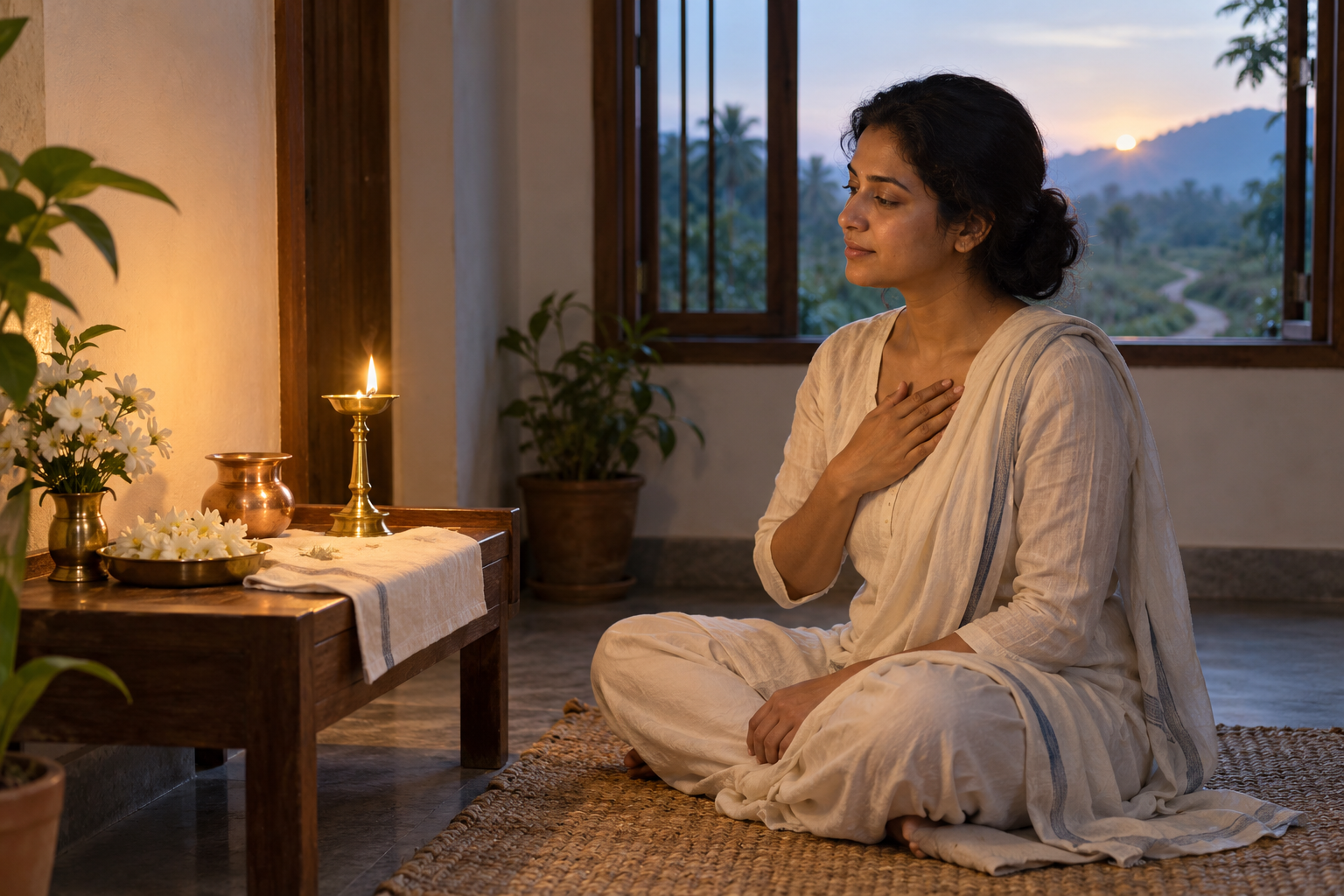
The name Brahmacharini points toward disciplined conduct directed to the highest truth. It should not be reduced to a narrow discussion of marital status or physical restraint. In the setting of sadhana, it asks for the intelligent conservation of attention, energy and intention.
Choose one discipline for the remainder of Navratri. Make it specific enough that you will know whether you kept it. You might set a fixed daily time for prayer, refrain from answering anger with anger, complete a neglected period of study, or put away a recurring distraction during your spiritual practice. Avoid making several dramatic promises at once. A modest niyama that is kept is more useful than an impressive vow abandoned the next morning.
One Vedic-astrological devotional interpretation associates Brahmacharini with Mars, or Mangal. Within that framework, devotees seek relief from aggression and impulsiveness as well as greater focus, balance and willpower. Treat those qualities as directions for sadhana, not as automatic results promised by a ritual. If anger is your concern, connect the puja to a visible discipline such as taking one deliberate breath before replying. Worship becomes transformative when the prayer changes the next action.
Confirm Dwitiya locally before fixing your puja time
For the 2026 calendar, Sharad Navratri’s second day falls on 12 October, while the second day of Chaitra Navratri fell on 20 March. These dates tell you the observance day, but they do not create one universal clock time for every location.
If you need a precise muhurta, check a panchang calculated for your city or follow the schedule of the temple where you worship. Tithi boundaries can cross civil dates, and a timetable prepared for another place may not match yours. If your household has an established custom, preserve that continuity rather than replacing it casually with an isolated online timetable.
You may also encounter a temple observing a different manifestation of Devi on the same day. At Vijayawada’s Kanaka Durga Temple, for example, the second-day alankaram on 12 October 2026 is Sri Gayatri Devi. That does not invalidate household worship of Brahmacharini. A temple’s alankaram sequence and the widely followed Navadurga sequence can operate within their respective traditions. Learn which paddhati you are following before treating a difference as a contradiction.
A simple Brahmacharini puja you can perform at home
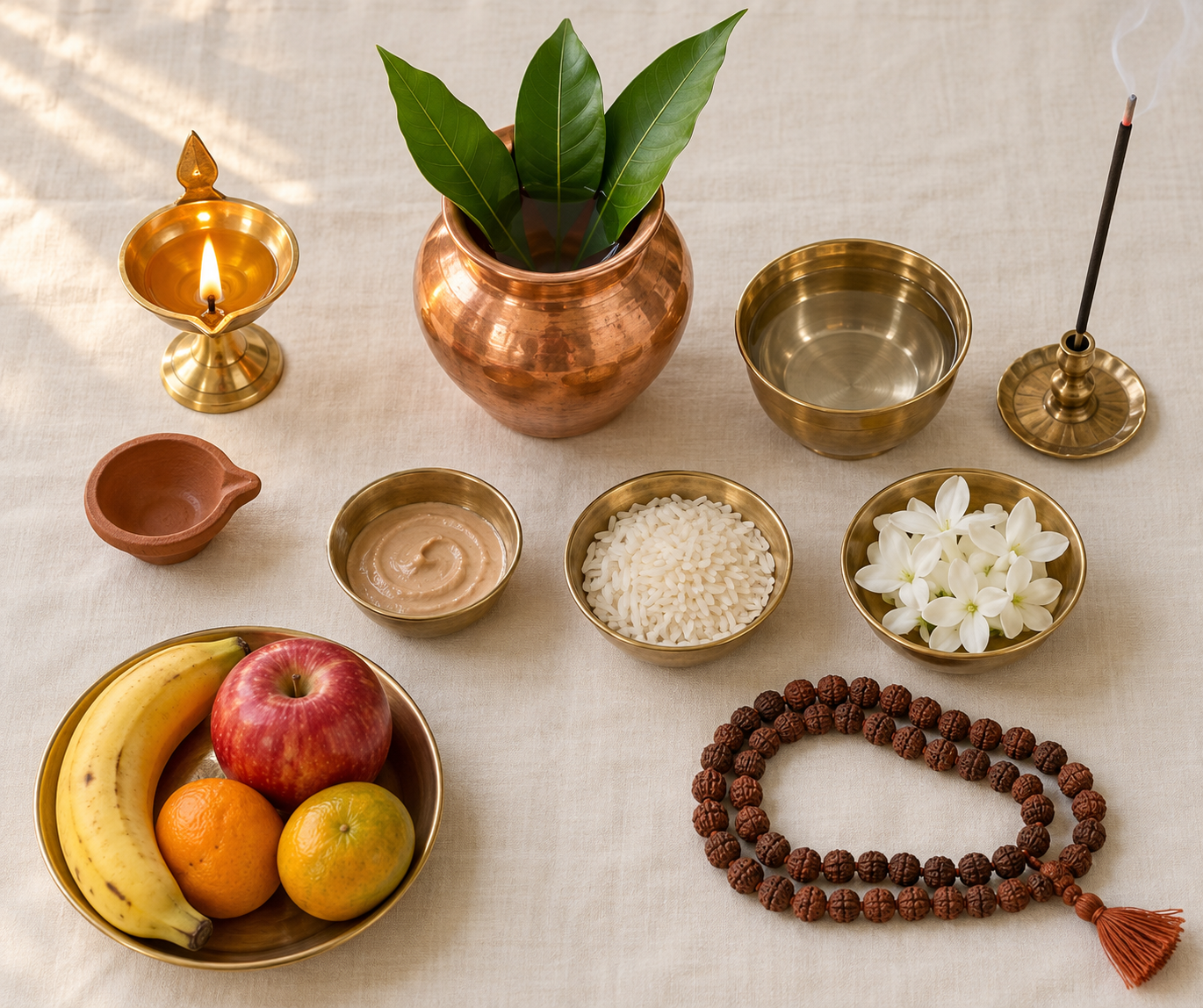
If your guru, temple or family has taught you a procedure, follow it. The sequence below is a simple framework for someone who wants to observe the day sincerely without pretending that every regional custom is universal.
- Prepare yourself and the place. Bathe, or at least wash your hands and face, wear clean clothes and clear the worship area. The preparation marks a transition from ordinary activity to deliberate attention.
- Arrange only what you can offer respectfully. Place an image or murti of Devi, clean water, a flower, a lamp if it can be used safely, and a simple food offering according to your household custom. More items do not make the sankalpa stronger.
- Become still before beginning. Sit quietly for a few breaths. Let the mind arrive at the altar instead of starting the words while your attention remains elsewhere.
- State your sankalpa plainly. Name the observance and the one discipline you are undertaking. Keep it concrete: what you will do, when you will do it and what temptation you intend to restrain.
- Invoke and honour Maa Brahmacharini. Light the lamp if you use one, offer water and the flower, and address Devi with reverence. Move slowly enough to know what you are doing.
- Recite the Brahmacharini verse. Use the pronunciation taught in your tradition. If Sanskrit is unfamiliar, recite carefully rather than quickly, and follow it with the name of Maa Brahmacharini in a language in which you can pray sincerely.
- Sit in silence. After the recitation, bring your chosen discipline to mind. Notice the situation in which you are most likely to break it, then decide what you will do when that moment appears.
- Close the worship. Offer pranam. Perform aarti if it belongs to your practice, distribute the offering as prasad, and carry the sankalpa into the rest of the day.
This framework deliberately avoids prescribing a compulsory colour, flower, food or repetition count. Such details can be meaningful within a regional or family tradition, but they should not be presented as universal when they are not. Honour the custom you actually inherit. If you do not inherit one, begin simply and learn from a trusted temple or teacher.
The same principle applies to fasting. Do not improvise a severe fast merely to make the observance feel more serious. Follow your established practice and your health needs. Brahmacharini’s discipline is purposeful self-governance, not careless punishment of the body.
Use the mantra to gather the mind
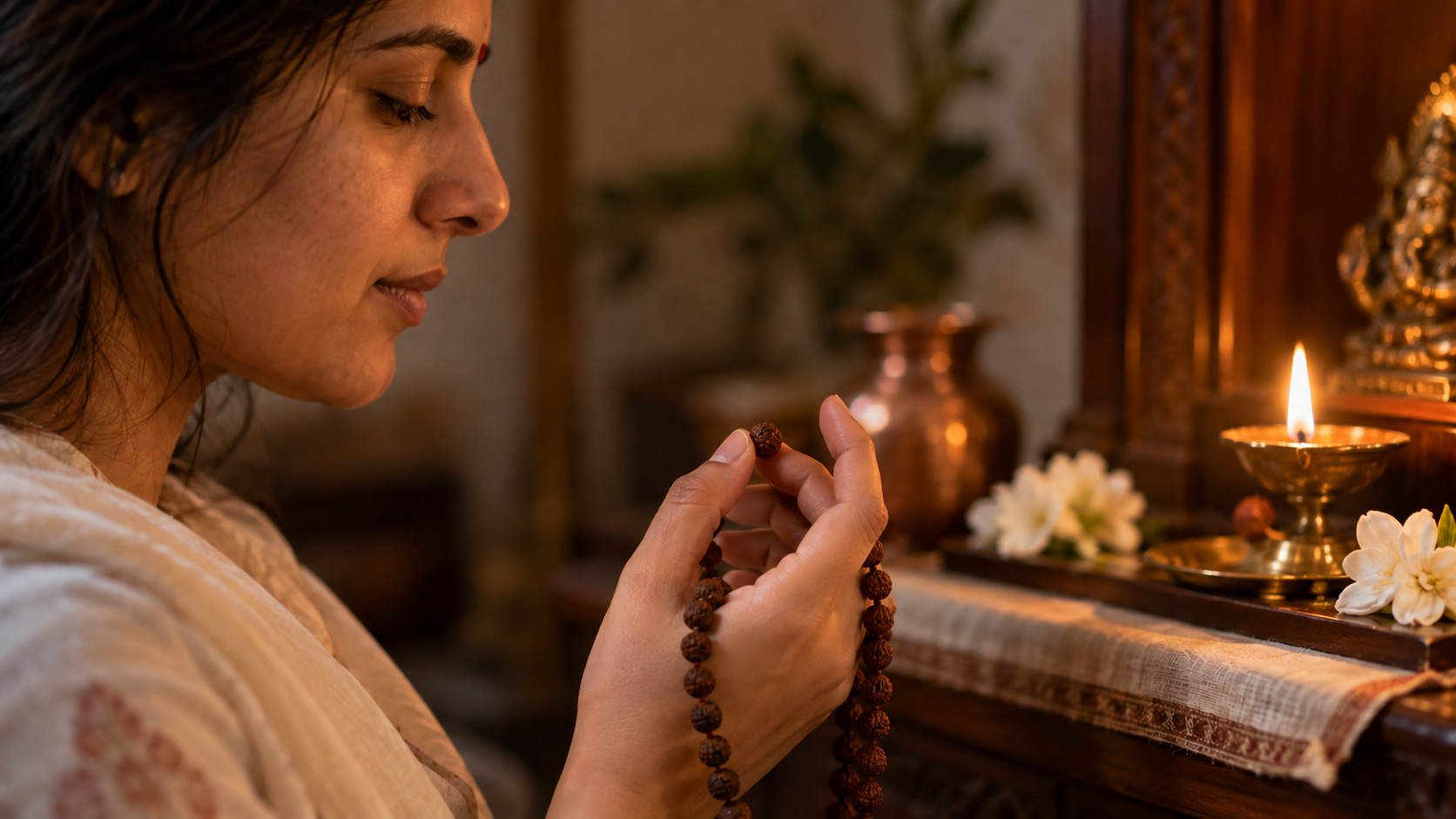
A traditional Brahmacharini mantra used for Navratri worship is:
Dadhana kara padmabhyam akshamala kamandalu, Devi prasidatu mayi Brahmacharinyanuttama.
Brahmacharini mantra
In plain sense, the verse asks the incomparable Brahmacharini, bearing an akshamala and kamandalu, to be gracious to the devotee. Transliteration and word division can differ, so do not turn a Roman-letter spelling into a test of devotion. Use the form taught by your family or temple when one is available.
Recitation should support attention. Do not race merely to finish a count, and do not select an arbitrary count because it appeared without context. Speak steadily, listen to the words you are saying, and return the mind when it wanders. If you cannot yet recite the full verse confidently, repeat Maa Brahmacharini’s name with concentration and learn the longer form carefully.
After the mantra, remain silent for a moment. Ask where your energy leaks through irritation, distraction or inconsistency. Then link the prayer to one response you can enact that day. This keeps the observance from ending when the lamp is extinguished.
Key takeaways for Navratri’s second day
- Maa Brahmacharini is the second Navadurga and is worshipped on the second day of Navratri.
- For Sharad Navratri 2026, the second-day observance falls on 12 October; use a local panchang or temple schedule for location-specific timing.
- Build the puja around one clear sankalpa rather than an accumulation of offerings or promises.
- A simple sequence of preparation, invocation, offering, mantra, silence and pranam is sufficient when no inherited paddhati is available.
- Follow family and regional customs where they exist; a temple’s different alankaram is not necessarily a contradiction.
- If you approach Brahmacharini through her association with Mangal, convert the symbolism into disciplined conduct rather than expecting an automatic astrological result.
Before the observance, write your sankalpa in one sentence and place it near the altar. When the puja ends, keep that sentence where you will see it at the moment you are most likely to forget it. The second day has done its work when remembrance becomes restraint, and restraint becomes steady action.
References
- Hindu Pad – Astrological Importance of Brahmacharini Pooja
- Hindu Pad – Brahmacharini Mantras: Moola Mantra, Dhyana Sloka, Stotra
- Hindu Pad – 2nd Day Navratri Puja Time: 12 October 2026
- Hindu Pad – 2nd Day Alankaram in Vijayawada Temple Navaratri 2026: Gayatri Devi

Leave a Reply
You must be logged in to post a comment.