
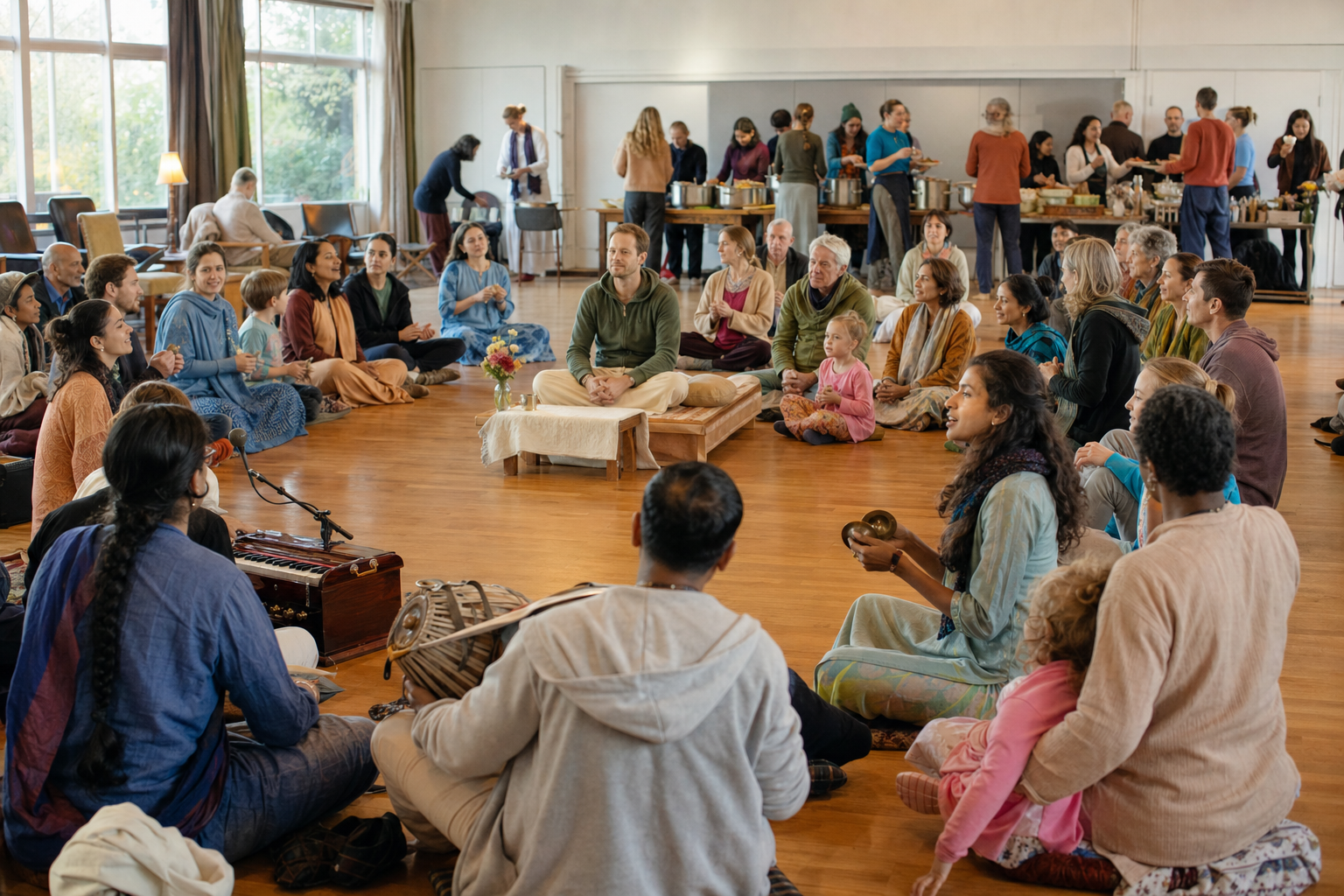
If you help plan a Sunday Feast, a full hall can conceal a teaching failure. Guests may enjoy the kirtana, understand part of the discourse, honor prasadam, and still leave unsure what bhakti-yoga asks them to do on Monday.
The answer is rarely more information. It is a clearer connection between what people hear, what they practice together, and what they can carry into family, work, and civic life. The Sunday Feast becomes effective bhakti-yoga pedagogy when every part of the gathering helps make that connection.
Plan one lesson across hearing, participation, and food

A Sunday Feast is not a lecture, a music session, and a meal sharing the same calendar slot. A. C. Bhaktivedanta Swami Prabhupada established it around the complementary disciplines of śravaṇa, kīrtana, and prasada-sevā: hearing sacred wisdom, chanting the Divine Names, and honoring sanctified food. Each discipline teaches differently, but they should point toward the same devotional truth.
- Śravaṇa gives language and orientation. Through śāstra-kathā, the listener learns how the tradition understands the self, karma, bhakti, and daily dharma.
- Kīrtana turns the listener into a participant. The maha-mantra is not merely discussed as an idea. It is heard, voiced, remembered, and received in association with others.
- Prasada-sevā makes devotion tangible. Food, labor, gratitude, hospitality, and restraint from harm meet in an ordinary human act transformed by offering.
Before planning the program, complete a single sentence: By the end of this Feast, a guest should understand that… If the planning team cannot finish that sentence plainly, the gathering probably carries too many themes.
Choose a throughline grounded in the Bhagavad-gita or Srimad Bhagavatam. It might be the nature of the ātman, the relationship between action and karma, the meaning of devotion, or the conversion of an ordinary duty into seva. Let the discourse explain that theme, let participation give it an experienced form, and let the closing invitation show how it enters the coming week.
Transitions matter because newcomers do not automatically know why the elements belong together. A facilitator can supply the missing bridge in a sentence: We have heard how daily action can be offered; as we serve and honor prasadam, notice how cooking, receiving, eating, and cleaning can also become seva. That sentence prevents the meal from feeling like refreshments after the spiritual program. It identifies the meal as part of the spiritual program.
Build the discourse from tattva to practical purpose
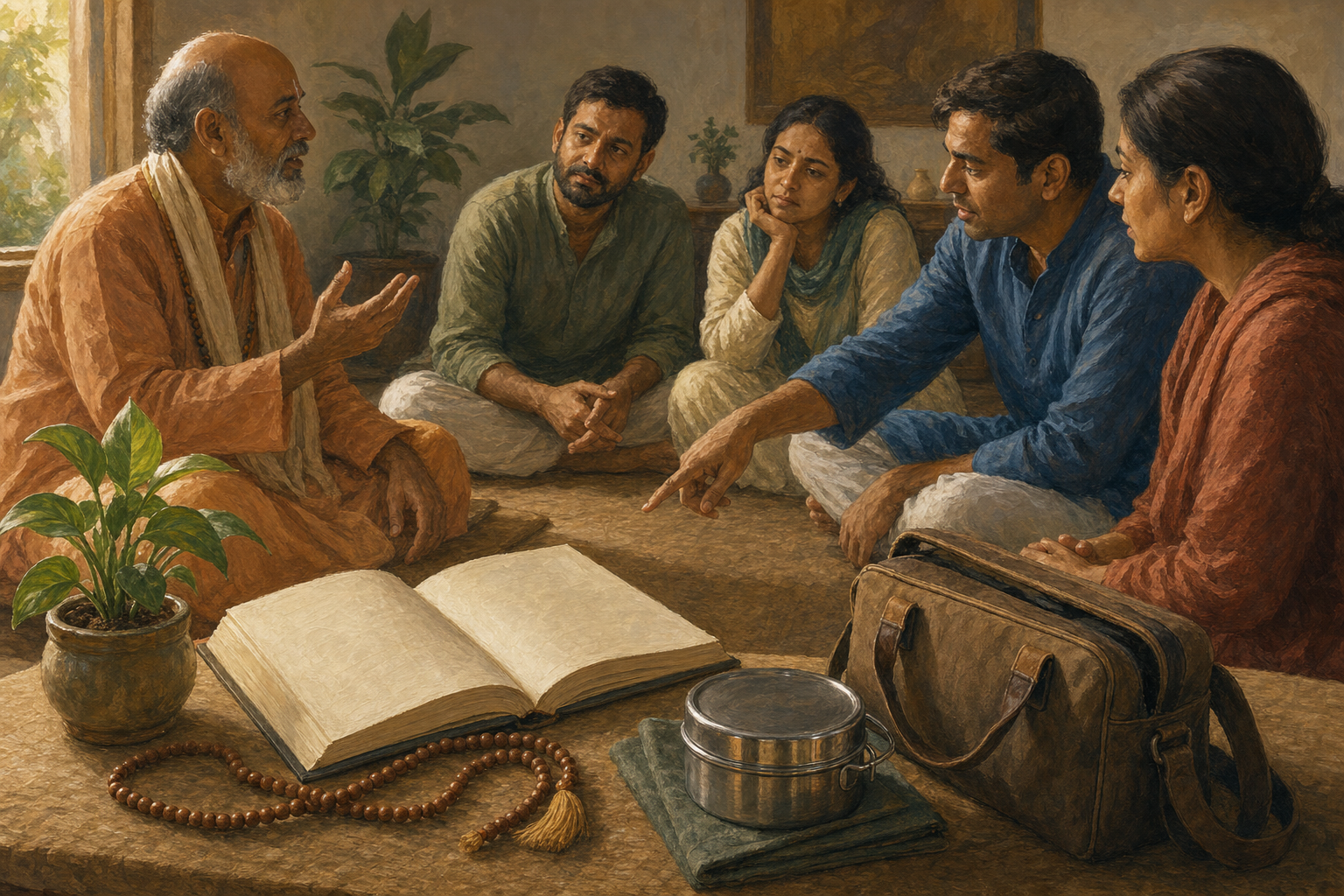
A reliable Sunday Feast discourse moves from tattva, the principle being taught, through dṛṣṭānta, an illustration that makes it intelligible, to prayojana, the purpose and practical consequence. This structure protects the gathering from two common failures: a technically impressive talk that nobody can apply, and a motivational talk whose advice has become detached from śāstra.
Gaudiya Vaishnava exposition begins with śabda-pramāṇa while also engaging pratyakṣa and anumāna. In plain language, revelation provides the governing authority, direct experience helps a person notice what practice does within consciousness, and reasoned inference helps the listener follow the argument. A good teacher uses all three without quietly substituting personal preference for śāstra.
- Begin with invocation. Establish that teaching and hearing are devotional acts, not performances by an expert for an audience.
- Read the selected passage. Keep the actual words of śāstra visible so the listener can distinguish the text from the explanation built around it.
- Define the necessary terms. If you use ātman, karma, bhakti, ahimsa, or seva, explain what the term means in the present teaching. Familiarity with a Sanskrit word is not the same as understanding it.
- State the tattva in plain speech. A newcomer should be able to repeat the central principle without reproducing the entire lecture.
- Use a narrative or analogy as dṛṣṭānta. Make clear what the illustration illuminates, and do not ask it to prove more than it can.
- Move to prayojana. Name the decision, habit, relationship, or act of service that should change if the teaching has been understood.
- Protect time for questions. Inquiry reveals where a definition was unclear, an inference moved too quickly, or a practical consequence needs qualification.
When answering a difficult question, separate the layers. State what the cited passage establishes. Then identify the reasoning that connects it to the question. Finally, describe what a practitioner may examine through disciplined practice. This allows intellectual honesty without weakening devotional conviction.
Accessibility does not require flattening theology. It requires disciplined explanation. Avoid accumulating Sanskrit terms when one precise term would carry the teaching. Avoid allowing an anecdote to replace the text. Avoid giving practical advice without showing the principle that makes it bhakti rather than generic self-improvement.
Turn navadhā-bhakti into a practice for the coming week
Navadhā-bhakti names nine modes of devotional life: śravaṇa, hearing; kīrtana, chanting; smaraṇa, remembering; pāda-sevana, service; arcana, worship; vandana, prayer; dāsya, servitorship; sakhya, friendship with the Divine; and ātma-nivedana, self-surrender. Reciting this list can inform a listener. Helping the listener recognize and practice one of its modes is pedagogy.
Do not present the nine modes as an inventory that every newcomer must immediately master. First show where they are already present. A guest has heard during the discourse, chanted during kīrtana, remembered the Divine Name, received an opportunity for service, and participated in prayer or worship. The unfamiliar system becomes comprehensible when it is connected to what the person has just done.
Then end the teaching with a practice small enough to enter an existing life. The invitation should identify the discipline, its ordinary setting, and the cue that will call it to mind. Useful options include:
- Steady japa: choose a repeatable part of the day and protect it from casual interruption.
- Mindful digital conduct: place remembrance before habitual device use, and notice which digital habits agitate or scatter attention.
- Ethical speech: carry the teaching into the next conversation by refusing needless harshness, gossip, or deception.
- Cooperative seva: take responsibility for a shared duty without making recognition the motive.
- Prayerful remembrance: connect a recurring household or workplace action with vandana or smaraṇa.
A practical invitation could be framed this way: This week I will practice this mode of bhakti in this ordinary setting whenever this cue appears. That formulation is more useful than telling people merely to be more devotional.
The following Feast should make room for reflection. Ask what supported the practice, what displaced it, and what the participant noticed. This is not public scorekeeping. It helps people see abhyāsa, steady practice, as a process of returning rather than a demand for instant perfection.
Householders especially need applications that enter their real duties. The teaching should not imply that family, vocation, or community responsibility is spiritually useful only when escaped. Ask instead how attention, speech, earning, caregiving, cooking, and cooperation can be reoriented toward remembrance and service. Bhakti-yoga then becomes the organizing intention within daily life rather than another activity competing for space within it.
Let prasadam and community complete the curriculum
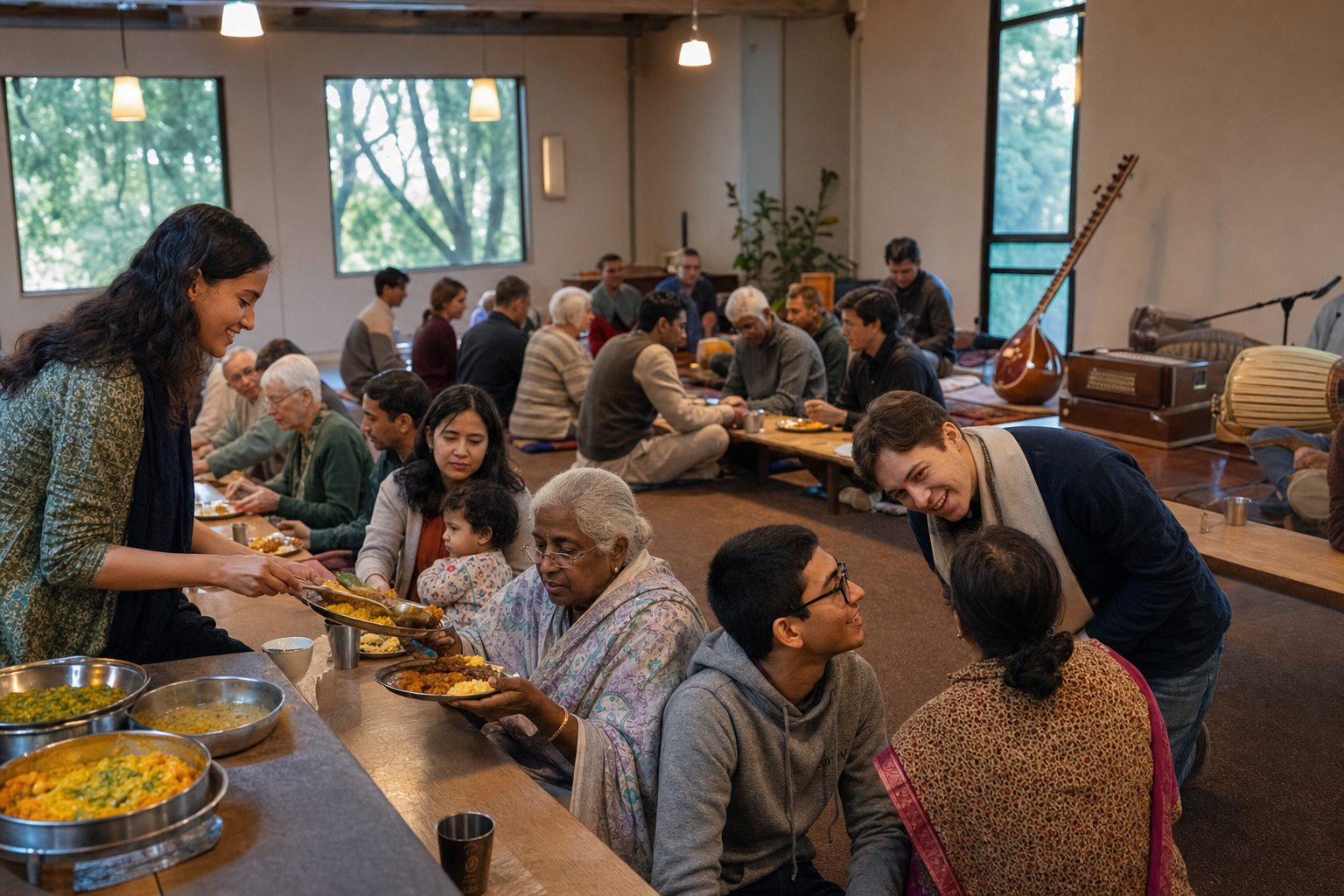
Prasadam is not a reward for sitting through the discourse. The Bhagavad-gita’s patraṁ puṣpaṁ phalaṁ toyaṁ principle joins simple food with devotional offering. In the Feast, a vegetarian meal can teach ahimsa, gratitude, restraint, equality at the table, and service without requiring another abstract lecture.
Make that meaning visible. Briefly explain that prasadam has been prepared and offered in devotion. Treat cooking, serving, receiving, and cleaning as forms of seva. Do not let status determine who is worthy of hospitality, and do not turn the meal into a test of whether a guest already knows the correct vocabulary or customs.
The social arrangement also teaches. Regular satsanga can provide mentorship for younger people, companionship for elders, and a shared moral setting for families. Give younger participants bounded responsibilities they can complete. Make elders accessible as people with knowledge and presence, not merely as spectators. Ensure a newcomer knows whom to approach with a question after the formal discourse ends.
This hospitality can welcome people from other dharmic traditions without pretending that all traditions are doctrinally identical. Buddhist mettā, Jain ahimsa and pratikraman, Sikh kirtan and langar, and Hindu bhakti provide points of contact through compassion, self-discipline, truthfulness, and service. Begin with the shared ethical concern, then explain the distinct Vaishnava practice on its own terms. Unity becomes stronger when it does not require erasure.
Leadership is part of the lesson as well. A facilitator who speaks about humility but dismisses a sincere question teaches dismissal. A community that praises seva but leaves the same people to carry every practical burden teaches hierarchy rather than service. Transparency, empathy, responsibility, steadiness, and compassion must be visible in how the gathering is run.
Use the planning debrief to ask concrete questions. Could a newcomer state the central teaching? Did kīrtana, discourse, and prasadam embody the same throughline? Was a home practice named clearly? Did children, elders, regular practitioners, and guests have a meaningful way to participate? Where the answer is unclear, improve the bridge between elements before adding more content.
Key takeaways
- Plan the Feast around a single scriptural throughline that appears in hearing, participation, service, and hospitality.
- Move from tattva to dṛṣṭānta to prayojana: establish the principle, illuminate it, and show what it changes.
- Distinguish revealed authority, reasoned inference, and direct experience so personal opinion does not masquerade as śāstra.
- Translate navadhā-bhakti into a specific practice that can enter the listener’s coming week.
- Treat prasadam, questions, intergenerational relationships, and the conduct of leaders as parts of the curriculum.
- Welcome dharmic kinship through shared values while preserving the distinct meaning of Vaishnava theology and practice.
At your next planning meeting, place the Feast outline on the table and mark where each element helps a person hear, participate, and carry the teaching home. Repair the missing connections first. A clear transition, an honest answer, a concrete practice, and reverent hospitality can do more pedagogical work than another layer of information.

References
