
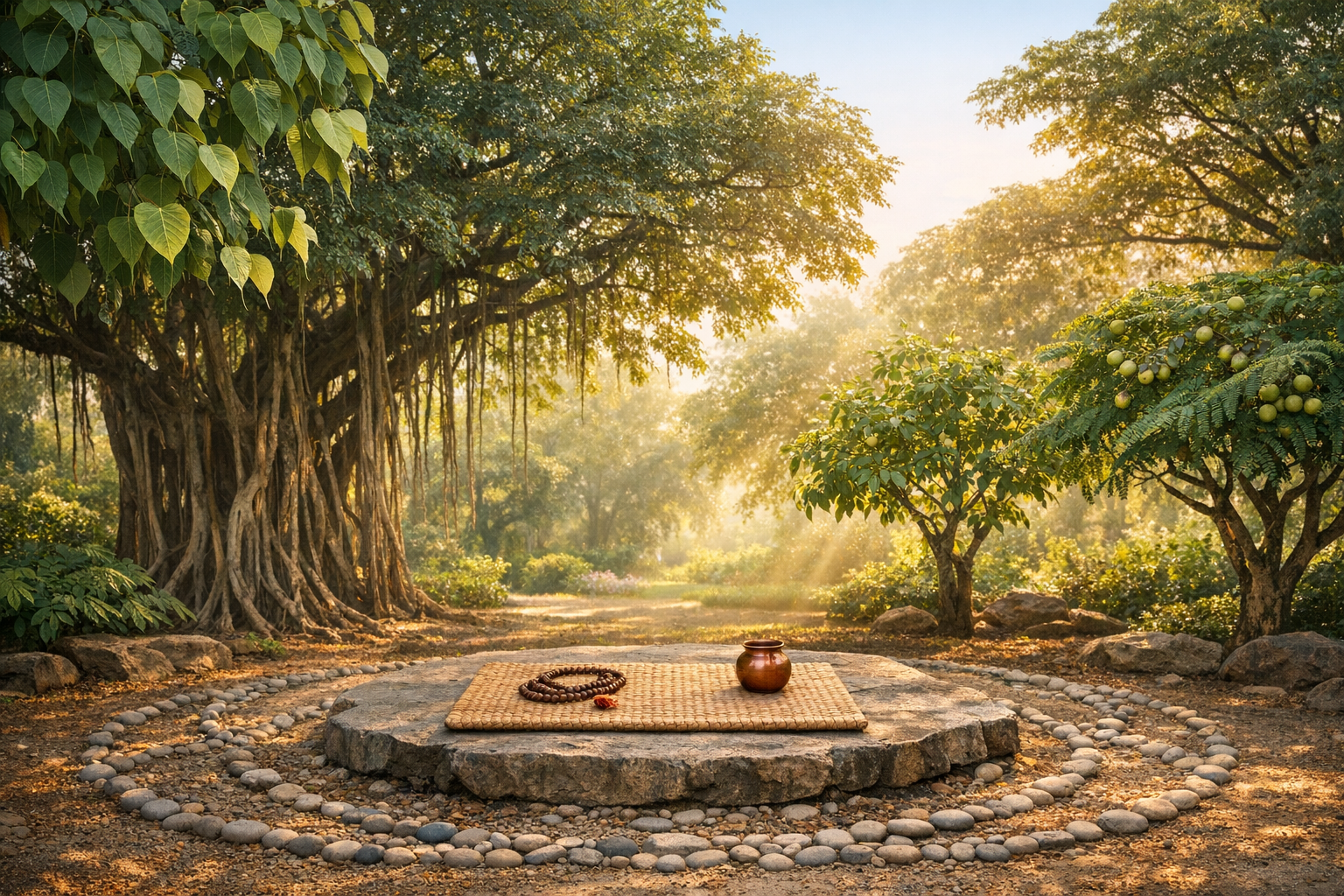
Across the dharmic world of Hinduism, Buddhism, Jainism, and Sikhism, trees have long functioned as living altarssanctuaries where breath, mind, and cosmos attune. Within Tantric practice in particular, several species are chosen deliberately for dhyāna because they shape a distinct energetic field, stabilize attention, and cultivate śānta-bhāva (an inner, peaceful disposition). This essay examines five sacred trees commonly selected by Tantric practitioners for meditation, situating them in scriptural, ecological, and contemplative contexts and highlighting their resonance across Dharmic traditions.
In Tantric manuals and oral lineages, the intentional planting or seeking of a Pañchavatīan auspicious cluster of five sacred treesappears as a recurring motif to support extended sādhanā (spiritual discipline). While enumerations vary regionally, a widely attested grouping includes the Aśvattha (Peepal, Ficus religiosa), Nyagrodha (Banyan, Ficus benghalensis), Bilva (Aegle marmelos), Nimba (Neem, Azadirachta indica), and Āmalakī (Indian gooseberry, Phyllanthus emblica). Together, these trees furnish a contemplative microclimate, reinforce ethical kinship with nature, and offer a bioenergetic matrix conducive to mantra-japa, prāṇāyāma, and interiorization (pratyāhāra).
Tantric selection criteria rest on four intertwined lenses. First, scriptural symbolism: each tree anchors a mythic or ritual association that cues the mind toward sacred presence. Second, ayurvedic energetics: qualities (guṇas) and subtle nutrition (ojas-building or doṣa-calming) that stabilize the body-mind system during seated practice. Third, ecological intelligence: shade, transpiration, leaf shape, root architecture, and under-canopy airflow that together compose a cooling, quiet, and oxygen-rich daytime habitat. Fourth, subtle-body alignment: how the tree’s archetype is used to prime specific psycho-spiritual themes, from groundedness (mūlādhāra) to lucidity (ājñā) and open awareness (sahasrāra).
Aśvattha (Peepal, Ficus religiosa). Venerated across India as the Aśvattha and globally as the Bodhi tree, the Peepal is emblematic of illumination. In the Bhagavad Gītā, the Aśvattha embodies the cosmic axis; in the Buddhist tradition, the Buddha’s awakening unfolds beneath its canopy; in Jain ritual space, it stands as a sign of sacred knowledge. The Peepal’s fluttering, heart-shaped leaves create a distinctive acoustic and visual ambience that calms attention without dulling it. Meditatively, teachers associate Aśvattha practice with sattvaclarity, compassion, and steadinessmaking it well suited for breath awareness (ānāpāna) and mantra-japa that emphasize ājñā–sahasrāra integration. From a scientific standpoint, the Peepal is a C3 plant; its contemplative benefit arises not from nocturnal oxygen emissiona common misconceptionbut from its generous daytime photosynthesis, shade, and microclimatic cooling that together ease physiological load during prolonged stillness.
Nyagrodha (Banyan, Ficus benghalensis). The Banyan’s aerial prop roots and vast crown foster a felt sense of permanence; classical literature repeatedly links it to longevity and protection (as in the Akṣaya Vaṭa). In Jain narratives, the Banyan is associated with kevala-jñāna settings and as an archetype of the teaching pavilion; in broader dharmic iconography, it functions as a cosmic sheltering presence. Tantrically, the Banyan is often chosen for practices aiming at sthiratā (stability) and mūlādhāra support, such as lengthy japa or advanced prāṇāyāma that benefit from a heavy, grounding field. The acoustic dampening under mature Banyans and the slow, diffused light contribute to sensory pratyāhāra, while the tree’s symbolic endurance counters restlessness and fosters perseverance during tapas.
Bilva (Aegle marmelos). With trifoliate leaves offered to Śiva and Śākta deities, the Bilva unites ritual centrality with profound ayurvedic value. Its cooling, astringent properties support a calm nervous system; the fruit and leaves are used traditionally for digestive steadiness and seasonal resilience. In Tantric contexts, the Bilva’s Śaiva association lends itself to practices that refine fiery ascents of kuṇḍalinī into balanced awareness, tempering over-excitation while sustaining depth. The tree’s modest shade and gently scented presence help maintain alertness without strain, enabling practitioners to sustain extended mantra rounds or subtle body visualizations without mental fatigue.
Nimba (Neem, Azadirachta indica). Long invoked for protection and purification, Nimba is central to bhūta-śuddhi (elemental and energetic cleansing) motifs across Śākta and folk traditions and aligns with healing goddesses in several regions. Phytochemically rich (e.g., azadirachtin, nimbin), Neem’s antimicrobial aura and crisp under-canopy feel are often described by practitioners as “cutting through mental fog.” It is selected for meditations that benefit from clarity and boundary-settingperiods when the aspirant is consolidating discipline, countering lethargy, or transitioning from rajasic agitation to a more sattvic poise. Symbolically and sensorially, Nimba reinforces discernment (viveka) and clean attention.
Āmalakī (Indian gooseberry, Phyllanthus emblica). Honored in Vaishnava observances (e.g., Amalaki Ekadashi) and praised in Ayurveda for its ojas-building profile (emblicanin A/B, abundant vitamin C), Āmalakī is associated with restoration and longevity. Meditatively, its cool, bright presence supports a clear yet gentle attentional stateuseful in seated practice after prāṇāyāma or as part of healing-oriented japa. Many sādhanā lineages describe the Āmalakī ambience as “luminous and nourishing,” a complement to practices that balance heart steadiness (anāhata) with discriminating insight (buddhi).
Regional and lineage variants. The fivefold constellation is not rigid. In several traditions, Udumbara (Ficus racemosa) or Aśoka (Saraca asoca) substitute for Āmalakī or Nimba, reflecting local ecologies and ritual lineages. Inter-dharmic resonance is notable: Buddhists remember the Buddha’s mahāparinirvāṇa amidst Śāla trees (Shorea robusta), and Jains honor tree-centered teaching spaces, while Sikhs revere sacred Ber trees (Ziziphus mauritiana) at historical gurdwaras. These convergences underscore a unifying insight: arboreal sanctuaries nurture contemplation across traditions, strengthening the shared ethic of Vasudhaiva Kutumbakam.
Why trees enhance meditation: a technical synthesis. From a physiological perspective, shaded canopies lower radiant heat load, stabilize heart rate and respiration, and reduce allostatic stressconditions favorable for sustained dhyāna. The leaf morphologies of Ficus species promote micro-breezes and subtle soundscapes that function as natural white noise, supporting sensory withdrawal. From a yogic anatomy lens, quiet, cool air and open space under stable trees facilitate balanced prāṇa flow in iḍā–piṅgalā and periodic settling into suṣumṇā nāḍī during mantra absorption. Ecologically, biodiverse groves enrich microbial exposure associated with calmer inflammatory tone, offering a modern complement to classical prescriptions for sacred grove practice.
Canonical cues and practice orientation. While specific Tantric manuals differ in detail, a coherent pattern emerges: locate a clean, undisturbed spot beneath one of the five trees; orient east or northeast at dawn or late afternoon; prepare a simple seat (kuśa-grass mat, deer skin where ethically permissible in premodern contexts, or modern plant-based alternatives); initiate with bhūta-śuddhi and protective mantra; settle breath (e.g., nāḍī-śodhana) before japa or visualizations. The Aśvattha and Āmalakī tend to favor lucid, sky-like attention; the Nyagrodha steadies long sittings; the Bilva refines ardent practice with cooling balance; the Nimba clarifies and protects. Such mapping is functional and non-dogmaticselected to match temperament, season, and specific sādhana goals.
Panchavatī design for householders and monastics. Where possible, aspirants establish compact home groves by clustering saplings of the five sacred species with adequate spacing, soil care, and water planning. Silent paths or circular walking routes (for prākṛtika prāṇāyāma during mindful walking) complement seated practice zones. The grove becomes a living mandalaan ecological, ethical, and contemplative commitment that benefits neighbors, pollinators, and future practitioners alike.
Ethics and conservation. Tantric discipline presupposes reverence and restraint: do not injure or nail into trunks; avoid open flames and synthetic incense under canopies; protect root zones from compaction; and prefer native species and locally appropriate cultivars. Ritual materials should be biodegradable and minimal. Where sacred trees are threatened, a protective duty arisescommunity engagement, replanting, and education transform personal practice into collective stewardship. Such care aligns with the shared dharmic conviction that spiritual growth and ecological guardianship are inseparable.
Safety and suitability. As with all advanced practicesintense prāṇāyāma, prolonged fasting, or austeritiesone should proceed gradually, honoring medical realities and mental health. The microclimate beneath dense trees can cool rapidly at dusk; appropriate clothing, seasonal timing, and attention to posture prevent strain. When engaging in esoteric sādhanā (such as pañcamuṇḍi-āsana symbolism within qualified lineages), guidance from competent teachers and adherence to ethical norms are imperative.
Unity in diversity: a dharmic bridge. Although the five trees discussed enter Tantric practice through Hindu śāstra and guru-paramparā, their contemplative power is celebrated across the dharmic family. Buddhist reverence for Aśvattha and Śāla, Jain sanctification of teaching groves, and Sikh memory of Ber trees each affirm a common intuition: trees are more than organisms; they are sites of remembrance, humility, and awakening. Recognizing this shared heritage strengthens mutual respect among traditions, invites collaborative conservation of sacred groves, and keeps the meditative path open to all seekers.
In summary, the Aśvattha, Nyagrodha, Bilva, Nimba, and Āmalakī flourish as “chosen trees” for Tantric meditation because they unite scriptural symbolism, ayurvedic support, ecological intelligence, and subtle-body resonance. Practitioners gravitate to them not from sentiment alone but through repeatable experience: steadier breath, quieter senses, clearer attention, and a more integrated heart-mind. Cultivating or visiting a Pañchavatī is thus both an inward discipline and an outward vowan affirmation that the path to awakening is rooted, literally, in living relationship with the more-than-human world.
Inspired by this post on Hindu Blog.
