
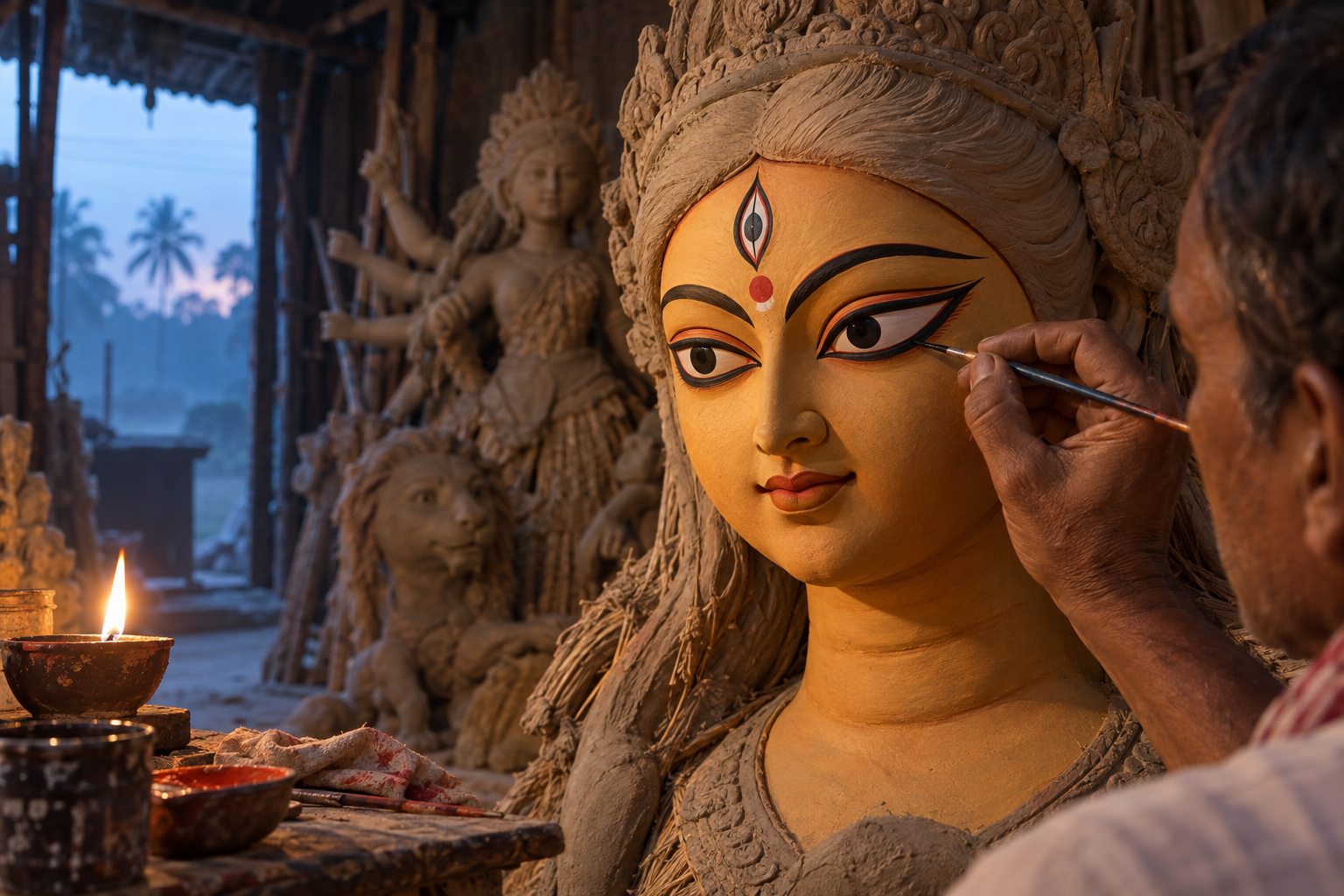
If you have seen a Durga murti whose face is complete except for the eyes, the work has not merely paused before its final decorative detail. The waiting itself matters. Chokkhu Daan marks the point at which artistic completion becomes a sacred encounter.
Knowing this changes how you should approach the ritual. Instead of watching for technical perfection alone, you can notice what the completed gaze asks of the devotee: to see Durga, to accept being seen by her, and to enter Devi Paksha with greater moral clarity.
The brushstroke changes the relationship
Chokkhu means eye, while daan means giving or bestowing. In this setting, Chokkhu Daan is the giving of eyes – and therefore sight – to the image of Goddess Durga. The visible act is the painting of the eyes, but its meaning cannot be reduced to finishing a face.
Before the eyes are completed, you can admire the murti as a work of disciplined craftsmanship. You can see its form, colour, posture and expression. Once the gaze appears, however, the devotional relationship changes. The image no longer seems merely available for inspection. It appears to look back.
This is why the ritual is often described as an awakening. The painting of Durga’s eyes on Mahalaya signifies the awakening of the Mother Goddess and the invocation of her descent into the mortal realm. The language is theological and symbolic, not an explanation of how pigment physically changes clay. It tells you how the community’s relationship with the murti changes at that threshold.
The distinction is important. Calling the murti only an art object misses the devotional event. Treating the artisan’s work as irrelevant to that event misses it too. Chokkhu Daan brings craftsmanship and worship together. The artist’s hand completes the form through which devotees will approach the Devi.
Durga’s gaze turns viewing into darshan
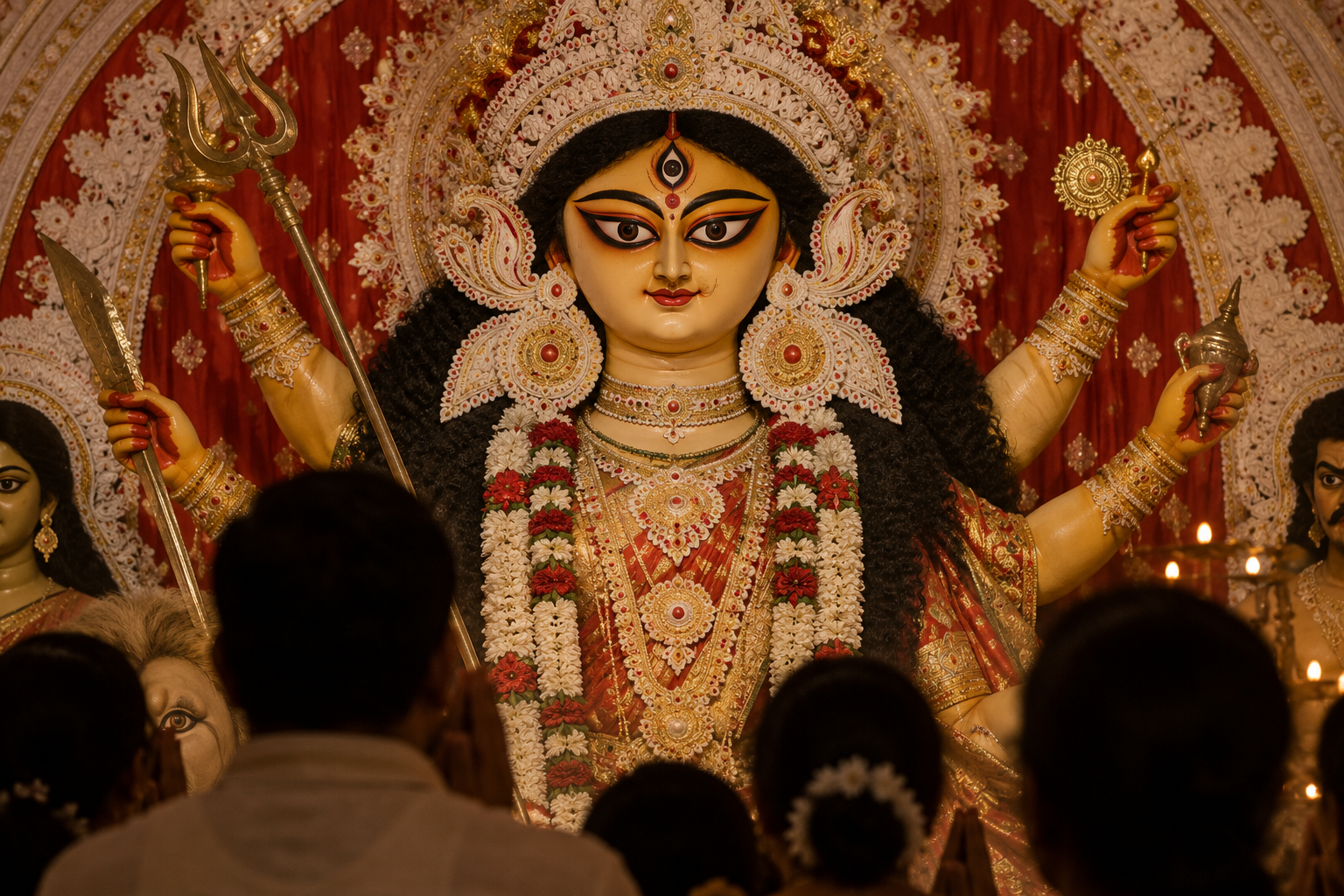
In Dharmic worship, darshan is not simply looking at a sacred image. It is the encounter of seeing and being seen. Chokkhu Daan gives that reciprocity a visible form. Durga’s eyes direct attention outward, while the devotee’s attention turns inward as well as toward her.
That is the first thing to notice if you witness the ritual. The essential change is not that the murti suddenly looks more realistic. It is that the completed gaze establishes a relationship. You are no longer standing before an unfinished representation. Symbolically, you are standing within the Devi’s field of vision.
This makes the gaze morally significant. Durga is invoked to overcome evil and restore cosmic order. Her sight can therefore be understood as discernment: the capacity to recognise adharma without confusion and to confront it without surrender. The eyes are not merely signs of awareness. They represent awakened awareness directed toward action.
The same symbolism returns the question to you. It is easy to pray for Durga to identify and defeat disorder somewhere outside us. It is harder to stand before her completed eyes and ask what those eyes would find in our own conduct. Where have we tolerated falsehood? What duty have we avoided? Which attachment prevents us from seeing a situation clearly?
This is not an invitation to turn the ritual into vague self-help. Its centre remains the Goddess. But devotion becomes more serious when being seen by the Devi carries a consequence. Her gaze calls the devotee away from passive admiration and toward truthful self-examination.
Why Mahalaya is the right threshold
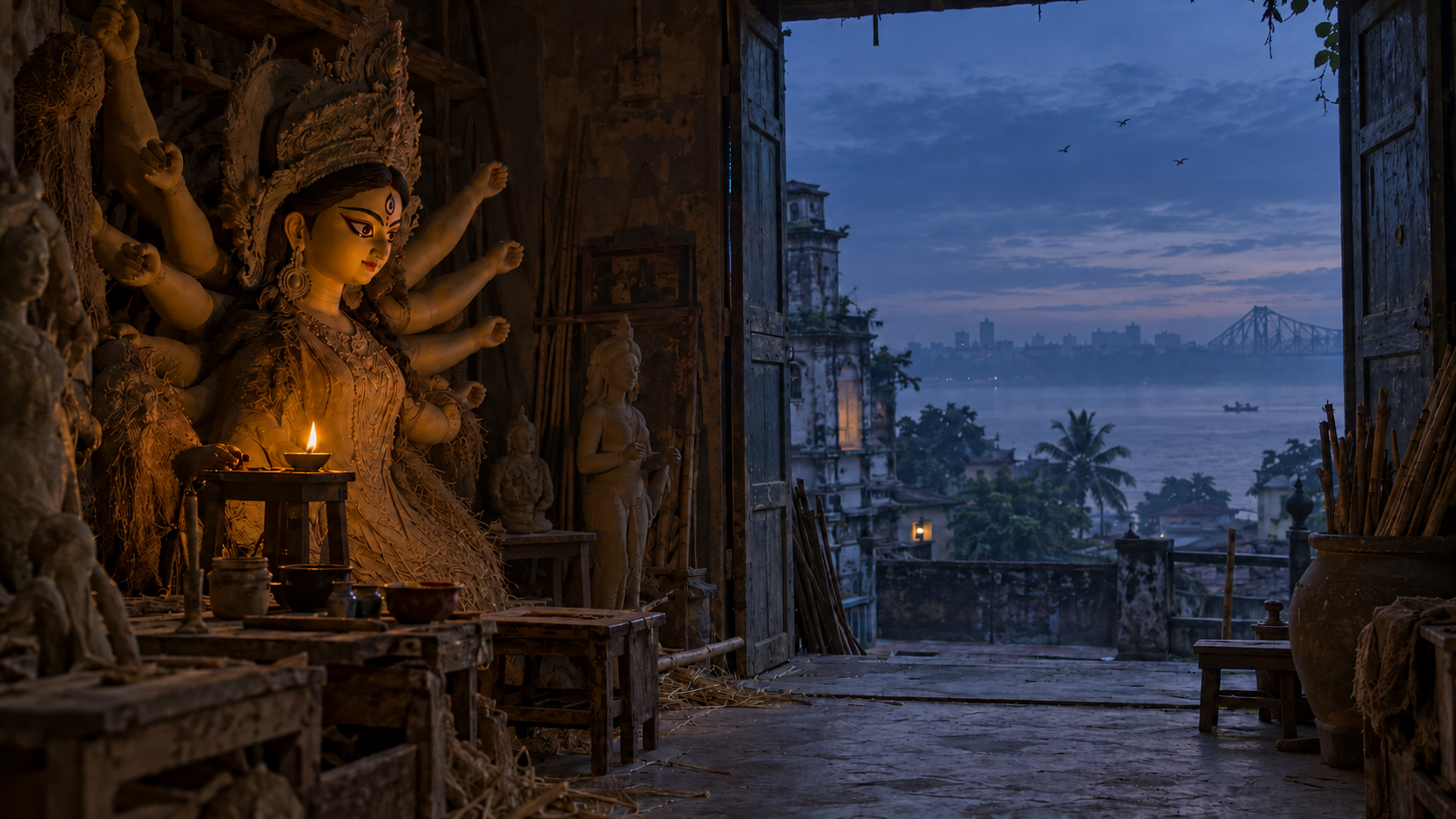
Mahalaya marks the beginning of Devi Paksha, the sacred fortnight that culminates in Durga Puja. Chokkhu Daan belongs naturally at this threshold because both the calendar and the murti are moving from anticipation toward presence.
You can read the timing on three connected levels:
- The calendrical threshold: Mahalaya opens Devi Paksha and directs attention toward the coming worship of the Goddess.
- The ritual threshold: the painting of the eyes changes a nearly completed image into the focus of a devotional encounter.
- The inner threshold: the devotee moves from preparing for a festival to preparing to be addressed, examined and strengthened by the Devi.
The association with dawn deepens the symbolism. Dawn is neither the darkness that preceded it nor the full light of day. It is a passage between the two. In the same way, Chokkhu Daan occupies the passage between making the murti and meeting Durga through that form.
This also helps you avoid a common misunderstanding: Mahalaya is not merely an early celebration added to the main festival. It changes the devotional atmosphere. Devi Paksha has begun, the Mother’s arrival is being invoked, and the community’s attention turns toward her work of defeating evil and restoring order.
Customs and schedules can differ among workshops, households and puja communities. The association with Mahalaya should not be used to declare every different local arrangement incorrect. If timing matters to your visit, ask the organisers when and how their Chokkhu Daan will be observed rather than assuming that every pandal follows an identical sequence.
How to witness Chokkhu Daan with understanding
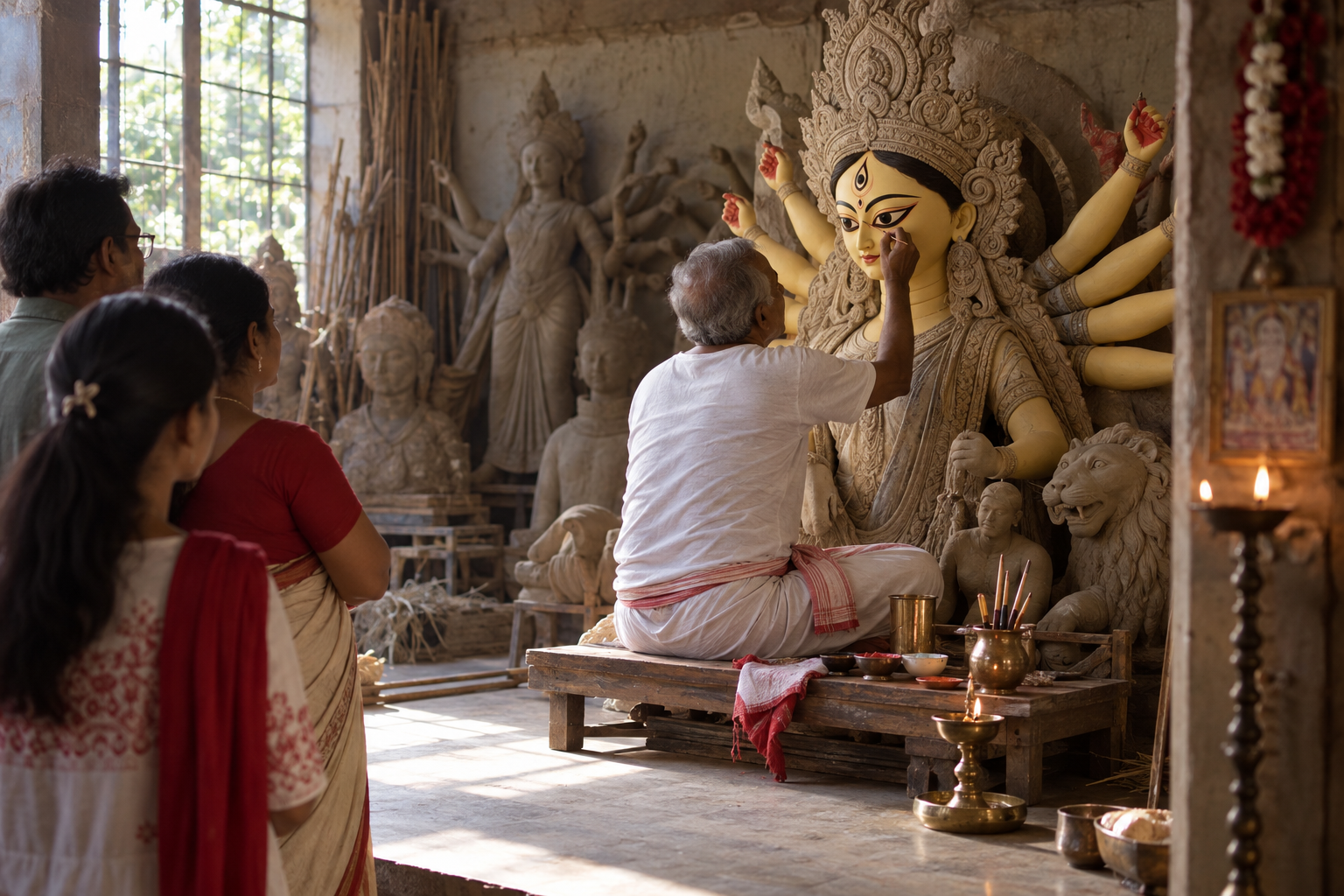
Chokkhu Daan can easily become another photographable moment in the rush toward Durga Puja. You will understand more if you approach it as a participant in sacred time, even when you are present mainly to learn.
- Confirm whether viewing is permitted. The work may take place in an active workshop or another space where access is limited. Follow the artisan’s and organisers’ instructions.
- Arrive before the eyes are completed if the observance is open to you. Seeing the transition matters more than arriving only for the finished image.
- Keep clear of the working area. Chokkhu Daan depends on the concentration and skill of the person holding the brush; spectators should not become an obstacle.
- Put photography behind attention. If images are permitted, take them without turning the sacred act into a staged performance. Watch first.
- Notice the three moments: the face before the gaze, the act of painting, and the changed relationship after the eyes are present.
- Make a devotional response appropriate to your practice. A pranam, a familiar prayer or a period of silence is more fitting than treating completion as applause for a spectacle.
- Ask practical or historical questions after the concentrated work has ended. The artisan and organisers can explain the customs followed by that particular community.
If you cannot attend in person, you do not need to imitate a formal community ritual at home. You can mark Mahalaya by looking deliberately at Durga’s eyes, offering the prayer already familiar to your household, and considering one form of adharma that requires a clear response from you. Treat this as personal reflection inspired by Chokkhu Daan, not as a replacement for the ritual itself.
Parents can make the moment understandable without flattening it into a craft lesson. Ask a child to compare how the face feels before and after the eyes are painted. Then explain that darshan is not only our seeing the Goddess; it is also our willingness to stand before her gaze. That single distinction carries more meaning than a long catalogue of festival details.
Key takeaways
- Chokkhu Daan means the giving or bestowing of eyes to the Durga murti; the physical act is eye-painting, but the ritual meaning is awakening.
- The completed gaze changes the devotee’s relationship with the murti from observation toward darshan.
- Durga’s eyes symbolise awareness and discernment in the struggle against evil and the restoration of cosmic order.
- Mahalaya begins Devi Paksha, making it a fitting threshold between preparation for the Goddess and devotional encounter with her.
- The most respectful way to witness the ritual is to follow local instructions, protect the artisan’s concentration and give attention priority over photography.
On the next Mahalaya, do not rush past Durga’s eyes as one more completed feature. Pause before the gaze and ask what you must learn to see without evasion. Then carry one honest answer into Durga Puja as conduct, not merely as festival sentiment.
References

Leave a Reply
You must be logged in to post a comment.