
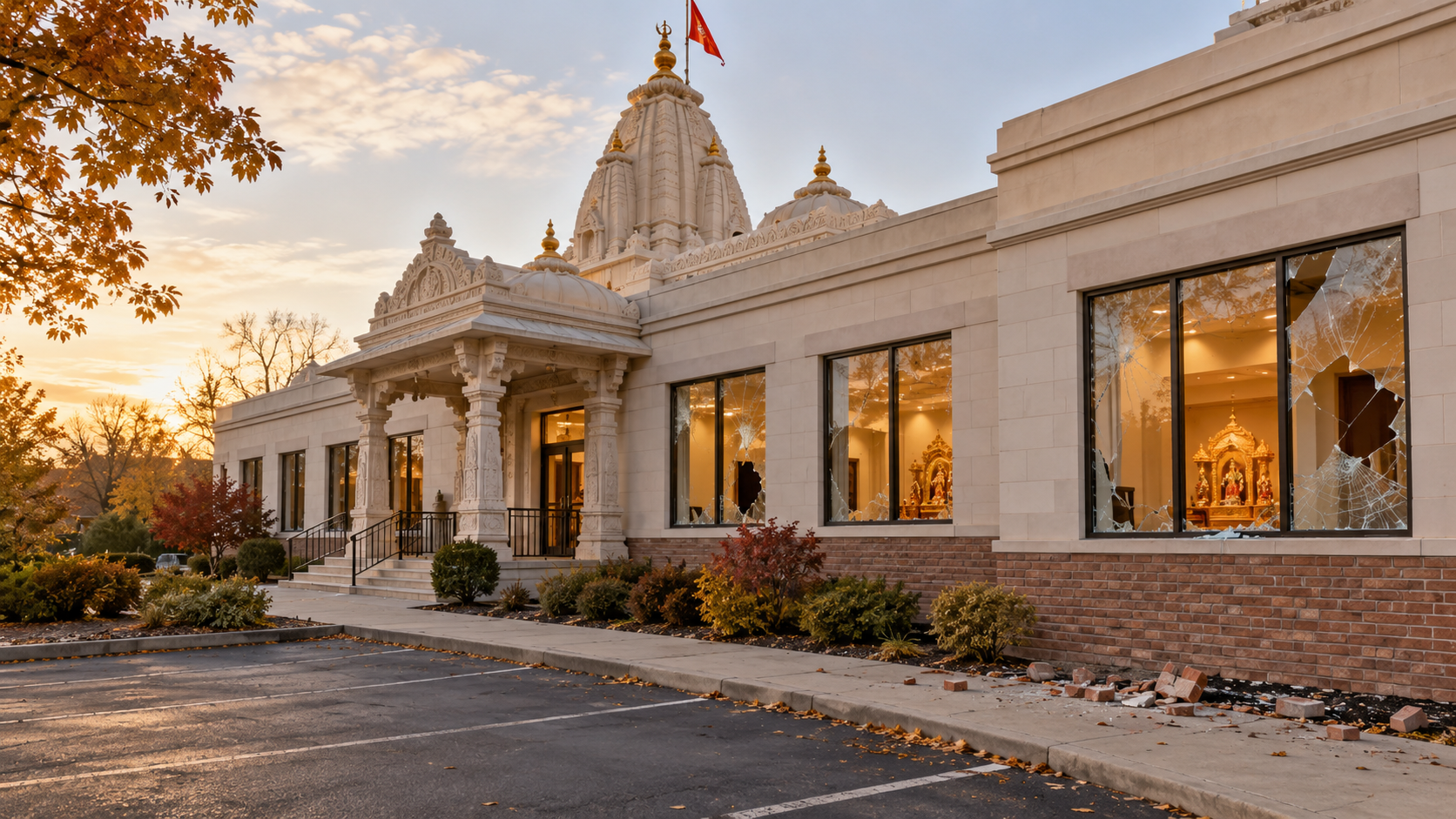
If you worship at, volunteer for, or help run a Hindu temple, your first concern after an attack is whether everyone is safe. Your next concern is harder: how do you defend the community forcefully without spreading claims that have not been proved?
At Shree Swaminarayan Vadtal Dham in Richmond Heights, Ohio, a man reportedly threw bricks at around 1:30 p.m., shattering windows while priests and devotees were inside; temple camera footage helped police track down and arrest a suspect. Because people were inside, this was a danger to human beings as well as damage to property. A motive, criminal charge, injury status, and court outcome have not been established here. That boundary should shape both the public response and the temple’s safety plan.
Key takeaways
- Describe the reported conduct precisely: bricks were thrown, windows shattered, people were inside, cameras recorded the incident, and police arrested a suspect.
- Do not turn an unconfirmed motive into a fact. An attack at a Hindu temple is not automatically proof that it happened because the site was Hindu.
- Do not minimize the danger as mere broken glass. Throwing bricks at an occupied building can place worshippers directly at risk.
- Preserve original recordings, independent witness accounts, damage records, and police identifiers before editing video or repairing the scene.
- Ahimsa does not require passivity. Safe intervention, disciplined preparedness, lawful protest, accurate speech, and a demand for accountability are compatible with nonviolence.
Say what happened without getting ahead of the evidence
The cleanest description is also the strongest: a man reportedly threw bricks at an occupied Hindu mandir, shattered windows, left the scene, and was later arrested after security-camera footage assisted police. It tells the reader what made the incident dangerous without assigning a motive that investigators have not established.
Several distinctions protect the community’s credibility:
- Arrest is not conviction. Use suspect rather than offender unless guilt has been determined through the legal process.
- Location is not motive. The fact that the target was a Hindu temple is important. It does not, by itself, prove anti-Hindu intent.
- Silence about injuries is not proof that nobody was hurt. Unless an injury status has been verified, do not claim that everyone escaped unharmed.
- Damage to property does not capture the whole danger. The mandir was occupied. Public statements should mention that fact rather than making the event sound like damage to an empty building.
- Speculation is not advocacy. Claims about ideology, religion, ethnicity, or political affiliation should wait for evidence such as statements, symbols, a documented history of threats, or an official finding.
If evidence later establishes that the temple was selected because it was Hindu, call the hostility Hinduphobia plainly. Until then, accurate wording is not weakness. It prevents an important allegation from being undermined by an avoidable exaggeration.
If an attack is unfolding, protect people and preserve evidence
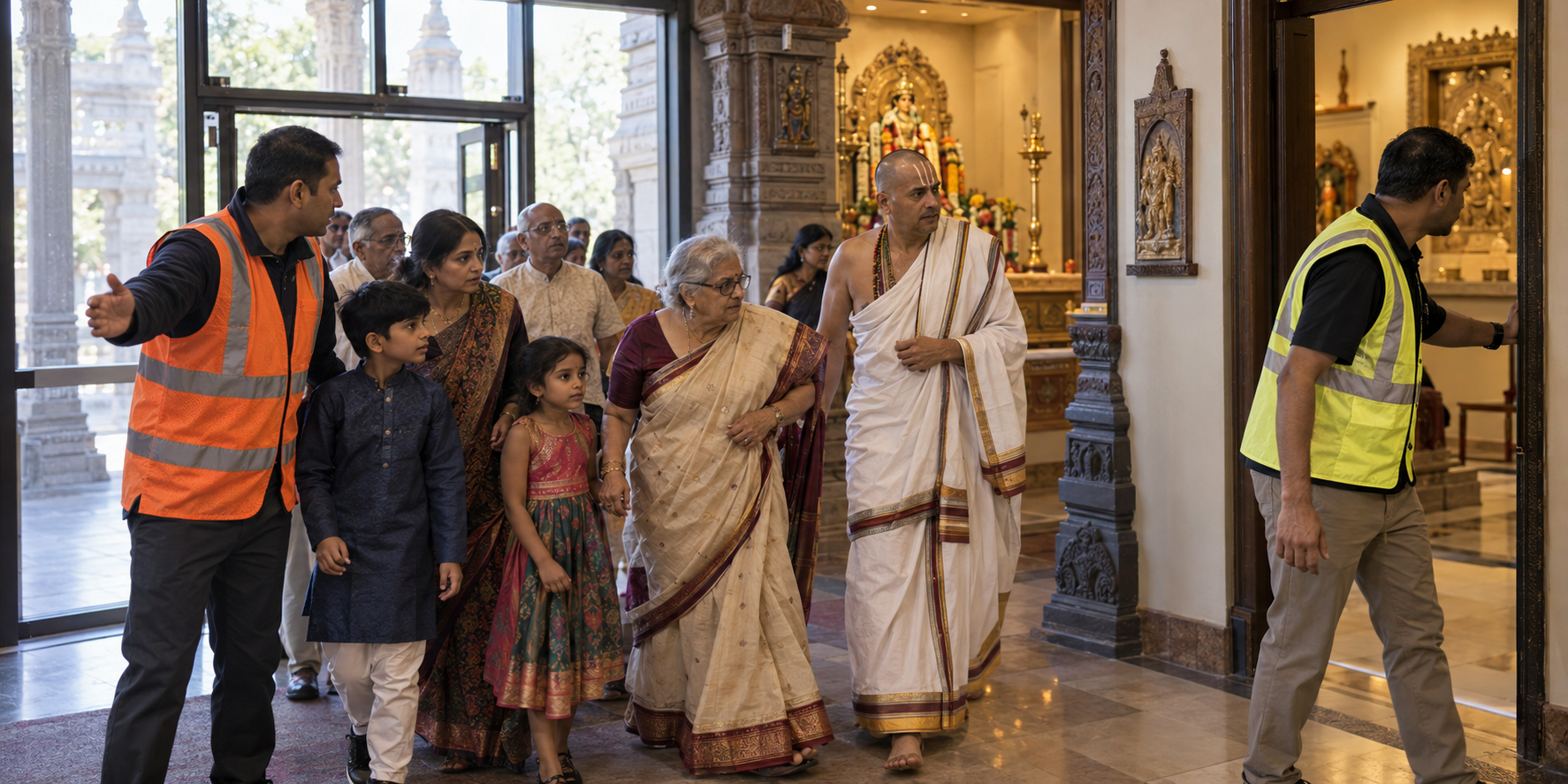
A devotee’s job during an active incident is not to win a confrontation. It is to reduce exposure, summon trained help, observe accurately, and keep evidence from disappearing. Chasing someone who is leaving can move the danger into a car park or public road and expose more people to injury.
- Create distance from the impact area. Move people away from windows, doors, and the line along which objects are being thrown. Use a controlled exit only when the route is clearly safer.
- Call local emergency services. State that the building is occupied, describe what is happening, give the exact location, and follow the dispatcher’s instructions.
- Do not pursue a fleeing suspect. From a safe position, note clothing, direction of travel, distinctive behaviour, and vehicle details. Do not guess the person’s ethnicity, religion, or motive.
- Keep witnesses’ memories independent. Each witness should record what they personally saw, where they were standing, and what they heard before discussing a shared version in a group chat.
- Protect the camera original. Export the native file before a recorder’s retention cycle overwrites it. Preserve a separate viewing copy, note whether the camera clock was accurate, and retain footage from before, during, and after the event.
- Do not edit evidence for social media. Cropping, captions, filters, or compression can remove context and metadata. Give investigators the original and ask whether public distribution could hinder identification or the inquiry.
- Secure the damaged area. Keep people away from unstable glass. Photograph damage from a safe position after police permit access, and use qualified help for cleanup and repair.
- Preserve connected threats. Save relevant messages, usernames, URLs, timestamps, voicemails, and screenshots. Do not provoke or bargain with a person making threats.
If anyone is injured or trapped, immediate safety takes priority over photography and evidence collection. Tell the emergency dispatcher what you can see and follow professional instructions.
A mandir needs parallel plans for safety, evidence, and communication
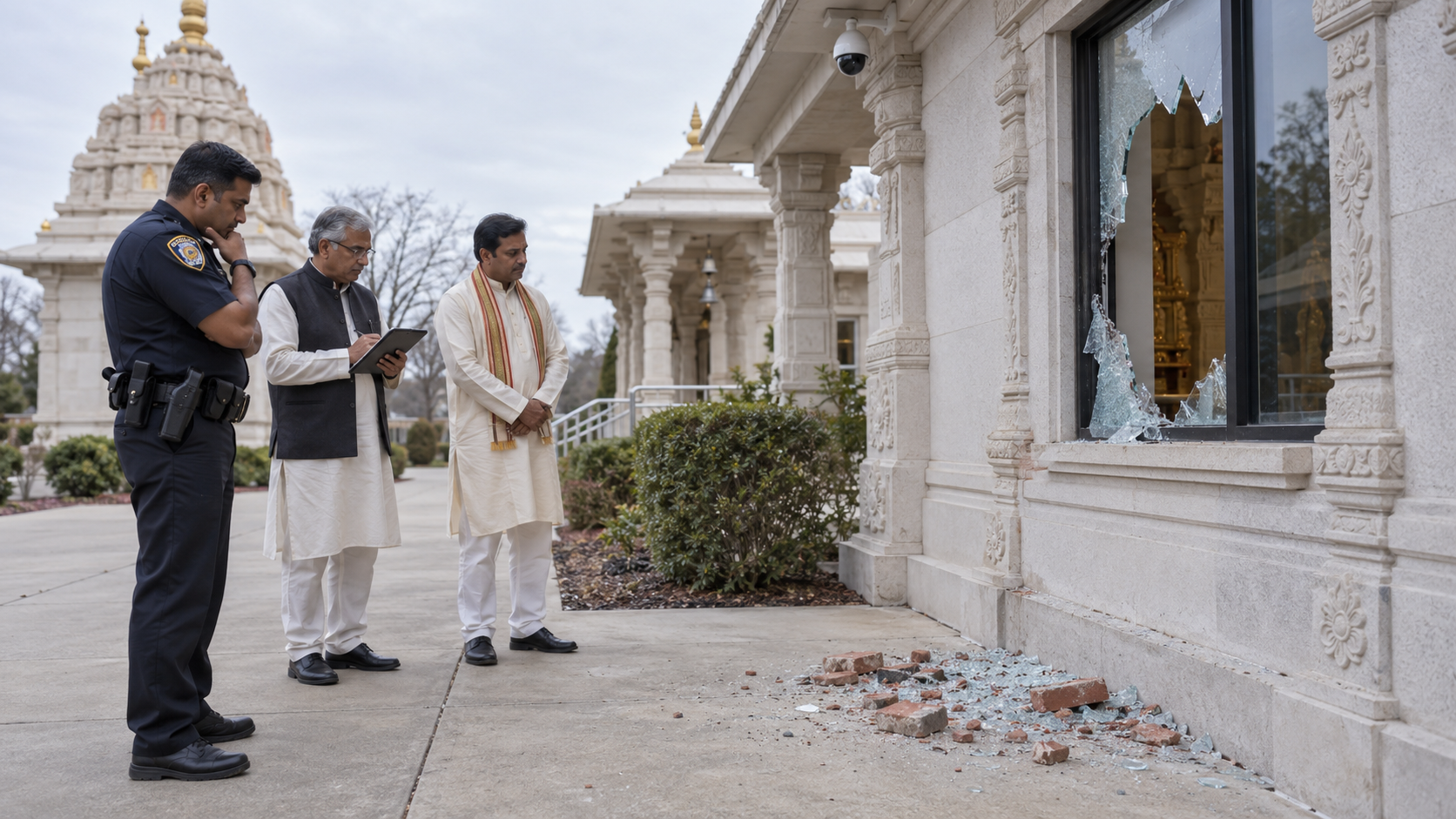
Stabilize the site and the record
Temple leadership should appoint a liaison for police, an internal incident coordinator, and a spokesperson. The roles may be filled by existing volunteers, but the responsibilities should be named. When everyone assumes somebody else saved the recording or called the insurer, the gap often becomes visible only after evidence is lost.
- Ask the investigating agency for the incident identifier, the name or unit of the contact handling follow-up, and instructions for submitting additional evidence.
- Maintain a chronology of verified events, decisions, calls, repairs, service disruptions, and public updates.
- Record who exported each camera file, when it was copied, where the original is stored, and who received it.
- Notify the property owner and insurer before discarding damaged materials or beginning non-emergency repairs. Keep photographs, estimates, invoices, and receipts.
- Have qualified professionals assess broken windows, frames, and other affected structures. Temporary barriers must not block emergency exits or create a new hazard.
- Review lighting, cameras, door controls, visitor flow, and emergency contacts without publishing the temple’s blind spots or security configuration.
Use a holding statement that leaves no room for rumours
A careful public statement can use this structure: At approximately [time], an individual damaged windows at [temple] while people were inside. [State the police status exactly as verified.] We are cooperating with investigators, supporting those affected, and reviewing site safety. We will share verified updates. Please do not circulate unconfirmed identities or motives.
Remove any sentence whose factual status cannot be checked. If religious bias has not been determined, the temple can say that it has asked investigators whether selection of the mandir or anti-Hindu animus is being examined. That records the community’s concern without presenting the answer as settled.
Do not publish a suspect’s name, address, workplace, or family information from community screenshots. Misidentification can endanger an uninvolved person and damage the investigation. If police issue an official public request for assistance, reproduce the request accurately and direct tips to the stated channel.
Continue worship when the site is genuinely safe
Reopening should follow the release of the scene and a practical safety assessment, not pressure to appear fearless. Tell devotees which entrance to use, which rooms are closed, whether police or trained security will be present, and where a service has been relocated. Devotional continuity is not denial. A safe return prevents the person responsible from dictating the community’s religious life.
Ahimsa becomes credible when it is organized
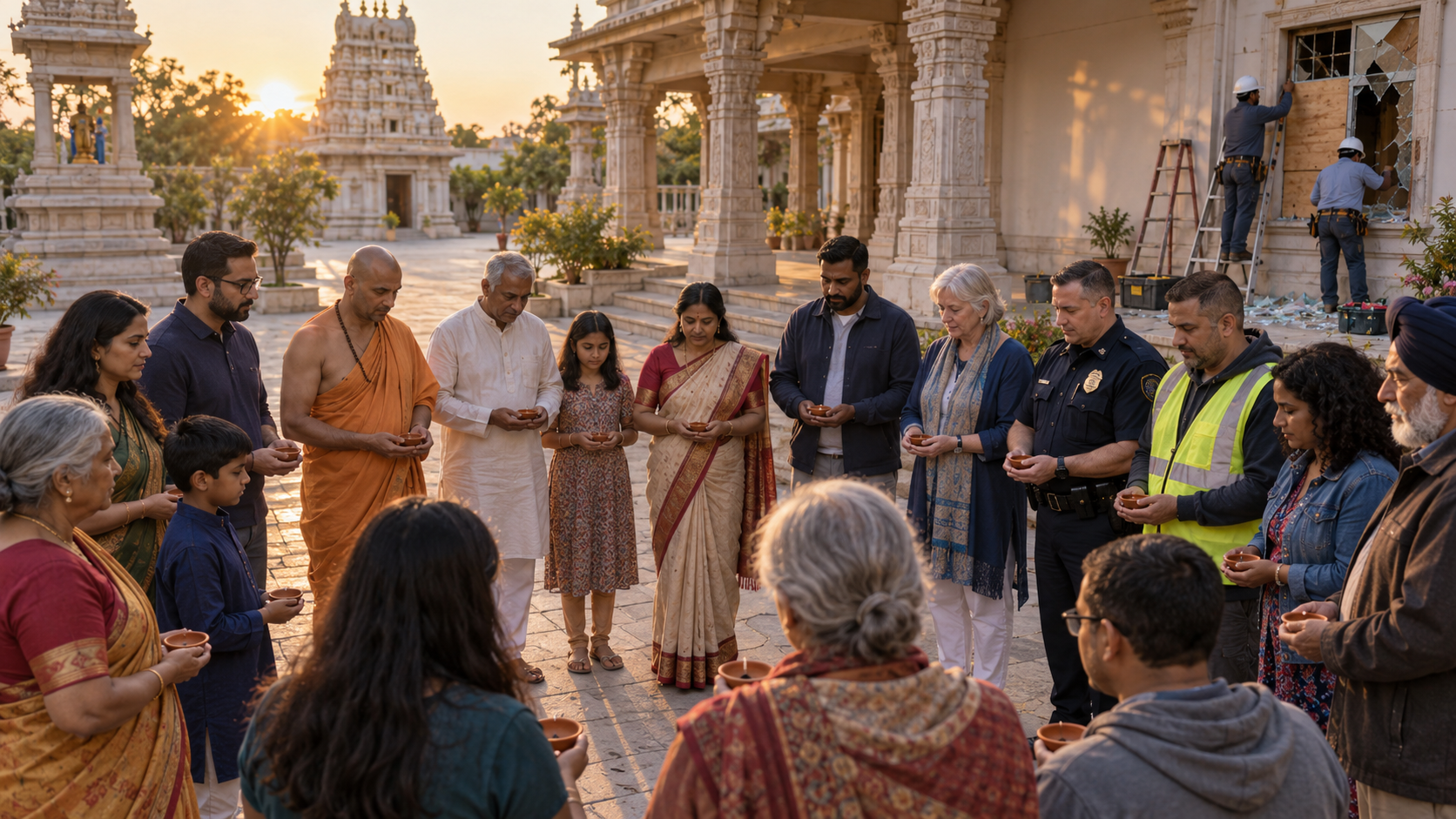
Ahimsa asks us to restrain anger, cruelty, and unnecessary harm. It does not require a temple to ignore danger, abandon its duty of care, or remain silent in public. Protection, truthful testimony, lawful protest, physical preparedness, and a demand for justice can all be pursued without vengeance.
An occupied mandir does not owe a fleeing suspect an improvised citizen’s pursuit. Proper role division is more effective: devotees move to safety and observe; trained personnel manage the site; temple leaders preserve evidence; police investigate and pursue; community advocates keep public attention on the case.
Fitness, martial-arts practice, situational awareness, first-aid instruction, and de-escalation training can have a place in temple life. They should be taught by qualified people and framed as discipline and preparedness, not as permission for volunteers to chase or punish someone. A martial-arts class is not a substitute for an emergency procedure, trained security, or clarity about local law.
Turn public concern into accountable civic action
A rally, vigil, or meeting with local officials should make requests that can be answered: a thorough investigation, consideration of evidence of religious bias, a verified public update, and practical protection for places of worship. Keep signs, speeches, and media statements tied to established facts. Do not publish private information, threaten retaliation, or turn suspicion into collective blame.
The community should also maintain an incident register. Record the date and place, conduct, exact words or symbols used, occupancy, reported injuries, damage, available video, police identifier, official classification, charges as publicly stated, repair costs, and case status. Correct the record when new facts displace old ones.
One attack deserves a complete response, but it cannot by itself prove a national pattern. A credible case that Hindu temples face recurring hostility requires comparable, verified records across incidents. Precision gives public officials, journalists, lawyers, and community advocates something stronger than viral outrage: evidence that can withstand scrutiny.
Before your mandir’s next gathering, ask who knows how to export an original camera recording if a window is struck. If nobody can answer, assign the responsibility and test the process. Then carry the same discipline into public life: protect people, preserve the truth, demand accountability, and keep the doors of worship open when it is safe to do so.
References

Leave a Reply
You must be logged in to post a comment.