
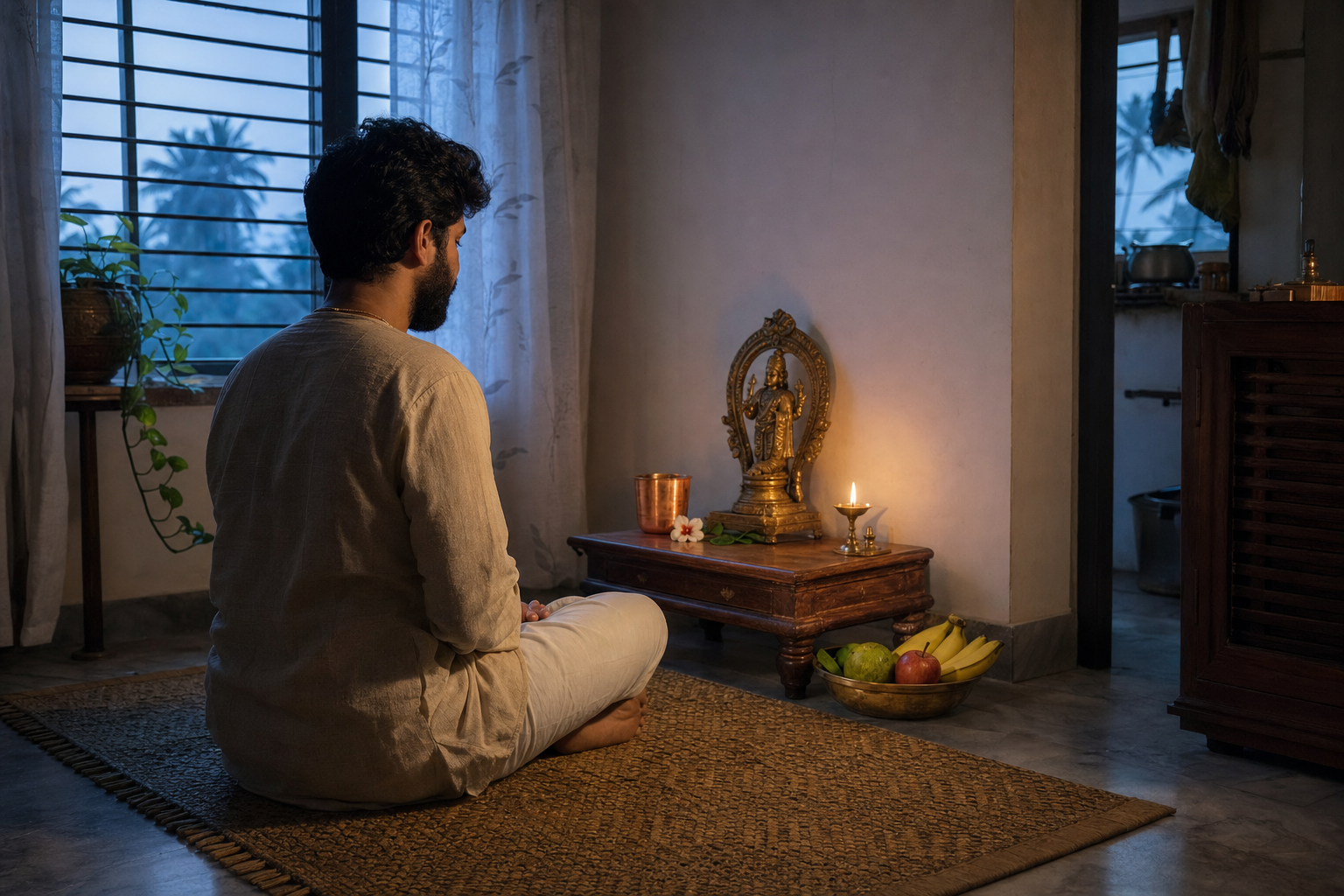
You want to worship Bhagavan regularly, but the home shrine has become a place you approach only when you have enough time, the right flowers, or a festival reason. Perhaps you also worry that a short puja will be disrespectful or that you do not know enough ritual detail to begin.
The answer is not to imitate a temple schedule in your living room. Build a practice you can keep: receive the deity with attention, make a clean and sincere offering, remember the Divine, and let that remembrance govern what you do after leaving the shrine. Elaborate worship can grow from this foundation, but it cannot replace it.
Begin with a relationship, not a performance
Within murti-puja, the deity is not approached as household decoration. Different Hindu schools explain divine presence and sacred form in different ways, but the practical attitude is consistent: you come to serve, receive darshan, remember Bhagavan, and make yourself available for correction.
This is why alankara matters. Dressing a murti, placing a flower carefully, or cleaning a lamp disciplines your attention. You notice what you would otherwise neglect. Beauty becomes an offering rather than a display, and the senses are given a sacred direction. In formal temple worship, cleansing, anointing, dressing, ornamentation, flowers, and light may appear within an ordered sequence of services. At home, the scale may be smaller while the disposition of seva remains the same.
A devotional life also begins from the recognition that human birth is a meaningful opportunity for remembrance, ethical living, and compassionate action. The purpose of your shrine is therefore not to help you escape ordinary responsibilities. It is to train you to meet them with a steadier mind.
Before adding practices, settle three decisions:
- Whom are you worshipping? Let your ishta-devata, family tradition, or sampradaya give the practice a clear centre.
- What can you offer every day? Choose a minimum that survives workdays, travel preparation, family demands, and low-energy mornings.
- Which duty will carry the worship outward? Connect the shrine to one concrete discipline, such as truthful speech, patience with family, care for an elder, or restraint in anger.
If you have received an initiated mantra or detailed instructions from a guru, acharya, or temple, follow those instructions. A general home routine should support a living lineage, not overwrite it with a collection of disconnected practices found online.
Use a daily sequence that can survive a difficult week
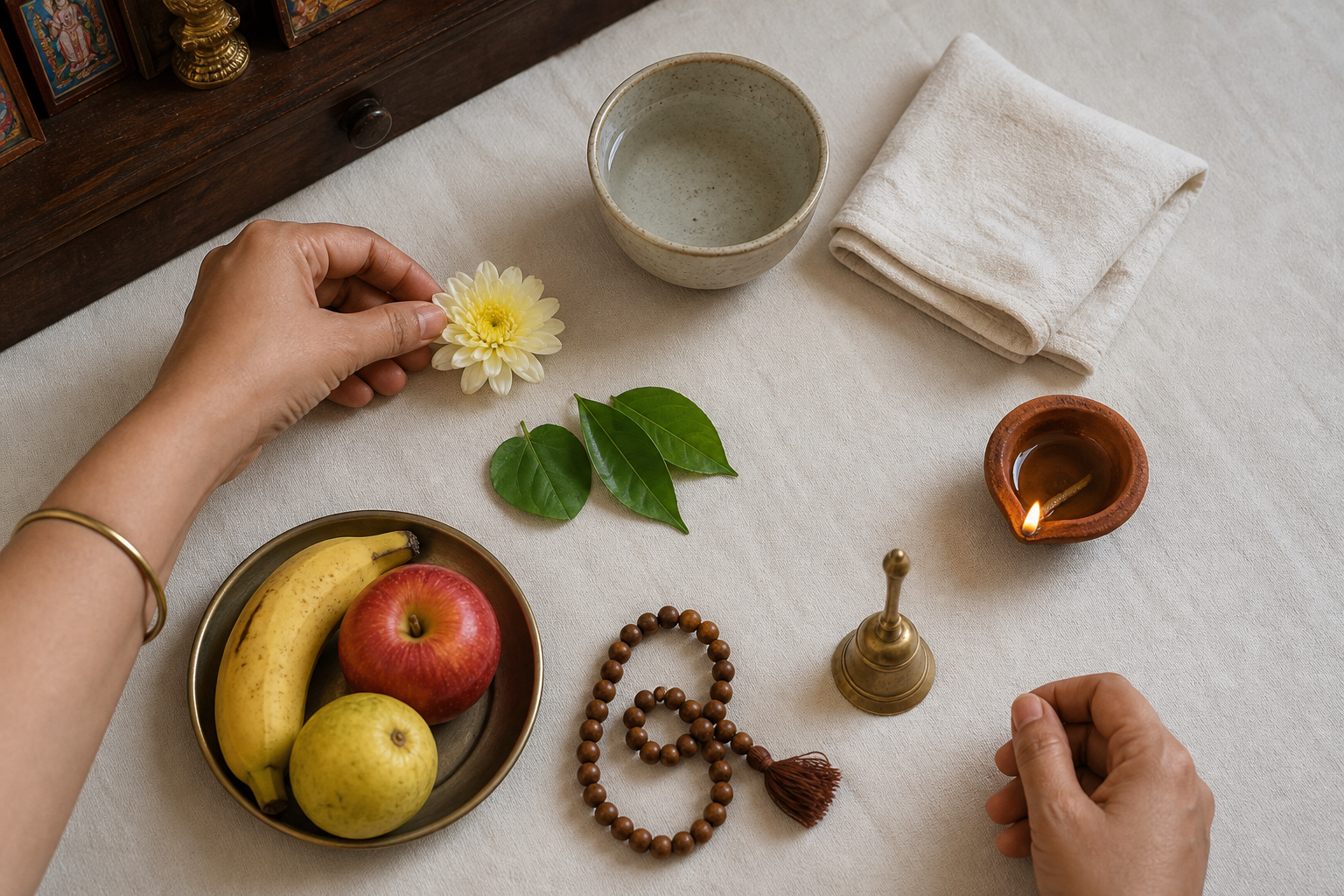
Consistency is built through a repeatable cue. Morning worship suits many households, but the most useful time is the one you can protect. Attach the practice to something that already happens every day, such as bathing, preparing the first meal, or returning home from work. Keep the sequence stable long enough for it to become abhyasa rather than a daily decision.
A simple home sequence can look like this:
- Prepare yourself and the place. Wash your hands, approach in clean clothing appropriate to your household custom, straighten the altar, remove faded flowers, and replace water that is no longer fresh. Cleanliness comes before ornament.
- Become present. Stand or sit quietly. Take a few unhurried breaths and name something for which you are grateful. This interrupts the habit of arriving before the deity while the mind is still arguing with the day.
- Offer what you can maintain. Fresh water, a suitable leaf or flower, or a small portion of fruit can be enough. Use only materials accepted for that deity in your family or sampradaya. A simple offering made within your means is not an inferior version of devotion.
- Offer light safely. If you use a diya, candle, camphor, or incense, keep it away from loose fabric and garlands. Do not leave a flame unattended, and supervise children and animals. If a flame is unsafe in your setting, do not turn a preventable hazard into a test of faith.
- Practise one form of remembrance. Repeat your mantra, recite a familiar stotra, perform aarti, sing a short bhajan, or sit in attentive silence. Japa, breath awareness, gratitude, contemplation, and reflective silence can form a coherent daily rhythm. Depth usually grows by remaining with a suitable practice, not by changing it whenever novelty fades.
- Dedicate the day. Name the duty that most needs dharmic attention. You might ask for restraint before a difficult conversation, concentration in study, fairness at work, or patience while caring for someone.
- Close deliberately. Offer pranam, receive or distribute prasad respectfully when there is an edible offering, and leave the shrine without immediately surrendering your attention to a screen.
On a pressured day, use a minimum form: clean the immediate space, offer fresh water or an appropriate flower, remember the deity by name or mantra, make pranam, and carry one dharmic intention into your next task. This is not a claim that every traditional puja can be reduced to a few acts. It is a way to prevent perfectionism from turning occasional grandeur into habitual absence.
Keep festival observances and longer recitations as an expansion of the daily foundation. If you repeatedly abandon the routine, reduce the number of elements before changing the time, deity, mantra, or altar. A smaller promise kept steadily will teach you more than a complicated plan that survives only a few auspicious days.
Make alankara an offering of care, not consumption
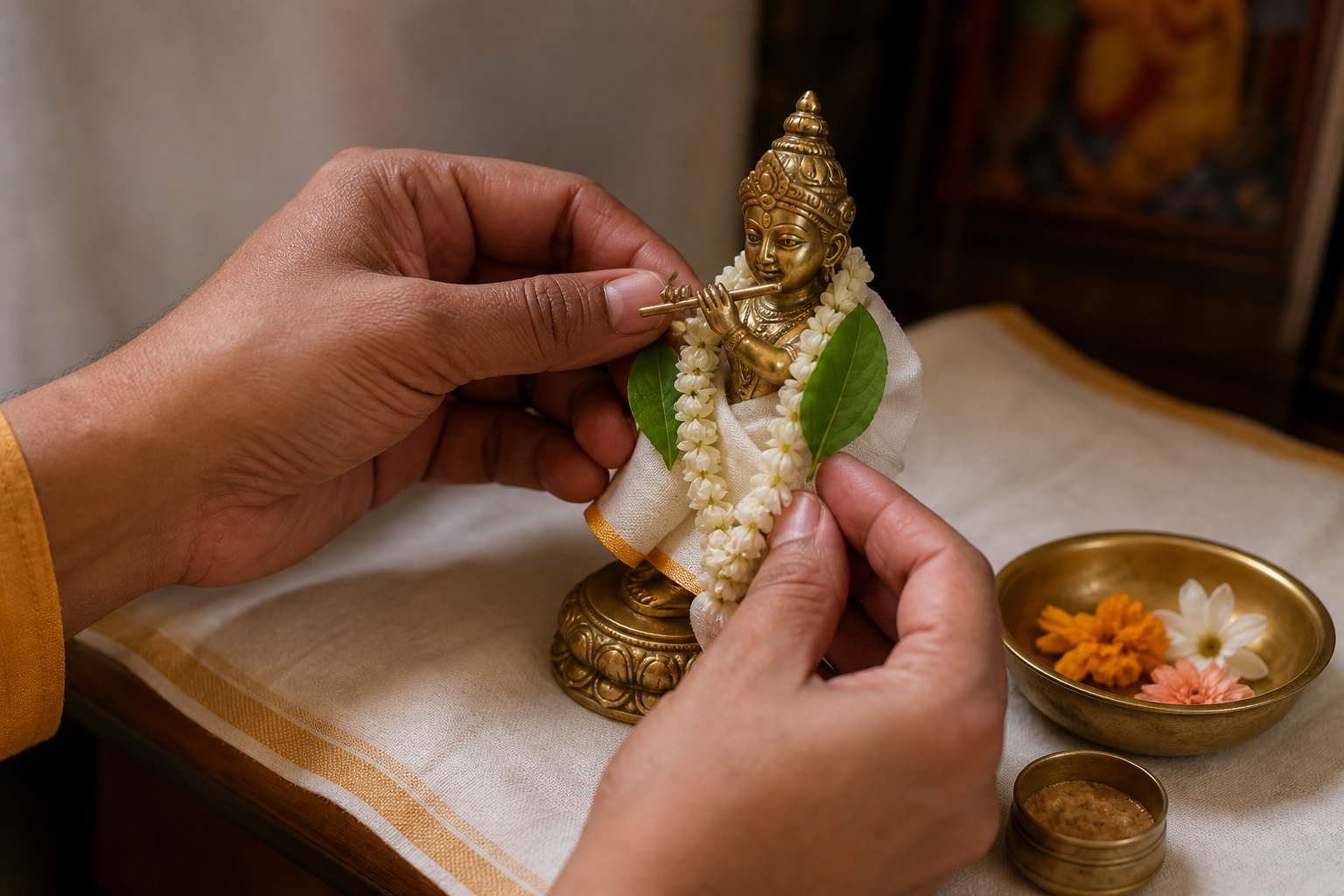
Deity adornment can deepen worship because it asks you to give beauty without making yourself the centre. The governing order is simple: clean first, inspect what is already present, and then adorn. Adding fresh garlands over neglected offerings reverses the meaning of seva.
Use four checks before placing anything on the shrine:
- Is it clean? Garments, altar cloths, vessels, ornaments, and reusable garlands need regular care. Remove wilted or spoiled offerings rather than allowing yesterday’s devotion to become today’s neglect.
- Is it appropriate? Flowers, leaves, colours, foods, marks, and adornments are not automatically interchangeable among deities or lineages. Follow your family practice, Agamic tradition, or reliable temple guidance where a rule matters.
- Is it proportionate? A carefully placed flower can express more attention than an overcrowded altar. Simple offerings and elaborate festival adornments both have a place when sincerity and seva remain central. Do not spend beyond your means to imitate a temple or an image on social media.
- Is it responsible? Local flowers, reusable fabrics, natural materials, and biodegradable decorations reduce waste. Avoid glitter, plastic fragments, chemical colours, or disposable items that leave the home, temple grounds, or waterways carrying the cost of your celebration.
Traditional materials should direct contemplation. A lotus can call purity to mind; sandalwood can recall compassion and refinement; turmeric and kumkum can signify auspiciousness. Meanings and accepted materials can vary, so learn the symbolic language of your own tradition instead of inventing a universal code. Then ask what quality the alankara is inviting you to practise that day.
Festival decoration can also teach rather than merely impress. Navaratri adornment can bring distinct forms of Shakti into view, Krishna Janmashtami can use floral and peacock imagery, and Deepavali can centre light and inner illumination. Choose one meaningful visual theme and explain it to younger family members. That preserves more tradition than buying decorations whose significance no one in the household knows.
Children can sort suitable flowers, help make a garland, fold a clean cloth, or place unbreakable items under supervision. Give them a real act of service rather than asking them only to watch. Keep flames, heavy ornaments, sharp objects, and fragile murtis under adult control.
Do not improvise abhishekam on a household murti or image merely because you have seen it performed in a temple. Some images and finishes can be damaged by liquids, oils, powders, or repeated washing. Confirm that the murti is intended for abhishekam and learn the appropriate procedure before doing it. Otherwise, clean and honour it in the manner your tradition or its maker recommends.
Let conduct reveal whether the worship is working

The most reliable feedback about your puja appears after you leave the shrine. A beautifully dressed murti cannot compensate for contemptuous speech, dishonesty, avoidable waste, or indifference to another person’s need. Bhakti is not confined to emotion before the altar; it matures as dharma under pressure.
Translate one ritual act into one ordinary discipline:
- After offering water, avoid wasting water and respond to another person’s basic need with care.
- After offering food, treat food as prasad: take a responsible portion, waste less, and share where you genuinely can.
- After alankara, care for the shared spaces and objects that other people depend on.
- After mantra-japa, pause before using speech to humiliate, exaggerate, or inflame.
- After pranam, practise enough humility to correct a mistake without constructing an excuse.
Seva should begin where duty is already present. Help within the household before searching for dramatic service elsewhere. Keep a commitment to a neighbour or community. Participate in temple cleaning, garland-making, education, food service, or environmental care when the opportunity is appropriate. Service to family, community, society, and nature turns devotion into responsible action rather than leaving it as a private feeling.
At night, ask three questions without self-flattery or self-condemnation:
- Where did remembrance change my speech or behaviour today?
- Where did anger, carelessness, or self-interest make me act against dharma?
- What one correction will I carry into tomorrow’s worship?
Look for gradual signs: steadier conduct, compassion when circumstances are difficult, clearer intentions, and a more responsible use of time. These are practical markers of devotional progress. Visions, intense moods, or public displays are not required for you to notice that practice is changing the way you live.
This ethical test also reveals a shared Dharmic grammar without erasing important differences. Hindu puja, Buddhist contemplation, Jain veneration, and Sikh simran do not rest on identical theology or use identical forms. They can nevertheless meet in disciplined attention, compassion, honesty, restraint, reverence, and service. Respecting that distinction is more truthful than forcing every path into the language of deity worship.
Questions that commonly block a home practice
Do I need to perform all sixteen services every day?
Not merely because you have heard of shodasha upachara or watched a temple puja. The sixteen-service framework belongs to an ordered ritual setting, and particular procedures may require training. If your lineage has given you a daily vidhi, follow it. Otherwise, establish a modest home practice that you understand and can perform respectfully, then learn additional upacharas from a qualified teacher or temple tradition.
What if I cannot buy flowers, garments, or ornaments?
Do not turn purchasing power into a measure of bhakti. Offer clean water, an appropriate leaf or flower when available, a portion of fruit or food accepted in your practice, a lamp when safe, or sincere prayer and remembrance. Use what is suitable and honestly within your means. The point is attentive giving, not visual competition.
What if the routine feels mechanical?
Do not immediately add more ritual. Slow one action down. Say the deity’s name attentively, understand one line of the stotra, or connect the day’s offering to a specific correction in conduct. A stable form can hold devotion when emotion is quiet. Mechanical speed is a problem to correct; the absence of dramatic feeling is not proof that worship is empty.
Can a household make room for different Dharmic practices?
Yes, through respect rather than careless mixing. Family members can maintain distinct mantras, images, observances, or periods of silence while sharing cleanliness, reverence, ethical discipline, and seva. Do not merge rituals in ways that violate a person’s lineage or conviction. Agree on practical matters such as shrine space, food restrictions, festival arrangements, and quiet times before conflict arises.
Tomorrow, resist the urge to redesign your whole spiritual life. Clean the shrine, make one suitable offering, practise one form of remembrance, and choose one duty through which the worship will continue. Repeat that sequence until care becomes natural. Then let greater knowledge and more elaborate seva grow from steadiness rather than guilt.
References
- DharmaRenaissance Blog – Discover the Essential Path: Master Devotional Living to Bhagavan and Transform Your Birth
- DharmaRenaissance Blog – Why Decorating Deities Matters: Discover the Essential Guide to Idol Adornment in Hindu Dharma
