
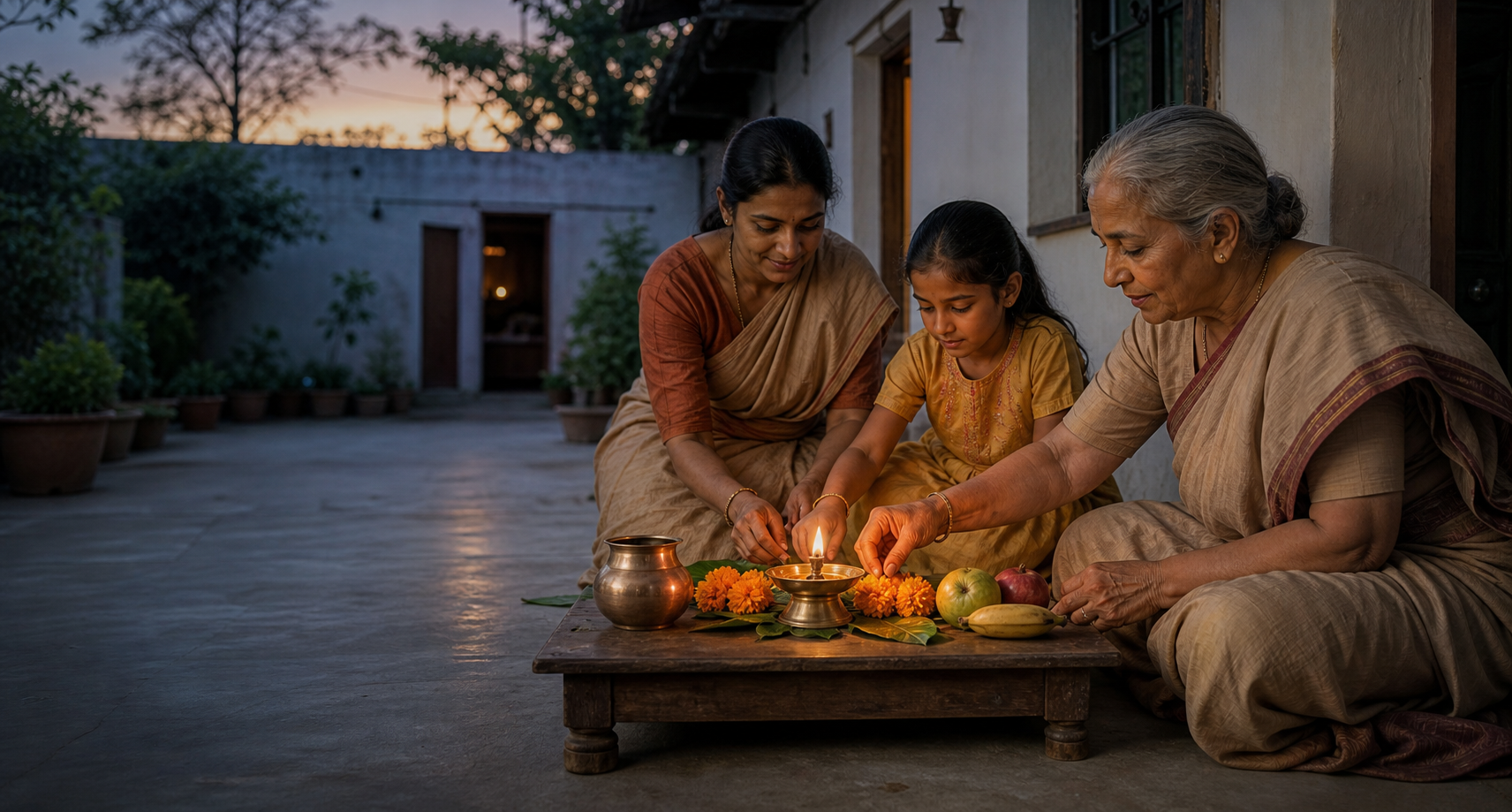
If your calendar gives Kartik Shukla Navami several names, you are not looking at a simple choice between competing festivals. You are seeing one lunar date expressed through different regional, family and theological traditions. Your real task is to identify the tradition that belongs to your household, confirm when Navami falls where you live and observe it without turning the day into a mixture of unrelated rituals.
A clear observance can be modest. You need a reliable local panchang, one coherent devotional focus and an action that carries the meaning of the day into ordinary life. That may mean Devi worship, reverence for the amla tree, study, dāna, annadānam or a deliberate commitment to truthful and disciplined conduct.
One tithi carries several distinct traditions
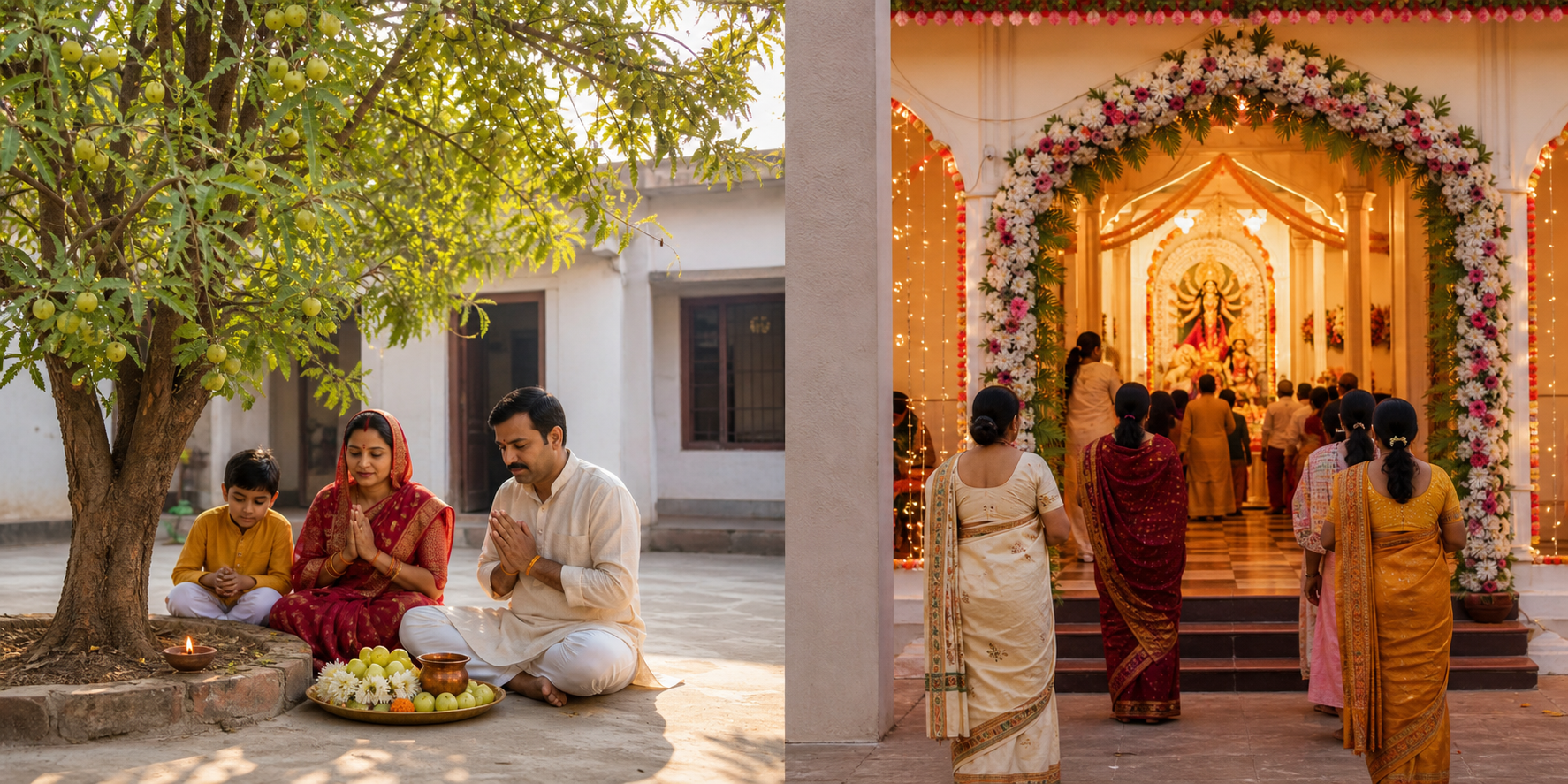
Kartik Shukla Navami is the ninth lunar day of the bright fortnight of Kartik. It is widely known as Akshaya Navami and Amla Navami, and it is also associated with Kruta Yugadi or Satya Yugadi. In Bengal, the same tithi carries the powerful devotional presence of Jagadhatri Puja.
These names illuminate different dimensions of the day:
- Akshaya Navami emphasizes the enduring spiritual value of righteous action. Akshaya means inexhaustible or imperishable, so the day directs attention toward conduct whose value extends beyond a single ritual moment.
- Amla Navami places reverence for the amla tree at the center. Tree worship, parikrama, charitable giving and shared food connect devotion with gratitude toward the natural world and the community.
- Kruta Yugadi or Satya Yugadi recalls the traditional commencement of Kruta or Satya Yuga, the Golden Age associated with truth, dharma and harmony. Its practical emphasis is ethical renewal rather than nostalgia for a remote age.
- Jagadhatri Puja venerates Jagaddhatri as a compassionate and powerful manifestation of Durga. The focus is Devi Shakti as the sustaining and protective power that restores order when adharma threatens it.
The shared tithi does not make every custom interchangeable. A Bengali family participating in Jagadhatri Puja and a family observing Amla Navami may honor the same lunar day through visibly different forms. Neither needs to treat the other as incorrect. Dharma often preserves unity through a common sacred calendar while allowing region, sampradāya and family memory to shape practice.
When you are unsure which form belongs to you, use three filters in order: your inherited family custom, the practice of your sampradāya or trusted temple, and the regional tradition in which your family lives. An online checklist should not displace those living authorities.
Let a local panchang settle the date before you plan

A tithi is a lunar division, not a midnight-to-midnight civil date. It can begin or end partway through a Gregorian day, while a particular observance may be assigned according to sunrise, a designated puja period or a regional calendar convention. That is why copying last year’s date is unreliable.
For example, Kruta Yugadi and Akshaya Navami fell on October 31 in 2025, and Bengal observed Jagadhatri Puja on that date. October 31 was a year-specific result, not a permanent festival date. It should not be carried into another year without checking the calendar again.
Before arranging leave, inviting guests or announcing a community program, confirm four details:
- Location: use a panchang calculated for your city or region rather than one generated for a distant place.
- Tithi span: note when Shukla Navami begins and ends locally, especially if it crosses two civil dates.
- Observance rule: ask whether your tradition follows the tithi present at sunrise or uses a particular puja window.
- Community schedule: verify the actual time published by the temple, satsang or Jagadhatri Puja committee you plan to join.
If two calendars disagree, do not combine the start time from one with the observance date from another. Ask which panchang your local temple follows and use it consistently. The aim is not to find a universal clock that erases every regional difference; it is to follow one recognized method with clarity.
Choose an organizing tradition instead of making a ritual collage
The most useful way to plan the day is to choose its organizing center first. You may include compatible practices from your family custom, but each act should support that center rather than compete with it.
| Observance | Central meaning | Practices that fit the emphasis | Where it naturally belongs |
|---|---|---|---|
| Akshaya Navami or Amla Navami | Enduring merit, gratitude and reverence for the amla tree | Amla worship, parikrama, dāna, annadānam, temple worship and sacred bathing where customary | A household or regional tradition that already recognizes the amla-centered observance |
| Kruta Yugadi or Satya Yugadi | Renewal of truth, dharma, compassion, restraint and social harmony | Home puja, Bhagavad Gita study, meditation, charity, satsang and a concrete ethical commitment | A family or community that marks the symbolic beginning of Kruta or Satya Yuga |
| Jagadhatri Puja | The protective and sustaining grace of Devi Shakti | Deity-centered puja, mantra recitation, flowers, sweets, lamps and participation in collective worship or a pandal | Especially Bengal and communities that have inherited Jagadhatri worship |
If Jagadhatri Puja is your tradition, let Jagaddhatri remain the theological center. The image of Devi as protector asks you to notice not only danger outside yourself but also anger, pride, fear or indiscipline within. Protection of dharma begins with mastery of the tendencies that repeatedly disturb your own conduct.
If your family observes Akshaya or Amla Navami, do not reduce the amla tree to a decorative prop. Approach it as a living object of reverence. Keep the space clean, avoid damaging the tree and connect the worship to a useful act of generosity. Dāna should answer a real need; annadānam should feed people with dignity rather than function merely as a display.
If Kruta Yugadi is your focus, the Golden Age is best treated as a standard for present conduct. The point is not to speak admiringly about Satya Yuga while leaving today’s habits untouched. Choose one place where satya, self-restraint or compassion is currently difficult, and make that the field of your observance.
Build a simple home observance that you can actually complete
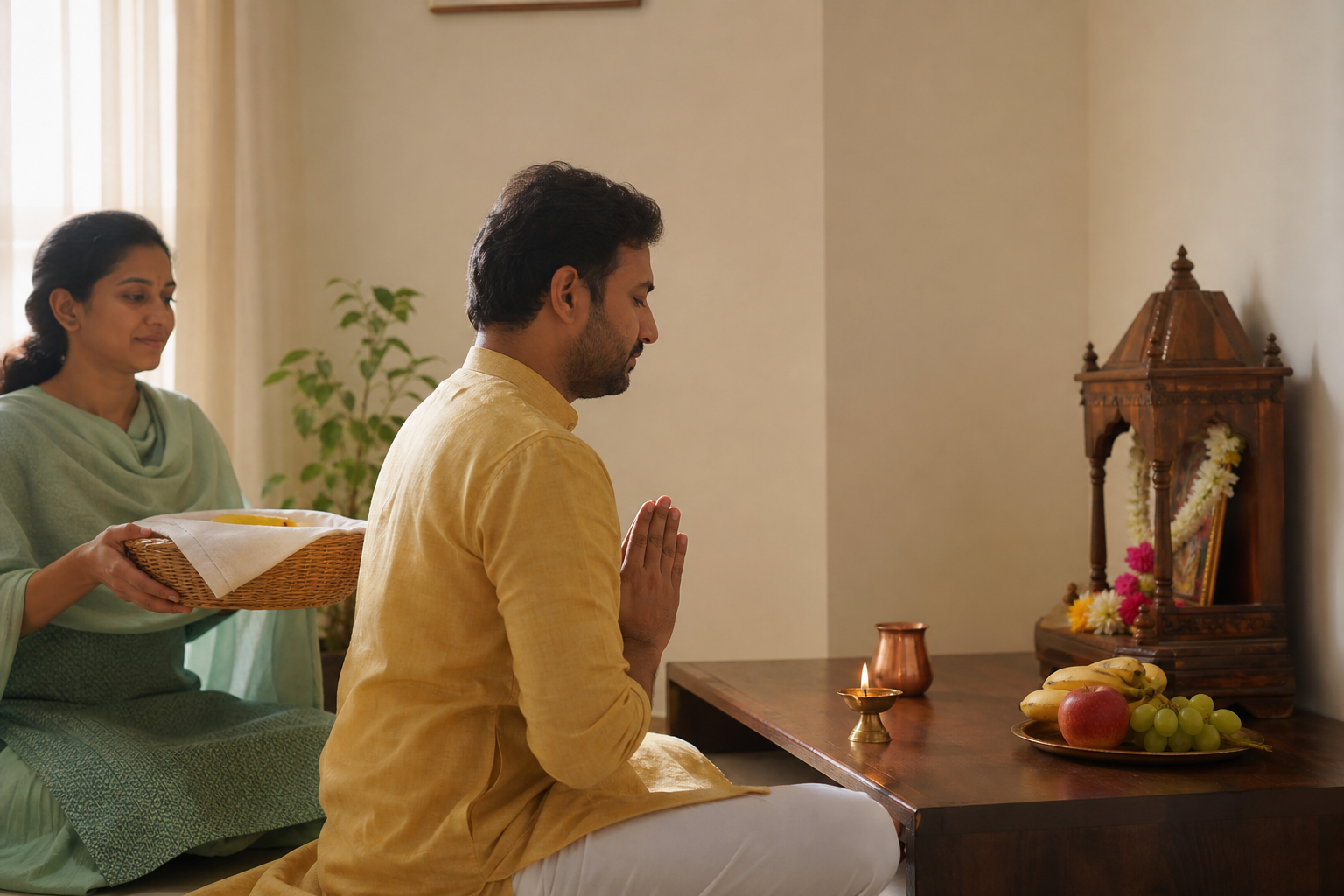
You do not need to reproduce a temple-scale celebration at home. Where your family has a detailed paddhati, follow it. Where it does not, a restrained observance can still preserve the day honestly without pretending to ritual expertise.
- Confirm the local Navami timing. Write down the date and the relevant puja period before buying offerings or coordinating with relatives.
- Name the form you are observing. Decide whether your center is Jagaddhatri, Amla Navami, Akshaya Navami or Kruta Yugadi. If two names belong to one inherited family practice, preserve that relationship rather than separating them artificially.
- Make a short sankalpa. State plainly what you are honoring and what you intend to cultivate: protection of dharma, truthful speech, self-discipline, gratitude, compassion or service.
- Use a familiar act of worship. Offer flowers or sweets where that is customary, recite a mantra you have received or already use, read from the Bhagavad Gita, meditate or join the local temple’s worship. Do not invent a deity-specific procedure from fragments found online.
- Pair devotion with dāna or seva. Share food, support education, assist a community effort or contribute to environmental care. Choose an act you can perform respectfully and complete, rather than announcing a larger promise that will disappear after the festival.
- Carry one commitment into daily conduct. Identify the action that will make the puja visible after the lamp is extinguished: correcting dishonest speech, restraining a harmful reaction, completing neglected service or repairing a duty you have avoided.
For Jagadhatri Puja, joining a temple or community pandal is especially valuable when you do not know the deity-specific procedure. Collective worship preserves mantra, image, offering and timing within a living tradition. You can participate through attention, flowers, food service or practical help without assuming the role of a trained ritualist.
For an amla-centered observance, access to a tree may be difficult in an urban home or in the diaspora. Do not create a false ritual merely to imitate the outward form. Follow the adaptation recognized by your family or temple, and retain the day’s deeper movement from reverence toward gratitude and generosity.
Fasting, sacred bathing, extended recitation and elaborate offerings vary by locality and household. Their absence does not need to be concealed with improvised substitutes. If a practice is important in your lineage but unfamiliar to you, ask before Navami rather than guessing during the puja.
Key takeaways for a coherent Kartik Navami
- Kartik Shukla Navami is one lunar tithi with several regional and theological expressions, not one standardized ritual observed identically everywhere.
- A current, location-specific panchang should determine the date; an old Gregorian date should never be reused automatically.
- Your family, sampradāya and trusted local temple are better guides to ritual form than a combined internet checklist.
- Jagadhatri Puja centers Devi’s protective power; Amla Navami centers reverence and generosity; Kruta Yugadi centers the ideals of truth and dharmic renewal.
- A manageable act of worship joined to dāna, seva or ethical discipline is more coherent than an elaborate mixture of unfamiliar practices.
- Shared Dharmic values do not require every tradition to perform the same ritual. Hindu, Buddhist, Jain and Sikh paths can resonate through truth, ahimsa, compassion, self-restraint and seva while retaining their distinct teachings and forms.
Before the next Kartik observance, record four things for your household: the name you use, the panchang or temple you trust for timing, the central ritual you follow and the form of dāna or seva that accompanies it. That small family record will prevent the same confusion from returning each year.
Then let Navami ask something concrete of you. If the day honors inexhaustible merit, protective Shakti or the moral clarity of Satya Yuga, give that ideal a place in your next decision. A tradition remains alive when its calendar changes conduct.
References
- DharmaRenaissance Blog — Jagadhatri Puja 2025: Discover the Complete Guide to Kartik Navami in Bengal
- DharmaRenaissance Blog — Ultimate Guide to Kruta Yugadi (Satya Yugadi) 2025: Discover Akshaya Navami’s Golden Era
