
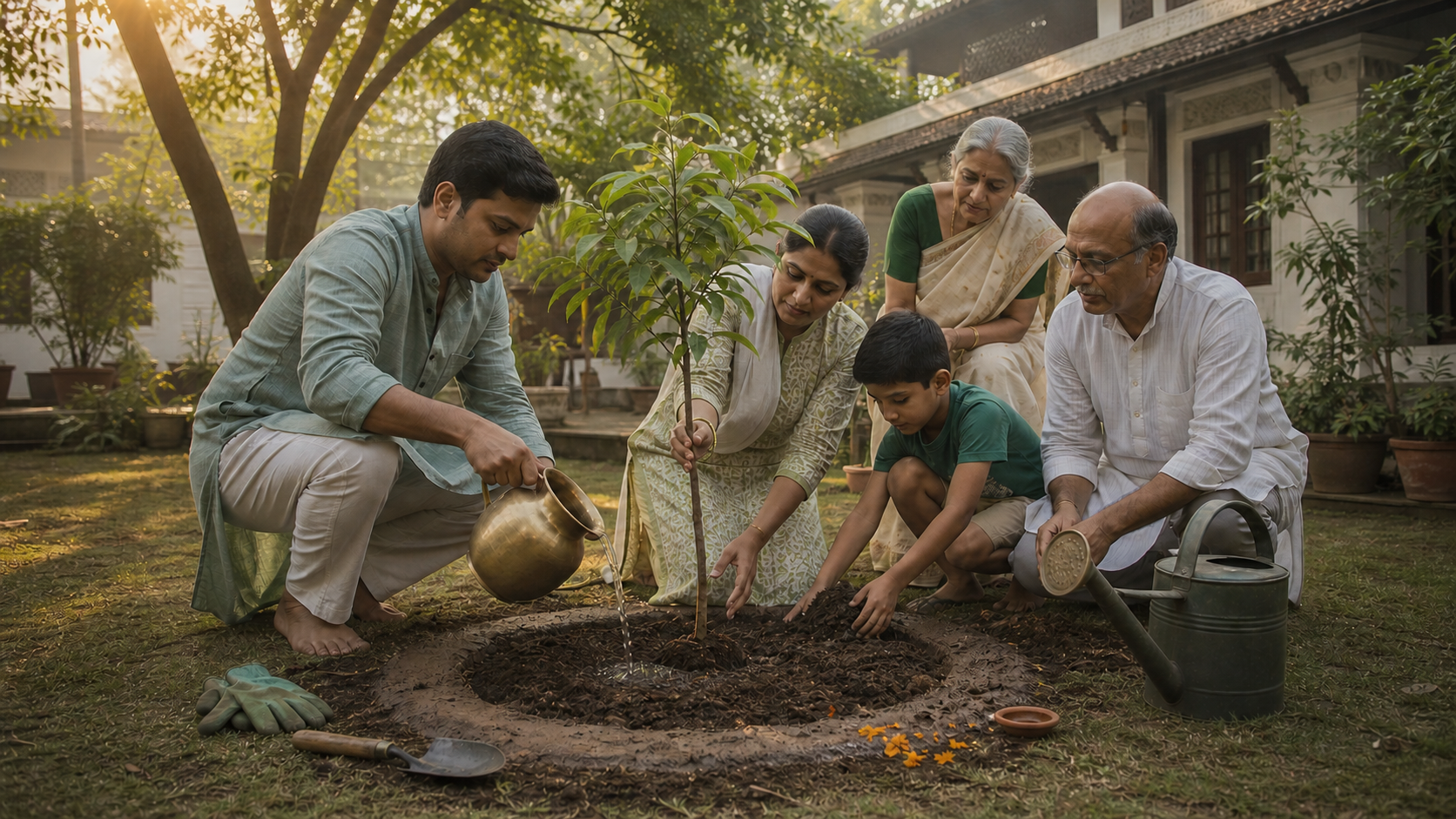
You may have a sincere manokamna—for steadiness in your family, clarity in a difficult season, better health, or a more secure livelihood—and wonder which sacred tree you should plant. The tree matters, but it isn’t the first decision. Your first decision is whether you are ready to care for a living being after the emotion of making the wish has passed.
A sound sacred-tree practice joins three things: an ethical sankalpa, a species the chosen place can sustain, and dependable care through changing seasons. When all three are present, your wish stops being a demand placed upon nature. It becomes a discipline practised with nature.
Make a sankalpa that includes your responsibility
A sankalpa is more useful when it directs your conduct instead of merely naming an outcome. You cannot command another person’s choices, guarantee a financial result, or bargain for recovery from an illness. You can decide how you will act while seeking those outcomes.
Use a simple form: May this dharmic quality or worthy outcome grow; as my part, I will undertake this specific duty. Keep it short enough to remember whenever you approach the tree.
Suppose you want harmony at home. “Make my family peaceful” puts the whole burden outside you. A more grounded sankalpa would be: “May harmony grow in our home; I will speak truthfully, repair quarrels promptly, and tend this Ashoka with my family.” The aspiration remains devotional, but it now carries a standard by which you can examine your own behaviour.
Before choosing a sapling, ask yourself:
- Is the aspiration compatible with dharma, or does it depend on coercing, deceiving, or harming someone?
- What action belongs to you, regardless of whether the desired result arrives quickly?
- Who will care for the plant when you travel, become ill, or move?
- Can you accept that the spiritual value lies in devotion and right action, not in controlling the outcome?
If you cannot yet answer the care question, pause before planting. A tree can outlive the urgency that inspired your vow. Waiting until you have a viable site and a second caretaker is more reverent than planting immediately and abandoning the sapling later.
Choose the tree for both its meaning and its place
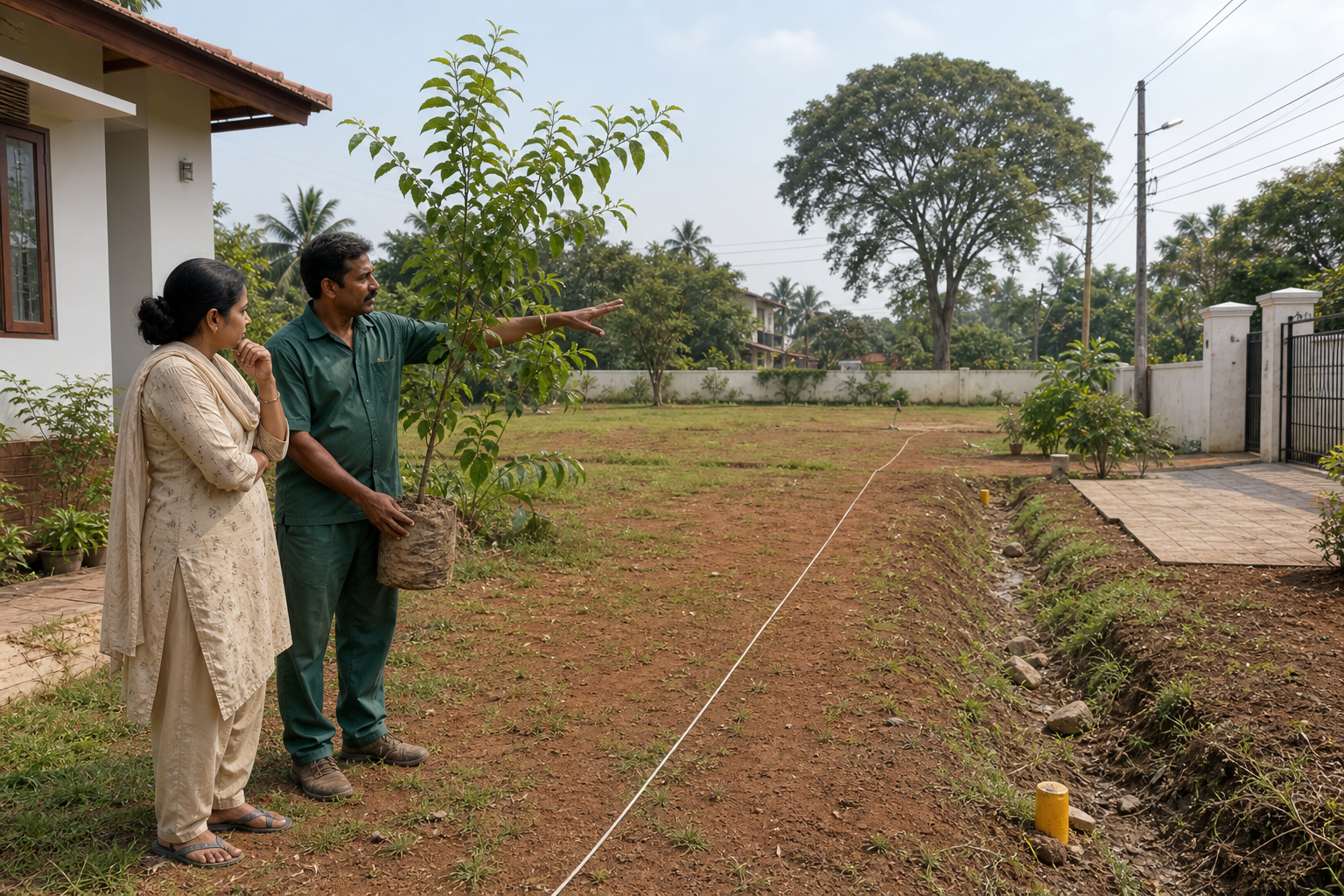
Traditional associations can help you give the practice a coherent form. Peepal is associated with spiritual clarity, Banyan with stability, Bilva with purity and balance, Tulsi with a sattvic home, Neem with purification, Amla with vitality, Ashoka with harmony, and Mango with auspicious beginnings. These associations guide intention; they do not override climate, space, soil, or the mature size of the plant.
| Sacred tree or plant | Traditional orientation | Practical selection test |
|---|---|---|
| Peepal (Ficus religiosa) | Spiritual clarity, calm, and contemplation | Choose it only where a large, long-lived tree can mature in open ground under continuing care. |
| Banyan (Ficus benghalensis) | Stability, longevity, and family welfare | Its symbolism calls for permanence, so favour a genuinely spacious community, temple, or institutional site with permission and a named steward. |
| Bilva (Aegle marmelos) | Purity, balance, and devotion to Shiva | Use it where the species is regionally suitable and its long-term garden care can be maintained. |
| Tulsi (Ocimum sanctum) | Health, protection, and a sattvic household atmosphere | It can suit a courtyard or appropriate container when the local climate and household routine support regular attention. |
| Neem (Azadirachta indica) | Purification and resilience | Confirm local suitability and leave enough room for a mature tree rather than treating it as a decorative sapling. |
| Amla (Phyllanthus emblica) | Nourishment and vitality | Choose it when a locally adapted fruit-bearing tree fits the site and someone will manage its continuing care. |
| Ashoka (Saraca asoca) | Household harmony and joy | Obtain suitable planting stock and confirm that the garden’s climate, soil, and available space can support it. |
| Mango (Mangifera indica) | Auspicious beginnings | Plant only where there is room and responsibility for a mature fruit tree, not merely a festival-season symbol. |
Run four checks before making the final choice: local climate, mature size, soil and water needs, and long-term stewardship. Ask an experienced local nursery or horticulturist which native or region-adapted species has a realistic chance of thriving. A locally suitable tree supports the surrounding ecology more responsibly than a symbolically preferred species forced into the wrong conditions.
Space is a decisive constraint, not a minor inconvenience. A small corner does not become an appropriate Banyan site because the intention is sincere. A container can suit a sacred household plant such as Tulsi when properly maintained, but a small pot is not a responsible permanent plan for a tree meant to reach substantial size. If you rent, expect to move, or lack planting rights, care for an existing tree with permission or join a community planting whose stewardship is already organised.
Keep ritual significance separate from medical use. Bilva, Neem, Amla, and other revered species have Ayurvedic associations, but sacred status alone does not establish that a preparation is safe for a particular person. Do not ingest leaves, fruit, bark, or homemade remedies merely because you planted the species for a sankalpa. Species identification and health decisions require appropriately qualified guidance.
Turn the planting ceremony into a care system
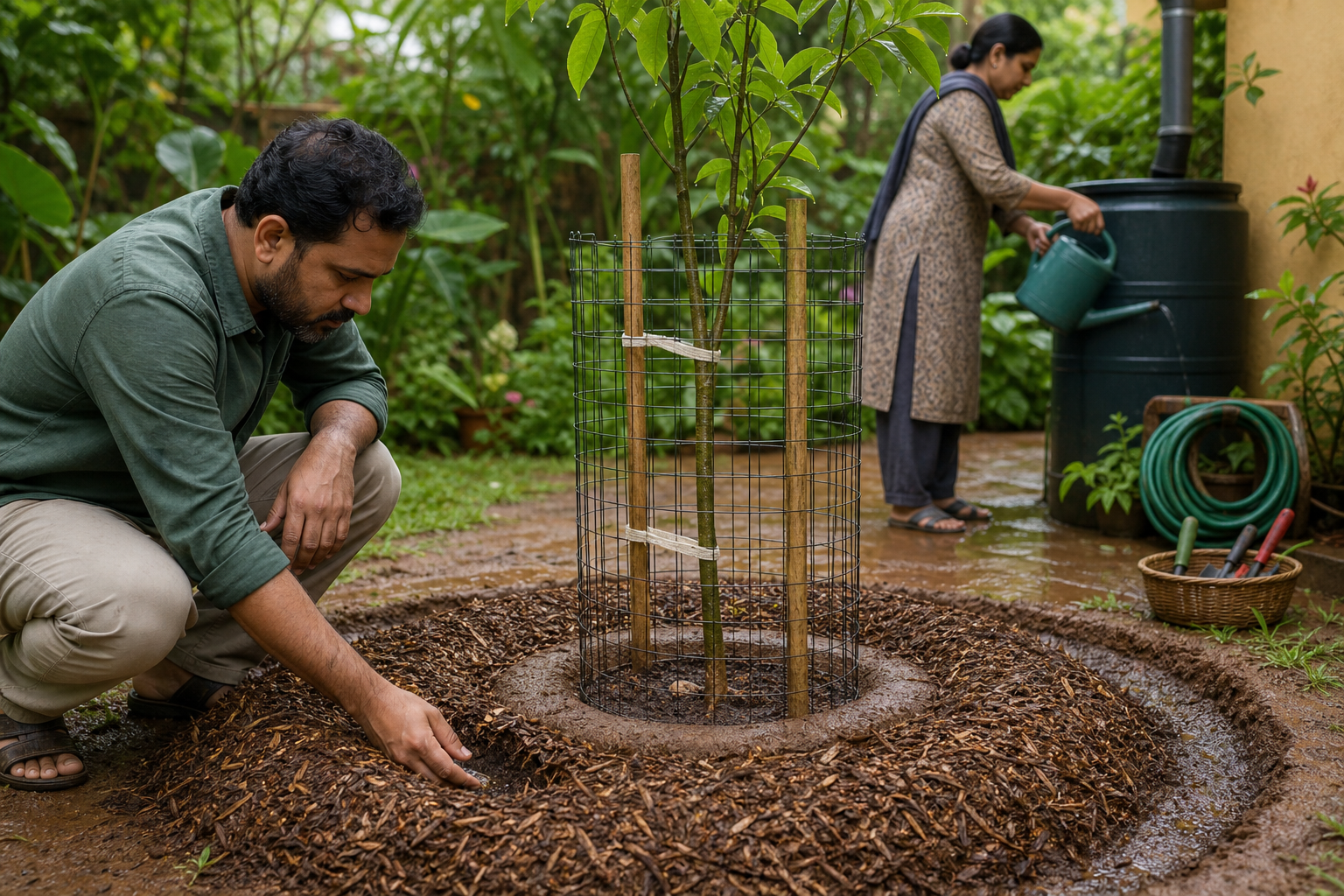
The vulnerable part of this practice is rarely the planting ceremony. It is the ordinary stretch afterward, when the family is busy, rainfall changes, or the enthusiastic organiser is away. Build continuity before you conduct the ritual.
- Secure the site and permission. Do this before obtaining the sapling. For temple, gurdwara, vihara, community, rented, or shared land, ask the responsible caretaker where planting is allowed and who controls future maintenance.
- Name a primary and backup steward. “The family will water it” is vague. Assign a person, identify a substitute, and make sure both know the species and its care requirements.
- Follow local planting guidance. The right season and method depend on local climate, soil, and species. A religiously meaningful date cannot compensate for conditions in which the sapling is unlikely to establish.
- State the sankalpa simply. At the planting, clean the area, recall the aspiration, name your corresponding duty, and offer prayer in the manner customary to your family or sampradaya. Circumambulation can become a quiet practice of returning the mind to that duty.
- Water according to the plant’s needs. Daily devotion does not necessarily mean daily watering. Attention may be daily, while the watering schedule must respond to rain, soil, season, and species. Treat ritual water as part of responsible care, not as a reason to overwater.
- Protect the young plant. Maintain the surrounding soil and use an appropriate guard where animals, foot traffic, or accidental damage threaten the sapling. Inspect it regularly for wilting, breakage, disturbed soil, or a failing support.
- Review care when the season changes. Do not assume that the routine used immediately after planting remains correct throughout the year. Seek local advice when growth, weather, pests, or soil conditions change.
Keep worship tree-safe. Do not drive nails into the trunk, bind it with tight wire, place flame against it, or leave plastic around the root area. Remove offerings that could become litter. Clean water, a clean site, prayer, and attentive care express reverence without turning the tree into a support for materials that may injure it.
A household can connect the care routine to an existing rhythm: a brief morning prayer, a weekly inspection, or a regular family visit. The ritual cue helps you remember, while the plant’s actual condition determines what work is necessary. This distinction prevents both neglect and excessive intervention.
For a community planting, put the care plan where participants can see it. Name the coordinator, identify who holds the water access or keys, and arrange coverage during absences. Planting near temples, gurdwaras, viharas, and community centres can turn devotion into shared service, but only when responsibility survives beyond the inaugural gathering.
This practice also offers genuine common ground across Dharmic traditions without pretending that all traditions are identical. The Bodhi tree carries the memory of awakening in Buddhism. Jain ahimsa deepens responsibility toward living beings. Sikh wisdom treats air, water, and earth with sacred and familial reverence. Hindu traditions preserve distinct relationships with Peepal, Banyan, Bilva, Tulsi, and many other forms of plant life. A shared planting should honour these connections while allowing each community to pray in its own way.
The outward benefits do not depend on everyone holding the same theology. A surviving tree can provide shade, support local life, improve the immediate soil environment, and help soften urban heat. Families and neighbours who maintain it also preserve ritual memory through action. That is a practical form of dharmic unity: cooperation rooted in ahimsa, gratitude, restraint, and care for the earth.
Do not turn the tree into a transaction or an omen
A sacred tree is not a vending machine for desired outcomes. Planting one cannot guarantee marriage, money, recovery, conception, reconciliation, examination results, or any other external event. It would be dishonest to promise otherwise. What the practice can clearly create is a structure for remembrance, disciplined action, ecological care, and service.
Keep taking the ordinary steps your situation requires. A health sankalpa belongs alongside appropriate medical care, not in place of it. A livelihood sankalpa belongs alongside honest work, planning, and sound financial decisions. A family-harmony sankalpa belongs alongside truthful conversation, boundaries, apology, and repair. The ritual should strengthen responsible action rather than excuse you from it.
Do not read every change in the plant as a verdict on your worth or the future. Wilting, leaf loss, slow growth, or the death of a sapling should first be treated as a practical horticultural problem. Check water, drainage, physical damage, weather, and regional suitability. Ask a knowledgeable local person to examine the situation. If replanting is appropriate, correct the likely cause rather than repeating the same conditions.
A failed planting need not become a spiritual accusation. It can become a lesson in humility: intention does not remove the need for knowledge, and devotion does not make a living organism obey our timetable. If the site cannot sustain the chosen species, changing the species or the site is not a betrayal of the sankalpa. It is the responsible fulfilment of it.
The inverse mistake is equally important. Do not keep an unsuitable or dangerous planting merely because removing or relocating it feels inauspicious. Obtain competent local guidance and act for the welfare of people, structures, and the tree. Dharma is not served by preserving an avoidable hazard.
The one-minute readiness check
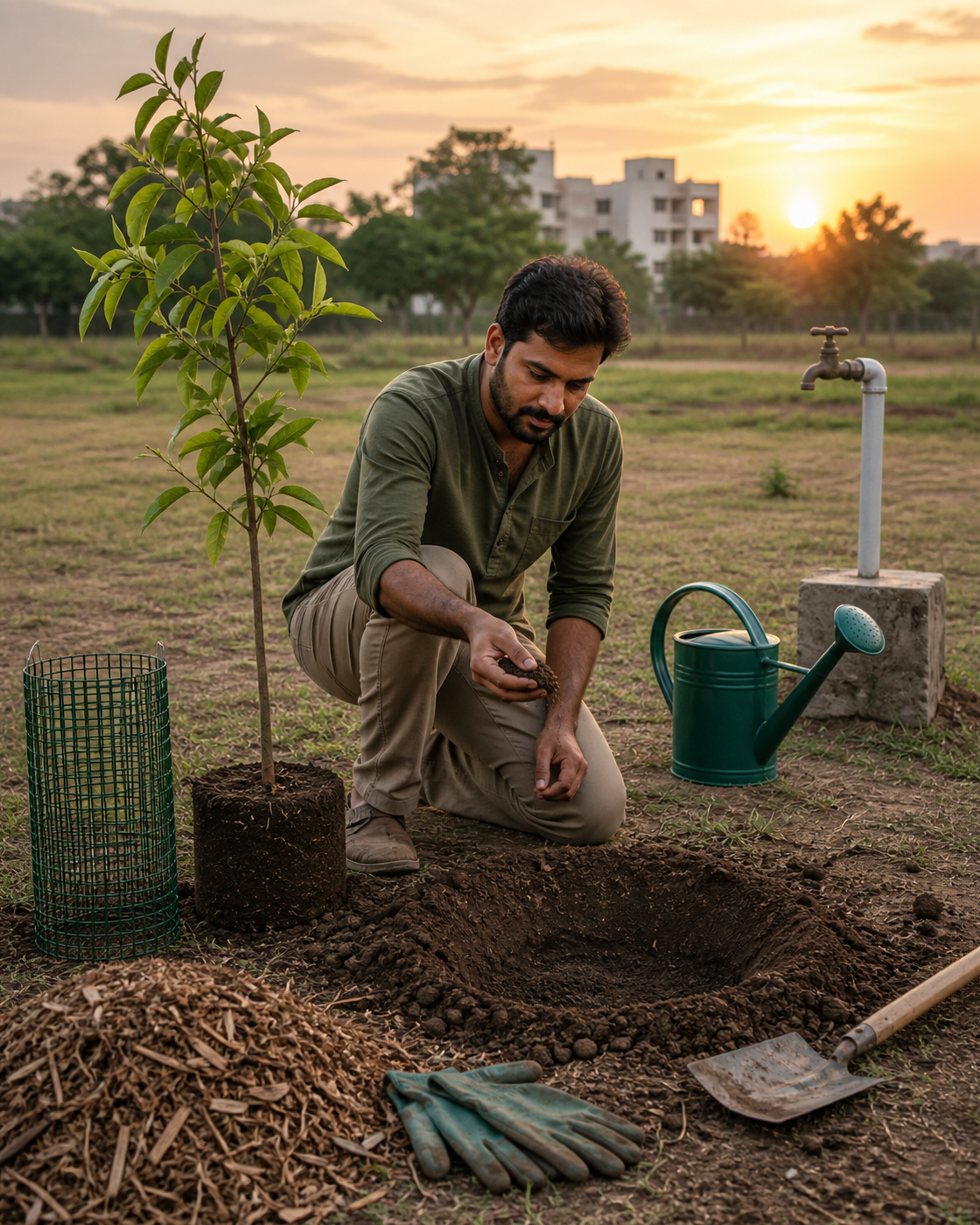
You are ready to begin when you can answer yes to each of these questions:
- Can you state one ethical sankalpa in a single clear sentence?
- Have you named the action you will take instead of demanding only an outcome?
- Is the species native or region-adapted, with enough room for its mature form?
- Do you have permission to plant at the chosen site?
- Are both a primary caretaker and a backup caretaker committed?
- Will you continue the medical, financial, relational, educational, or professional actions that the aspiration requires?
If one answer is no, resolve it before planting. This week, choose one aspiration, examine one realistic site, and speak to one person who understands local plant care. Once the practical foundation is sound, plant with prayer—and let every season of care become part of the sankalpa.
References
