
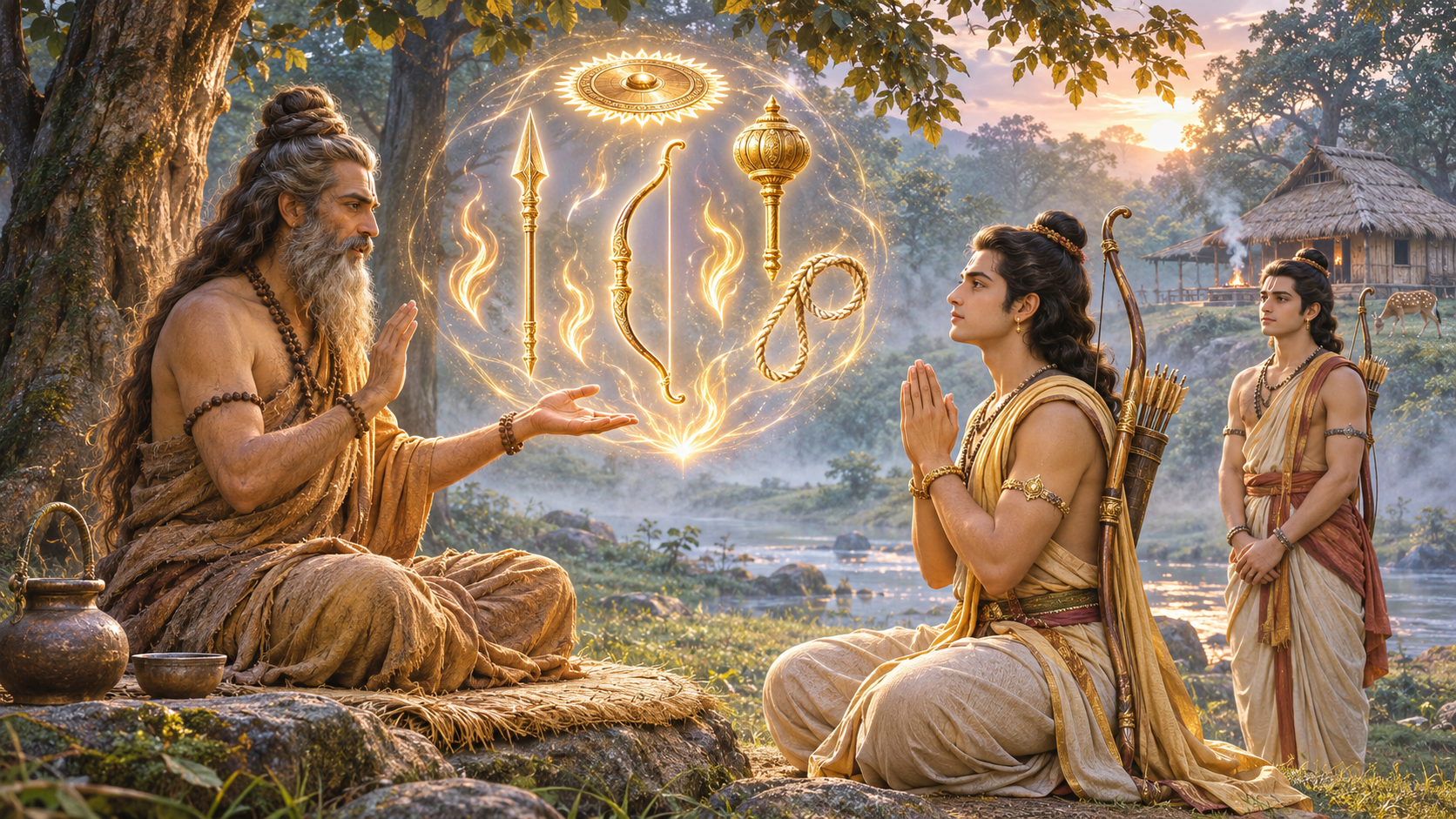
If you came here expecting only a catalogue of celestial weapons, pause at the question the episode itself makes unavoidable: why does a sage entrust such power to Rama? The useful answer lies not in spectacle, but in the relationship between duty, readiness, guidance, and restraint.
In Bala Kanda, Chapter 27, Vishwamitra gives Rama a large number of divine weapons. He has come to Ayodhya to take Rama and Lakshmana to defend his yajna from rakshasas, and he expresses great delight in Rama. Those details tell you how to read the scene: extraordinary capability is placed inside a defined dharmic responsibility.
What Bala Kanda 27 actually establishes
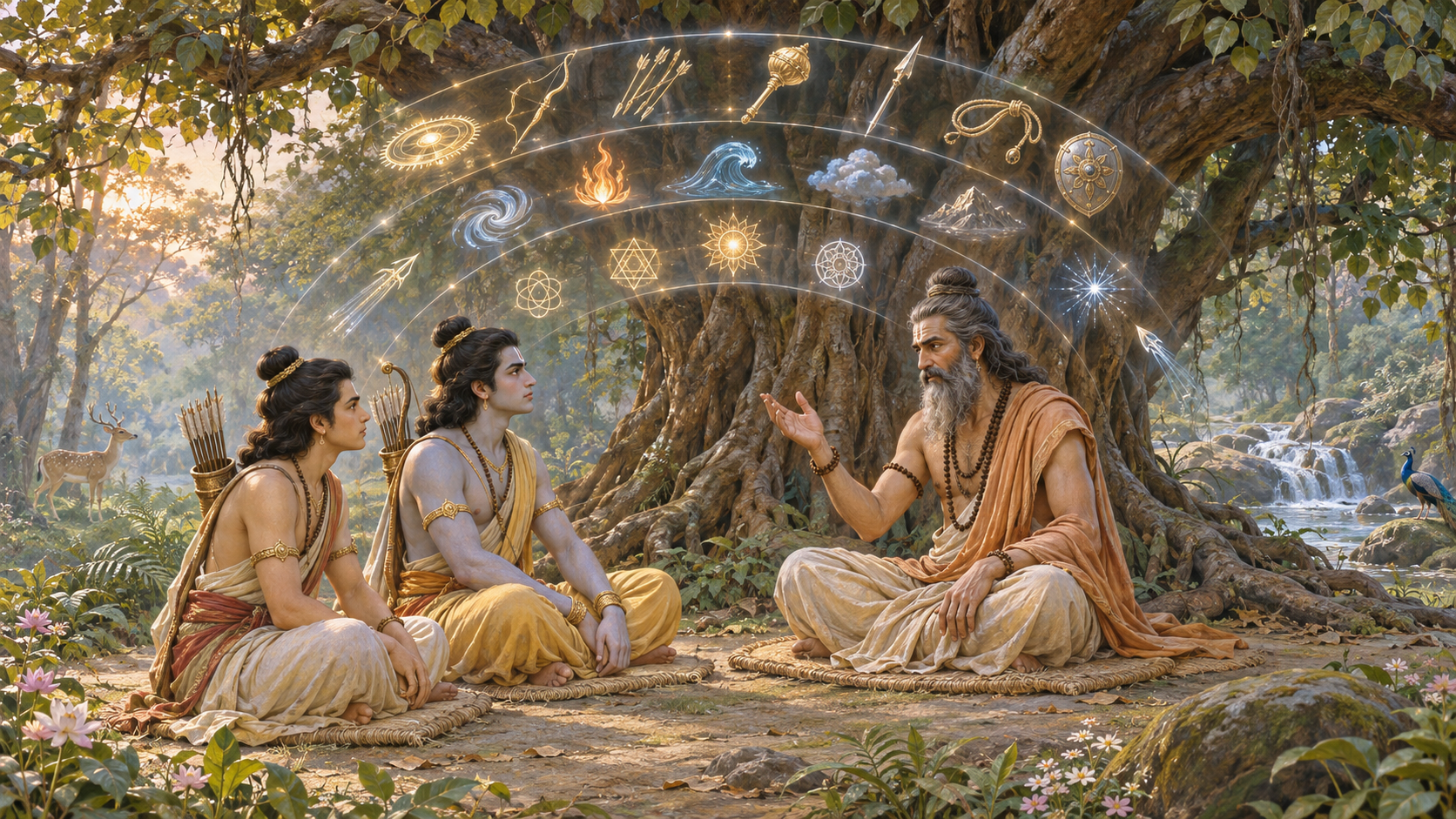
Vishwamitra’s gift can be stated precisely without embellishment: the sage entrusts Rama with many divine weapons. The narrative setting is just as important as the gift. Vishwamitra has sought the two princes for a protective mission because rakshasas are obstructing his yajna.
- Vishwamitra defines the mission and supplies the means needed to undertake it.
- Rama is the recipient of the divine weapons.
- Lakshmana accompanies Rama on the mission, but the gift described here is made to Rama.
- The yajna supplies the purpose: the princes have not left Ayodhya in search of weapons or personal glory.
- The rakshasas are the identified threat against which protection has been requested.
Keep those roles distinct. It prevents two common reading errors: treating Rama and Lakshmana as interchangeable recipients, and detaching the weapons from the reason Vishwamitra brought them out of Ayodhya.
If you need an exact name-by-name inventory, verify every name and spelling directly in the Ramayana edition or translation you intend to cite at Bala Kanda 27. Do not construct a catalogue from memory, social-media graphics, or a mixture of retellings. The secure point is that Vishwamitra gives Rama a substantial body of divine weapons; an unverified list only creates false precision.
The same discipline applies to modern technological comparisons. Calling an astra a nuclear, electrical, or extraterrestrial weapon requires evidence beyond the phrase “divine weapon.” You can preserve the grandeur of the episode without forcing its sacred vocabulary into a modern weapons manual.
The yajna defines the moral boundary of Rama’s power
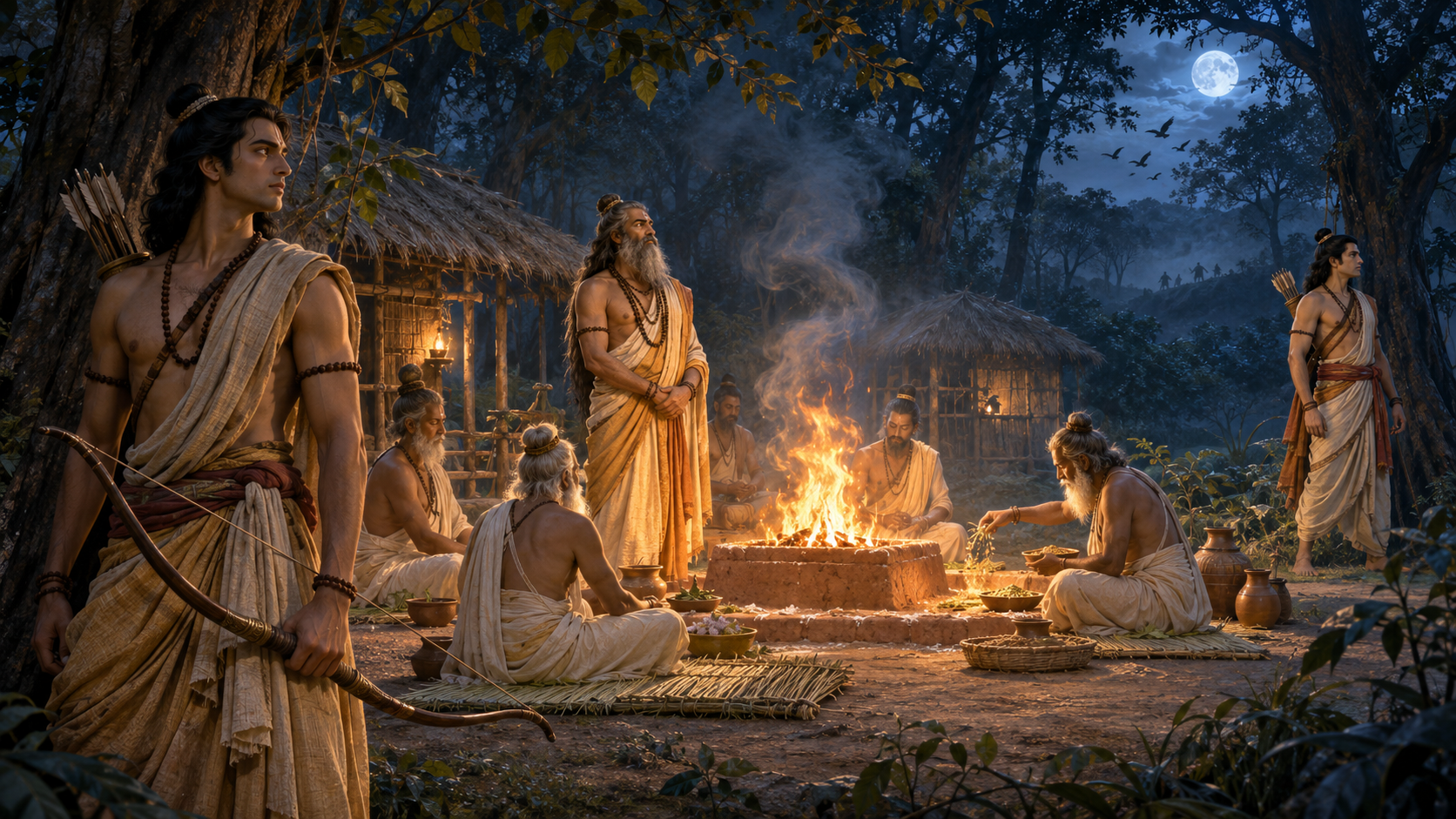
The yajna is not decorative background. It is the duty around which the entire mission is formed. A sacred undertaking is being obstructed; Vishwamitra seeks protection; Rama and Lakshmana accompany him; and Rama is equipped for that responsibility.
Remove the yajna, and the episode can look like a simple increase in a hero’s combat power. Keep it in view, and a dharmic pattern appears: power is entrusted for service, not collected for display. Rama’s capability is connected to something he has been called upon to protect.
This does not mean that invoking a sacred cause automatically makes any use of force dharmic. The scene gives you a more demanding set of questions:
- What specific duty has been placed before the person receiving power?
- Who entrusts that responsibility, and on what basis?
- What is being protected rather than merely acquired or conquered?
- Does the use of power remain connected to the declared mission?
- Has possession of a capability been mistaken for unlimited permission to use it?
These questions help you avoid two opposite mistakes. One is reducing the episode to fantasy equipment. The other is extracting a vague slogan about righteous force while ignoring the particular duty that gives the force its context. The narrative joins mission and capability; a sound interpretation should keep them joined.
Vishwamitra’s trust is part of the gift

Vishwamitra is not merely someone who requests protection. He is also the sage who equips Rama. His declared delight in Rama matters because the transfer is not portrayed as random or impersonal. The person who defines the duty also recognizes the recipient and entrusts him with the means to carry it out.
Three elements therefore remain joined in the episode: a duty that must be performed, a relationship of trust, and the capacity needed for action. If you focus only on the weapons, you lose the first two. Yet those first two are what stop power from becoming an end in itself.
This gives the passage practical value beyond its martial setting. Whenever you accept authority, specialized knowledge, leadership, or any tool that can affect others, apply the same structure:
- Name the duty in one clear sentence. If you cannot define the responsibility, you cannot define the proper use of the power.
- Identify the relationship of accountability. Ask who entrusted you, who can correct you, and whose welfare the responsibility serves.
- Define where the authority ends. A tool supplied for one duty does not silently create permission for every possible use.
- Learn before acting. Receiving capability carries an obligation to understand it rather than displaying it prematurely.
If you are explaining the episode in a class, satsang, family discussion, or short public talk, begin with the mission rather than the arsenal. A reliable summary is: Vishwamitra came to Ayodhya seeking Rama and Lakshmana’s protection for his yajna. In Bala Kanda 27, pleased with Rama, he entrusted Rama with many divine weapons. The scene connects exceptional power with a defined duty under a sage’s guidance.
Key takeaways
- The transfer of divine weapons occurs in Bala Kanda, Chapter 27 of the Ramayana.
- Vishwamitra came to Ayodhya to take Rama and Lakshmana on a mission to protect his yajna from rakshasas.
- Rama is the recipient of the large body of divine weapons; Lakshmana accompanies him on the protective mission.
- Vishwamitra’s delight in Rama makes trust and recognition part of the scene, not incidental details.
- The yajna supplies the moral frame: the weapons are entrusted in connection with service and protection.
- Any exact inventory or modern technological comparison should be checked against the text rather than supplied from memory or speculation.
On your next reading of the chapter, mark four things before studying any weapon name: duty, teacher, trust, and boundary. That order preserves the wonder of Vishwamitra’s gift while keeping its dharmic meaning intact.
References

Leave a Reply
You must be logged in to post a comment.