
If you have seen the Kurla case presented as proof that parts of Mumbai have become communal no-go zones, pause before forwarding that conclusion. A serious gang-assault allegation demands prompt police action, but there is still a gap between what the victim’s family alleges and what has been publicly established.
Recognising that gap is not a retreat from Hindu safety. It is how you keep a grave complaint from being weakened by claims that investigators cannot yet prove. The responsible position is firm: preserve the evidence, investigate the violence, explain the police response and determine motive from facts rather than neighbourhood labels.
Key takeaways before you share the Kurla claim
- The central allegation is that Shubham Parmar and two friends were attacked by a large motorcycle gang near Phoenix Marketcity on the night of 20 November.
- Shubham’s family says he suffered head, dental and facial injuries, yet only a non-cognisable complaint had been registered four days later.
- A couple separately alleged another attack near the same mall earlier that day. Proximity and timing justify investigation, but they do not establish that the two incidents were connected.
- Shubham’s Hindu identity does not by itself prove that he was selected because he was Hindu. Communal motive is a claim about why an attack occurred, not merely who the victim was.
- The most useful public demand is immediate CCTV preservation, documented police action, witness protection and a clear explanation of the complaint’s present status.
What is alleged, and what remains unverified
On the night of 20 November, Shubham Parmar and two friends were allegedly set upon by 13 to 15 men on motorcycles opposite Phoenix Marketcity in Kurla. His brother, Vrushab Parmar, said Shubham required stitches for head and lip injuries and had broken teeth. These details describe potentially grave violence, not a minor street quarrel.
The family’s concern is also about the official response. Vrushab said that four days after the attack, Vinoba Bhave Nagar police had registered only a non-cognisable complaint rather than an FIR. He further alleged that, after two visits to the police station, Shubham was sent to check nearby CCTV cameras himself. While doing so, Shubham reportedly recognised one alleged attacker near Naaz Hotel.
That last allegation should trouble anyone concerned with victim safety. An injured complainant should not have to expose himself to a suspected assailant while trying to secure evidence. Identifying cameras, approaching possible suspects and obtaining recordings are matters that should be handled through lawful investigative channels.
At the same time, we do not have a police statement, the complaint itself, medical documents, CCTV footage or a response from any accused person. Their absence here does not mean that those records do not exist. It means you should describe the details as the family’s allegations unless and until independent evidence or an official case record corroborates them.
A second allegation has added to public concern. At about 4 pm on the same date, a Hindu couple reportedly said they were attacked at Pramod Mahajan Garden behind the mall. The woman alleged sexual touching, while the man allegedly faced a group using sticks, stones and knuckle-dusters. A firearm threat was also alleged.
These are two distinct complaints involving different alleged attackers and circumstances. The same date and general area create a legitimate investigative question: was there any overlap in participants, vehicles, communications or planning? They do not supply the answer. Until evidence connects the episodes, merging them into one coordinated operation would go beyond what is known.
Why the communal conclusion is not yet proved

A communal motive cannot be inferred from the victim’s religion alone. Investigators would need evidence bearing on selection and intent: communal threats during or before the attack, prior targeting, communications among attackers, a pattern connecting identified perpetrators, witness testimony or other reliable material. No such evidence has yet been made available to us in Shubham’s case.
Nor does a locality’s religious reputation establish who committed a particular offence. A claim that an area is an Islamist pocket or a no-go zone is much broader than a claim that a violent incident occurred there. It implies persistent territorial control, selective intimidation and a failure of ordinary law enforcement. That conclusion requires sustained, verifiable evidence; it cannot rest on demographic assumptions or one family’s account.
The earlier garden allegation does not remove this evidentiary burden. Even if the alleged attackers there are accurately identified as madrassa students, that would not establish the identity or motive of the motorcycle gang. Similarity of fear is not proof of common participants, and physical proximity is not proof of coordination.
The initial police classification also needs scrutiny without being treated as automatic proof of communal bias. A non-cognisable entry, an FIR and a later change in invoked offences are not interchangeable outcomes. The family is entitled to ask what facts were recorded, how the alleged injuries were considered and why the matter received its particular classification. But the conclusion that police acted from bias requires evidence of its own.
This discipline strengthens pro-Hindu advocacy. If every uncertainty is filled with the most inflammatory interpretation, officials can dismiss a concrete demand for investigation as social-media speculation. If we distinguish established facts from allegations, the essential questions become harder to evade: who attacked Shubham, what evidence was preserved and why did the initial police response take the form described by his family?
How to turn outrage into a usable evidence trail
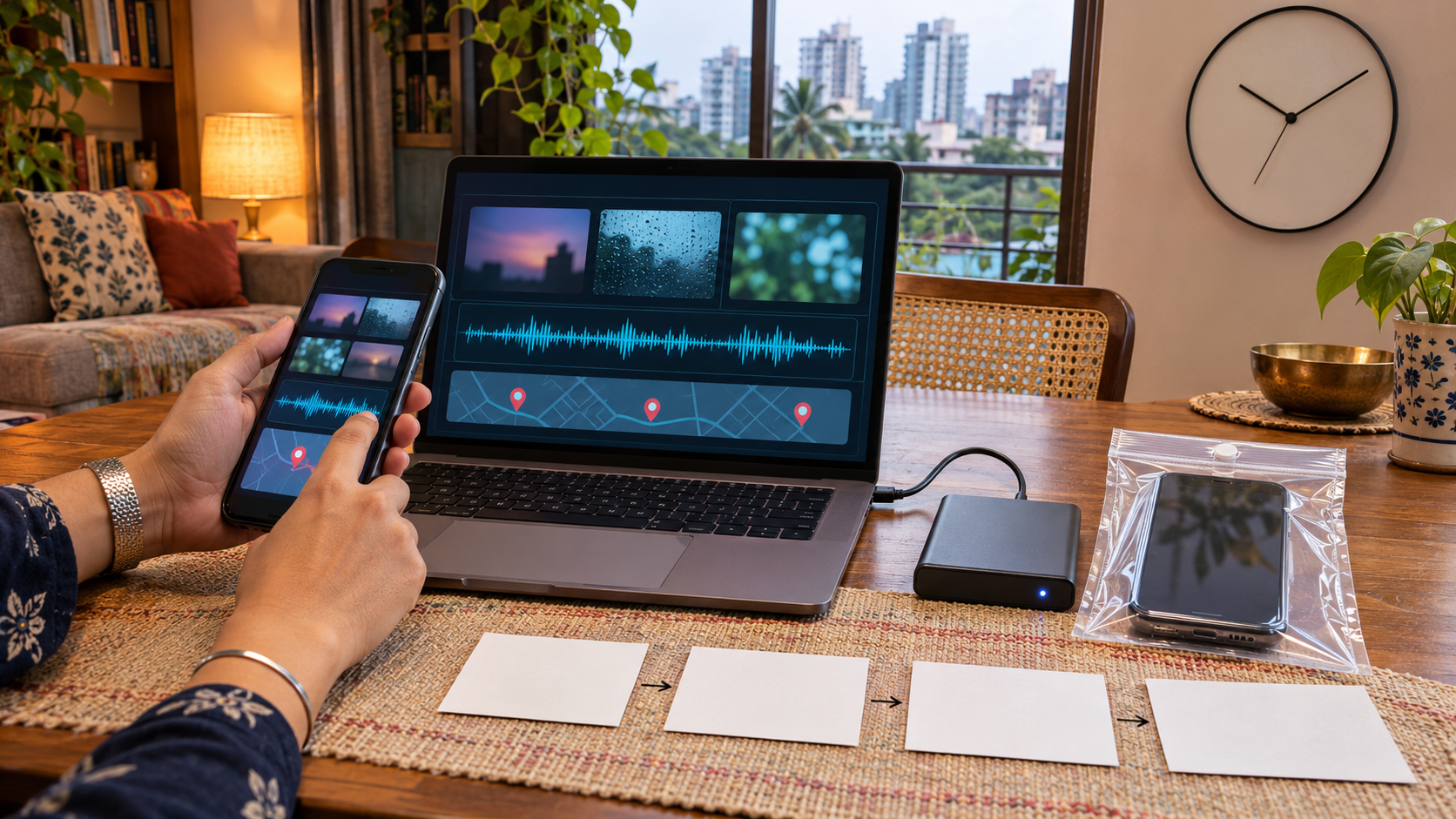
If you are helping a victim’s family in a case like this, the first priority is not a viral label. It is a record that remains useful after online attention moves elsewhere. Medical needs and immediate safety come first; documentation should follow without sending an injured person back into a potentially dangerous situation.
- Create one chronology. Record the approximate time, precise locations, direction of travel, vehicles, clothing, words allegedly spoken, injuries, witnesses and every interaction with police. Mark uncertain details as uncertain instead of filling gaps from memory.
- Preserve the medical trail. Keep hospital papers, prescriptions, bills, dental records and original injury photographs. Retain the original files with their dates and make backups. Publicly posting every image is unnecessary and may compromise privacy.
- Preserve the complaint trail. Keep the NC or other complaint number, copies of written submissions, acknowledgement receipts and the dates and names associated with station visits. If the family disputes the legal classification, it should obtain advice from a qualified local lawyer rather than relying on social-media interpretations of criminal procedure.
- Request CCTV preservation promptly. List the mall, road, traffic, hotel, shop and building cameras that may cover the route. Ask police in writing to secure relevant footage for a defined time window, and retain proof that the request was made. The Parmar family has specifically warned that recordings could be overwritten.
- Do not send the complainant to confront or track a suspect. Pass a location, vehicle description or possible identification to police and counsel. Personal pursuit risks another attack and may complicate identification evidence.
- Record witnesses separately. Save contact details and let each witness describe what was personally seen or heard in their own words. Group discussions can unintentionally merge memories and make later accounts easier to challenge.
- Keep the two Kurla allegations separate. Maintain distinct timelines, witnesses, suspect descriptions and evidence lists. Connect them only if CCTV, communications, common vehicles, reliable identification or another evidentiary bridge emerges.
- Use careful public language. Say who alleges what, avoid naming an uncharged person without compelling verified grounds, do not circulate an unverified face as an attacker and correct a claim if later evidence contradicts it. Accuracy protects both innocent people and the credibility of the complainant.
Supporters can help with this work without becoming substitute investigators. They can arrange legal assistance, help organise documents, accompany the family through lawful follow-up and ask senior officials for a written status update. They should not organise a confrontation, pressure witnesses into a common narrative or treat a religious community as collectively responsible for unidentified assailants.
What Mumbai Police must clarify, and what you should watch
Public confidence will not be restored by a generic assurance that a complaint was received. Mumbai Police can address the core concerns without prejudging guilt by answering concrete procedural questions:
- What is the present status and number of Shubham Parmar’s complaint?
- Which alleged acts and injuries were recorded, and what explains the initial classification?
- Were Shubham’s medical records and the statements of his two companions collected?
- Which CCTV cameras were identified, when was preservation requested and has the footage been secured?
- What safety response followed the claim that Shubham saw an alleged attacker near Naaz Hotel?
- Were motorcycle descriptions, registration details or travel routes obtained from witnesses or cameras?
- What is the status of the separate Pramod Mahajan Garden allegation?
- Has any evidence established a connection between the garden incident and the motorcycle-gang allegation?
You should judge the response by dated actions, not slogans: preservation of expiring footage, documented witness contact, lawful identification work, medical corroboration and a reasoned decision about the offences under investigation. An arrest would not itself prove guilt, just as a delay in arrest would not automatically prove a conspiracy. Unexplained delay becomes a legitimate accountability issue, however, when evidence is perishable and the complainant alleges serious injury.
Kurla residents should not have to choose between silence and communal escalation. They are entitled to safe public spaces, equal policing and transparent case handling. Hindus are also entitled to insist that violence against them be treated seriously without first proving a political narrative around it.
If you want to help, ask for a documented case-status update and amplify only claims you can trace. Hindu safety is not served by timidity, but neither is it served by turning an allegation into a verdict. The durable demand is narrower and stronger: secure the evidence, investigate every alleged act, protect the complainants and make the reasons for official decisions visible.
References

Leave a Reply
You must be logged in to post a comment.