
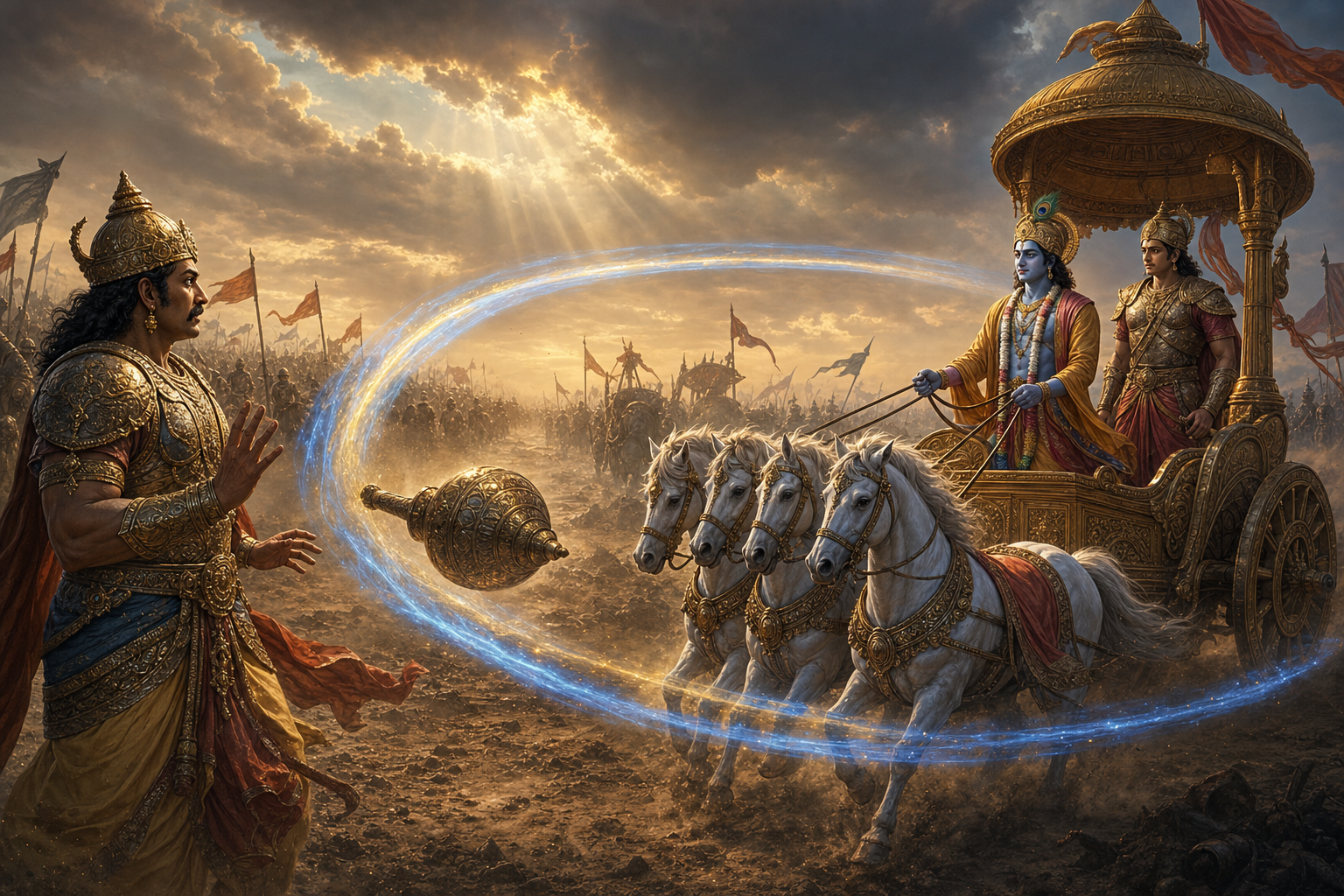
If you came here wondering how a divinely granted weapon could kill its own bearer, the answer is precise: Shrutayudha violated the condition attached to the gift. He used Varuna’s mace against Krishna, who was not fighting as a weapons-bearing warrior, and the weapon returned upon Shrutayudha.
The mace did not malfunction or change loyalties. It completed the consequence built into it. That makes Shrutayudha’s death more than an unusual battlefield incident: it is a compact lesson about power, eligibility, restraint, and the limits of divine protection.
What happened to Shrutayudha at Kurukshetra
Shrutayudha was a warrior king of Kalinga who fought on the field of Kurukshetra. His exceptional weapon came through maternal devotion: his mother sought protection for her son, and Varuna granted him a formidable mace. Yet the gift did not amount to unconditional immortality. Its protective power came with a prohibition: it must not be hurled at someone who was not fighting. If Shrutayudha ignored that boundary, the mace would turn back and destroy him.
That warning determined the end of his story. During his encounter with Arjuna, Shrutayudha directed the mace at Krishna. Krishna was present at the centre of the battle as Arjuna’s charioteer, but he was not engaging Shrutayudha as an armed combatant. The target therefore fell outside the permitted use of the weapon. The mace rebounded, and Shrutayudha died by the very power intended to protect him.
The chain of cause and consequence is important. Shrutayudha was not killed merely because his opponent possessed greater strength. Nor did Varuna suddenly withdraw his favour. Shrutayudha selected a forbidden target, activated the weapon’s stated condition, and brought its destructive force back upon himself.
Varuna’s boon was a covenant, not a blank cheque
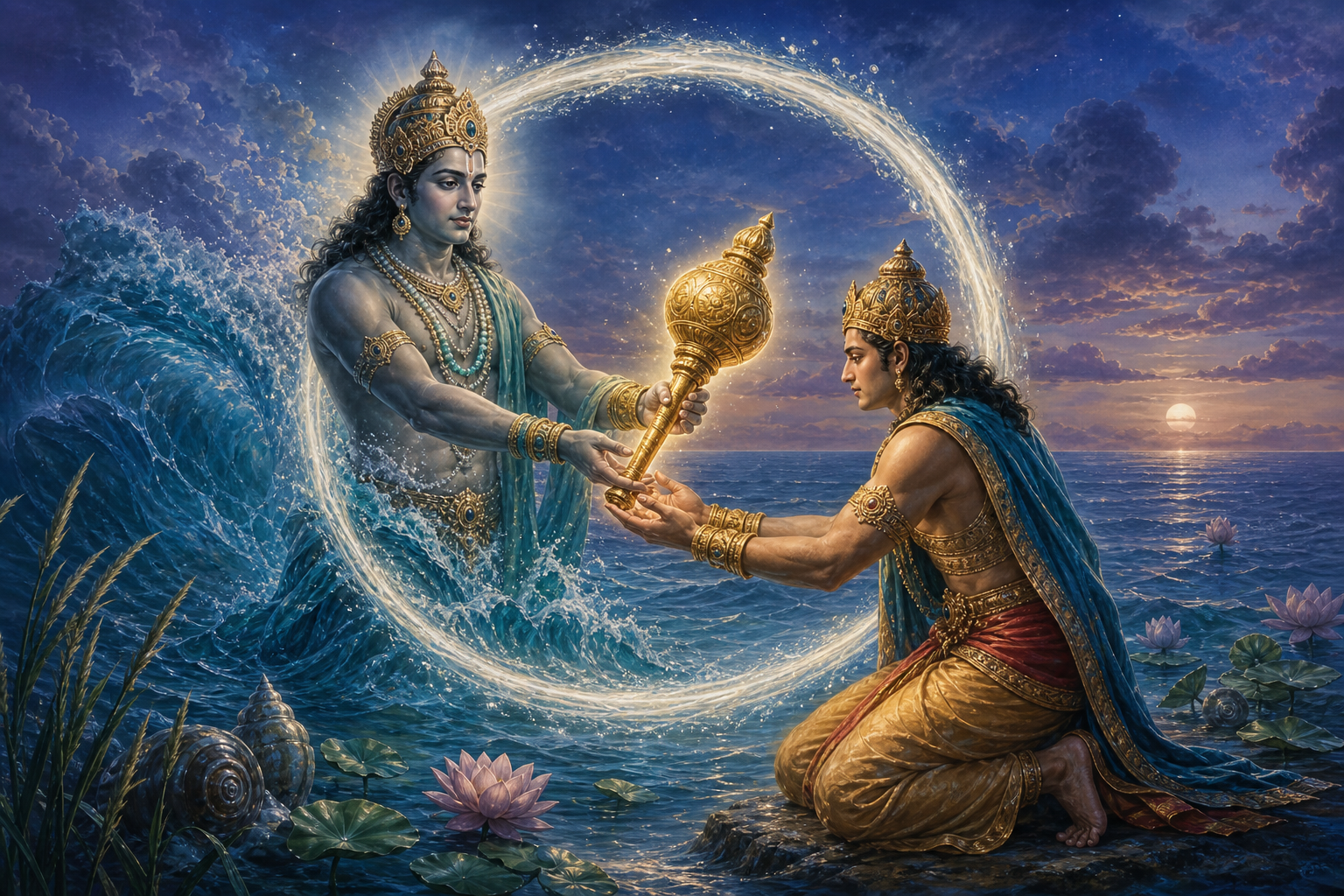
It is tempting to hear the words “divine weapon” and assume unlimited power. Shrutayudha’s mace teaches the opposite. The condition was not a footnote added to the gift; it was part of the gift’s nature. To receive the power was also to accept the rule governing it.
This distinction changes how you should read the episode. Shrutayudha’s fatal error was not that he possessed extraordinary strength. Dharmic narratives do not ordinarily treat strength, skill, authority, or divine favour as inherently corrupt. The decisive question is whether the bearer keeps that strength within its proper boundary. Capability answers “What can this do?” Dharma asks the further questions: “When may it be used, against whom, and for what purpose?”
Shrutayudha behaved as though possession created permission. It did not. Varuna had supplied the weapon, but Shrutayudha still had to exercise discernment. Divine assistance enlarged his capacity; it did not replace his judgment or relieve him of responsibility for choosing a target.
This is also why the story should not be reduced to “the gods punished pride.” That reading is too vague. Whatever emotion accompanied Shrutayudha’s decision, the narrative identifies a concrete failure: he used a conditional power outside its authorised scope. You do not need to speculate about his inner state to understand his fall.
Why Krishna was the wrong target
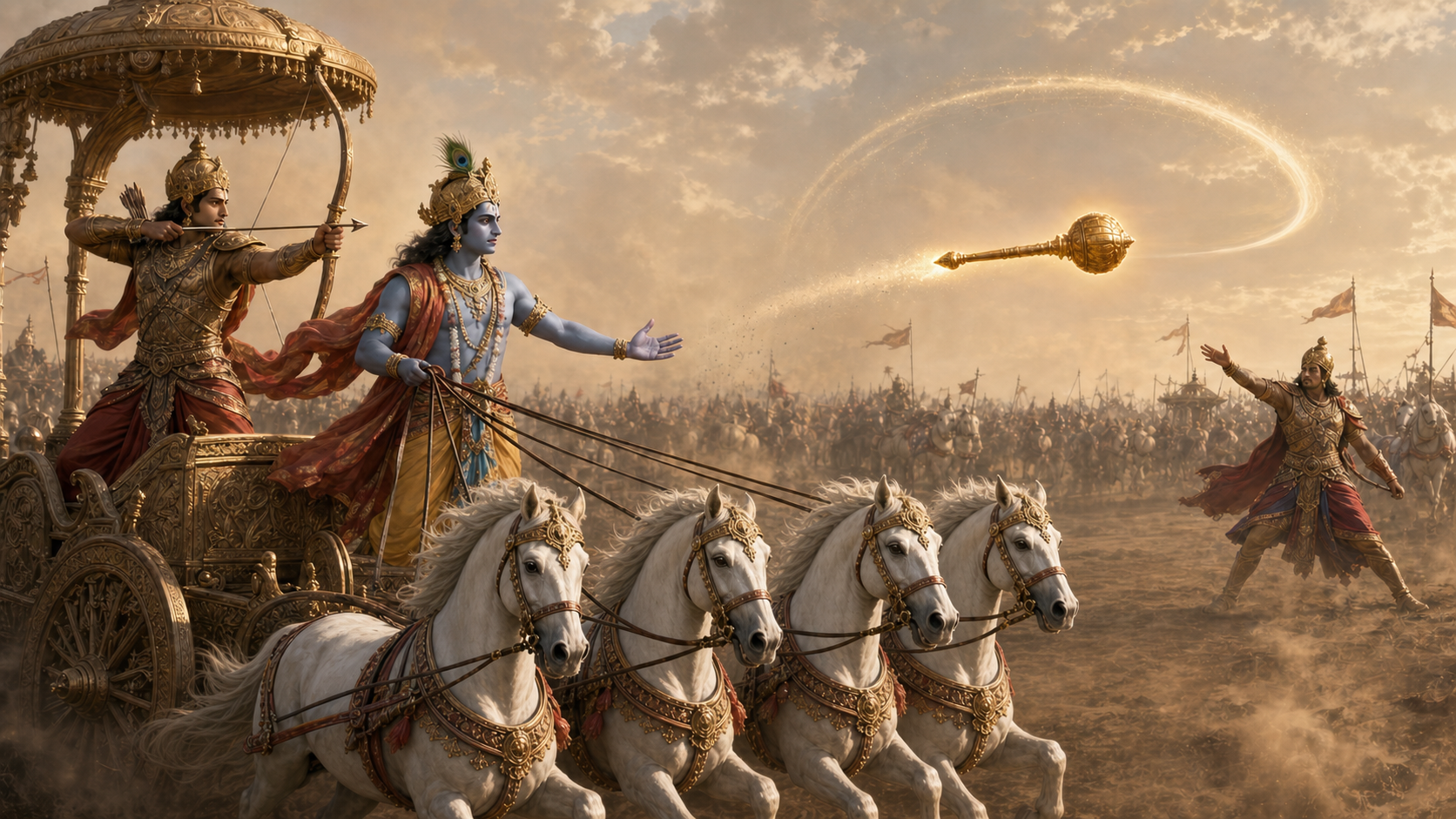
Krishna’s role requires careful language. He was not absent from the conflict, neutral between the armies, or irrelevant to Arjuna’s effectiveness. He drove Arjuna’s chariot and guided him. Yet influence on a battle is not the same thing as fighting as an armed warrior. The mace’s condition turned on the latter distinction.
Modern readers sometimes describe Krishna simply as a “noncombatant,” but that label can obscure as much as it clarifies. Krishna stood on the battlefield and played an essential strategic and spiritual role. The safer formulation is narrower: when Shrutayudha attacked him, Krishna was not fighting Shrutayudha with weapons. He was therefore an ineligible target under the rule attached to Varuna’s mace.
The episode is not about exploiting a technical loophole. Krishna did not make the mace treacherous. Shrutayudha’s own target selection crossed a boundary disclosed in advance. The weapon’s return was the direct operation of that boundary.
This precision matters because it keeps the moral burden where the story places it. If we say only that “Krishna caused Shrutayudha’s death,” we hide Shrutayudha’s agency. If we say that “the mace betrayed its owner,” we hide the condition. The complete explanation is that Shrutayudha knowingly bore a restricted weapon and used it against a person whom its restriction protected.
The deeper dharmic lesson: shakti must remain within maryada

Shrutayudha’s mace joins two ideas that should never be separated: shakti, the capacity to act, and maryada, the boundary that makes action rightful. Maryada is not an inconvenience imposed on power after the fact. It is what prevents power from becoming self-destructive.
You can see the principle in the structure of the weapon itself. Used within its rule, the mace protected its bearer and threatened his opponent. Used outside that rule, the same force reversed direction. The object did not become morally different; Shrutayudha’s use of it did. Power magnified the quality of the decision behind it.
The immediate rebound should be read as the epic’s concentrated picture of moral causation, not as a promise that every wrongful act in ordinary life produces instant and visible punishment. Life rarely resolves consequences so quickly. The dramatic reversal makes a subtler truth impossible to miss: a power that ignores its governing purpose can eventually injure the person who relies on it.
Maternal devotion adds another layer. Love could seek protection for Shrutayudha, and divine grace could place a remarkable means in his hands, but neither could make his later choices for him. Blessings, inheritance, status, education, and institutional authority all work in a similar moral pattern: they may create opportunity or protection, but the recipient must still use them with viveka, discriminating judgment.
That is the practical test this episode gives you. Whenever you receive unusual capacity, identify its boundary before celebrating its reach. Ask what the power is for, what it is not for, who must not be subjected to it, and what happens when its conditions are ignored. If you cannot answer those questions, you do not yet understand the gift you hold.
Key takeaways for reading and practice
- Shrutayudha died because he violated the mace’s explicit condition, not because Varuna’s gift failed.
- The weapon and its restriction formed one indivisible grant. Accepting its power meant accepting its rule.
- Krishna was active as Arjuna’s charioteer, but he was not fighting Shrutayudha as a weapons-bearing warrior. That precise distinction made him a forbidden target.
- The central failure was misuse, not strength itself. The episode does not teach you to reject power; it teaches you to govern power.
- Divine favour does not erase human agency. Shrutayudha remained responsible for deciding when and where to use the mace.
- Before exercising authority, skill, wealth, technology, or force, name its purpose, its excluded uses, and the consequence of crossing those limits.
The next time you encounter Shrutayudha’s story, begin with the condition rather than the spectacle of the weapon. Then bring the same habit to your own responsibilities: do not ask only how much power you possess. Ask what keeps its use aligned with dharma before you act.