
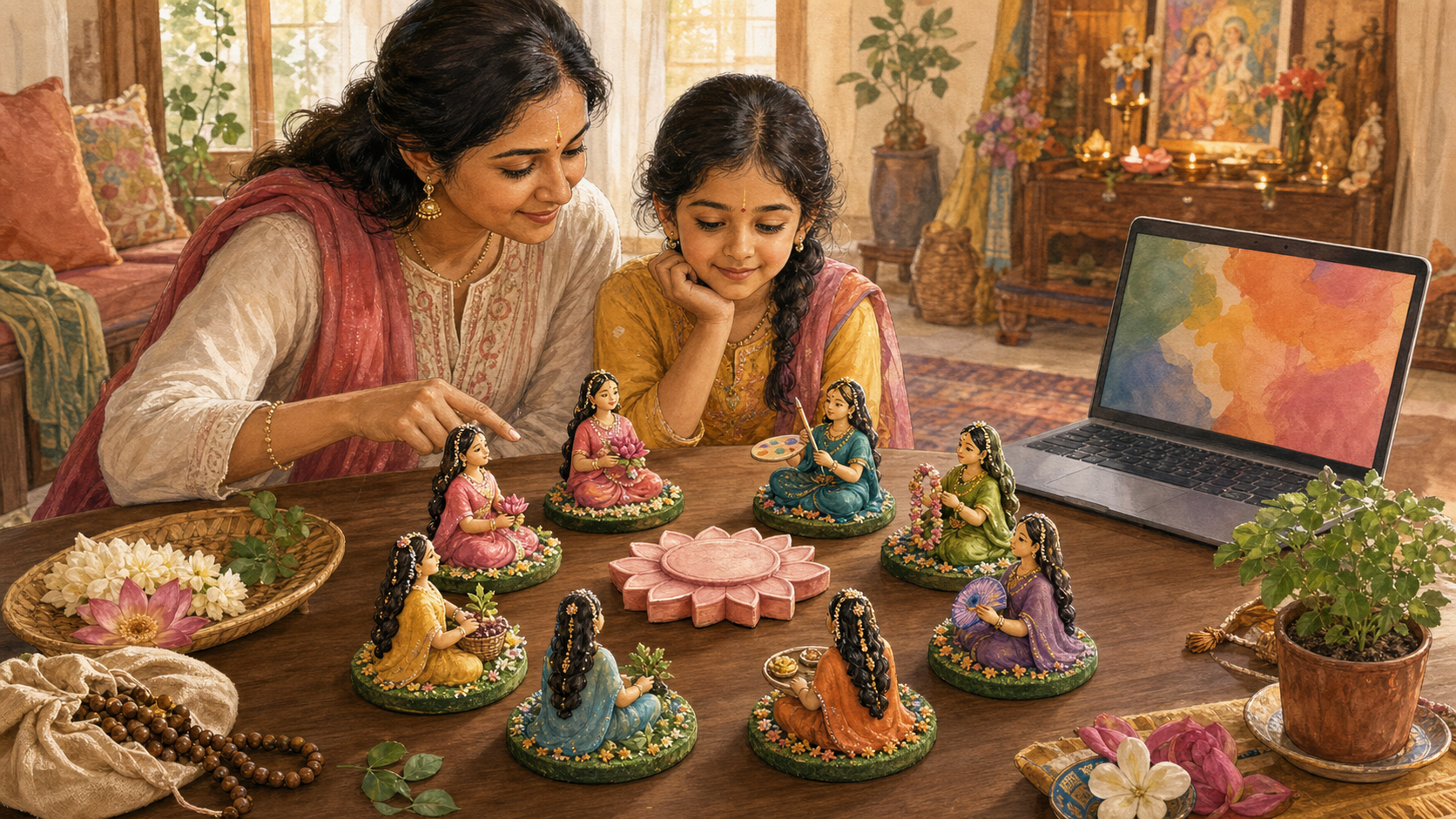
You may know that eight gopis surround Sri Sri Radha-Madhava at the Mayapur altar, yet still struggle to explain to your child who they are as individuals. An Ashta Sakhis course can bridge that gap when it helps a young devotee see distinct personalities, talents and forms of service rather than memorize eight unfamiliar names.
The online course planned for August is designed for children and uses stories, discussions, activities, games and creative learning. Here is how to decide whether that format suits your child, prepare without turning bhakti into homework and make the learning meaningful after class ends.
What your child will actually explore
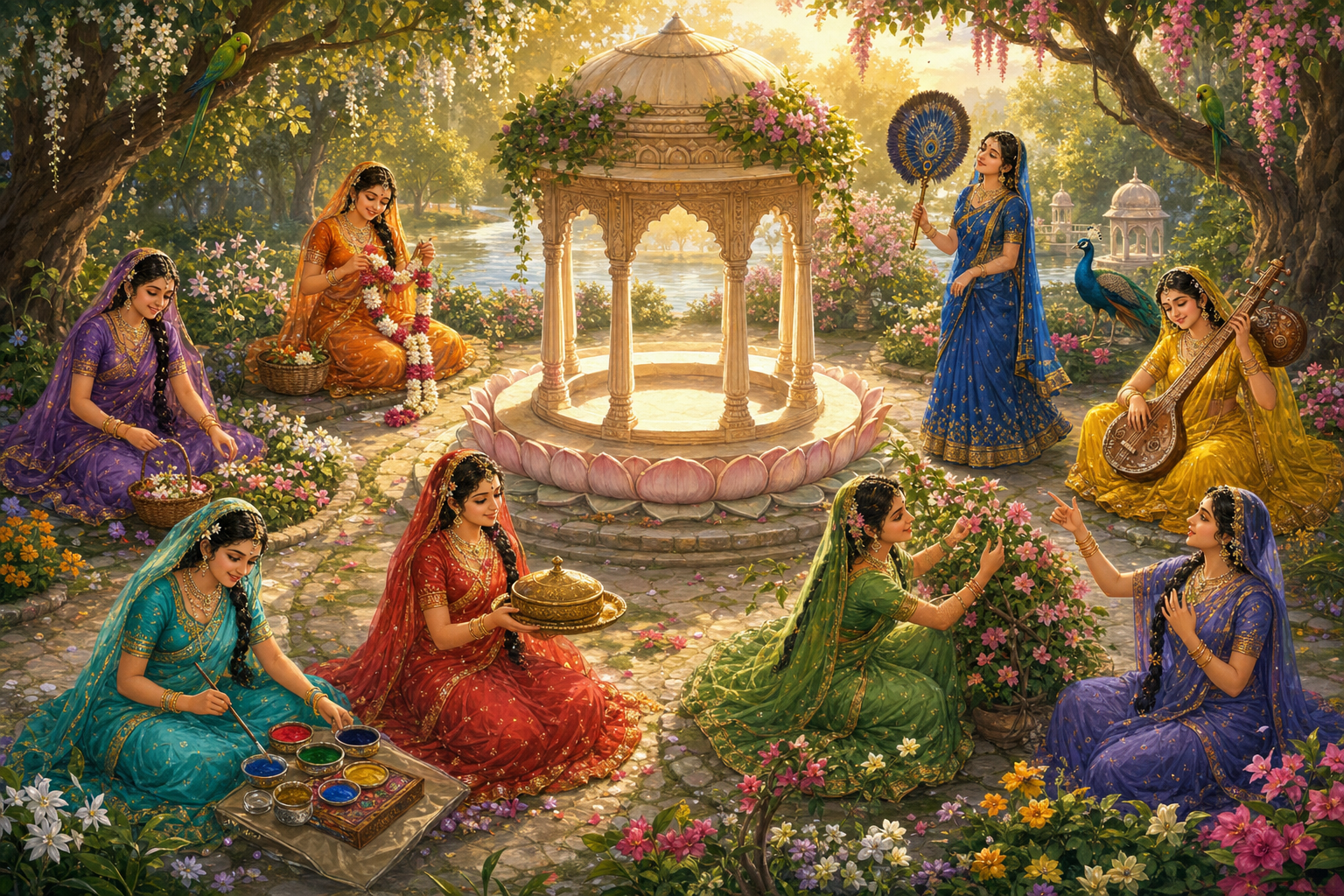
Within Gaudiya Vaishnava devotion, the Ashta-sakhis are the eight most exalted and intimate friends of Srimati Radharani. Their identities matter because loving Radha and Krishna also means learning to appreciate the devotees who serve Them most intimately. The course therefore aims at relationship, not merely identification.
The curriculum brings several dimensions of each sakhi together:
- Her individual personality and characteristic forms of service.
- Her talents, so the child can notice what makes her contribution distinctive.
- Her kunja and its place in the sacred setting of Braj.
- Pastimes that show relationships and service in action.
- Her birthplace and parents, giving the child a fuller personal profile.
- Teachings connected with the Ashta-sakhis from Srila Rupa Goswami and other acharyas.
That combination is important. A list of names gives a child labels; personality, place, relationship and service give those labels meaning. When your child can explain what distinguishes one sakhi from another and why her service is precious, the learning has moved beyond recall.
HG Gourangi Gandharvika Mataji leads the course and is also the author of a newly released book about the sakhis. That alignment may help lessons and reading reinforce one another, but do not assume the book is compulsory. Confirm whether it is required, recommended, included with registration or intended as optional family reading.
Check the fit before you register
The format is explicitly child-centered. It is most likely to suit a young devotee who responds to narrative, conversation, games and making things. If your child expects a silent lecture, dislikes group participation or needs substantial help following an online class, ask how much interaction and parental support will be expected.
An adult seeking close textual study should also check the intended age range before enrolling. Teachings from Srila Rupa Goswami and other acharyas are part of the curriculum, but the use of games and creative activities indicates that those teachings will be presented for young learners rather than as an advanced scholarly seminar.
Before paying or committing your child’s time, obtain clear answers to these practical questions:
- What are the complete dates, class times and time zone?
- What age range is the course designed for, and is prior familiarity with Radha-Krishna lila expected?
- How long is each meeting, and how many meetings are included?
- Must children attend live, or will recordings or make-up arrangements be available?
- Which language will the teacher use, and how much reading or writing is expected?
- Is the accompanying book required, and are any other materials needed?
- Which online platform will be used, and should a parent remain nearby?
- Are cameras required, will sessions be recorded and what names or chat messages will other participants see?
- What are the fee, registration deadline, cancellation terms and correct contact for questions?
The privacy questions deserve a direct answer because children will be learning interactively with other young devotees online. You should know whether video is recorded, who can access it and whether your child’s full name will be visible before the first meeting, not after it.
Prepare without turning devotion into homework

Your child does not need to master eight biographies before class. Heavy preparation can make the course feel like a test and leave little room for discovery. Give your child a simple map of the subject, then let the teacher introduce the details.
- Begin with the relationship. Explain that the Ashta-sakhis are eight especially intimate friends of Srimati Radharani whose lives are centered on serving Radha and Krishna.
- Use the Mayapur altar as a visual doorway. If your family has visited Mayapur or has an image of Sri Sri Radha-Madhava, invite your child to notice the eight gopis surrounding Them. Ask what the arrangement makes the child curious about; do not demand names.
- Prepare a learning book with eight sections. Leave each section mostly blank. As a sakhi is introduced, your child can add her name, a service, a talent, a place, a relationship and a drawing or symbol based on the lesson.
- Bring one genuine question. A child might wonder why each friend serves differently, what a kunja is or how talents become offerings. A real question makes discussion more purposeful than a prewritten quiz.
Keep spelling corrections and factual review gentle. The first task is to help the child notice a sacred person, not produce a perfect worksheet. Accuracy can be strengthened as the course provides a shared vocabulary and context.
Make each lesson continue at home
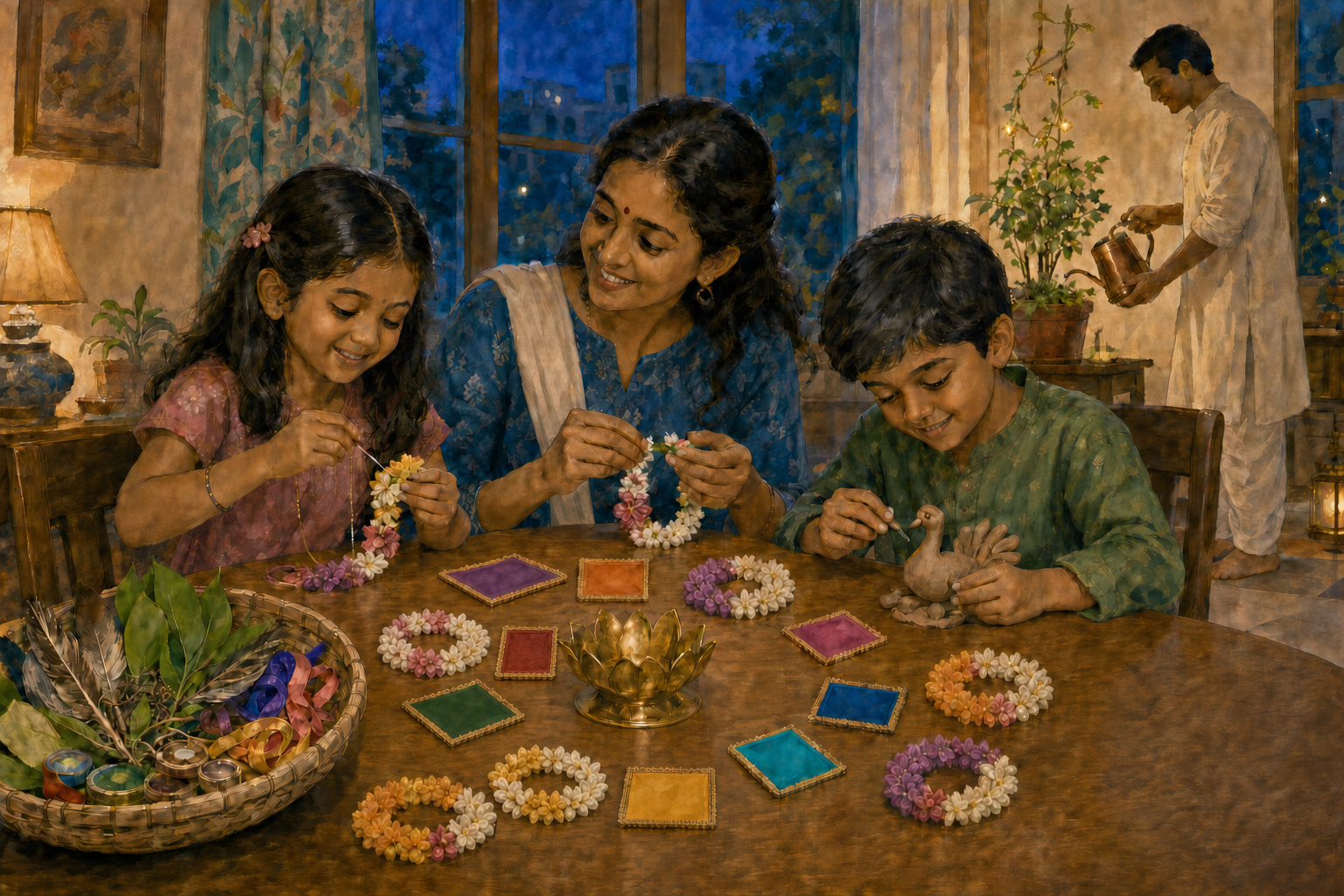
An engaging session can still disappear from memory if the family never returns to it. A short conversation after class is more useful than a large assignment days later. Let your child teach you one thing while it is still vivid.
Use the same prompts after every meeting:
- Which sakhi did you meet today?
- What service, talent or personality trait made her recognizable?
- Where did the lesson take place, and who was involved?
- What did the story show about friendship or attentive service?
- What would you like to ask in the next class?
Do not turn these prompts into an oral examination. If your child remembers a drawing, game or scene but not a formal detail, begin there. Ask the child to describe it and then consult the class material together. Retrieval through something the child made is often more natural than demanding a name without context.
You can also invite your child to choose one small act of thoughtful service at home after a lesson. The act is not a reenactment of a sacred pastime, nor should it be presented as one. Its purpose is to help the child notice the underlying orientation: affection becomes concrete through attention, cooperation and service.
If your child enjoys games, make simple review cards only from material already taught. Put a sakhi’s name on one card and a corresponding service, talent or place on another. Ask the child to explain each match. The explanation matters more than speed because it reveals whether the relationship between the facts is understood.
Key takeaways
- This is an online August course for children, built around stories, discussion, games, activities and creative learning.
- The scope goes beyond eight names: it includes personalities, services, talents, kunjas, pastimes, birthplaces, parents and teachings from Srila Rupa Goswami and other acharyas.
- The strongest sign of learning is not rapid recitation. It is your child’s ability to recognize each sakhi as a distinct person and connect her qualities with her service.
- Confirm the age range, schedule, time zone, language, cost, book requirements, attendance policy and child-privacy arrangements before registering.
- Prepare lightly, then preserve each lesson through a simple notebook and a brief child-led conversation at home.
Open the course information with your child and ask what they would want to know the next time they see the eight gopis around Sri Sri Radha-Madhava. If that question awakens real curiosity, confirm the missing logistics and let the course build from it. Curiosity joined with reverence is a better beginning than forced memorization.