
If you are building your family’s Shravan calendar for 2026, the difficult part is not finding more festival names. It is knowing which date actually belongs to your region and inherited practice. A generic calendar can place a real observance on the wrong day for your household.
For the observances covered here, reserve August 16 for Durva Ganapati Poojan and August 26 for Rig Veda Upakarma. Mark them as planning dates until your family priest, acharya, or local temple confirms the applicable calendar and ritual details.
The two dates to place on your 2026 calendar
| Observance | 2026 planning date | Who and where it applies | What you still need to confirm |
|---|---|---|---|
| Durva Ganapati Poojan, also known as Durva Ganapati Vrata | August 16 | Shravan Shukla Paksha Chaturthi; observed in Maharashtra and parts of Karnataka and Gujarat | Your household’s form of the vrata or puja, local tithi timing, and required offerings |
| Rig Veda Upakarma | August 26 | Families and communities following Rig Veda Upakarma | Your Vedic affiliation, local timing, venue, preparations, and materials |
This is deliberately not presented as a complete Shravan calendar. It is a focused planning list for two observances with confirmed 2026 dates. Other Shravan vratas and temple events need their own calendar checks.
Do not copy August 26 into every Upakarma entry. Upakarma may be observed in Shravan or Bhadrapada, during August or September, and its date depends on the Veda followed. The Rig Veda date is therefore not automatically the date for Yajur Veda or Sama Veda households.
Key takeaways for Shravan 2026
- Durva Ganapati Poojan falls on August 16, 2026, on Shukla Paksha Chaturthi in Shravan.
- Its established regional setting includes Maharashtra and parts of Karnataka and Gujarat; do not treat it as a universal household obligation.
- Rig Veda Upakarma falls on August 26, 2026, but that date should not be applied to every Vedic tradition.
- Use the dates to reserve time, then obtain local timing and ritual instructions from the authority your household actually follows.
- If you do not know your family’s Vedic or regional practice, establish that before selecting mantras, fasting rules, or puja materials.
For Durva Ganapati, confirm the practice before buying supplies
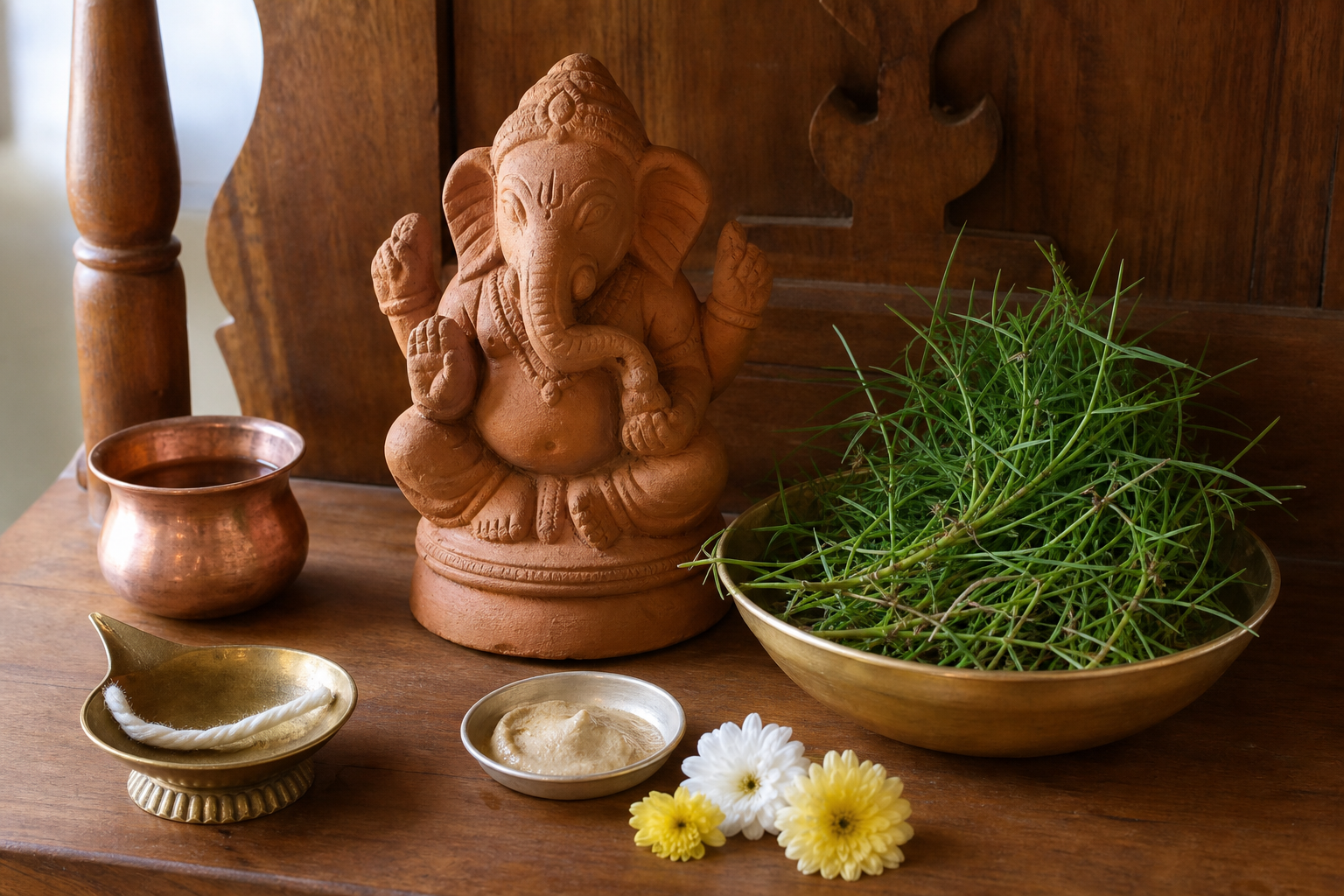
Durva Ganapati Poojan is also called Durva Ganapati Vrata and Durva Ganesh Chaturthi. It is dedicated to Lord Ganapati and falls on Chaturthi in the bright half of Shravan. The name comes from durva grass blades used in Ganapati worship.
That gives you the identity of the observance, but it does not give you a universal ritual script. The quantity and arrangement of durva, the other offerings, the vrata rules, and the order of worship can belong to a regional, temple, or family practice. Guessing those details from the observance’s name is where an otherwise sincere plan becomes unreliable.
- First ask whether your household traditionally observes the vrata, attends a temple puja, or follows another local form.
- Ask the person guiding the worship for the local tithi timing, required materials, and any preparation expected beforehand.
- Do not buy an assumed quantity of durva from an unaffiliated checklist. Confirm how your tradition presents it and obtain it close enough to the observance for it to be suitable for worship.
- Put the confirmed instructions in the calendar entry itself, together with the name and contact details of the temple, priest, or family elder who supplied them.
If your family has no inherited Durva Ganapati practice, you have not failed to observe Shravan. You can ask a nearby Ganapati temple whether it marks the day and how visitors may participate respectfully. Whether you undertake a vrata is a question of practice and guidance, not a test of devotion.
For Upakarma, establish the Veda before confirming the date
Upakarma is an ancient annual Vedic ritual followed in Brahmin communities. A principal act is changing the yajnopavita, or sacred thread. It is not a generic Shravan observance required of every Hindu, and even among families that perform it, the relevant date depends on the Veda they follow.
Your first question should therefore be, “Which Veda and family tradition do we follow?” Do not infer the answer from a surname, mother tongue, or present place of residence. Ask a knowledgeable elder, family priest, acharya, or institution connected to your actual lineage.
- Confirm that your family observes Upakarma and identify the Veda it follows.
- If the answer is Rig Veda, use August 26 as the 2026 planning date and ask for confirmation based on your location.
- If the answer is another Veda, do not reuse the Rig Veda date. Request the applicable date directly.
- Ask where the rite will be conducted, who will guide it, what materials are required, and what preparation belongs to your tradition.
- Keep the sacred-thread change within the transmitted rite rather than treating it as an isolated replacement procedure.
A concise message usually gets a clearer answer: “Namaste. Our family follows [Veda or tradition] and lives in [place]. Should we observe Upakarma on August 26 in 2026? Please share the local timing, preparations, venue, and required materials.” If your Veda is not yet known, omit the date and ask the recipient to identify the correct observance with you.
Build calendar entries that preserve the distinctions
A calendar title such as “Shravan puja” is too vague to be useful when the day arrives. Name the observance, its scope, and its confirmation status. This lets another family member understand why the entry exists without reconstructing your reasoning.
- Create an August 16 entry titled “Durva Ganapati Vrata – local practice to confirm.”
- Create an August 26 entry titled “Rig Veda Upakarma – family calendar to confirm” only if Rig Veda is relevant to your household.
- Add the location of worship and the person or institution whose calendar you are following.
- Record local timing and preparation instructions when received instead of leaving them in a message thread.
- If you live outside Bharat, ask a local temple or priest whether the civil date or tithi timing needs adjustment for your location.
- Change the entry from provisional to confirmed only after the regional and family questions have been settled.
Open your 2026 calendar now and reserve the applicable day. Your next action is not to collect a larger internet checklist; it is to contact the person who can connect that date to your own sampradaya, family practice, and location.
References
- Hindu Pad – Durva Ganapati Poojan 2026 | Durva Ganapati Vrata
- Hindu Pad – Upakarma 2026 | Rig Veda Upakarma, Yajur Upakrma, Sama Upaakarma