
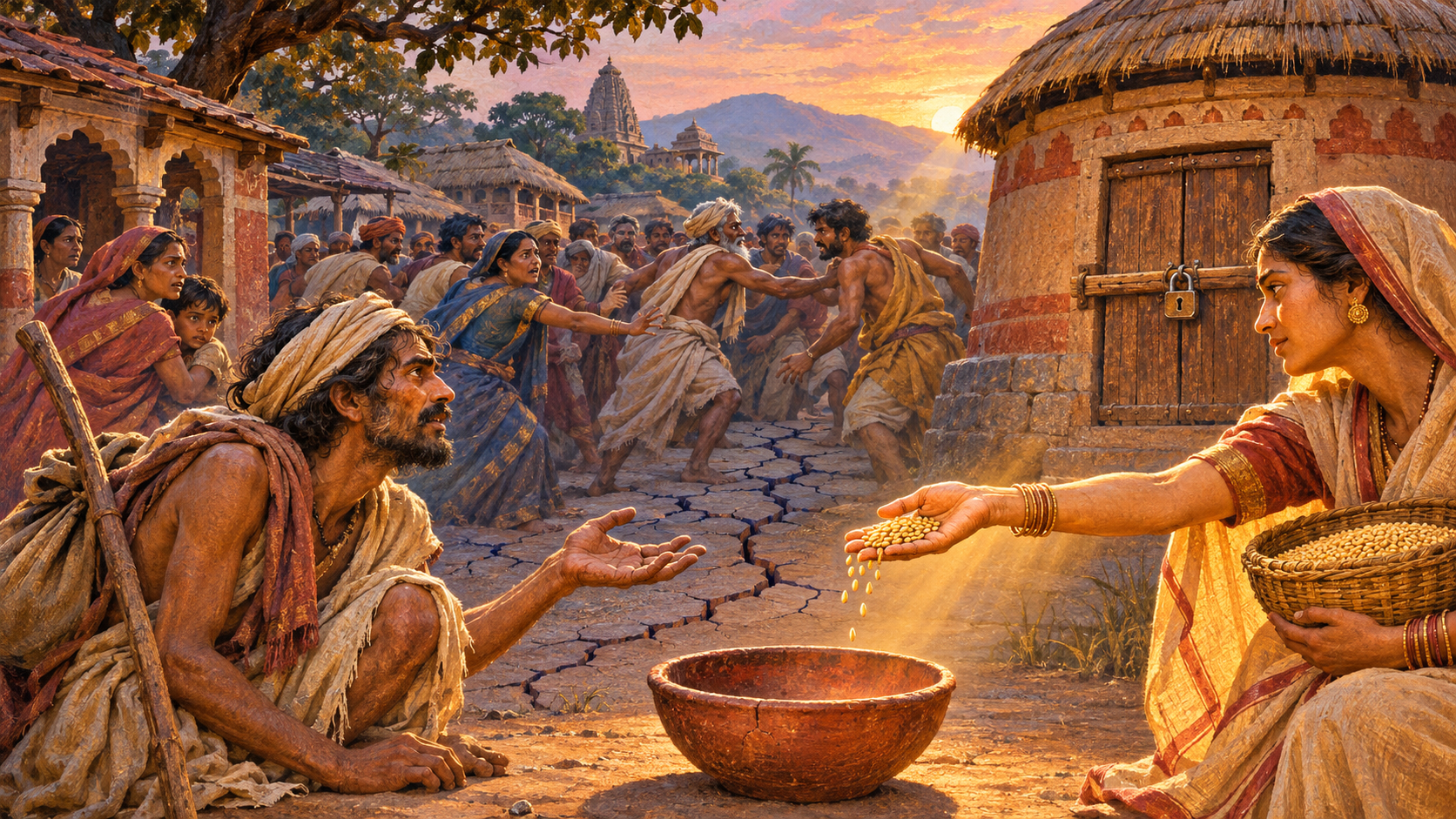
If you have wondered why a sacred epic would connect hunger with the birth of Adharma, the answer is not that a hungry person is wicked. The sharper lesson is that moral order becomes fragile when a basic need becomes an unchecked command – or when a community allows that need to go unanswered.
You can read this episode as a practical diagnostic. Before asking who broke a rule, ask what pressure preceded the breach, who had the power to relieve it, and whether a legitimate need turned into domination. That does not erase personal agency. It makes moral judgment more exact.
The genealogy is a map of moral causation

In the Sambhava Parva of the Adi Parva, a long genealogical account of sages, humans, animals, birds and other beings places the emergence of Adharma within a wider account of creation. The setting matters. Adharma is not introduced as an inexplicable force arriving from outside the world. It has an origin that can be examined.
A genealogy of this kind does more than answer, “Who came from whom?” It invites another question: “What condition gives rise to what consequence?” When hunger stands near the origin of Adharma, the sequence directs your attention to the conditions under which right relationship begins to fail.
Dharma is the order that sustains life, obligation and relationship. Adharma is therefore more than private wickedness. It appears whenever appetite, fear or power breaks the obligations that allow life to be sustained. Hunger makes this visible because food sits at the boundary between individual survival and communal duty.
This reading avoids two easy mistakes. The first is to treat the genealogy as a claim that physical need is sinful. The second is to use need as an automatic excuse for every action committed under pressure. The Mahabharata’s framing is more demanding: look at the need, the choice made under that need, and the conduct of those who could have prevented the crisis.
Hunger is a condition; Adharma is a breakdown
Physical hunger is not a moral failure. It is a bodily demand shared by living beings. A person does not become adharmic merely by needing food, nor does virtue consist in pretending that the body has no claims.
The moral danger begins when hunger changes the way beings relate to one another. Someone may treat another person as an obstacle to be removed, an instrument to be used or a weaker claimant whose need does not matter. A person with abundance may also act under a kind of hunger: the desire to accumulate without limit, even while others lack what is necessary.
That gives you three questions for interpreting the episode and applying it beyond the epic:
- What is actually needed? Separate the requirements of life from preference, status and accumulation.
- Has need become mastery? Notice when appetite occupies the whole field of judgment and pushes every other obligation aside.
- Who bears the cost? Ask whether one person’s survival, comfort or excess is being secured by making another person vulnerable.
This distinction also keeps the teaching separate from voluntary religious fasting. A chosen and bounded upavasa can train attention and self-command. Involuntary deprivation is different: it is a need imposed on someone, often without control over when it will end. Treating those two experiences as morally identical confuses discipline with abandonment.
How unmet need can become moral disorder
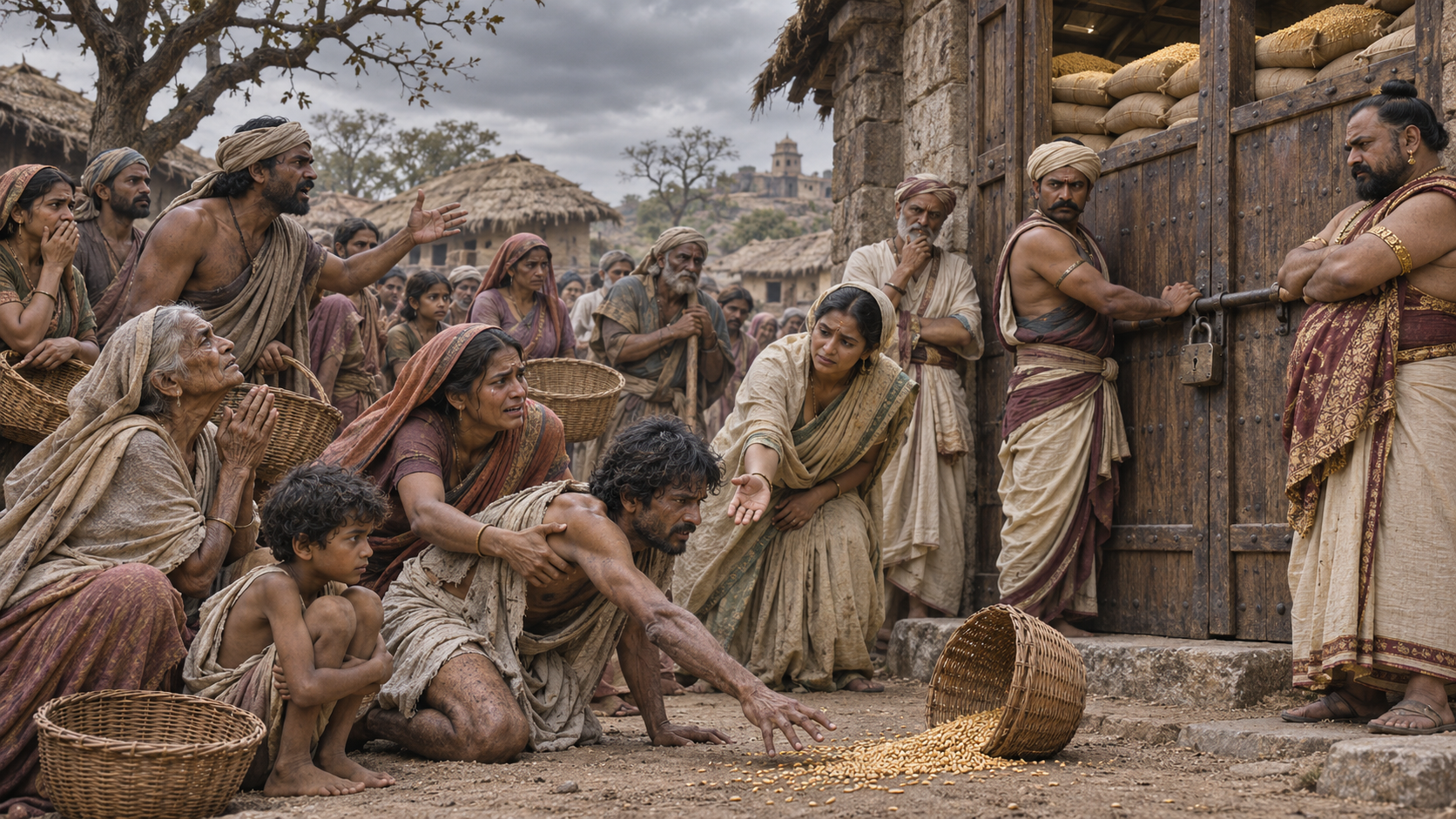
The connection between hunger and Adharma is not a deterministic formula. Hungry people do not inevitably become dishonest or violent, and well-fed people are not automatically righteous. The genealogy instead points to a pressure under which moral order can deteriorate.
That deterioration can be noticed as a sequence:
- A legitimate need becomes urgent. Food, safety or another necessity can no longer be postponed.
- The horizon of judgment narrows. Immediate acquisition begins to outweigh duties, promises and long-term consequences.
- Relationship gives way to rivalry. Other beings are seen chiefly as competitors for what is scarce.
- A boundary is crossed. Deception, coercion, hoarding, exploitation or violence becomes thinkable because obtaining the desired object now appears supreme.
- Disorder reproduces itself. The injured party responds, trust weakens, and conduct that began with one unmet need creates further fear and deprivation.
The practical value of this sequence is that it lets you intervene before the final breach. If someone lacks a meal, the earliest response is not a lecture on self-control. If someone already has enough but insists on taking another person’s share, supplying more will not correct the problem. The first case calls for relief; the second calls for restraint. Both require discernment.
Power also changes the moral assessment. A desperate person seeking food and a powerful person withholding food do not stand in equivalent positions simply because both actions concern the same object. Dharma asks what each person needed, what alternatives each possessed, and what duties came with control over the resource.
A Dharmic response joins nourishment with responsibility
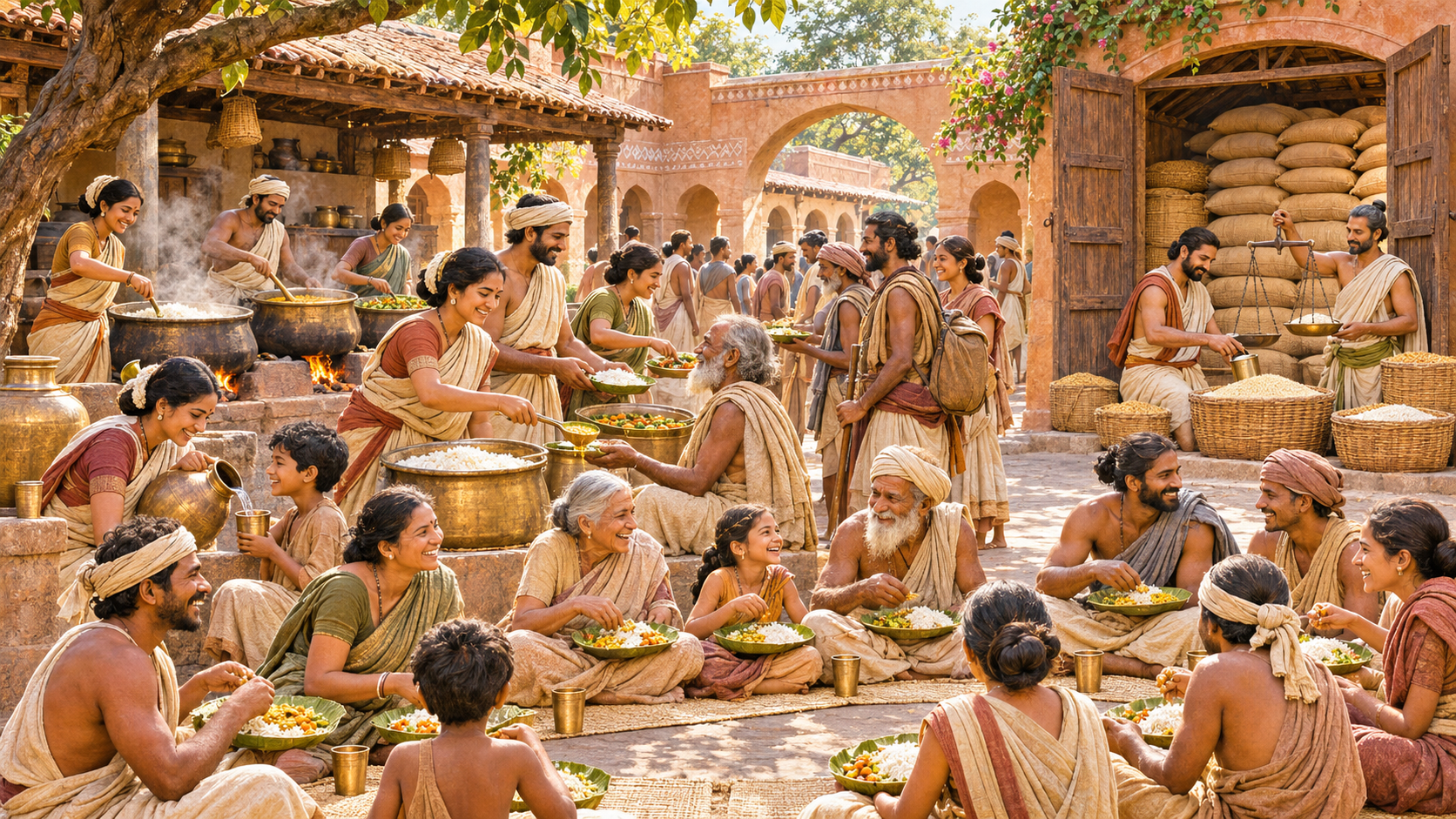
If hunger can prepare the ground for Adharma, a Dharmic response must do more than condemn the last visible act. It should address the need without declaring every response to that need permissible.
- Stabilize the immediate need. When a person is acutely hungry, make food available before demanding a complicated moral explanation. Relief restores the possibility of calmer judgment.
- Name the relevant boundary. Feeding someone does not require approving deception, coercion or harm. State clearly which action was wrong and whose rights were affected.
- Distinguish need from limitless appetite. Ask whether the person lacks what sustains life or wants possession, prestige or control beyond sufficiency. The same language of “need” can conceal very different moral situations.
- Repair the relationship. Where harm occurred, responsibility may include returning what was taken, acknowledging injury, renewing a neglected duty or changing how a shared resource is distributed.
- Examine the surrounding order. If hunger repeatedly drives people into conflict, the problem is not only a succession of bad individuals. Look at who controls food, who is excluded, which obligations are being ignored and why relief arrives only after a breach.
Seen through this lens, anna-dana, the giving of food, is not merely a gesture of generosity. It interrupts one condition under which fear and rivalry can grow. Yet food-giving is most Dharmic when it respects the recipient. Humiliation converts assistance into another display of power.
You can apply the same principle at the personal level. Do not make an important accusation, promise or irreversible decision while physical hunger is dominating your attention if the matter can safely wait. Eat, regain steadiness and then decide. This is not moral weakness; it is recognition that Dharma requires the conditions for discernment as well as the intention to discern.
At the household or community level, notice whether access to food depends on submission, silence or social status. A meal cannot be called freely given if it is used to purchase obedience. The response to hunger must not create a new form of bondage.
Key takeaways
- The Mahabharata’s association of hunger with Adharma does not condemn the body’s need for food; it identifies a pressure under which sustaining relationships can break.
- Need explains moral pressure but does not erase agency. Relief and accountability belong together, in that order when the need is immediate.
- The hunger of deprivation must be distinguished from the hunger of limitless acquisition. One calls for nourishment; the other calls for restraint.
- A complete moral judgment examines power as well as conduct: who lacked food, who controlled it, what choices were available and which duties were neglected.
- Preventing Adharma means intervening before desperation becomes rivalry and before abundance becomes domination.
The next time conflict appears around food, money, recognition or control, begin one step earlier than blame. Identify the hunger at work, decide whether it is a need to be met or an appetite to be governed, and then act without abandoning either compassion or responsibility. That is where this ancient genealogy becomes a living practice of Dharma.
References

Leave a Reply
You must be logged in to post a comment.