
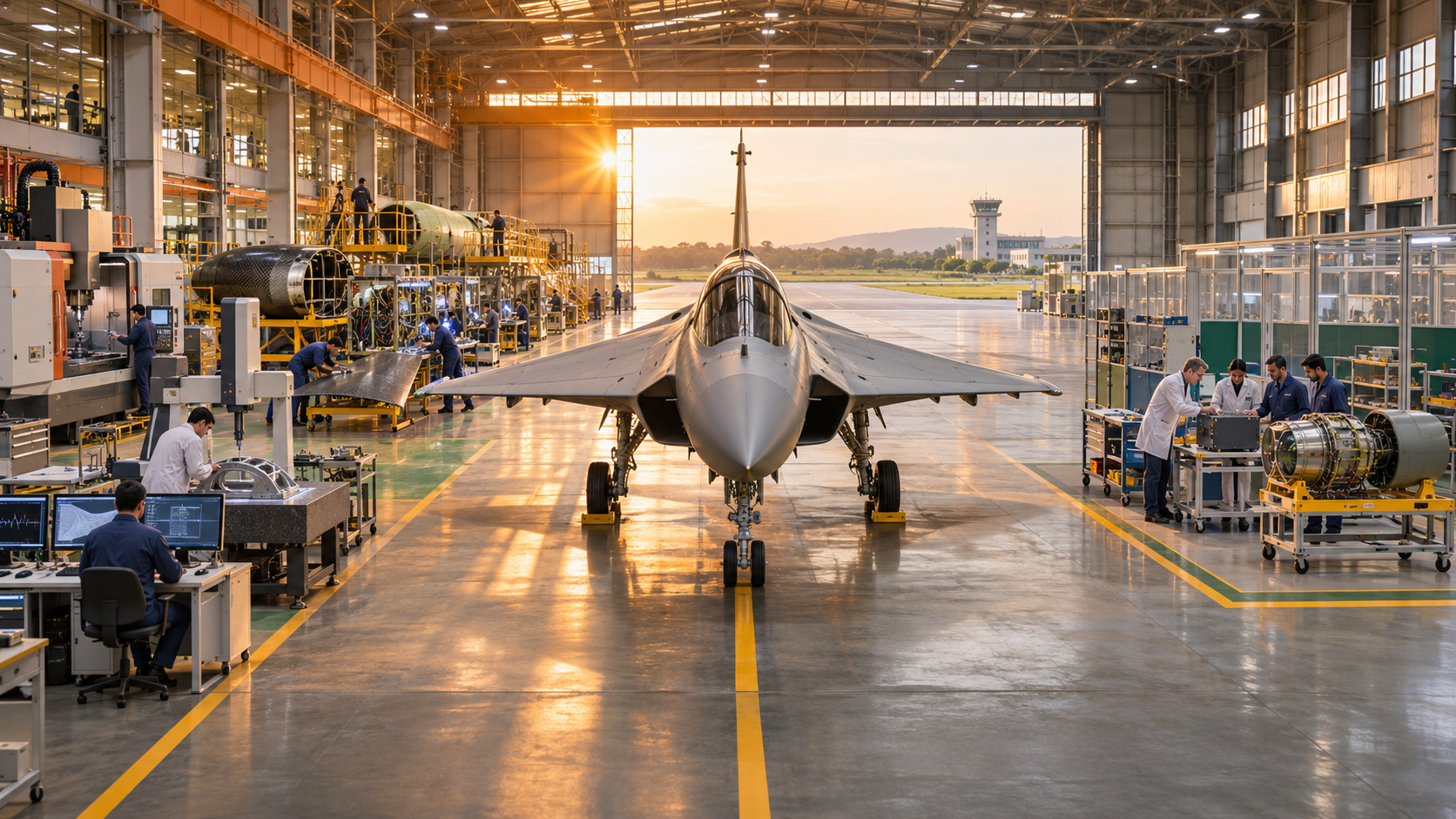
If you are asking whether Bharat should protect indigenous defence production or invite foreign partners, reject that binary. The useful questions are harder: Which capabilities must remain under Indian control? Which bottlenecks can be shared without creating dependence? What must a partner contribute before cooperation deserves to be called co-production?
The answer should be a two-track strategy. Bharat should preserve fully indigenous development where sovereign control demands it, while adding a disciplined route for Indian-designed systems whose development costs, critical subsystems or production scale can be shared with trusted partners. Strategic autonomy is the power to decide, modify, produce and sustain. It is not a requirement that every component originate within one border before the armed forces receive a usable system.
Key takeaways
- Keep the existing IDDM route, but add IDCM – Indigenously Designed, Co-Manufactured – for programmes in which Bharat can retain design authority while sharing cost, work and production.
- Treat delivery time as a strategic requirement. A technically indigenous platform that arrives after the operational need has become acute does not fully serve self-reliance.
- Protect configuration control, technical data, modification rights, domestic maintenance and production-scaling authority. These matter more than a ceremonial percentage of local content.
- Require every partner to bring a measurable contribution: capital, proven technology, testing capacity, manufacturing work, supply-chain access or entry into an additional market.
- Do not call imported-kit assembly co-production. If Indian engineers cannot modify, support and progressively deepen the system, the arrangement remains a form of licensed manufacture.
Tejas changed the question Bharat needs to ask
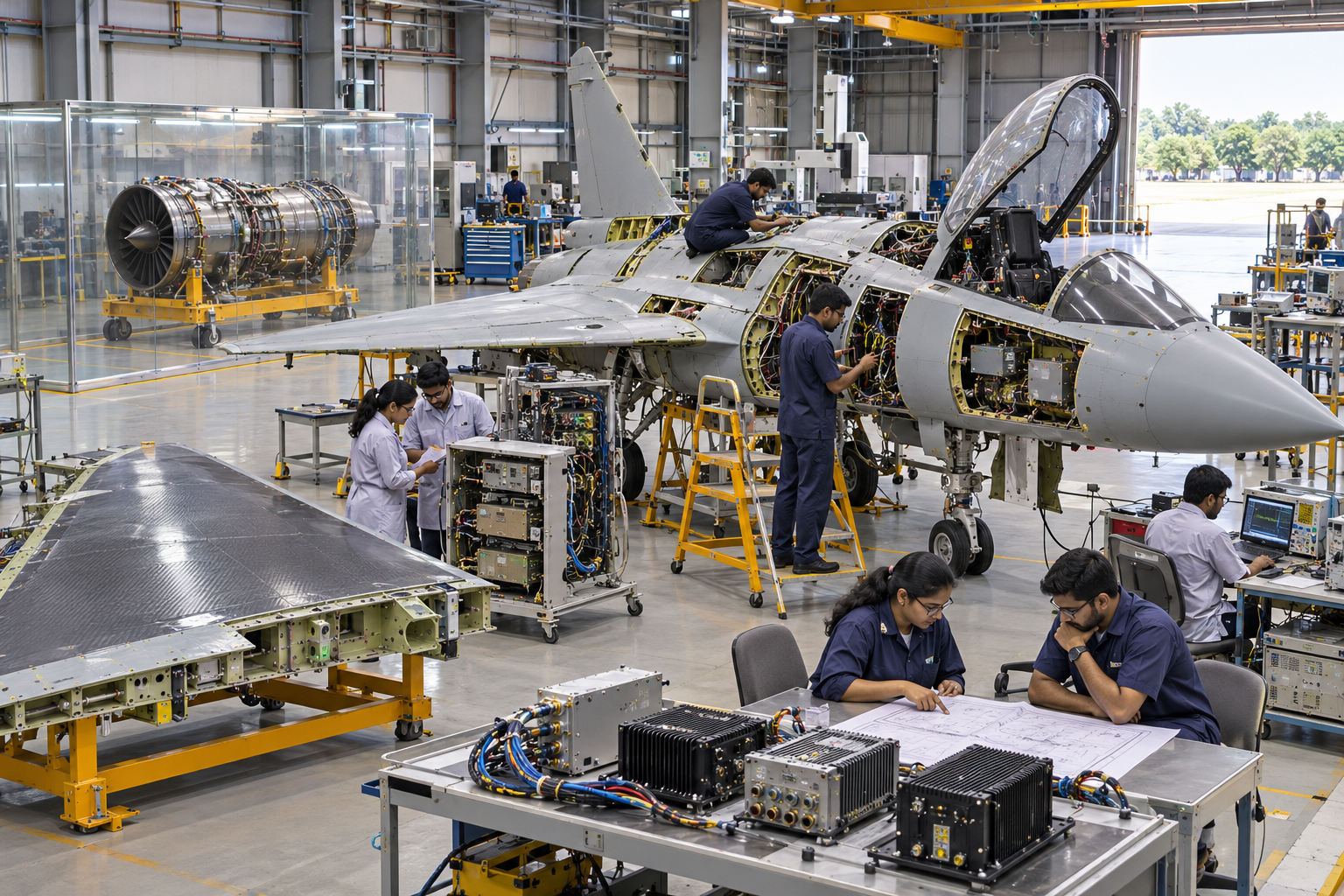
The Light Combat Aircraft Tejas is an indigenous achievement. It also carries a severe warning about time. The programme required approximately 32 to 35 years to reach Final Operational Clearance. Its progress involved a GE engine and an Israeli radar rather than an entirely domestic set of critical systems. The warning became sharper with the Indian Air Force standing at 31 squadrons.
That history does not prove that indigenous development was a mistake. Nor can a long aircraft programme be reduced to one cause; a combat aircraft must bring many difficult technologies, tests and institutions together. It does show why schedule cannot be treated as an administrative detail. When an immature subsystem sits on the critical path, the whole platform waits. The operational shortfall does not wait with it.
Bharat therefore needs to distinguish platform sovereignty from component autarky. Platform sovereignty means Indian authority over the system’s purpose, architecture, configuration and evolution. Component autarky means refusing a foreign input until a domestic substitute is ready. The first is essential in carefully selected areas. The second can become self-defeating when it delays an urgently needed capability without creating a realistic path to mastery.
A foreign engine or sensor can shorten a programme, but it can also become a future choke point. The correct response is not automatic acceptance or automatic rejection. It is a negotiated plan covering supply continuity, integration data, maintenance, upgrades, alternatives and eventual domestic competence. A dependency that is identified, bounded and reduced over time is different from one hidden beneath an indigenisation slogan.
This is where an IDCM route can complement IDDM. IDDM means Indigenously Designed, Developed and Manufactured, while IDCM means Indigenously Designed, Co-Manufactured. IDDM should remain the preferred path when the domestic ecosystem can deliver within the required window or when sharing would expose an unacceptable strategic core. IDCM should be available when Indian design leadership can be combined with outside capital, proven subsystems, additional production capacity or access to another market.
Borrow South Korea’s structure, not merely its salesmanship

South Korea offers two useful forms of industrial partnership. They solve different problems, and Bharat should not collapse them into one generic idea of cooperation.
Share development risk before the system is finished
Indonesia was assigned 20 per cent of the KF-21 development cost. The importance of that arrangement is not the percentage by itself. It is the conversion of a prospective customer into a participant with a financial stake and an industrial role.
Bharat can adapt this structure for an Indian-led platform when a partner can contribute before the design is frozen. The contribution might be funding, a proven subsystem, testing facilities, a production line or a committed order. In return, the partner could receive an agreed workshare, manufacturing rights for its own requirements or participation in specified export markets.
Risk-sharing only works when obligations are enforceable. A serious agreement must define who pays at each milestone, what happens after a missed payment, which technical information accompanies the workshare and how delays by one participant affect the programme. Otherwise, a politically attractive partnership can leave the lead country carrying both the cost and the schedule risk.
Use local production to turn a buyer into a long-term stakeholder
South Korea’s approximately $14 billion arrangement with Poland links K2 tanks and K9 howitzers to production on Polish soil. This is more durable than a transaction in which finished equipment is shipped, accepted and gradually separated from the supplier’s industrial ecosystem.
Production in the buyer’s country can give that buyer employment, industrial learning, faster support and a greater sense of control. The originating country can gain scale, a larger installed base and a partner whose factories and armed forces now have a practical interest in the programme’s success. Neither benefit is automatic. It depends on what the local plant is authorised and equipped to do.
Bharat should therefore offer graduated partnerships rather than one standard package. One country may only need final assembly and maintenance. Another may be able to manufacture major structures. A more capable and trusted partner may join development, testing and future upgrades. Sensitive technologies can remain compartmentalised while enough real work is shared to make the relationship valuable.
The civilisational point is straightforward. Bharat should build relationships in which other states invest in Indian-designed capability and become stakeholders in its continuity. That is different from importing a foreign platform and hoping the supplier’s strategic priorities will always align with ours.
Make IDCM a contract architecture, not a slogan

The label on a procurement route matters less than the rights created by its contracts. Bharat can manufacture a high percentage of a platform locally and still lack the information or permission needed to alter it. Conversely, a system containing imported components can preserve substantial Indian autonomy if Bharat controls integration, configuration, support and future development.
| Route | Use it when | Non-negotiable discipline |
|---|---|---|
| IDDM | Full domestic development is strategically necessary and the Indian ecosystem can meet the operational window. | Fund the complete development path, including testing, certification, production engineering and long-term upgrades. |
| IDCM | Bharat can lead the design but needs shared development risk, a proven subsystem, additional manufacturing capacity or access to a partner market. | Keep defined sovereign rights while assigning genuine, measurable work to the partner. |
| Licensed manufacture or interim import | An immediate operational gap cannot wait for the preferred indigenous system. | State its limits honestly, preserve competition where possible and set a clear transition path rather than relabelling assembly as self-reliance. |
An IDCM agreement should settle at least six matters before production announcements are made:
- Design and configuration authority: identify who approves changes to the platform and who holds the authoritative technical baseline.
- Technical access: specify the interface information, manufacturing data, test procedures, diagnostic tools and software access required for Indian integration and support.
- Modification and upgrade rights: ensure Bharat can adapt the system to Indian requirements without reopening every engineering decision with an external supplier.
- Workshare milestones: link payments and privileges to actual delivery of technology, tooling, qualified production and tested components, not broad promises of transfer.
- Sustainment and scaling: establish how Indian facilities will maintain, repair and increase production of the system during a crisis or a rapid rise in demand.
- Export governance: decide which markets each participant may serve, how third-country sales are approved and how revenue, liability and continuing support are divided.
These clauses prevent two opposite failures. The first is dependency disguised as localisation: imported kits are assembled in Bharat, but major repairs, changes and supply decisions remain elsewhere. The second is partnership without protection: excessive technical exposure is granted before the other party has delivered its capital, orders or workshare.
Trust matters, but contract design is how states preserve cooperation when governments, budgets or strategic priorities change. Bharat should share enough to make the partner invested, while retaining what it would be dangerous to lose. The boundary will differ by programme. It should be stated explicitly rather than hidden behind a universal local-content target.
Apply five gates before approving any co-production offer
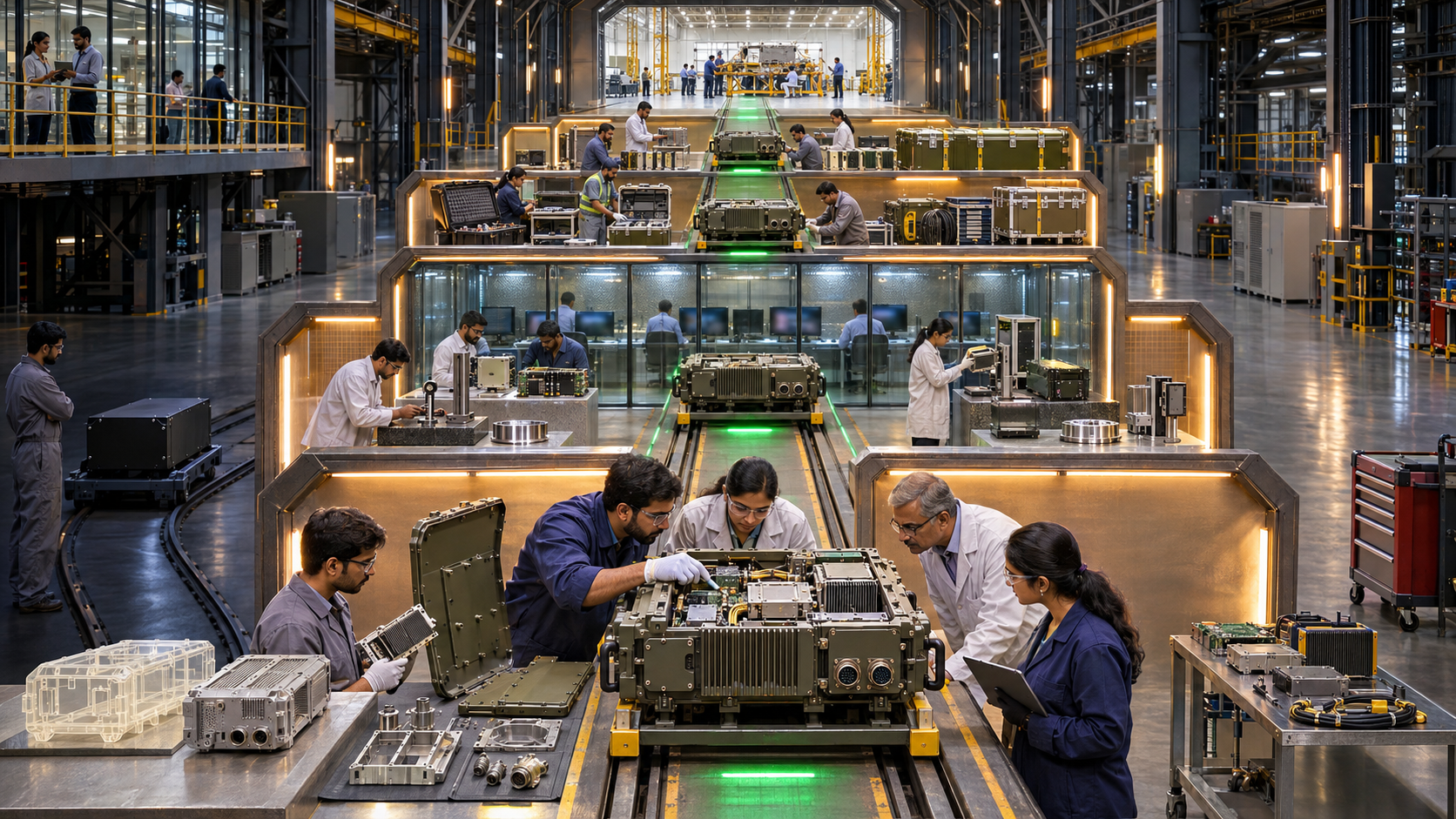
You can judge a proposed partnership without being distracted by launch ceremonies or headline contract values. Ask whether it passes these five gates.
- Operational urgency: What fielded capability is required, by when, and which subsystem is most likely to delay it? If cooperation does not shorten the critical path or increase deliverable scale, its strategic value is doubtful.
- Sovereign core: Which decisions and technologies must remain under Indian control? Name them before negotiations begin. Architecture, configuration, integration, maintenance, mission-specific adaptation and production scaling should not be left to vague assurances.
- Partner contribution: What arrives from the partner that Bharat does not already possess on acceptable terms? Count committed funding, qualified technology, test capacity, factory work, binding orders and credible market access. Do not count political language.
- Domestic depth: What will Indian engineers and suppliers be able to do after the first production batch that they could not do before it? Tooling, quality control, repair, redesign and subsystem integration show deeper capability than final assembly alone.
- Lifetime alignment: Who controls spares, upgrades, export approval, pricing and dispute resolution over the system’s service life? A deal that works only while political relations are ideal is not a resilient defence arrangement.
The approval rule can be simple even when the negotiations are complex. Choose IDCM when it provides a material schedule, technology, scale or market advantage and Bharat retains the sovereign rights defined for that programme. Choose IDDM when sharing would expose an unacceptable core or when domestic capability can deliver in time. Use a limited interim purchase when the armed forces face an immediate gap, but do not let the interim arrangement quietly replace the long-term indigenous objective.
This approach also changes how success should be measured. Weapons sold abroad matter. Local-content percentages matter. Neither is sufficient. Ask whether Bharat owns the design decisions, whether Indian factories can sustain and expand the system, whether partner countries are investing in Indian-led platforms, and whether the armed forces receive capability inside the operational window.
The next time a defence partnership is announced, look past the word “indigenous” and ask four questions: Can Bharat modify it? Can Bharat support it? Can Bharat scale it? Can Bharat take it to agreed third markets? Precise answers indicate a path towards real autonomy. Vague answers usually indicate that the hard part of co-production has not yet been negotiated.
References

Leave a Reply
You must be logged in to post a comment.