
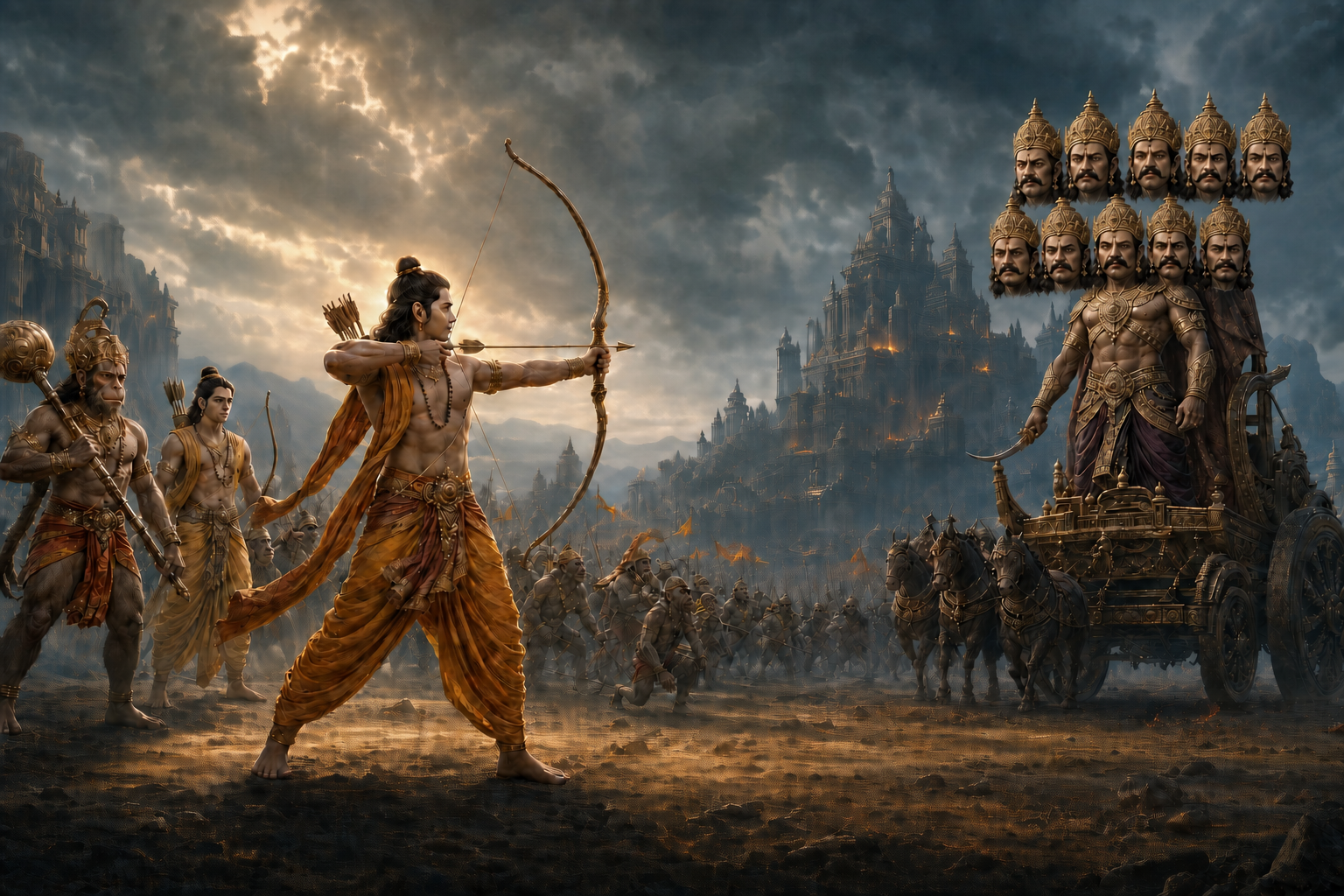
If you have ever wondered why Vishnu did not simply appear in overwhelming divine form and destroy Ravana, you are asking more than a question about power. You are asking whether dharma permits a righteous end to be reached by any available means.
Rama’s human incarnation answers that question with unusual precision. Humanity was not a disguise hiding divine strength. It was the lawful condition under which Ravana could be defeated without making Brahma’s boon meaningless. The form of the victor, the limits he accepted, the allies he needed, and the suffering he endured were all part of the moral meaning of the victory.
Ravana’s boon set the boundary of the conflict
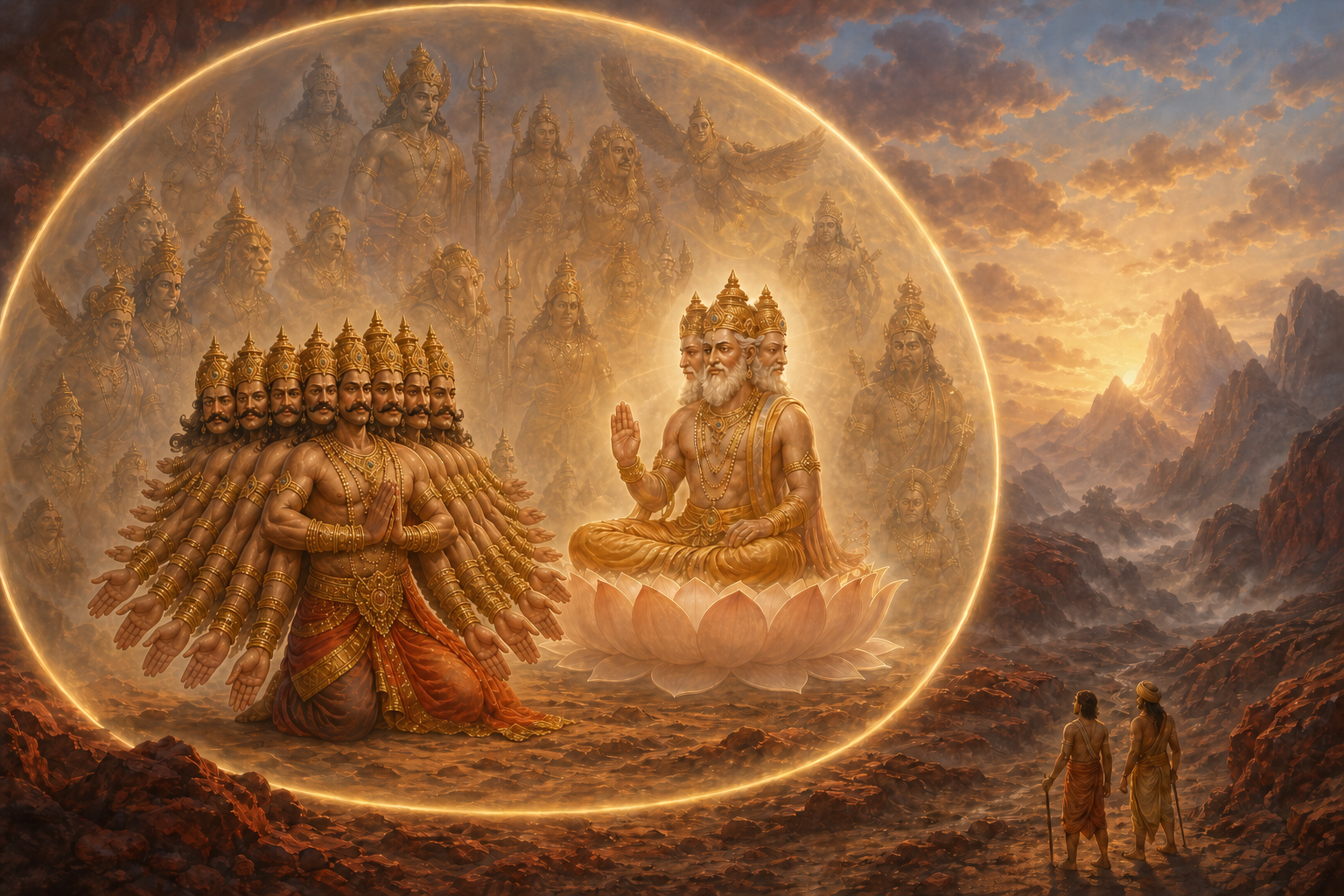
Ravana gained extraordinary power through intense tapasya and received a boon from Brahma. The boon protected him from devas, gandharvas, yakshas, and other formidable beings, while humans and certain animals remained outside its protection. Ravana did not consider them serious threats. His confidence therefore determined the scope of the protection he sought.
The first distinction you need to make is between protection and moral approval. Brahma’s boon restricted who could defeat Ravana; it did not declare Ravana righteous. Adharma did not become dharma merely because its practitioner possessed a sacred assurance. At the same time, Ravana’s misconduct did not give everyone permission to pretend that the assurance had never been granted.
This is why the boon matters. A sacred promise cannot sustain moral order if it is honored only while convenient. If divine power could revoke its own word whenever the recipient became troublesome, a boon would be no boon at all. The defeat of Ravana therefore had to check adharma while preserving the integrity of Brahma’s commitment.
Ravana’s omission supplied the lawful route. Vishnu could enter the human condition because humanity was not covered by the protection Ravana had requested. Rama did not falsely assume the identity of a protected being or erase the boon after the fact. He entered an unprotected category openly and accepted everything that came with it.
Calling this a mere loophole misses the point. A loophole usually exploits wording against the purpose of an agreement. Rama’s humanity honored both the stated boundary and the moral seriousness of the boon. Ravana himself had excluded humans because he judged them insignificant. Dharma answered his arrogance through precisely the form he had despised.
When you encounter a boon, vow, or curse in a Dharmic narrative, separate four things before drawing a conclusion:
- The gift or promise that was actually made.
- The beings, situations, or actions covered by its terms.
- The recipient’s moral conduct after receiving it.
- The remedy that remains available without breaking the original commitment.
This prevents two opposite mistakes. One is assuming that divine protection makes every protected act righteous. The other is assuming that righteous opposition may disregard every prior promise. Rama’s path avoids both.
Human limits were part of Rama’s authority
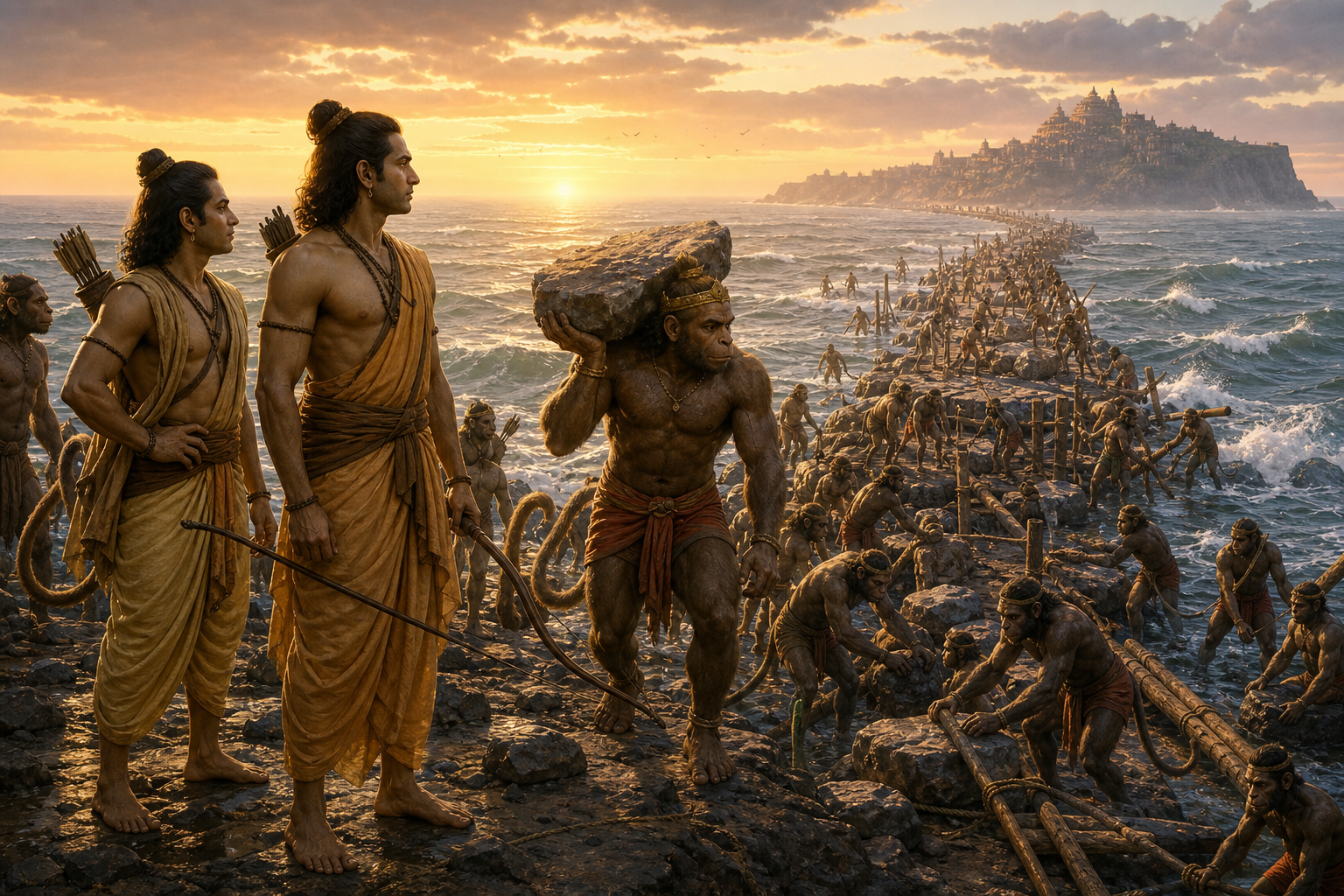
Rama did not merely borrow a human appearance for the final battle. He accepted a human life shaped by exile, separation from Sita, responsibility toward family and kingdom, dependence on allies, and the strain of duties that could pull in different directions. If those limits were only theatrical, his conduct would offer little guidance to anyone who must act without divine exemption.
His humanity makes the title Maryada Purushottama intelligible. Maryada is a boundary that disciplines conduct. Purushottama identifies the highest human exemplar. Rama’s greatness is therefore not raw capacity without restraint. It is strength governed by right conduct while grief, uncertainty, and limitation remain real.
That difference matters when you read the Ramayana for guidance. Do not ask only what Rama eventually achieved. At each difficult moment, ask:
<!– wp:list {