

If you have missed your japa, hurt someone, or watched a familiar weakness return, the hardest question is not whether you still count as spiritual. It is whether the setback needs a gentle restart or a decisive repair.
Bhagavatam-centered healing restores relationship: with Krishna, with your own conscience, and with the people affected by your conduct. It does not require you to manufacture a peaceful mood. It asks you to remember, tell the truth, repair what you can, and return to service.
First decide whether you are tired, wounded, or drifting

A distracted morning and an entrenched pattern of dishonesty are not the same spiritual problem. Treating every lapse as a catastrophe produces needless shame. Treating repeated harm as a minor fluctuation lets adharma settle into character.
The difference between a recoverable injury and a wound that threatens what is vital gives you a useful diagnostic discipline. Ask what has actually been damaged before choosing the remedy.
- Strain: You are tired, distracted, emotionally unsettled, or temporarily irregular, but you have not abandoned your guiding values. Reduce unnecessary demands, rest where needed, and resume a manageable form of japa, study, or seva. Do not turn fatigue into a verdict on your devotion.
- A moral injury: You have lied, spoken cruelly, neglected a duty, or harmed a relationship. Chanting remains important, but chanting alone does not complete the repair. Name the action, acknowledge its effect, and make amends where doing so is appropriate and safe.
- A threat to your direction: You repeatedly defend conduct opposed to satya, daya, or ahimsa. You hide the pattern, reject correction, or use devotional language to excuse it. This calls for firm boundaries, honest guidance from trustworthy satsang, appropriate prayaschitta, and sustained changes in conduct.
These are descriptions of conditions, not permanent labels for people. A wound can be serious without becoming your identity. The practical question is whether you are willing to stop protecting it.
Use three questions for a brief spiritual self-audit:
- What happened, stated plainly and without calling yourself either hopeless or blameless?
- Which vital quality was affected: truthfulness, compassion, nonviolence, humility, fidelity to duty, or willingness to serve?
- What concrete act would repair harm or make repetition less likely?
Notice the difference between shame and conscience. Shame collapses an action into an identity: “I failed, therefore I am beyond devotion.” Conscience is more exact: “This action violated dharma, so this is what I must correct.” Bhakti can work with the second statement because it leaves room for responsibility, grace, and action.
Make the Divine Name the center, not an escape
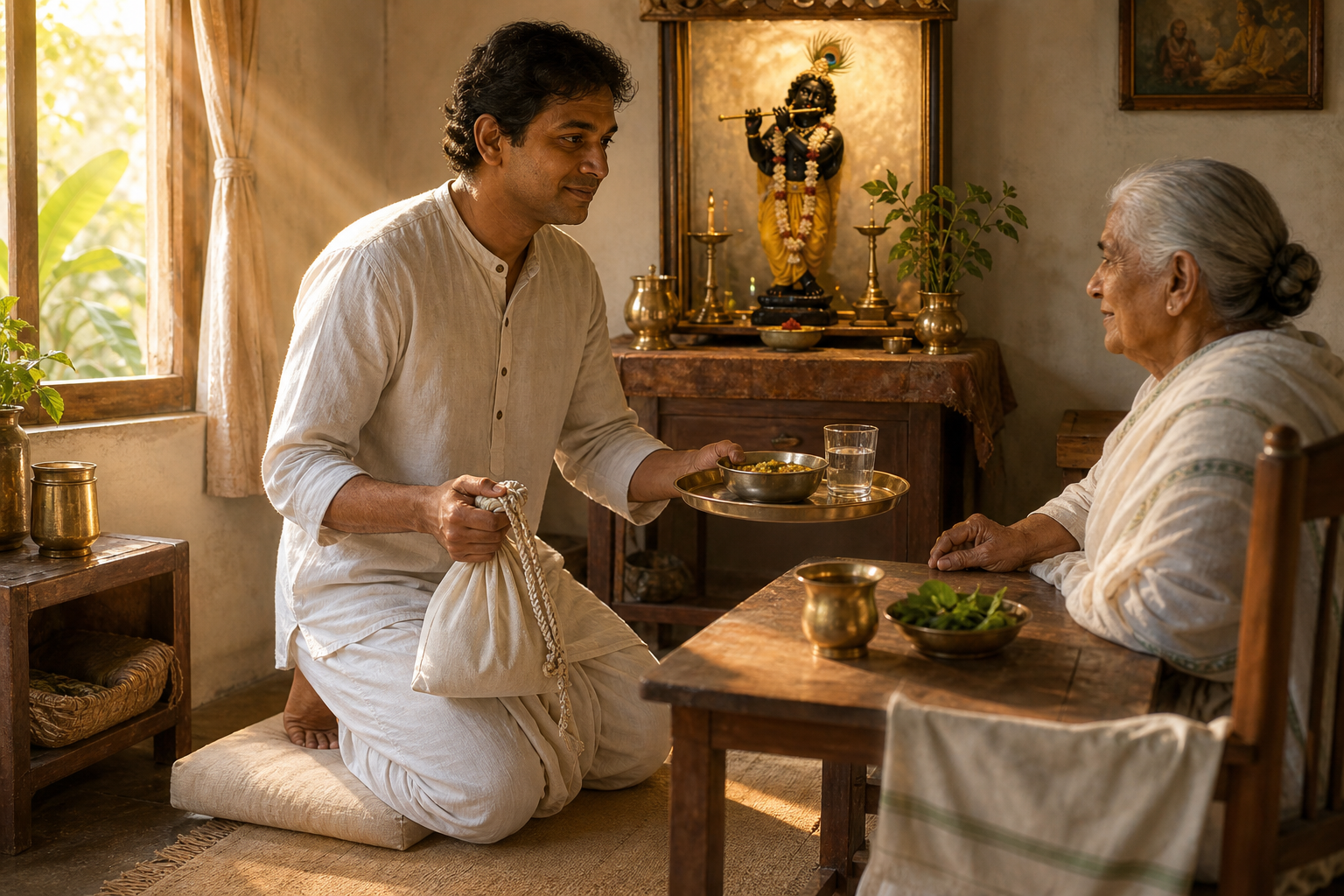
The Srimad-Bhagavatam places remembrance of Krishna at the center of spiritual life. Within the Gaudiya bhakti understanding of Kali-yuga, nama-sankirtan is an especially accessible path toward peace, liberation, and prema. Its accessibility should not be confused with shallowness. The practice joins theology, attention, ethical formation, and community.
Japa and sankirtan can support healing in different ways. Japa gives you a regular place to stop fleeing from your own mind and hear the Name. Collective kirtan carries remembrance into a shared devotional space, which can be especially valuable when isolation is feeding discouragement. Neither practice is permission to ignore consequences outside the prayer space.
- Arrive honestly: Before chanting, state the difficulty in one plain sentence. “My attention is scattered” is more workable than “My practice is useless.” “I spoke dishonestly and need to correct it” is more truthful than asking Krishna only to remove your discomfort.
- Return through hearing: When attention wanders during japa, return to hearing the mantra. The return is part of abhyasa. You do not need to dramatize the wandering or negotiate with every thought.
- Carry remembrance into conduct: Let the Name expose the next dharmic action. If an apology, truthful conversation, changed boundary, or act of restitution is needed, put it into practice rather than admiring the insight.
- Use community when secrecy is strengthening the problem: Attend kirtan or speak with a mature, discreet practitioner who will neither flatter you nor humiliate you. Healthy satsang joins compassion with accountability.
- Add seva: Choose service that turns attention outward and benefits another being. Seva is not self-punishment. It retrains the heart away from self-absorption and toward loving participation.
Do not judge every chanting session by emotion. Restlessness is not proof that the Name has failed, and a powerful devotional feeling is not proof that a damaged relationship has been repaired. A better test is whether remembrance is making you more truthful, compassionate, teachable, and ready to serve.
Put ethical repair in the right order

Devotional healing becomes confused when remorse, ritual, and restitution are mixed together without sequence. If your actions have affected someone else, begin with the harm rather than with your preferred image of yourself as a devotee.
- Stop the active harm. End the lie, cruelty, manipulation, or enabling condition that is still operating. A ritual performed while the conduct continues can become a shield against conscience.
- Name the breach without euphemism. Say what you did and which dharmic value it violated. Precision prevents vague guilt from taking the place of responsibility.
- Acknowledge the effect. Do not make the harmed person comfort you, accept your theology, or grant immediate forgiveness. Listen to the consequence of your conduct.
- Make appropriate amends. This may include an apology, restitution, correction of a false statement, restoration of a neglected duty, or a change in the circumstances that enabled repetition. If direct contact would be unsafe or would renew harm, seek qualified guidance before acting.
- Undertake prayaschitta as re-alignment. Atonement should reinforce truth and restraint, not function as a transaction that purchases permission to repeat the act.
- Return to disciplined devotion. Resume japa, meditation, Bhagavatam study, satsang, and seva. Regularity matters because one intense reaction rarely changes an established habit.
This sequence keeps two errors apart. Spiritual bypassing uses prayer to avoid accountability. Self-condemnation uses accountability to deny the possibility of transformation. Dharma requires neither evasion nor despair. It requires truthful repair followed by disciplined re-alignment.
Comparable forms of moral maintenance appear across dharmic traditions. Buddhism cultivates Right Intention and Right Speech. Jain practice joins ahimsa and aparigraha with pratikraman, a disciplined return through reflection and repair. Sikh practice joins Naam-simran with seva. These traditions are not interchangeable, and their theological claims should not be flattened into a generic spirituality. They do, however, show a shared practical wisdom: remembrance must change how you speak, restrain harm, accept responsibility, and serve.
Measure healing by your conduct under pressure

The first sign of spiritual recovery may not be serenity. It may be that you notice a harmful impulse earlier. You make fewer excuses. You tell the truth sooner. You accept correction without turning the conversation into a defense of your intentions. This is resilience in a dharmic sense: the capacity to recover moral alignment when pressure has disturbed it.
Look for changes that can be observed in ordinary life:
- The gap between a lapse and honest acknowledgement becomes shorter.
- You can distinguish tiredness from temptation and respond appropriately to each.
- Your speech becomes less defensive and more accurate.
- You repair harm without demanding praise for apologizing.
- You maintain devotional practice without using it to bargain for exemption from duty.
- You become more willing to receive guidance from trustworthy people.
- Your seva continues even when it brings no recognition or immediate emotional relief.
Peace matters, but the Bhagavatam’s devotional horizon is larger than relief. The mature movement is from “Please remove everything that troubles me” toward “Please keep me in loving service.” This does not glorify suffering or prohibit asking for help. It prevents devotion from shrinking into a technique for controlling every circumstance.
That distinction is particularly important for householders. Devotion is not measured only in the prayer room. Care for family, honest work, responsible speech, fulfillment of promises, and protection of vulnerable beings are places where remembrance becomes visible. If private practice grows while avoidable harm at home or work continues, the practice has not yet reached the wound.
Here, spiritual healing means restoration of remembrance, conscience, dharmic conduct, and capacity for service. It is not a medical or psychological diagnosis. If your suffering includes a physical illness, severe emotional distress, inability to function, risk of self-harm, or danger from another person, seek appropriate professional or emergency help. Japa, kirtan, and satsang may accompany qualified care, but they should not replace it.
Key takeaways
- Do not treat distraction, moral injury, and an entrenched harmful pattern as though they require the same response.
- Use japa and sankirtan to restore remembrance and honesty, not to avoid the consequences of conduct.
- Protect the vital qualities of satya, daya, and ahimsa before a repeated compromise becomes part of your character.
- When another person has been affected, stop the harm, acknowledge it, make appropriate amends, and change the conditions that enabled it.
- Measure recovery through truthfulness, teachability, compassion, steadiness, and service under pressure – not through devotional emotion alone.
- Keep spiritual practice beside appropriate medical or psychological care when illness or serious distress is present.
At your next practice, name one wound without exaggerating or minimizing it. Identify the virtue it touched and the repair it requires. Then chant, take the next honest action, and let someone trustworthy help you remain accountable. That is how a setback stops being an identity and becomes a return to dharma.
References
- Dandavats – Srimad Bhagavatam 10.90.18: Mortal Wounds, Spiritual Resilience, and Dharma’s Healing Power
- Dandavats – Srimad-Bhagavatam and Sankirtan: Transformative Peace, Love, and Liberation in Kali-yuga
