
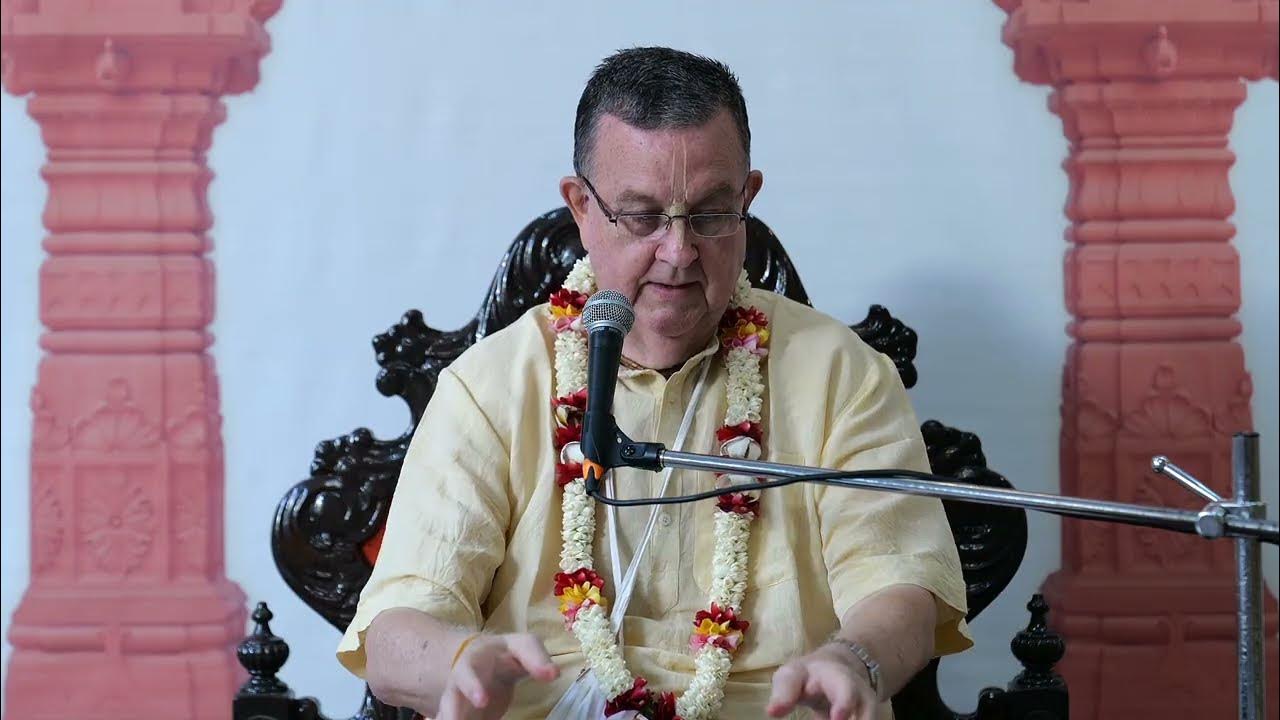
Delivered on 12th Apr 2026 by H.G Bhima Prabhu, a class on Śrīmad Bhāgavatam 11.3.19–20 set out a clear, rigorous thesis: the entire spectrum of material attainmentswealth, family prestige, social status, and even refined pleasures of heavenly planescannot yield abiding happiness. Each of these achievements is time-bound, vulnerable to loss, and therefore bound up with anxiety, competition, and fear. By examining the text within its wider philosophical architecture, the teaching demonstrates why impermanence is not only a metaphysical claim but also an observable psychological and social reality, and why genuine freedom (moksha) requires a qualitative shift of orientation rather than mere quantitative accumulation of merit or assets.
These verses, situated in the Eleventh Canto where the Nine Yogendras offer penetrating insights on the path of liberation, argue that even the pious ascent to higher planetsthough achieved through virtuous actiondoes not abolish rivalry or envy, nor does it end the cycle of gain and loss. Material results, by definition, arise and pass away. Hence, they cannot secure the unshakable contentment that seekers of śreyaḥ (the highest good) intuitively desire. This reading accords with a consistent current across Vedic wisdom and Hindu philosophy: all that is produced by time is reclaimed by time, and therefore cannot be the ground of lasting joy.
The analysis turns next to the triad of anxiety, competition, and fear. When identity takes shape around variable markersincome, recognition, familial roles, social visibilitystability is delegated to unstable conditions. Competition becomes structurally embedded because status is relative; fear proliferates because loss is inevitable. Thus the mind becomes conditioned to scan for threats, rivals, and contingencies, all in service of maintaining a fragile self-concept constructed upon external referents. Śrīmad Bhāgavatam, read alongside cognate texts, identifies this as an error of orientation rather than of effort.
From a scriptural standpoint, one finds the same conclusion in allied passages: fear emerges when consciousness, diverted from the Absolute, becomes absorbed in duality and difference. What begins as attachment to outcome soon matures into vigilance against loss, then into rivalry with those perceived to endanger one’s standing. The psychology of scarcityhowever subtleorganizes the entire field of perception. In practical terms, even benevolent projects can devolve into contests for credit or control when they are yoked to identity maintenance rather than to service (seva) anchored in the Self or the Divine.
A common objection holds that if earthly life is ultimately transient, perhaps heavenly pleasures (svarga) provide a secure alternative. Śrīmad Bhāgavatam 11.3.19–20 anticipates this and answers in the negative: these enjoyments also expire with the depletion of accumulated merit. This is harmonized by the Bhagavad-Gita’s description that those who reach celestial realms through pious activity eventually return once their merit is exhausted. Thus, finitude remains the rule; temporality cannot produce eternity. The result is a refined but still conditional happinesssubject to rivalry, envy, and decayrather than the unconditional freedom of moksha.
Scriptural narratives further illustrate that even among higher beings, rivalry punctuates the storyline; prestige and position can trigger subtle insecurity. These episodes are not intended as gossip about the heavens but as mirrors for human tendencies. If rivalry can appear where resources are abundant, then competition is not merely material but mental: it flows from identification with roles and outcomes, not only from scarcity of things. Śrīmad Bhāgavatam’s diagnosis is therefore comprehensiveaddressing the roots of suffering rather than only its symptoms.
Viewed through the lens of contemporary behavioral science, the text anticipates what is now described as the hedonic treadmill: gains quickly become baselines, prompting new desires and renewed striving. The Vedic account attributes this cycle to the interplay of the guṇas: rajas energizes ambition and restlessness; tamas feeds inertia and fear; even sattva, though clarifying, remains a subtle bond when clung to as identity. None of these modes can deliver permanence; each binds in proportion to identification. Consequently, material victories, however impressive, cannot confer existential security.
Śrīmad Bhāgavatam 11.3.19–20 does not recommend passivity or neglect of duty; it prescribes a revaluation of ends. The pivot it invites is from preoccupation with artha and kāma to prioritization of dharma and moksha, so that wealth, family, and social responsibility are reframed as instruments of service rather than instruments of self-creation. This pivot transforms relationships from arenas of control into opportunities for offering, where care deepens but clinging loosens. What is loved is honored more fully when it is not made to bear the impossible burden of providing permanence.
In the immediate vicinity of these verses, the Eleventh Canto famously directs the sincere seeker to approach a realized guide. The instruction emphasizes readiness (jijñāsā for the highest good) and the qualities of a spiritual mentor grounded in revealed wisdom and steady realization. This is not a call to abdicate discernment but to refine it: study guided by one who is both śāstra-competent and inwardly established prevents misinterpretation and hastens integration. In this way, the Bhagavatam aligns personal effort (sādhana) with trustworthy direction (guru-śiṣya paramparā).
Within the Bhagavata tradition, bhakti-yoga becomes the integrative discipline that resolves the paradox of living purposefully in a changing world while seeking the changeless. Practices such as śravaṇa (listening), kīrtana (recitation), and smaraṇa (recollection) gradually relocate identity from perishable attainments to an imperishable relationship with the Divine. When practiced as dharma rather than as another form of acquisition, bhakti dissolves envy by celebrating others’ progress, and it undercuts fear by re-centering value in what cannot be lost.
These insights resonate across dharmic traditions and thereby support unity rather than sectarianism. Buddhism’s anicca and dukkha analyze impermanence and unsatisfactoriness with surgical clarity; Jainism’s aparigraha prescribes non-possessiveness to free the soul of karmic accretions; Sikhism’s teachings on māyā and haumai warn against the egoic appropriation of roles and results. Each stream points toward the same summit: lasting happiness is secured not by perfecting the transient but by transforming the knower’s relation to it. This shared grammar of liberation underscores a civilizational convergence within Sanatana Dharma, Buddhism, Jainism, and Sikhism.
A practical synthesis emerges from this convergence. Daily disciplines of mantra-japa or nām-simran focus attention on the imperishable; contemplative meditation cultivates equanimity; scriptural study steadies understanding; and seva broadens the heart’s field beyond self-reference. In parallel, the Jain ethic of aparigraha can be operationalized through periodic audits of consumption and attachment, ensuring that sacred practice is mirrored by responsible living. These compatible pathways reinforce one another, fostering both inner freedom and outer integrity.
Crucially, Śrīmad Bhāgavatam does not dismiss family or professional life; it exposes the error of extracting identity from them. When roles are consecrated as offerings, family affection matures into steady care unthreatened by changing circumstances, and work evolves into karma-yogaskill in action without bondage to outcome. This transvaluation does not weaken commitment; it purifies intent, replacing rivalry with cooperation and fear with trust.
Obstacles naturally appear. Old patterns of comparison and insecurity may reassert themselves, especially under pressure. Here the text’s counsel is methodological rather than merely moral: return attention to the anchoring practice, re-establish the motive as service, and consult the guiding wisdom to recalibrate. Over time, this looppractice, reflection, guidancebecomes a virtuous spiral, gradually dissolving the reflexes of grasping and aversion.
Concrete indicators help assess progress. Anxiety begins to loosen its grip, not because conditions magically improve but because identity is no longer wagered on them. Envy diminishes as the heart learns to rejoice in others’ welfare. The appetites for prestige or moral superiority soften, replaced by gratitude and humility. Fear subsides into a quiet courage born of alignment with dharma and trust in the Divine. These are empirical shifts, recognizable in daily interactions and inner weather alike.
By insisting that even exalted enjoyments culminate in loss, Śrīmad Bhāgavatam 11.3.19–20 protects the seeker from a refined detourmistaking sophisticated impermanence for permanence. The proposed solution is neither escapism nor ascetic denial for its own sake, but well-guided transformation: grounding life in bhakti-yoga, ethical clarity, and contemplative insight so that worldly participation becomes a field of purification rather than entanglement. In that groundedness, the senses are not enemies, relationships are not threats, and responsibilities are not burdens; they are vehicles of maturation.
This reframing carries significant social implications. As competition and fear recede, cooperation and generosity scale. Institutions shaped by dharma and seva can pursue excellence without toxic rivalry. Cultural confidence grows not from triumphalism but from inner freedom, allowing genuine pluralism to flourish. The unity of dharmic traditions becomes lived reality, not merely an abstract aspiration, when each pathway is honored for its contribution to the shared pursuit of liberation.
In sum, the class’s central insight is both simple and demanding: what is temporary cannot deliver the permanent good; what is rivalrous cannot yield universal peace. Śrīmad Bhāgavatam 11.3.19–20 directs the quest for lasting happiness away from accumulation and toward realizationsupported by guru, illumined by śāstra, and matured through steady practice. On that path, joy no longer depends on circumstances, and courage is no longer the product of denial; both emerge from alignment with what cannot be diminished by time.
Thus, even while fully engaged with family, community, and professional commitments, a seeker can gradually experience the promised transition: from anxiety to assurance, from competition to compassion, and from fear to freedom. That transformationquiet, durable, and shareableembodies the teaching’s promise and validates its method. It is here that material life, transfigured by wisdom and devotion, begins to reflect the light of enduring happiness.
Inspired by this post on Dandavats.
