Vyasa occupies three positions at once in the traditional account of the Mahabharata: he helps continue the family at the centre of the narrative, advises that family as its crisis deepens, and gives its history enduring literary and philosophical form. Reading these roles together reveals why he cannot be understood merely as an author standing outside his work.
The supplied DharmaRenaissance account presents Vyasa as both implicated in the Kuru tragedy and capable of interpreting it. That tension provides a useful way to examine the epic’s treatment of duty, consequence, human agency, and the preservation of moral memory.
One figure, three kinds of authority
Vyasa’s importance comes from the interaction of three forms of authority. His genealogical authority arises from his place within the Kuru family. His spiritual authority rests on the insight and discipline associated with a rishi. His literary authority comes from the tradition that remembers him as the Mahabharata’s composer and arranger.
These roles are not interchangeable. As a participant, Vyasa acts under the pressure of a succession emergency. As a counsellor, he sees dangers that political actors either cannot or will not overcome. As the traditional composer, he places those actions and failures within a much larger inquiry into dharma. The result is a distinctive kind of self-awareness: the intelligence shaping the narrative also belongs to the family whose conduct the narrative examines.
Key takeaways
- Vyasa stands inside the Kuru genealogy while also serving as the traditional composer of its history.
- His participation in niyoga resolves an immediate succession problem but helps establish the family lines later divided by conflict.
- His warnings demonstrate foresight, yet the epic does not give him control over other people’s choices.
- His authorship turns a dynastic catastrophe into a continuing examination of duty, power, suffering, and liberation.
Succession duty and the architecture of conflict
The genealogical role begins with Vyasa’s mother, Satyavati. According to the source account, Vyasa was born from her union with the sage Parashara and departed for a life of spiritual discipline after promising to return when she needed him. Satyavati later married King Shantanu after Bhishma renounced both the throne and marriage so that her future children could inherit.
That renunciation secured Satyavati’s marriage but made the dynasty unusually dependent on a narrow line of succession. Her sons Chitrangada and Vichitravirya subsequently died without heirs. The source describes the resulting problem as more than private grief: the royal household faced a break in political, familial, and ritual continuity.
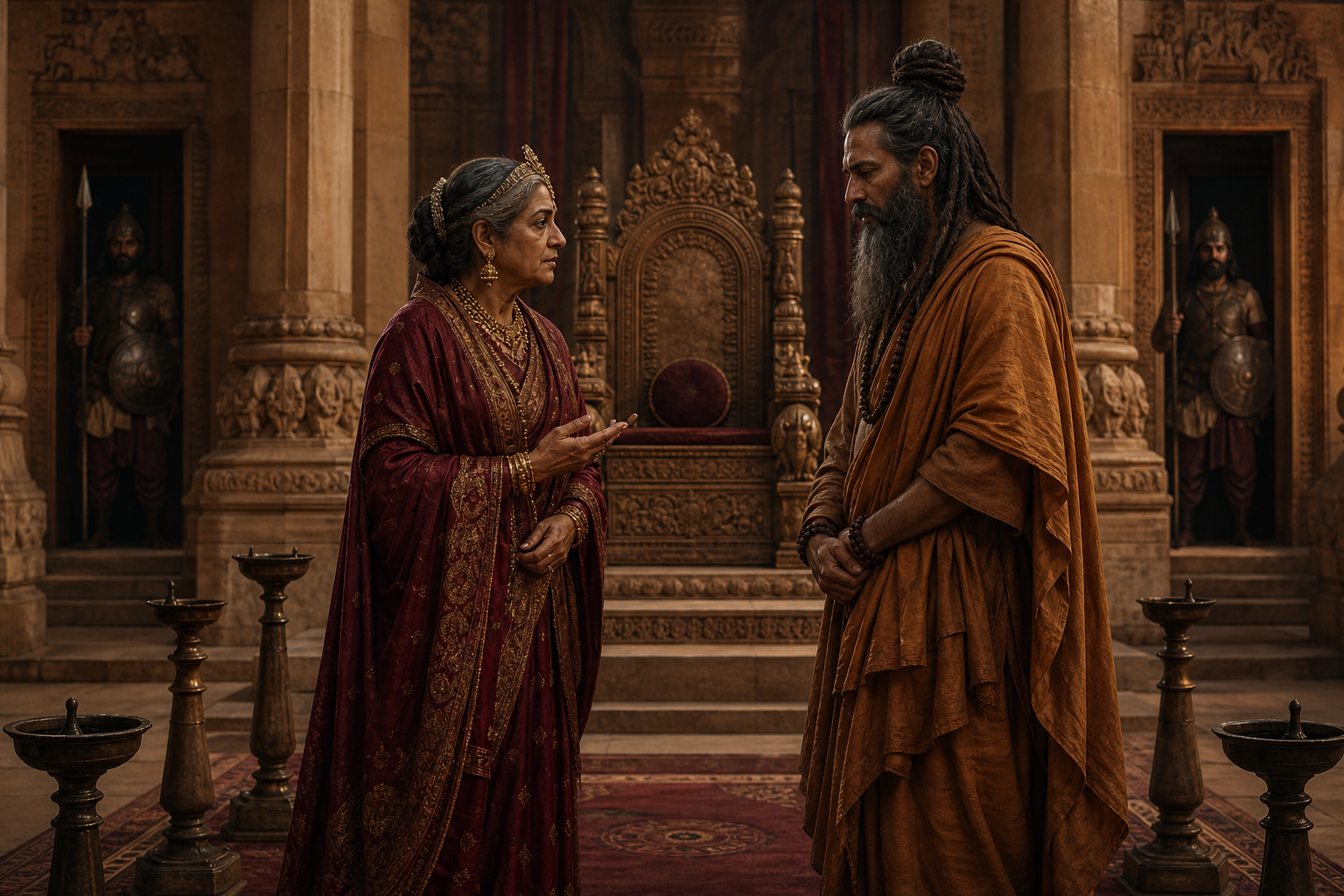
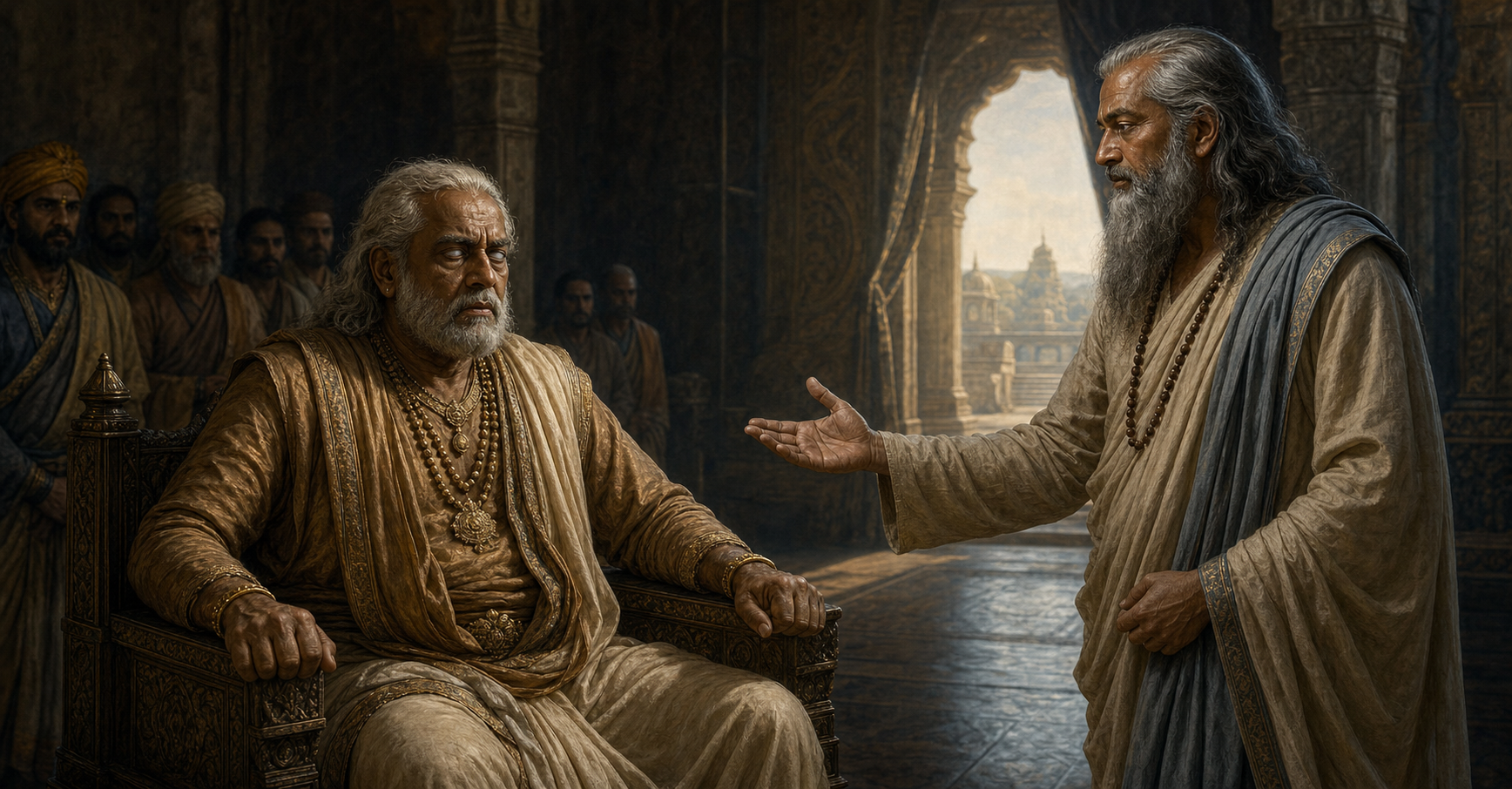
Satyavati therefore summoned Vyasa to continue the line through niyoga, which the source presents as an ancient custom for producing heirs on behalf of a deceased husband. Vyasa consented to his mother’s request. Dhritarashtra was born to Ambika, Pandu to Ambalika, and Vidura to a maid sent in Ambika’s place. The account identifies Dhritarashtra as blind from birth, Pandu as pale or wan, and Vidura as a figure distinguished by wisdom and ethical clarity.
This intervention makes Vyasa the biological father of the generation from which the Kaurava and Pandava branches emerge. It does not make him the sole cause of their later conflict. Bhishma’s vow, the deaths of Satyavati’s sons, the demands of succession, and the later decisions of many family members all belong to the chain of circumstances. Vyasa’s act is better read as a point where an urgent duty creates consequences that no participant can fully contain.
The episode consequently resists a simple verdict. Refusing Satyavati would have left the dynasty without the requested means of continuation; agreeing brought new heirs into an already fragile political structure. The Mahabharata’s moral complexity is visible here before the battlefield appears: an action can answer one legitimate obligation without guaranteeing a harmonious future.
Foreknowledge without coercion
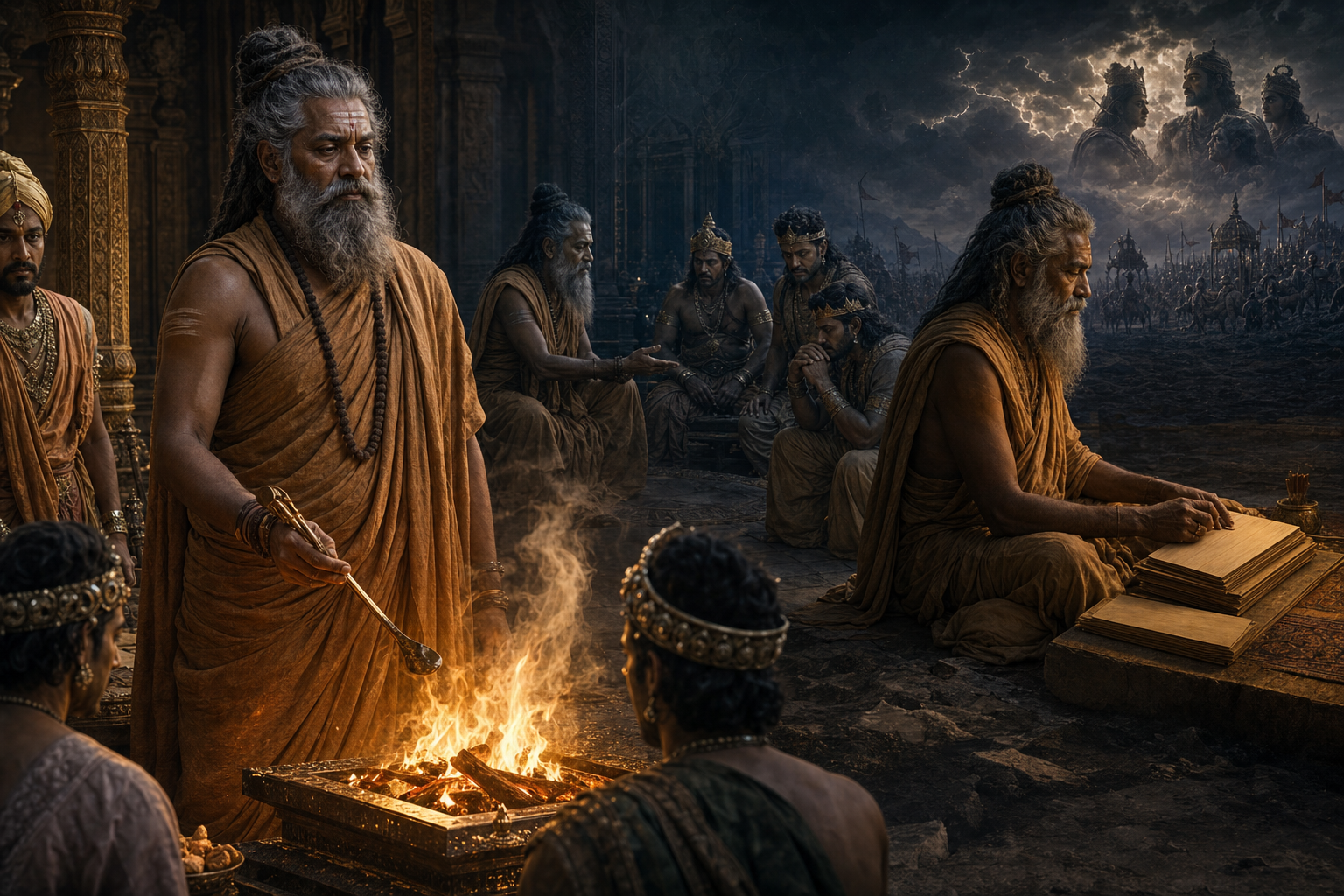
Vyasa’s later appearances differ from those of a ruler or court strategist. The source portrays him as entering at decisive moments, disclosing what others do not see, offering counsel, and withdrawing. His influence depends on insight rather than command.
One example is his warning to Satyavati about the suffering approaching the dynasty. Following his advice, she leaves the palace for the forest with Ambika and Ambalika. The moment shows that Vyasa’s foresight can guide those willing to listen, but it does not reorganize the entire court or cancel the choices of its remaining members.
His inability, or refusal, to prevent the eventual war is therefore central to his role. If wisdom automatically compelled obedience, the epic’s moral world would become mechanical: a seer’s warning would eliminate the need for deliberation, responsibility, and consequence. Instead, Vyasa can illuminate a course of action without living other people’s duties for them.
This distinction separates knowledge from control. Knowing that a family is moving toward disaster is not the same as possessing legitimate power to override every vow, attachment, ambition, and judgment within it. Vyasa’s restraint preserves the agency of the epic’s other characters, even when that agency produces grief.
Authorship turns family sorrow into moral memory
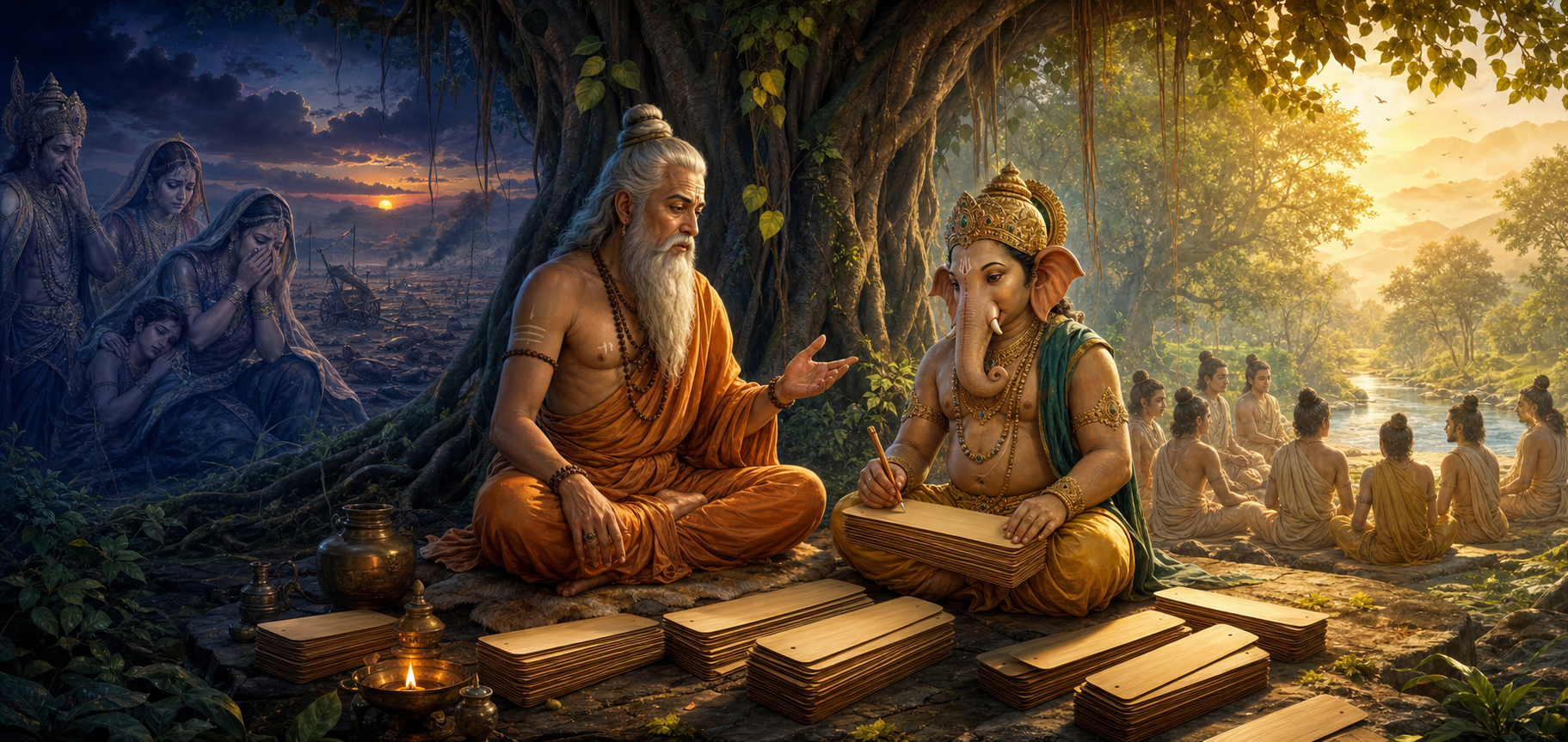
The name Vyasa is associated in the source with arranging, compiling, or dividing knowledge. Within the Mahabharata tradition, that function is not simply the recording of a sequence of royal events. It gives the Kuru family’s experiences a structure through which later audiences can consider the meaning of those events.
This helps explain the epic’s breadth. The source characterizes the Mahabharata as an inquiry extending beyond a war between cousins to questions of kinship, kingship, karma, renunciation, devotion, social obligation, suffering, and liberation. Its debates and embedded narratives allow different kinds of people to speak rather than reducing dharma to a single formula.
Vyasa’s participation gives that expansiveness additional weight. He does not preserve the fall of an unrelated house from a position of detachment; he preserves the consequences of a lineage he personally helped continue. Authorship thus becomes an act of moral responsibility: experience that could have remained private devastation is organized into a resource for reflection.
The tension between involvement and insight also protects the epic from easy moral superiority. Its traditional composer cannot be placed among the untouched observers who diagnose everyone else’s failures. He belongs to the history he interprets, just as human beings generally must reason about duties and consequences from within relationships they did not design and cannot fully escape.
Reading Vyasa beyond a single verdict
A productive reading of Vyasa asks neither whether he secretly engineered the conflict nor why an all-knowing sage simply failed to stop it. Both questions flatten the distinction among participation, foresight, and power. The source instead supports a more demanding interpretation: he performs a requested duty, recognizes the accumulating danger, counsels those involved, and preserves the resulting history without pretending that wisdom erases human freedom.
Future engagement with the Mahabharata can build on this distinction by examining when counsel becomes obligation, when intervention becomes overreach, and how painful consequences should be remembered. Vyasa remains important because his role keeps those questions open rather than resolving them through a single judgment.