
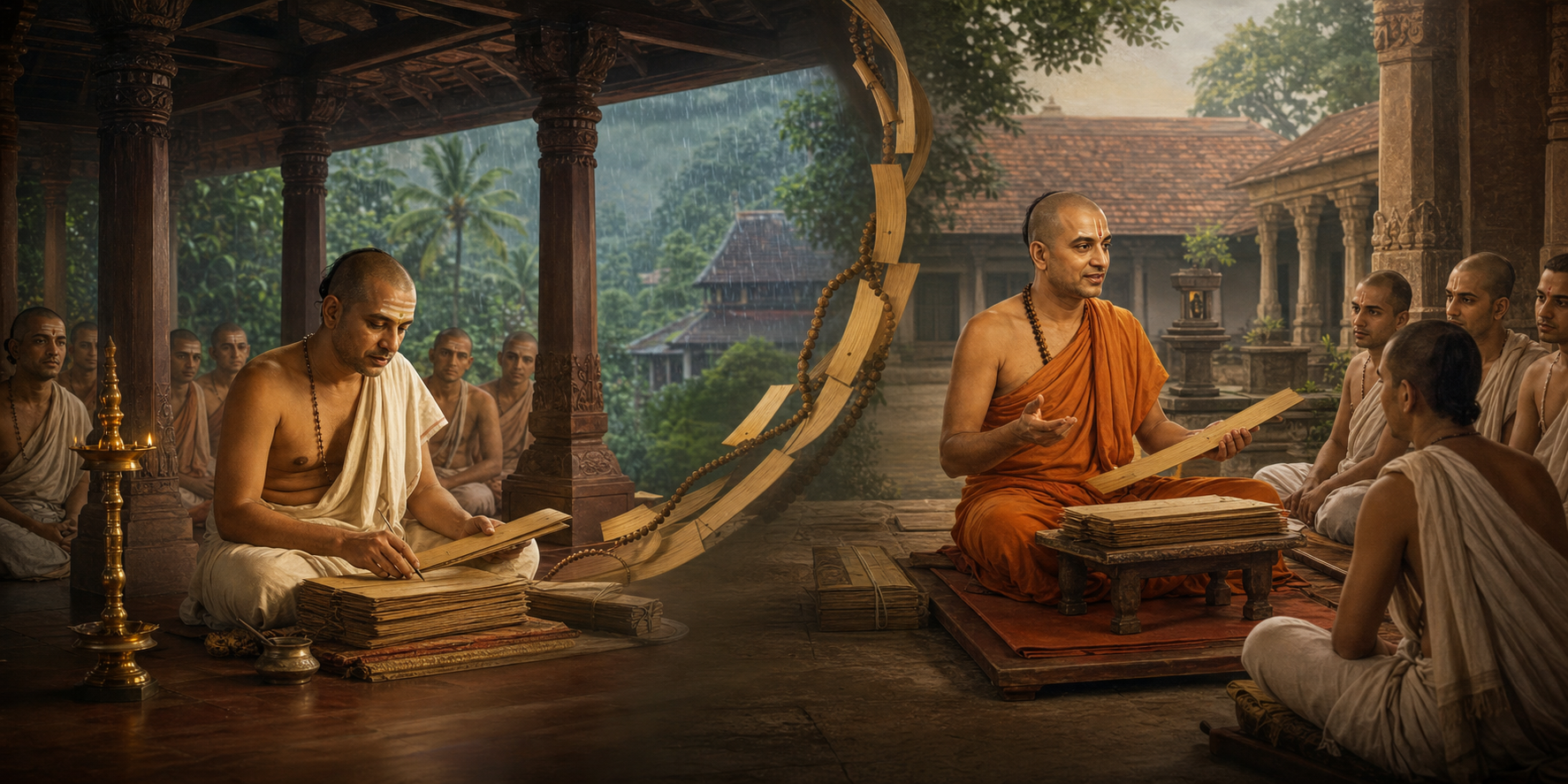
Narayana Bhattathiri and Vijayendra Tirtha represent two distinct ways of becoming a saint-scholar in South India. One is remembered especially through devotional poetry, grammar, and Kerala’s learned culture; the other through Dvaita Vedanta, public disputation, commentary, and monastic leadership.
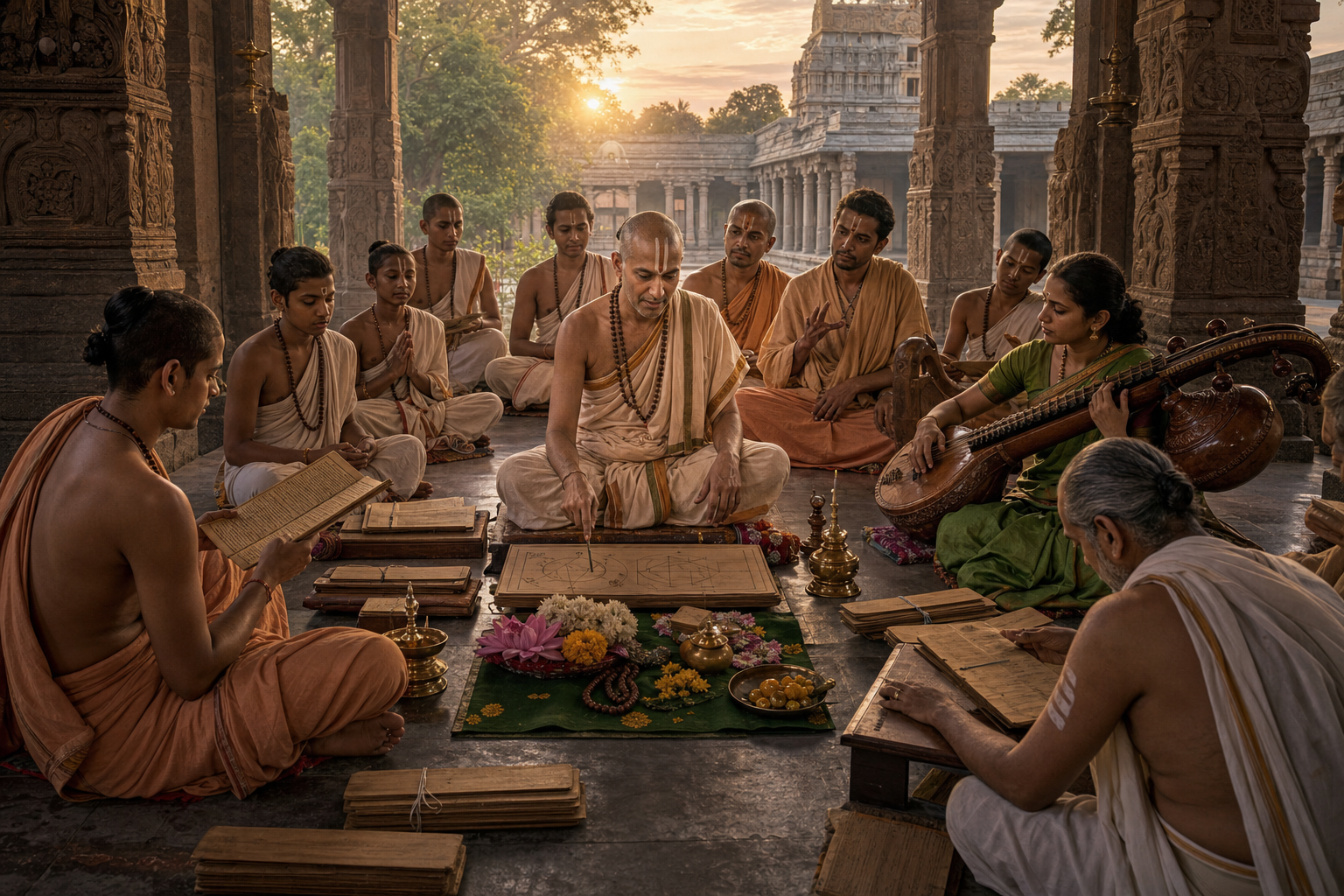
Read together, the two DharmaRenaissance profiles show that sacred learning was neither a single curriculum nor an escape from worldly institutions. It joined intellectual technique to devotion while depending on teachers, temples, monasteries, courts, manuscripts, and communities of recitation.
A shared scholarly world, but different paths to authority
The profile of Narayana Bhattathiri gives his traditional dates as 1560-1646, while noting that some accounts extend his life to 1666. The profile of Vijayendra Tirtha places him around 1517-1614. Their reported lifespans therefore locate both men in an overlapping early-modern South Indian setting, not in an undifferentiated ancient past.
Bhattathiri’s path began, according to his profile, in a learned Brahmin household at Melpathur near the Tirur region of present-day Kerala. His father, Mathrudattan Bhattathiri, was an early teacher. The article then names specialized instruction in the Rig Veda under Madhava, reasoning and debate under Damodara, and grammar under Achyuta Pisharati. This sequence presents scholarship as a layered formation: family learning established the foundation, while expert teachers developed particular disciplines.
Vijayendra’s profile reports a different structure of formation. Traditionally identified by the birth name Vitthalacharya and associated with a Kannada-speaking Madhva Brahmin background, he entered the lineage of the Dvaita master Vyasatirtha. He later became closely associated with the pontifical seat at Kumbakonam in present-day Tamil Nadu. His authority consequently appears not only in texts but also in succession, institutional office, doctrinal defense, and the training of later scholars.
The contrast prevents the term saint-scholar from becoming a vague honorific. Bhattathiri’s profile moves among household education, individual teachers, Guruvayur’s temple culture, scholastic circles, and royal patronage. Vijayendra’s emphasizes an acharya lineage, a monastic center, philosophical controversy, and Dvaita’s expansion beyond its Karnataka heartland. Both models joined sanctity and learning, but they organized scholarly authority differently.
Devotion expanded rather than narrowed the curriculum
Both profiles reject a modern division between religious commitment and analytical study. Bhattathiri is presented as a Sanskrit poet and grammarian with training in Veda, logic, and debate, as well as an association with the Kerala school of astronomy and mathematics. Vijayendra is described as working across Vedanta, Nyaya, Mimamsa, poetry, drama, and literary ornamentation. In each account, breadth was part of religious scholarship rather than a distraction from it.
Bhattathiri’s Prakriya-sarvasvam, as described by its source, elaborated the grammatical system of Panini. The profile stresses the formal habits required by such work: rules, operations, exceptions, linguistic generation, and internal consistency. It also places Bhattathiri in the learned environment associated with figures such as Madhava of Sangamagrama, Jyeshtadeva, and Achyuta Pisharati. The article is careful, however, to say that Bhattathiri’s direct technical contributions are less famous than those of some other members of that mathematical and astronomical milieu.
Vijayendra’s intellectual task was more overtly dialectical. His source explains Dvaita Vedanta as a realist and theistic system in which Vishnu is the independent supreme reality, while souls and the material world are real but dependent. It also reports Dvaita’s fivefold distinction between God and soul, God and matter, soul and matter, one soul and another, and one material entity and another. Defending this account required arguments about perception, inference, scriptural interpretation, causality, error, liberation, and the reality of difference.
The commonality, then, was not that every discipline was treated as interchangeable. Each supplied a different capacity. Grammar cultivated precision in the formation and interpretation of language; logic tested arguments; Mimamsa examined scriptural and ritual interpretation; poetry concentrated theological narrative into memorable form; and devotional discipline gave learning its ultimate orientation. Sacred learning was integrated because these capacities supported one another while retaining distinct functions.
Teachers, temples, monasteries, and courts sustained knowledge
The two lives also show why texts alone cannot explain intellectual continuity. Bhattathiri’s profile gives special weight to his relationship with Achyuta Pisharati, described there as a grammarian, astronomer, astrologer, and mathematician. A traditional narrative says that when Pisharati suffered a grave illness, Bhattathiri prayed to bear the affliction himself. The source explicitly allows this episode to be read as sacred memory, hagiography, or spiritual symbolism, rather than presenting it as independently documented biography.
Within that tradition, Bhattathiri went to Guruvayur and, following advice associated with Thunchaththu Ramanujan Ezhuthachan, began a composition on Vishnu’s manifestations. The resulting Narayaneeyam became an offering to Guruvayoorappan, the Krishna worshipped at Guruvayur. The profile also reports a tradition that Bhattathiri’s illness abated during its composition and recitation. That claim belongs to the text’s devotional reception; it should not be converted into independent medical evidence.
Vijayendra’s source foregrounds institutional continuity instead. His link to Vyasatirtha placed him within an established Madhva intellectual lineage, while his position at Kumbakonam provided Dvaita with a center in the Tamil region. The article situates that center amid temple scholarship, royal patronage, and sectarian debate under the influence of the Thanjavur Nayaks and the broader post-Vijayanagara cultural world.
Bhattathiri’s career was not confined to temple devotion either. His profile connects him with the patronage of Cochin Vira Keralavarman and attributes court-related works such as Gosrinagaravarnana and Virakeralaprasasti to that relationship. Together, the accounts reveal an intellectual infrastructure extending across personal discipleship, sacred sites, monastic succession, courts, and scholastic communities. Knowledge endured because several institutions carried it for different audiences.
Place mattered within this infrastructure without making either legacy merely regional. Bhattathiri condensed the pan-Indian narrative and theology of the Bhagavata Purana around the locally worshipped form of Krishna at Guruvayur. Vijayendra carried a Vedantic lineage associated strongly with Karnataka into Kumbakonam’s Tamil scholarly environment. Each case shows localization as a means of transmission: a larger Sanskrit tradition acquired durable life through a particular sacred center.
Different kinds of texts reached different communities
The Narayaneeyam is the clearest example of learned compression becoming a public devotional form. Bhattathiri’s profile describes it as 100 dasakams, comprising 1,036 verses, that condense the expansive world of the Bhagavata Purana. Its achievement lay not merely in shortening a source but in retaining narrative movement and devotional intensity within a structure suitable for sustained recitation.
According to the same article, the work came to function in homes, scholarly study, devotional gatherings, and temple observance. It reports continued recitation in Kerala and Tamil Nadu and identifies Narayaneeyam Dinam at Guruvayur as part of Bhattathiri’s public memory. His technical and ritual writings, including Prakriya-sarvasvam, Dhatukavya, and works attributed to several other genres, show that this widely received devotional poem was only one part of a broader scholarly career.
Vijayendra’s surviving image is shaped more heavily by specialist writing. His profile says that tradition credits him with as many as 104 works, while cautioning that not all remain extant or readily accessible. It associates him with works including Laghu Amoda, Tattvaprakasika Tippani, Nyayamauktikamala, Yuktiratnakara, Pramana Paddhati Vyakhyana, Chakra Mimamsa, and Bhedavidyavilasa. These titles are presented as evidence of sustained work in Vedanta, epistemology, Mimamsa, commentary, and polemical theology.
The source describes Laghu Amoda as connected with Vyasatirtha’s Nyayamruta and associates the Tattvaprakasika Tippani with Dvaita interpretation of the Brahma Sutras. Such works helped advanced students inherit arguments, respond to rival interpretations, and preserve a school’s reading of foundational texts. Their form differs from the recitational accessibility of the Narayaneeyam, but their transmission function is comparable.
The difference in the two profiles must also be read as a difference in surviving emphasis. The Bhattathiri account makes a living culture of communal recitation particularly visible, whereas the Vijayendra account foregrounds corpus, debate, commentary, and institutional lineage. This evidence supports comparison between modes of transmission, but it does not justify reducing one figure to emotion and the other to argument. Both profiles describe devotional practice and demanding intellectual work as mutually reinforcing.
Key takeaways
- A South Indian saint-scholar could derive authority through several overlapping roles, including poet, grammarian, philosopher, teacher, commentator, debater, and pontiff.
- Bhattathiri and Vijayendra shared a multidisciplinary ideal but applied it differently: one profile centers poetic condensation and grammatical order, while the other centers Vedantic defense and institutional continuity.
- Guru relationships supplied an ethical framework for learning, while temples, monasteries, courts, and manuscript traditions supplied its social infrastructure.
- Hagiographical memory, attributed corpora, institutional lineage, and continuing recitation are different kinds of evidence and should be interpreted according to their limits.
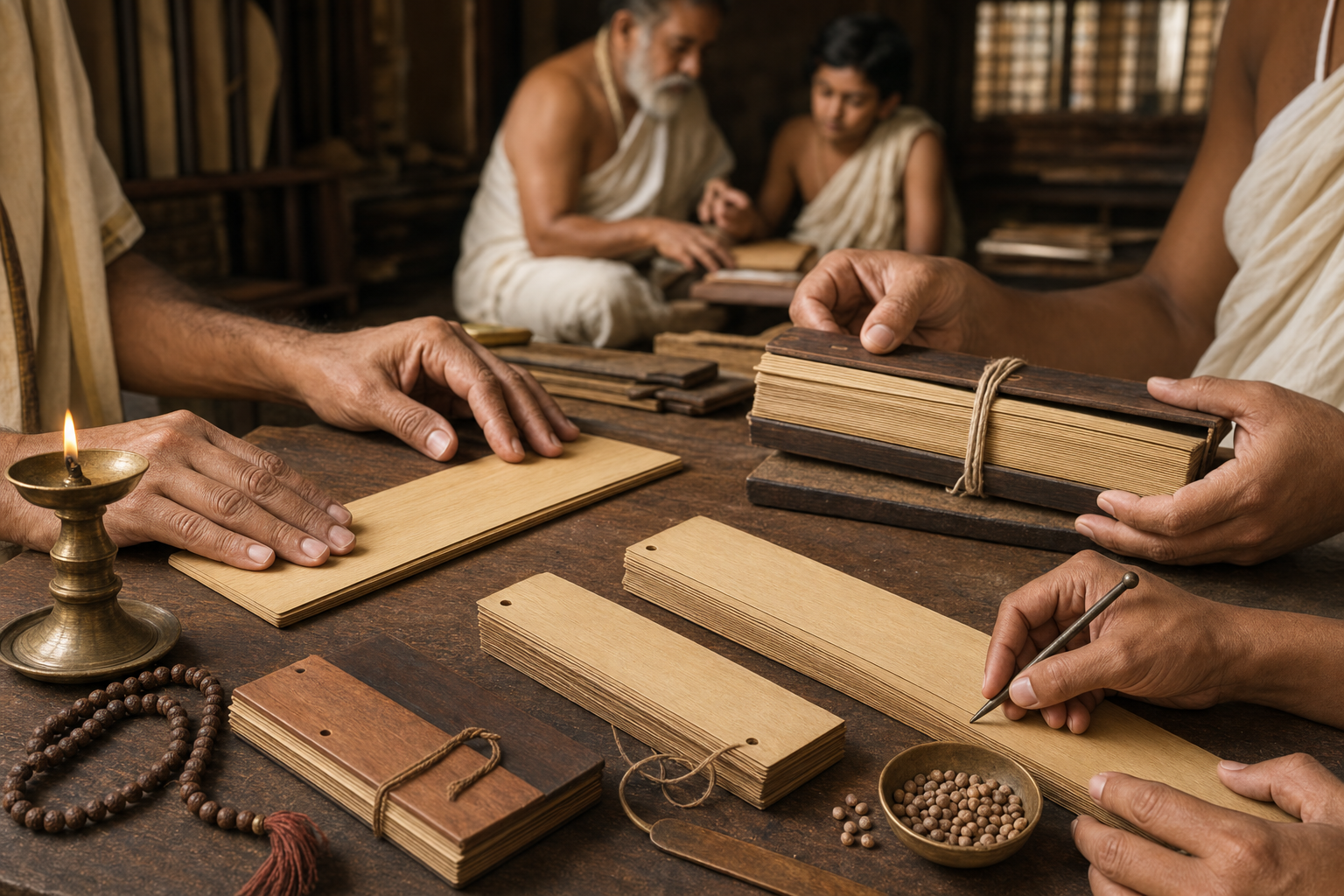
Further study can build on this comparison by examining surviving manuscripts, the later reception of technical works, and the local communities that still transmit these legacies. That approach would preserve the unity of sacred learning without flattening its regional settings, institutional forms, or philosophical disagreements.
References
- DharmaRenaissance Blog — Narayana Bhattathiri: Profound Genius Behind Narayaneeyam and Kerala’s Sacred Learning
- DharmaRenaissance Blog — Vijayendra Tirtha: Powerful Lessons from a Dvaita Vedanta Master’s Legacy