
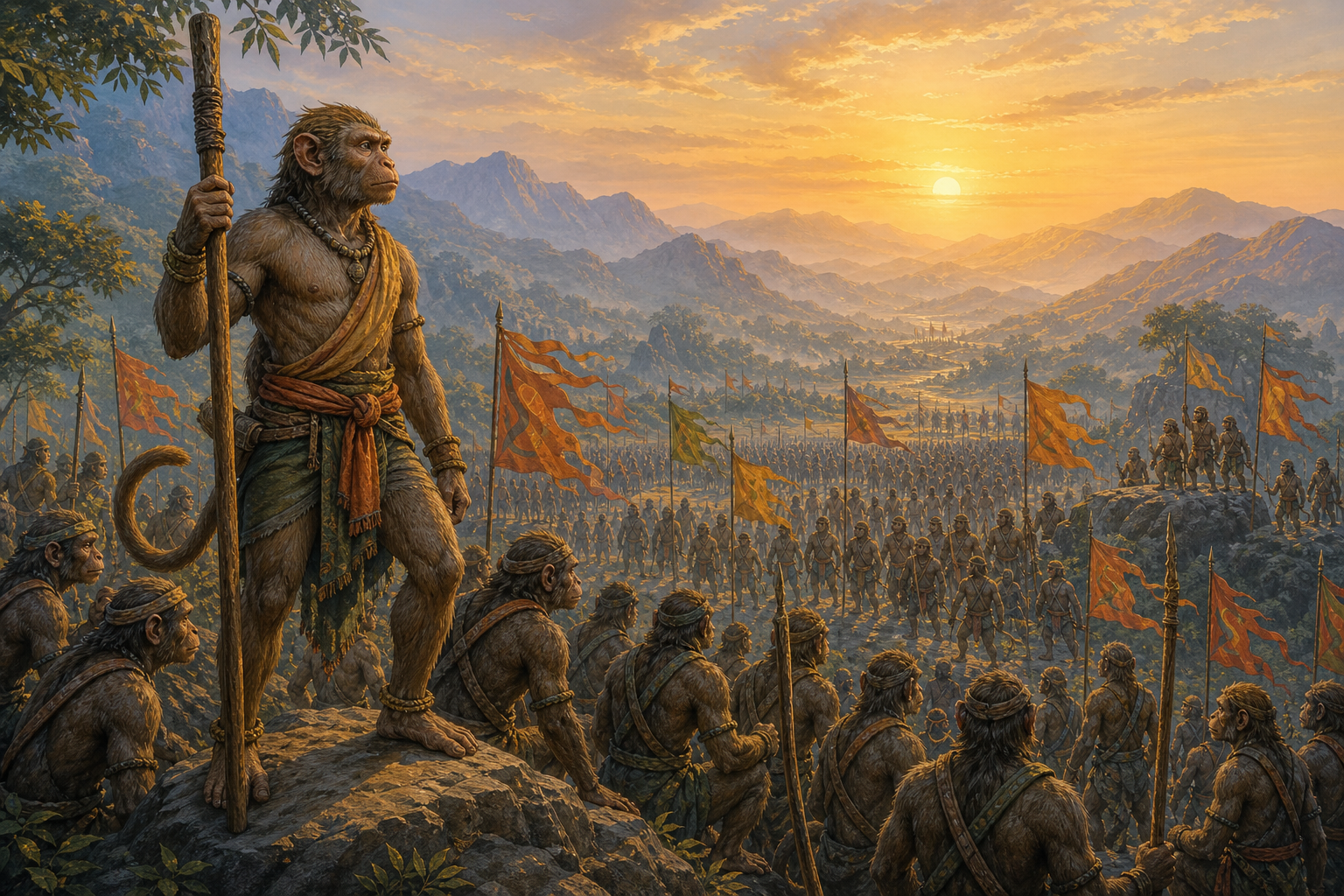
You may have encountered Sarabha in a list of vanara warriors and wondered whether you had missed an important episode. You probably had not. Sarabha matters precisely because the Ramayana does not give every contributor to Rama’s cause a long, self-contained story.
The useful question is therefore not, “Why is Sarabha not as famous as Hanuman?” It is, “What does this commander reveal about the army that fought for Rama?” Read him carefully and you begin to see the organization, shared responsibility and disciplined service behind the celebrated individual feats.
What we can responsibly say about Sarabha
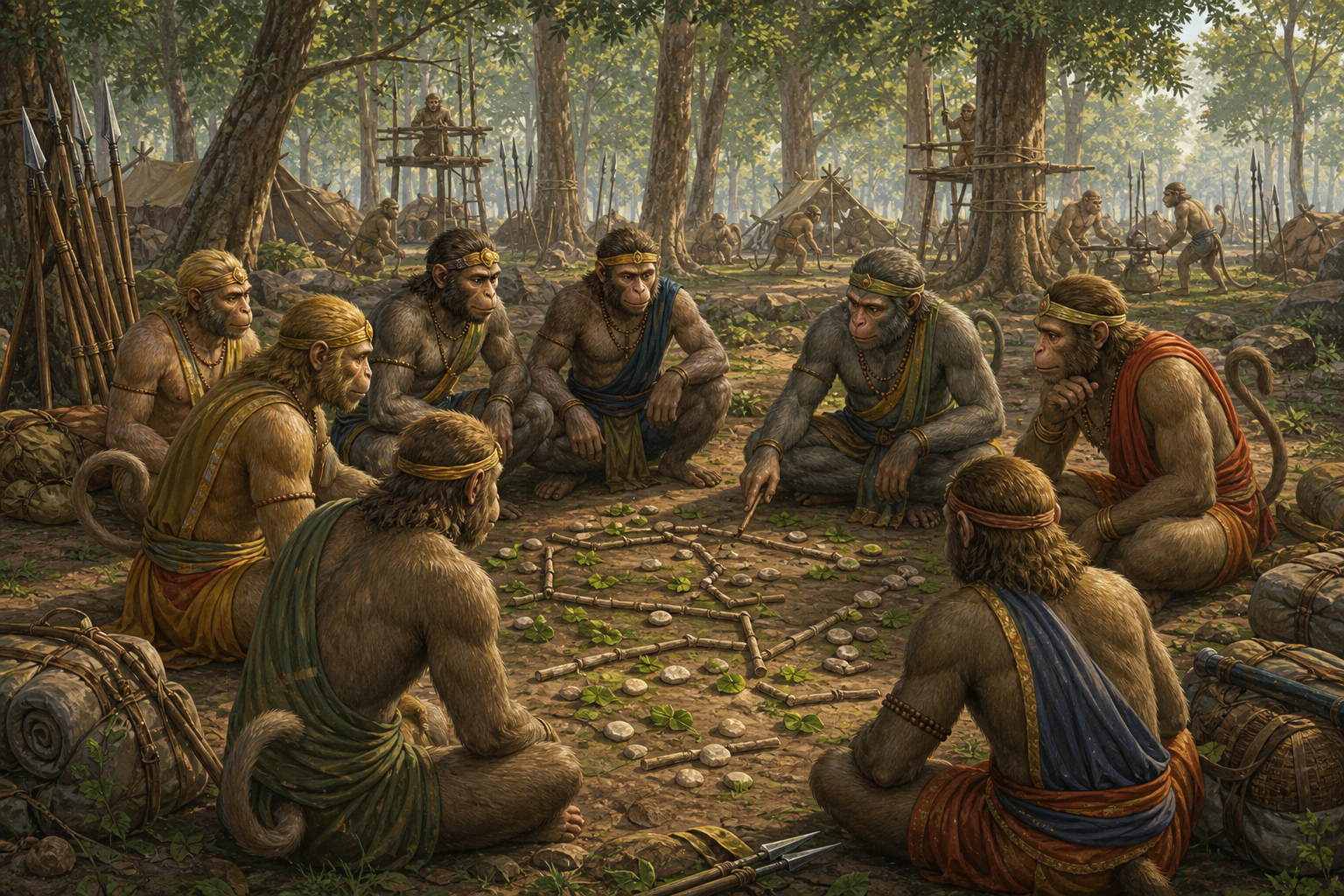
Sarabha belongs to the vanara forces organized under Sugriva and allied with Rama. He is remembered as a fearless commander, or general, whose martial presence inspired fear among adversaries. He is also associated in tradition with Salveya Mountain.
Those details establish a clear profile, but not a detailed biography. Sarabha is not supplied with a uniformly narrated sequence of exploits comparable to the great episodes centered on Hanuman, Angada or Jambavan. Recensions and regional retellings also differ in how much attention they give him. Any confident account of numerous battles, speeches or private motivations should therefore identify the particular version on which it relies.
- Affiliation: Sarabha serves among Sugriva’s vanara forces supporting Rama.
- Responsibility: He is identified as a commander rather than merely an unnamed combatant.
- Character: Fearlessness and martial resolve define his remembered battlefield presence.
- Geographical association: Tradition connects him with Salveya Mountain.
- Textual limit: His role is meaningful, but his individual exploits are not equally detailed in every textual tradition.
This boundary is important. Reverence does not require embellishment. Saying only what the textual record can bear protects Sarabha from being turned into a modern invention wearing an ancient name.
Why a briefly named commander still matters
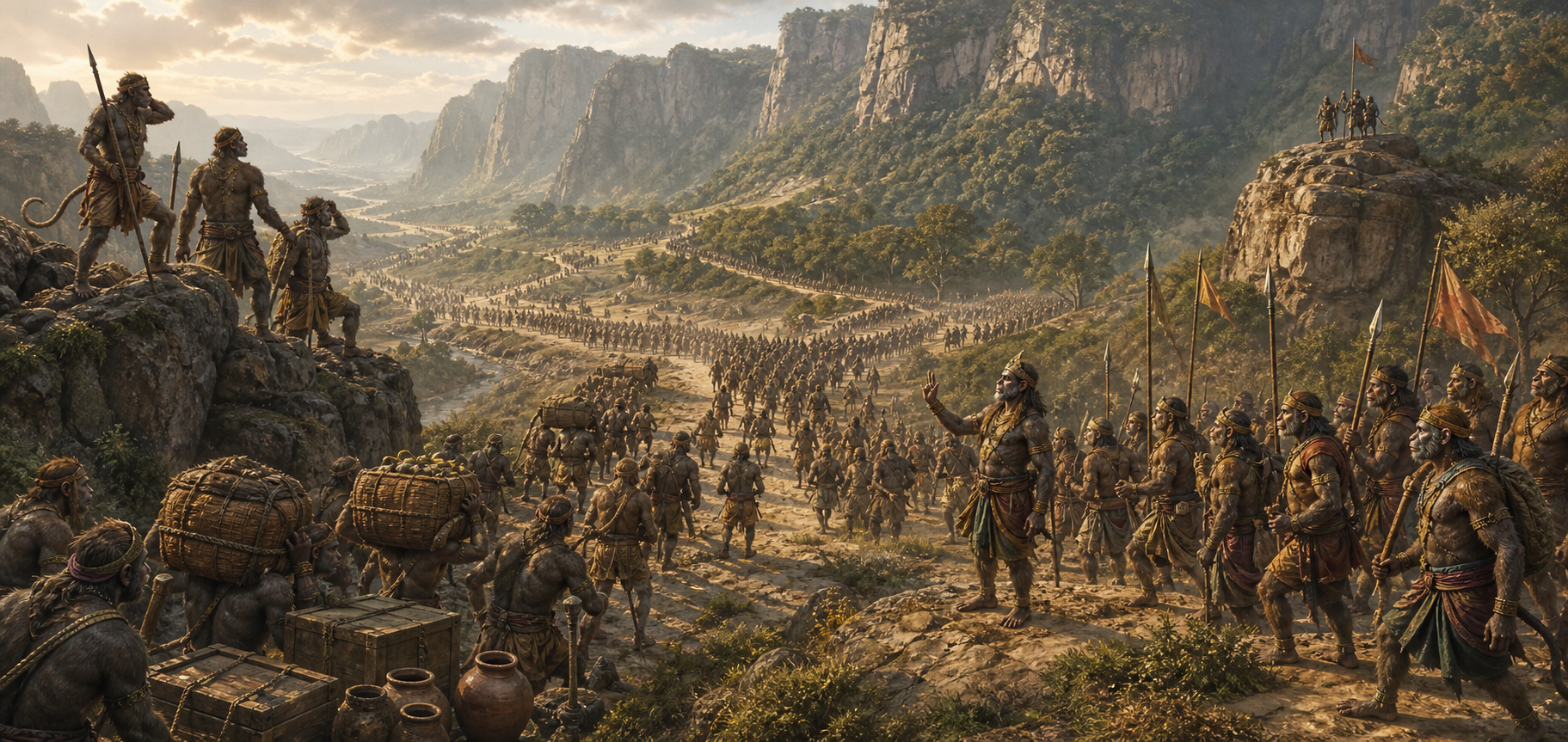
Modern retellings naturally concentrate on a few unforgettable figures. Hanuman crosses the ocean and locates Sita. Angada and Jambavan possess memorable identities and major narrative functions. That focus can make Rama’s campaign look like the work of several exceptional individuals surrounded by an indistinct crowd.
Sarabha corrects that impression. The designation “commander” asks you to notice an organized body of allies with leaders, regional identities and responsibilities. Rama’s cause required extraordinary deeds, but it also required forces that could be assembled, directed and held to a common purpose. A named commander represents part of that essential structure.
When you meet a compact introduction to a warrior in the Ramayana, do not measure significance only by the number of verses devoted to him. Ask instead what the introduction establishes. A name can indicate the scale of the alliance. A title can indicate organization. A place of origin can show the breadth of participation. A character trait can clarify the quality expected from those who enter the struggle.
This also sharpens the meaning of dharma-yuddha. Physical power does not become righteous merely because it is impressive. Its moral value depends on the cause it serves, the discipline governing it and the restoration of order toward which it is directed. Sarabha’s courage is therefore best understood as courage placed at the service of Rama’s mission, not as aggression pursued for personal fame.
The distinction gives you a practical test for leadership. Strength without moral direction becomes domination. Loyalty without justice becomes submission to a leader’s desires. Speed without deliberation becomes recklessness. Sarabha’s remembered role holds these qualities together: courage, command, loyalty and a cause larger than the commander’s reputation.
Salveya Mountain belongs to a wider sacred geography

The association with Salveya Mountain should not be treated as decorative trivia. The Ramayana repeatedly places its communities and warriors within landscapes. Mountains, forests, rivers and kingdoms help the reader perceive a world in which land, community and duty remain connected.
For Sarabha, the mountain association supplies a regional identity within a much larger alliance. Rama is not supported by an anonymous force detached from place. The vanara ranks gather strength from varied regions, bringing distinct communities into a shared undertaking. The geography thus reinforces the political and moral scale of the campaign: a wrong affecting the order of the world calls forth participation beyond one household or locality.
You should still preserve the difference between sacred geography and a modern map claim. The available material supports a traditional association with Salveya Mountain; it does not, by itself, provide a precise present-day location or an archaeological identification. If you encounter a proposed location, check whether it comes from the recension being discussed, a regional tradition or a later geographical argument. Do not merge those kinds of evidence without labeling them.
This restraint does not reduce the land’s significance. It helps you appreciate that significance at the right level. Salveya Mountain identifies Sarabha as a warrior rooted somewhere, formed by a community and then summoned into a wider dharmic responsibility.
How to study Sarabha without outrunning the text

If you want to investigate Sarabha in your own Ramayana, use a method that separates discovery from interpretation. This is especially important for a secondary character whose treatment varies across recensions and retellings.
- Name the version in front of you. Record the recension, language, translator or regional retelling. “The Ramayana says” is too broad when the amount of detail can vary.
- Record the spelling actually used. Transliteration and regional-language conventions can affect how a name appears. Begin with the form printed in your edition before assuming that an absent search result means an absent character.
- Concentrate on Sundara Kanda and Yuddha Kanda. Read beyond the isolated name. The surrounding passage may explain whether Sarabha is being introduced as part of a force, located within a region or presented in a martial setting.
- Make two columns in your notes. Put explicit details such as affiliation, rank, quality and geographical association in the first. Put symbolic or ethical readings in the second. This prevents an interpretation from quietly becoming a supposed textual event.
- Compare versions only after establishing a baseline. If another retelling adds an exploit or changes the emphasis, describe that feature as belonging to that version. Variation is part of the Ramayana’s living reception, but variation is not permission to combine every detail into one imagined master account.
- Test the lesson against the character’s actual role. Leadership, disciplined courage and collective duty follow naturally from Sarabha’s identity as a commander. A detailed psychological portrait does not.
The same discipline should govern cross-Dharmic interpretation. Sarabha’s steadfast energy can be placed beside the Buddhist language of viriya, while his concentrated resolve can evoke tapas. His combination of ethical purpose and protective courage can also be considered beside the Sikh saint-soldier ideal. These are illuminating parallels, not claims that Sarabha teaches identical doctrines in every tradition.
Hindu, Buddhist, Jain and Sikh traditions each develop their own vocabularies, authorities and ethical arguments. Their shared concern with disciplined action does not erase real differences concerning violence, restraint, renunciation and protective duty. Use the comparison to identify a family resemblance: power is morally incomplete until governed by self-command and responsibility. Do not use it to flatten the traditions into interchangeable systems.
This method also guards against a common devotional error. We sometimes think honoring a lesser-known figure means enlarging his biography. A better form of honor is attentive reading. Sarabha can remain a briefly described commander and still expose something central about dharma: great work depends on people who accept responsibility without requiring the narrative to revolve around them.
Key takeaways
- Sarabha is best understood as a fearless vanara commander within Sugriva’s organized forces supporting Rama.
- His traditional connection with Salveya Mountain places him within the Ramayana’s broad landscape of regional allies, but it should not be converted into a precise modern location without further evidence.
- The brevity of his surviving profile is not evidence of irrelevance. His rank reveals the organization and collective responsibility behind Rama’s campaign.
- Sarabha’s courage has dharmic meaning because it serves a righteous purpose; force by itself is not the lesson.
- Recensions and retellings do not provide uniform detail, so distinguish explicit textual information from later tradition and personal interpretation.
- Parallels with viriya, tapas and the saint-soldier ideal can clarify disciplined service, provided you do not erase the differences among Dharmic traditions.
On your next reading, pause when Sarabha’s name appears. Note his title, affiliation, place and defining quality in the margin. Then look at the warriors around him. That small act changes the scene: Rama’s victory no longer belongs only to the figures with the longest episodes, but to an ordered community whose many members placed their strength in the service of dharma.
References
