

You may know the Mahabharata as a great war story, or you may have encountered only the Bhagavad Gita and wondered why the rest of the epic matters. The practical answer is that the Mahabharata shows what spiritual principles look like after they leave the safety of a discourse and enter family life, political responsibility, wounded pride, fear, loyalty, ambition, and irreversible choice.
Read in that spirit, the Mahabharata is not merely something to admire. It becomes a method of examining your motives, clarifying your dharma, and acting without pretending that difficult decisions will always feel pure or produce painless results.
Why the Bhagavad Gita belongs inside the larger epic
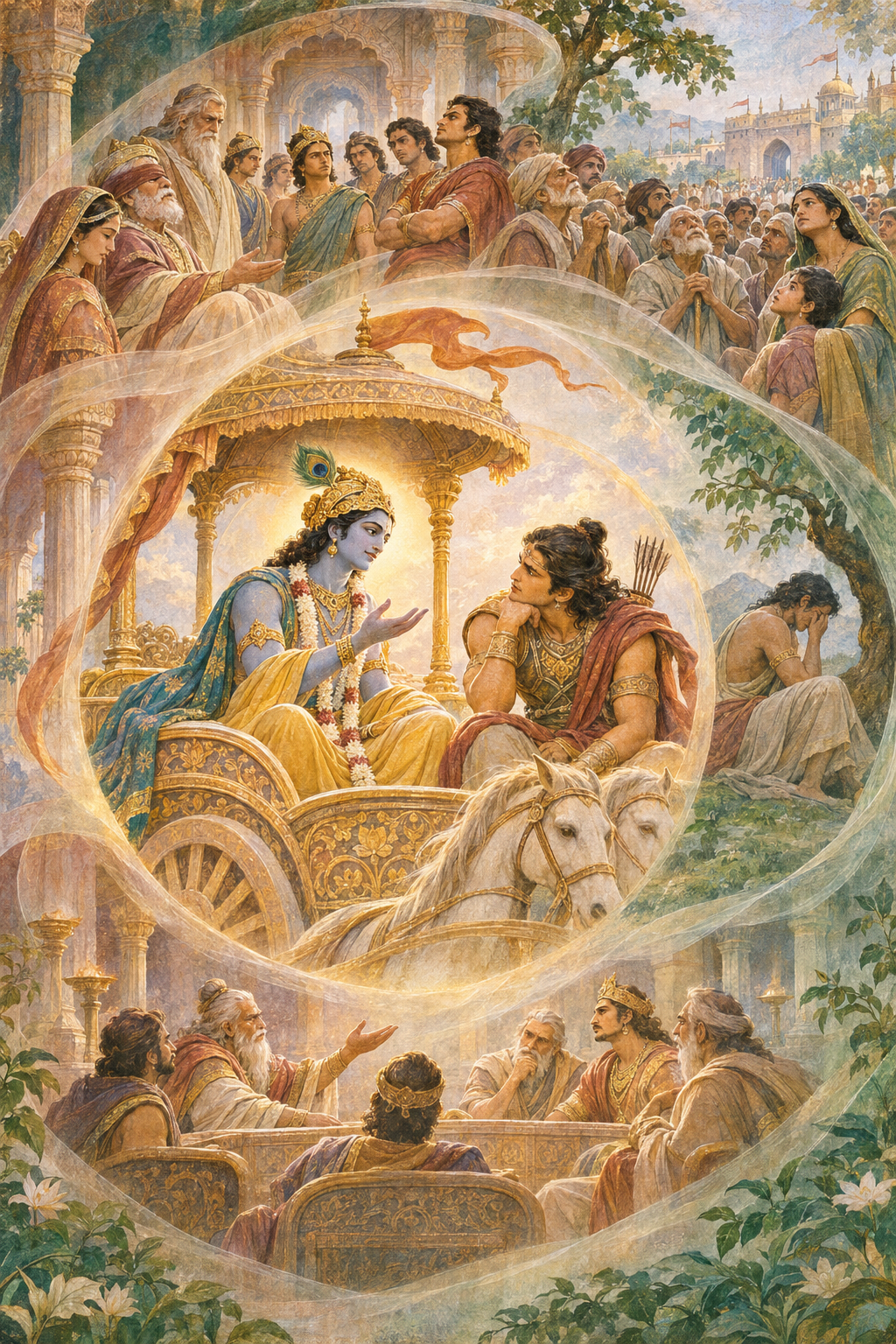
The Mahabharata is traditionally remembered as composed by Maharishi Vedavyasa, written down by Vinayaka, and the setting from which the Bhagavad Gita emerges. That relationship is spiritually important. The Gita does not appear in a quiet retreat where every duty is obvious. Its wisdom is delivered amid a crisis in which action, kinship, conscience, fear, and consequence collide.
You can read the Bhagavad Gita independently and receive profound instruction from it. Yet the Mahabharata prevents that instruction from becoming an escape into attractive abstractions. Detachment can otherwise be mistaken for indifference. Devotion can become a way to avoid judgment. Duty can be used to defend habit, authority, or personal advantage. The surrounding epic forces you to ask whether a spiritual idea still holds when applying it costs something.
This is one reason the Mahabharata remains a spiritual treasure rather than merely an account of the past. It places philosophy under pressure. It shows that knowing a principle, speaking about it, and embodying it are different achievements.
When you read a teaching from the Gita, therefore, test it against a real responsibility in your life. If you are considering detachment, ask what responsible action still has to be performed. If you are thinking about surrender, ask whether you are surrendering selfish control or simply surrendering your courage. If you invoke duty, identify who benefits from the definition you have chosen. Context turns a noble word into an honest practice.
Dharma becomes visible when duties collide

The Mahabharata does not make dharma spiritually valuable by presenting it as an easy rulebook. It makes dharma valuable by showing why discernment is necessary. A person may owe something to family, society, truth, a promise, a position of responsibility, and the welfare of others at the same time. Those obligations do not always point in the same direction.
This distinction matters whenever someone tells you that dharma means simply obeying your assigned role. A role carries responsibilities, but it does not eliminate moral judgment. Loyalty may be virtuous, yet loyalty to wrongdoing can extend the wrongdoing. A vow may express discipline, yet attachment to the vow can become an excuse for ignoring its consequences. Silence may appear peaceful while allowing harm to proceed.
When your duties conflict, do not begin with the question, “Which rule gives me permission to do what I already want?” Use a stricter examination:
- Role: What responsibility is actually mine, and what authority am I merely assuming?
- Motive: Am I acting from duty, fear, resentment, vanity, attachment, or the wish to protect my reputation?
- Means: Does my chosen method contradict the value I claim to defend?
- Consequences: Who is likely to bear the cost of my decision, especially if that person has less power than I do?
- Accountability: Would I still defend this action if I received no praise, victory, or personal reward from it?
This examination will not convert every dilemma into certainty. That is not its purpose. It makes self-deception harder. The Mahabharata’s spiritual realism lies precisely here: uncertainty does not release you from responsibility. You must act with the clearest understanding available, accept that actions have consequences, and remain willing to correct yourself.
Suppose honesty in a family or workplace will create conflict. “Always speak” and “always preserve harmony” are both too crude. You need to consider whether the truth is necessary, whether you have verified it, whether you are the right person to raise it, whether your manner is proportionate, and whether silence would make you complicit. That movement from slogan to discernment is the work of dharma.
Karma is about participation, not fortune-telling

The Mahabharata invites you to notice how actions mature through relationships and time. A decision made from pride does not remain sealed inside the person who made it. It affects loyalties, institutions, families, and later choices. One compromise makes the next compromise easier; one refusal to confront adharma gives it more room to organize itself.
This is a more useful way to contemplate karma than treating every pleasant event as a reward and every hardship as proof of personal fault. The epic’s moral world is too complex for that mechanical reading. People inherit conditions they did not create, suffer from decisions made by others, and still retain responsibility for how they respond. Karma directs attention toward participation: what you initiate, what you reinforce, what you permit, and what you can now change.
Use that insight by looking for chains rather than isolated incidents. If anger repeatedly damages a relationship, do not examine only the final outburst. Notice the earlier sequence: the slight you rehearsed, the conversation you avoided, the justification you strengthened, and the moment when retaliation began to feel righteous. Spiritual practice becomes effective when it interrupts the chain before its most visible result.
The same principle applies to good action. A truthful admission may not repair everything immediately, but it stops feeding concealment. A fair decision may not win approval, but it prevents your dependence on approval from governing the next decision. You cannot command every result. You can become more responsible for the causes you place into motion.
This is also where non-attachment must be understood carefully. Acting without a possessive claim over the result does not mean acting without preparation, care, or accountability. It means doing the work that dharma requires without making your inner stability depend entirely on success, recognition, or control over other people.
The epic works as a mirror, not a cast of labels
It is tempting to divide an epic into heroes to imitate and villains to condemn. That approach may simplify the plot, but it weakens the spiritual encounter. The Mahabharata becomes personally demanding when you recognize that admirable qualities and dangerous attachments can coexist within a human being.
Courage can be tied to pride. Loyalty can protect injustice. Intelligence can rationalize desire. Discipline can harden into self-importance. Affection can become possessiveness. Even a person who understands dharma may fail to act when the social cost becomes too high.
As you read, resist the urge to ask only, “Who was right?” Ask what each conflict reveals about the mind. Notice the point at which a virtue becomes distorted. Notice which warning is ignored, which attachment makes retreat impossible, and which private weakness acquires public consequences. Then turn the question toward yourself without theatrics: Where does the same mechanism operate in a smaller form in my life?
This does not mean declaring yourself equivalent to every figure or event in the epic. It means studying patterns. You may never face a royal dispute, but you may cling to status. You may never make a battlefield decision, but you may avoid a necessary conversation because you want to preserve your image as a peaceful person. The scale differs; the inner movement can be recognizable.
The Mahabharata also guards against self-righteousness. Once you identify completely with the supposedly righteous side, you stop examining your own methods. A spiritually mature reading keeps moral distinctions intact while refusing to use them as protection from self-scrutiny. Adharma should be opposed, but the opposition itself must be watched for hatred, vanity, cruelty, and the intoxication of victory.
A reading practice that changes your decisions

You do not need to master the whole Mahabharata before it can shape your life. Work with a passage or episode slowly enough to see its moral structure. The following practice turns reading into abhyasa, a repeated discipline rather than a collection of impressions.
- State the conflict plainly. Describe what each person wants, fears, owes, and stands to lose. Avoid spiritual vocabulary at first; it can hide the human problem.
- Separate duty from attachment. List the genuine responsibilities involved. Then list the desires for control, approval, revenge, comfort, status, or victory that may be borrowing the language of duty.
- Find the neglected consequence. Ask which result is foreseeable but inconvenient to acknowledge. Moral failure often begins before the action, in the refusal to look at what the action will do.
- Identify the inner turning point. Look for the moment when another choice was still possible. This teaches you to recognize similar moments before your own habits gather momentum.
- Translate the insight into one decision. Choose a live situation in which the same pattern appears. Name the next responsible action: a conversation, an apology, a refusal, a boundary, a correction, or the completion of a duty you have delayed.
- Release ownership of the response. Carry out the action carefully, but do not make another person’s praise, agreement, or gratitude the condition of doing what is right.
Keep the final application modest and exact. “I will become less attached” is too vague to test. “I will give the necessary answer without adding an insult” can be practiced. “I will follow dharma” remains an aspiration. “I will disclose the conflict of interest before the decision is made” is an action.
Key takeaways
- The Mahabharata gives spiritual teachings their full human context: duty, fear, kinship, power, and consequence.
- Dharma requires discernment when valid obligations conflict; it cannot be reduced to obedience or personal preference.
- Karma is best examined through the causes you create, reinforce, tolerate, or interrupt.
- Non-attachment means releasing possessiveness over results, not abandoning effort or responsibility.
- Characters and conflicts become spiritually useful when you study their inner patterns and then examine those patterns in yourself.
- Reading becomes practice only when it changes a specific decision, response, or habit.
Before your next serious decision, pause before asking which outcome you prefer. Ask which duty is genuinely yours, which attachment is shaping your judgment, and which consequence you are tempted not to see. Then act as carefully as you can without demanding control over every result. That is where the Mahabharata moves from sacred inheritance to living guidance.
References

Leave a Reply
You must be logged in to post a comment.