
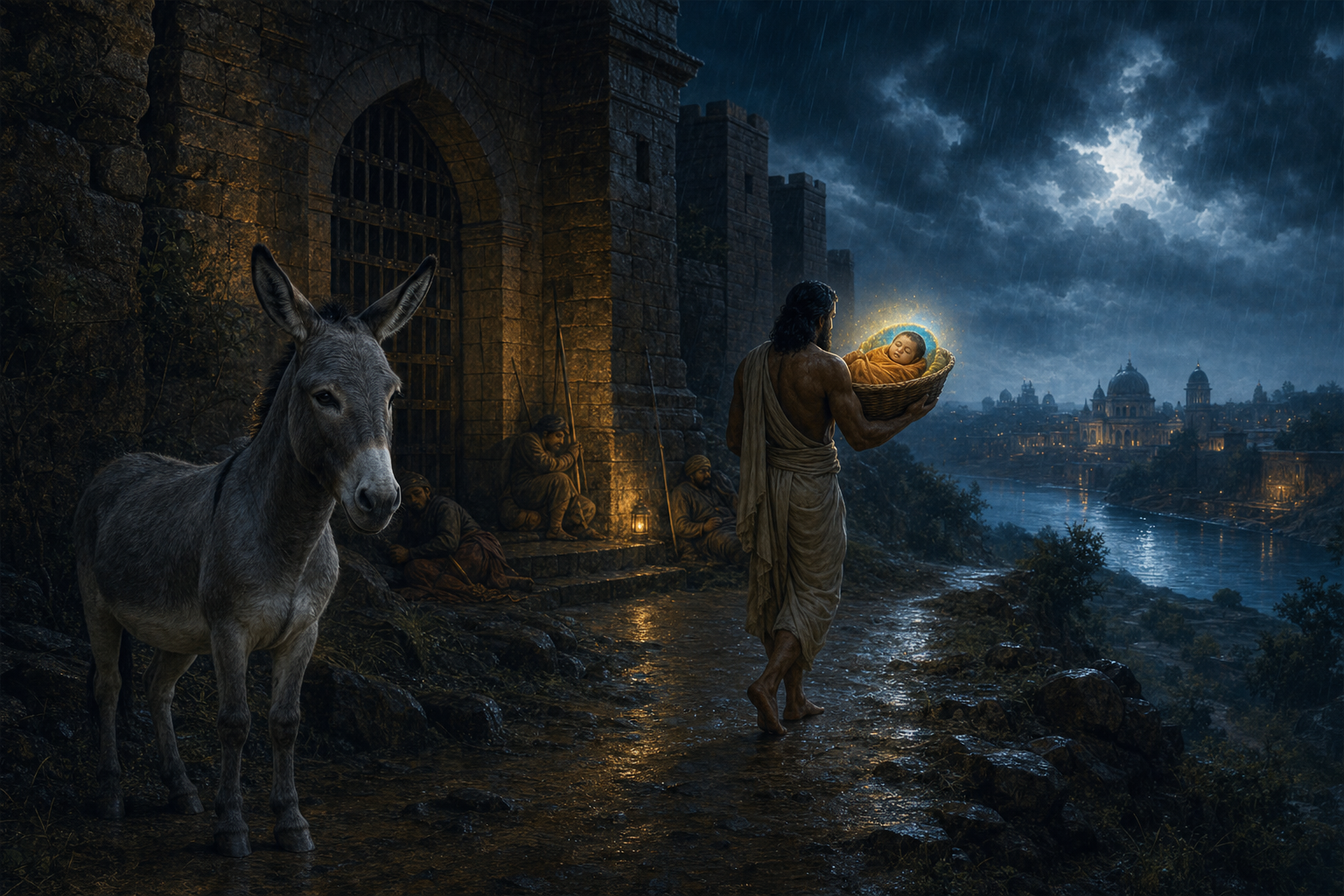
You may have heard that a donkey brayed during Devaki’s earlier deliveries but became silent on the night Sri Krishna was born. If you are trying to decide whether that episode comes from scripture, the careful answer is straightforward: no donkey appears explicitly in the Krishna birth accounts of Bhagavata Purana Canto 10 or the Harivamsa.
That does not make the legend worthless, nor does it justify presenting folklore as a verse from an ancient text. Once you separate the scriptural narrative from its later devotional staging, you can appreciate both: the foundational account supplies the divine stillness, while oral katha gives that stillness an unforgettable sound-symbol.
Key takeaways
- The donkey episode is not stated in Bhagavata Purana Canto 10 or the Harivamsa, the two foundational sources relevant to this question.
- It is best classified as a folk or performative addition found in some regional kathas, pravachanas, Janmashtami plays, rasa-lila presentations, and family retellings.
- The animal’s bray represents danger, disorder, or fearful noise; its silence turns an ominous sign into an act of protection.
- You can tell the legend devotionally without confusing your audience by introducing it with one phrase: Some regional kathas add that…
What the foundational birth narrative actually contains
Here, the word foundational is more precise than treating Hindu tradition as though it had one closed and universally binding canon. For the birth of Krishna, Bhagavata Purana Canto 10 and the Harivamsa establish the narrative baseline against which the donkey claim should be tested.
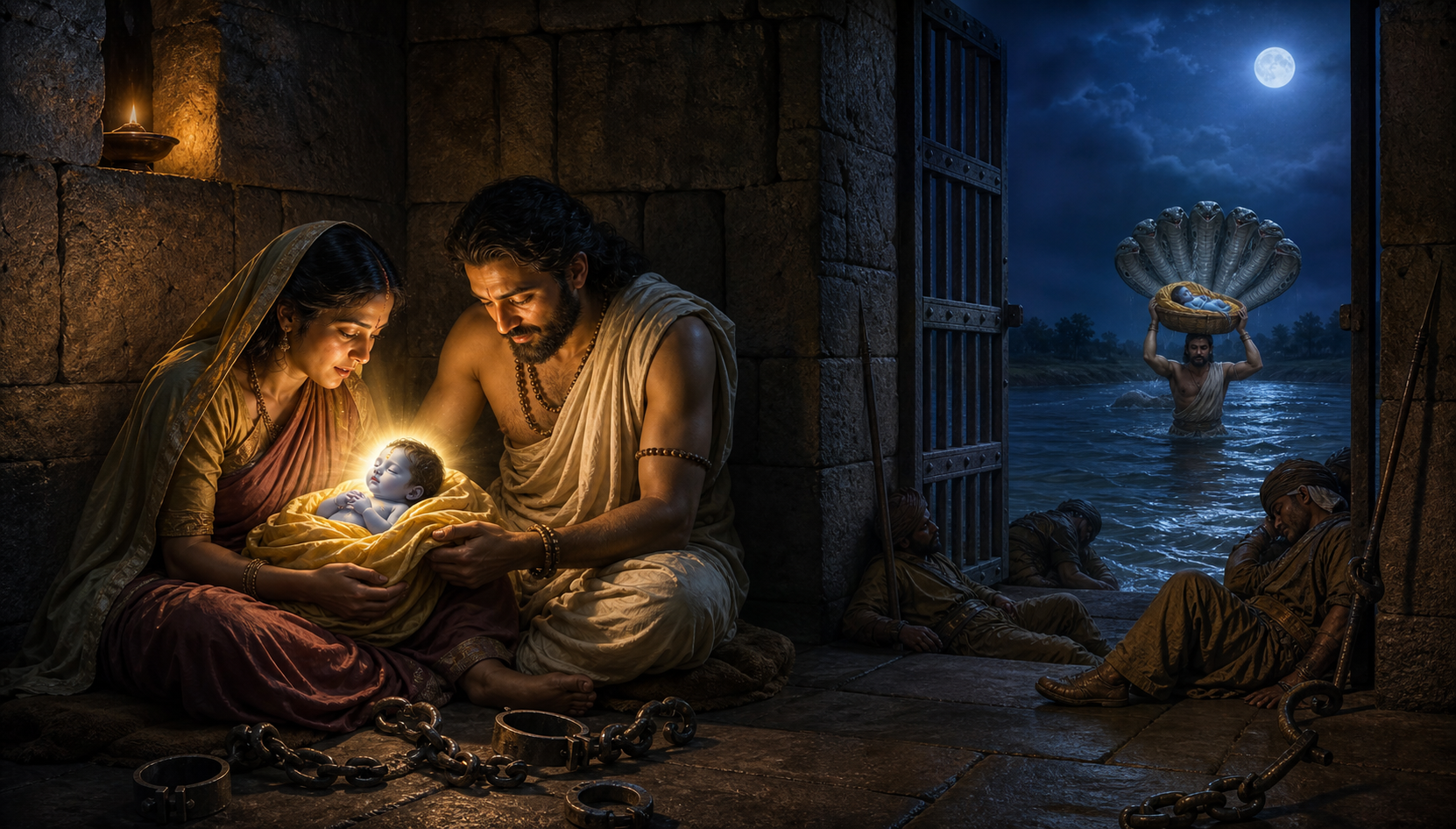
Kamsa imprisons Devaki and Vasudeva and kills their first six infants. The seventh embryo is mystically transferred to Rohini and becomes Balarama, also known as Sankarshana. Krishna then appears as the eighth child. Shackles loosen, prison doors open, the guards sleep, and the night becomes providentially calm. Vasudeva carries the infant across the Yamuna to Gokula and exchanges him with Yashoda’s child.
Notice how protection works in this account. Kamsa’s prison is not defeated through a noisy assault. The machinery of confinement simply loses its power: restraints release, barriers open, sentries cease to watch, and the threatening night assists rather than obstructs Vasudeva. Silence is already central to the theology and drama even though no animal is named.
The distinction supports a narrow, defensible conclusion: these two accounts do not explicitly contain a donkey at the prison, a recurring bray during the earlier births, or a prayer by Vasudeva asking the animal to remain quiet. It does not prove that no later compilation, regional composition, sermon, song, or manuscript tradition could ever mention such an animal. A claim about every retelling in every language would require far more evidence.
If someone attributes the scene directly to scripture, ask for three things: the name of the grantha, the canto or chapter, and the verse. A general answer such as it is somewhere in a Purana does not establish textual provenance. This simple check lets you remain open to evidence without granting scriptural status to a story merely because it is familiar.
Why oral storytellers give the danger a voice
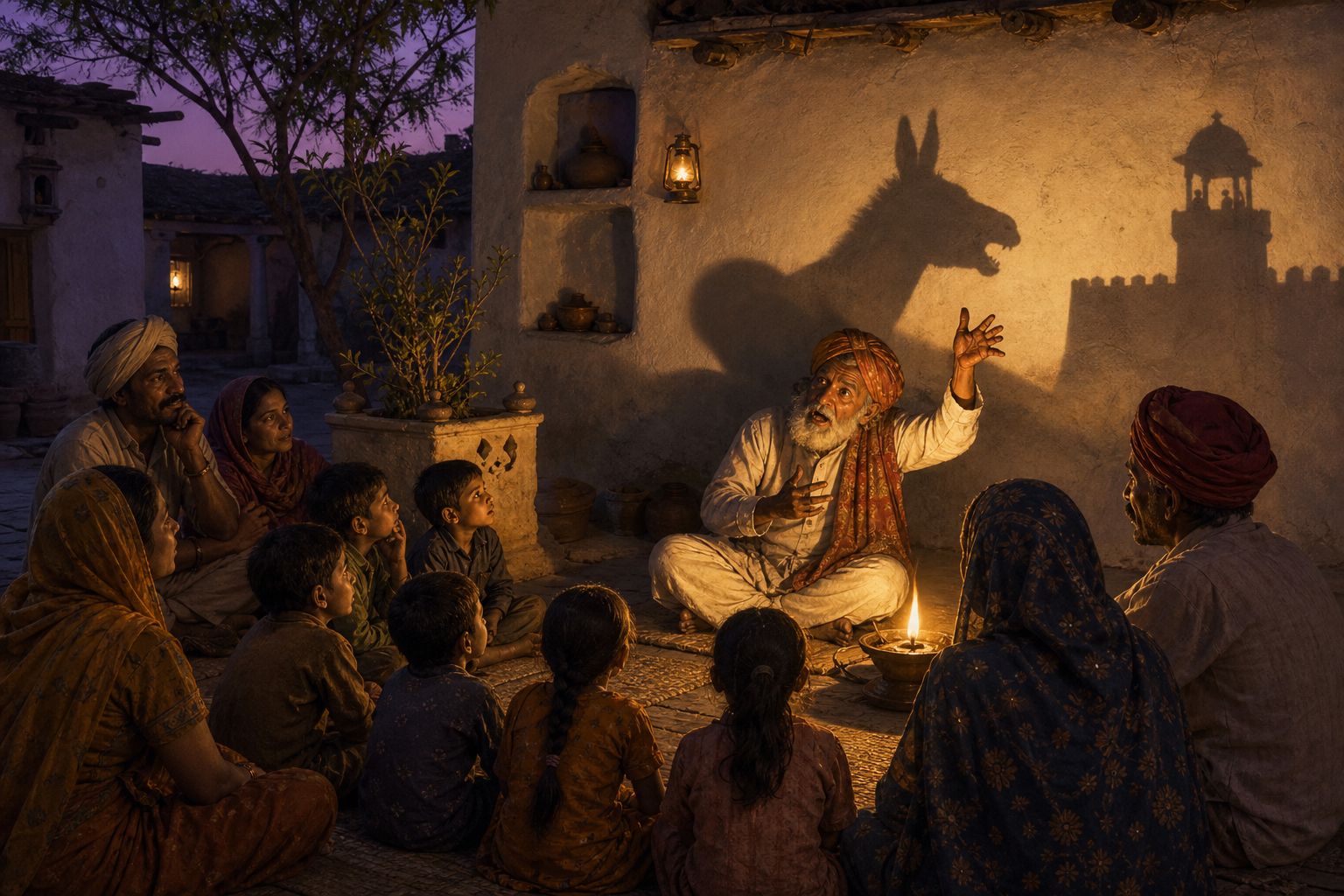
A prison door opening by itself is visually powerful, but an oral storyteller also needs a sound that makes an audience tense. A donkey’s sudden bray does that immediately. It is ordinary enough to belong outside a prison, loud enough to threaten a secret escape, and familiar enough to give children and adults an instant sense of risk.
That one sound can perform several dramatic tasks. It turns Kamsa’s surveillance into something the audience can hear. It adds a moment of earthy humor to an otherwise terrifying sequence. Most importantly, its disappearance makes the miraculous hush perceptible. The listener first anticipates a cry and then experiences its absence.
Some versions heighten the contrast by saying that the donkey brayed during Devaki’s earlier deliveries but not during the eighth. That addition compresses years of fear into a repeated signal: the old pattern announces danger, while Krishna’s arrival interrupts the pattern. The donkey should not be blamed for the deaths of the infants; its bray is an alarm within the tale, not the moral cause of Kamsa’s violence.
Other tellings have Vasudeva appeal or pray to the donkey so that it will not awaken the guards. This is better understood as devotional drama than as evidence of a separate rite or cult. A frightened father carrying a vulnerable child addresses every presence that could help or hinder him. The appeal makes his humility visible and extends the circle of cooperation to a creature people commonly overlook.
The motif’s exact origin should not be stated more confidently than the evidence permits. Regional katha and performance traditions, especially in parts of North India, provide its likely home, but a likely channel of transmission is not the same as a dated first appearance. Unless a narrator can identify an early text or documented performance, it is safer to call the scene a living folk addition rather than an ancient verse.
What the donkey’s silence can mean without becoming doctrine
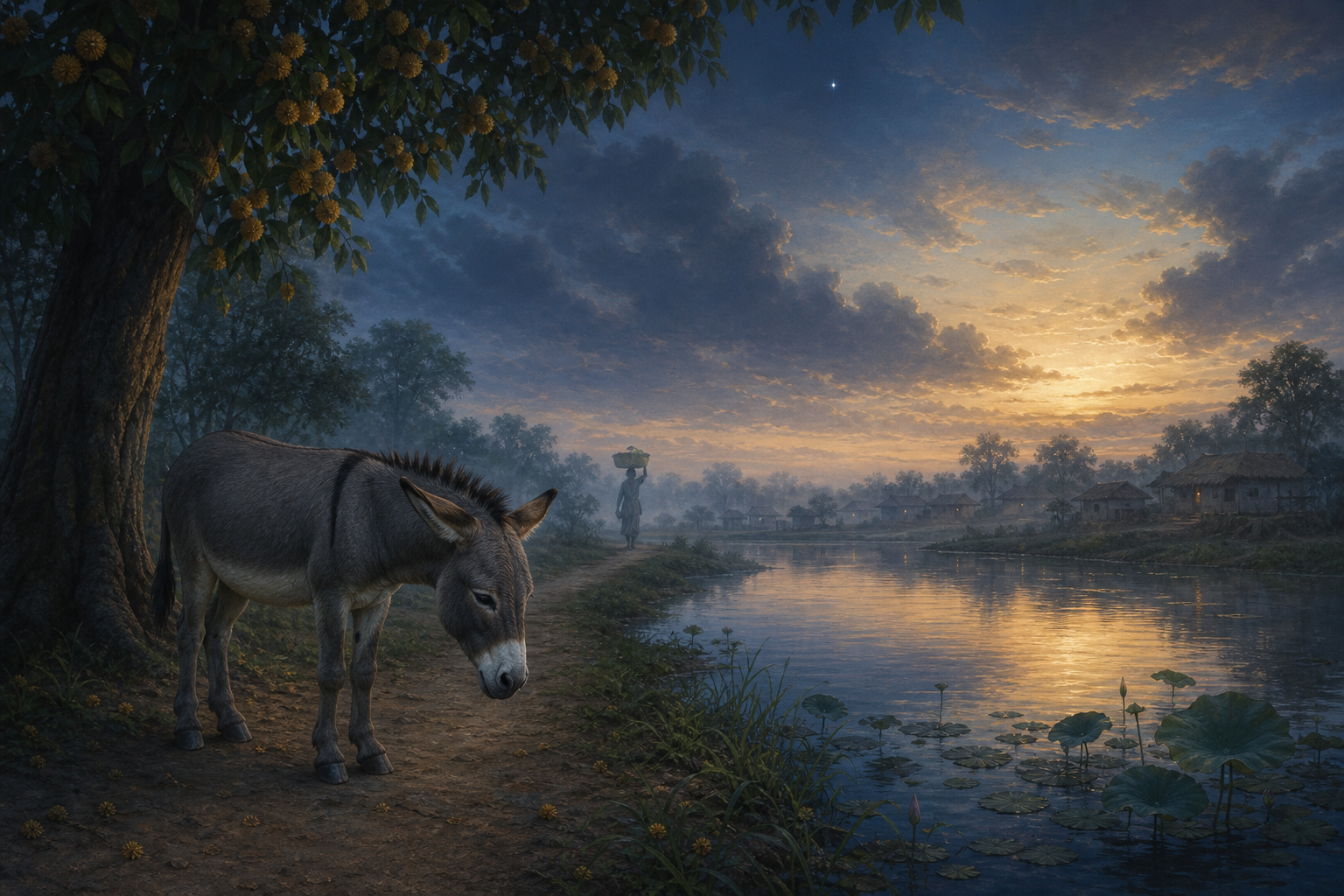
In the Indian language of omens, the gardabha’s cry can signal disorder, folly, or impending trouble. Fable traditions represented by the Panchatantra also use the donkey as a comic or cautionary figure whose poorly timed noise creates danger. As a burden-bearing animal, it can evoke the suffering carried by ordinary people under a cruel ruler. In some goddess iconographies, the donkey also serves as a vahana with ambivalent associations, reminding us that dharmic symbolism does not divide every creature into a permanently pure or impure category.
The birth legend reverses those associations. The familiar herald of peril becomes silent at exactly the moment when silence protects life. The burden-bearer does not add another burden. The creature associated with foolish noise participates in wise restraint. That reversal is the motif’s central strength, and you do not need to pretend it is canonical to recognize it.
At the theological level, the donkey expands the cooperation already visible in the birth narrative. Locks, doors, guards, weather, river, parents, and the night itself cease to serve Kamsa’s order. Folk imagination brings one more member of creation into that alignment. The claim is not that nature permanently loses its danger whenever an avatara appears. It is that, for one decisive passage from prison to safety, adharma cannot command the whole world.
At the contemplative level, the bray can represent the mind under oppression: repetitive, alarmed, and unable to distinguish a real duty from fearful noise. The silence then represents the stillness created by shraddha and anugraha, trust and grace. This reading should lead to a practical question, not a vague slogan: when fear is loud, which sound carries useful warning, and which sound merely gives tyranny more control over your attention?
At the ethical level, the legend challenges contempt for humble life. If even a donkey can be imagined as helping to protect a newborn, human beings have still greater reason to practise ahimsa and sarva-prani-daya, compassion toward all creatures. The moral is not that an animal earns dignity only by serving a divine plan. Its inclusion helps the listener notice that the world of dharma already contains beings whom social pride often renders invisible.
This narrative instinct also appears in other dharmic settings without implying that every tradition tells the same story. Buddhist narratives of bodhisattva births describe moments of cosmic accord. Jain accounts surround the births of Tirthankaras with auspicious dreams and gentle omens. Sikh Janamsakhi traditions contain scenes in which animals or natural elements respond to grace. These parallels do not establish a shared donkey episode or direct borrowing. They reveal a broader intuition: moral renewal is large enough to be registered by more than human observers.
How to retell the legend with both honesty and bhakti
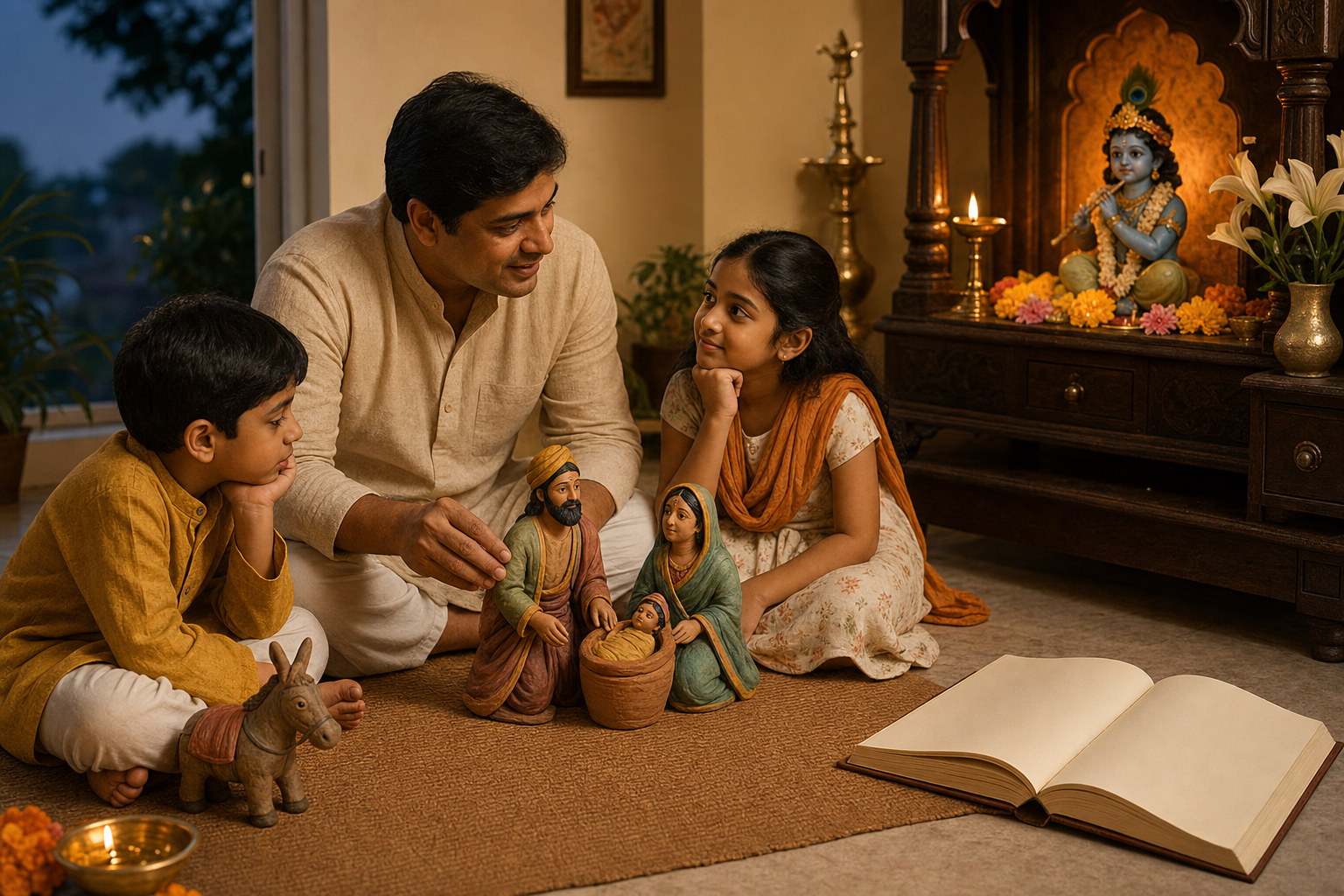
You do not have to choose between a dry correction and an unqualified miracle claim. A careful retelling can preserve the canonical boundary while allowing folk memory to do its proper work.
- Begin with the textual core. Tell your listeners about Kamsa’s imprisonment of the parents, the six murdered infants, the transfer of the seventh embryo, Krishna’s appearance, the sleeping guards, the opened doors, and Vasudeva’s passage toward Gokula.
- Mark the transition into folklore. Use a clear sentence such as: Some regional kathas imagine that a donkey near the prison had brayed before, but became silent on Krishna’s birth night.
- Do not manufacture a citation. If you cannot supply a grantha, chapter, and verse, do not say that the incident is found in Bhagavata Purana or the Harivamsa. Familiarity in performance is evidence of reception, not proof of scriptural wording.
- Explain why the addition belongs there. The bray gives fear an audible form; the hush shows the old order losing its grip; the humble creature’s cooperation widens the story’s field of compassion.
- Turn the image toward conduct. Ask what each person in the scene does to protect vulnerable life. This keeps attention on Vasudeva’s courage, the cooperation of creation, and the duty of care rather than reducing the donkey to a comic prop.
This method is especially useful with children. They can enjoy the sound, suspense, and animal character while learning that sacred traditions have layers. Scripture, commentary, sermon, theater, song, and family narration can carry the same theological current without becoming identical forms of evidence.
It also prevents two common mistakes among adults. The first is dismissing every non-scriptural detail as meaningless fabrication. The second is granting scriptural authority to any beloved detail. Living tradition needs neither mistake. A folk motif may deepen memory, bhava, and ethical imagination while remaining plainly identified as a folk motif.
At your next Janmashtami telling, add one honest phrase before the donkey enters: Some regional kathas imagine… That is enough to protect textual accuracy and keep the devotional image alive. Then ask your listeners, and yourself, what fearful noise needs to become quiet so that vulnerable life can be carried to safety.