
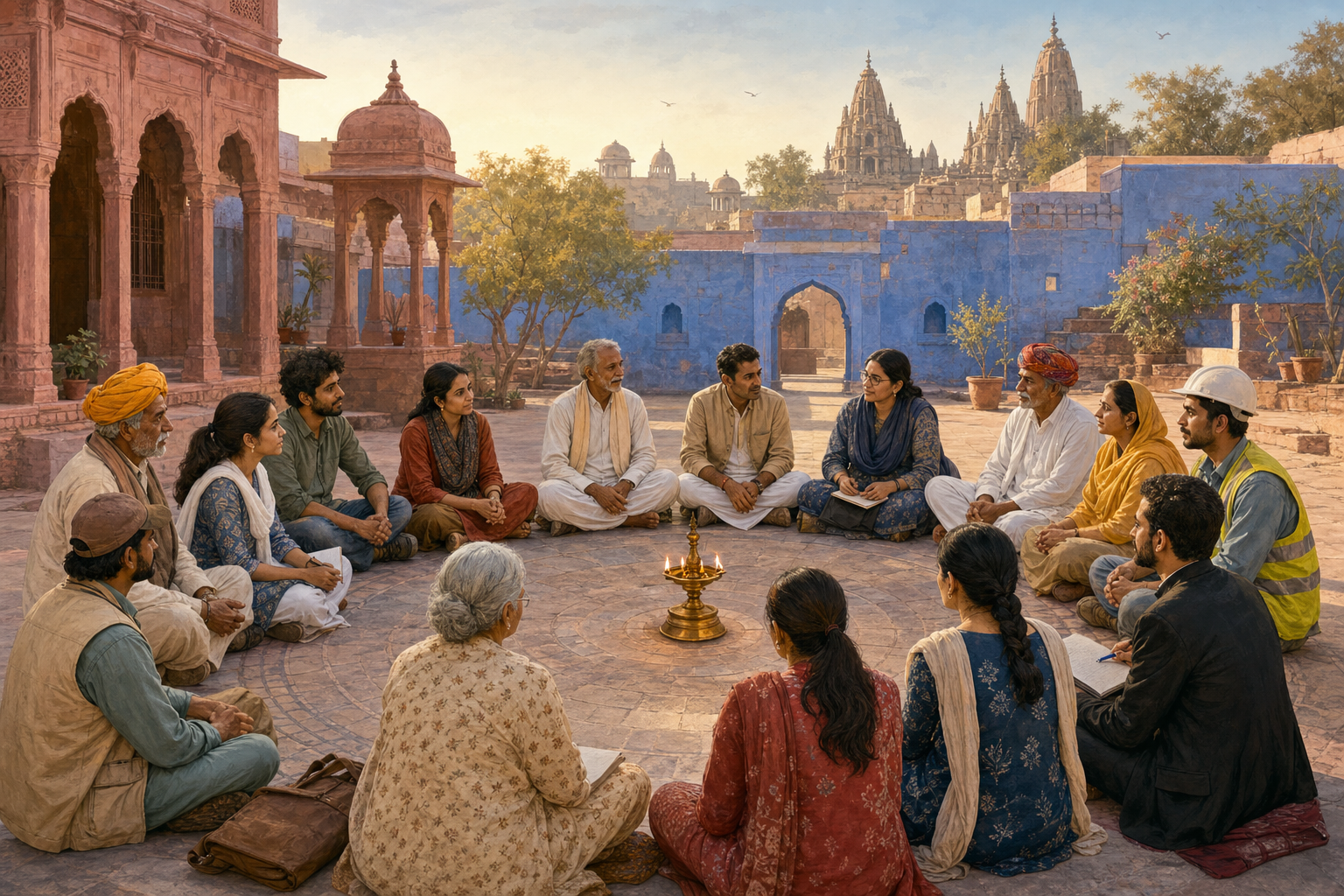
If you have been asked to support Hindu Rashtra outreach in Rajasthan, the first question is not whether dharmic unity sounds desirable. It is whether temples, seva groups, scholars, youth associations, legal volunteers and heritage workers can cooperate without erasing their differences, provoking needless conflict or creating another network that becomes active only for speeches.
The Hindu Rashtra Sampark Abhiyan in Jaipur and Jodhpur, led in these engagements by Sadguru Dr Charudatta Pingale, National Guide of Hindu Janajagruti Samiti, offers a useful starting point. Its promise will be fulfilled when sampark produces durable relationships, visible seva and lawful coordination that people can rely on between public events.
Define unity before you build the network
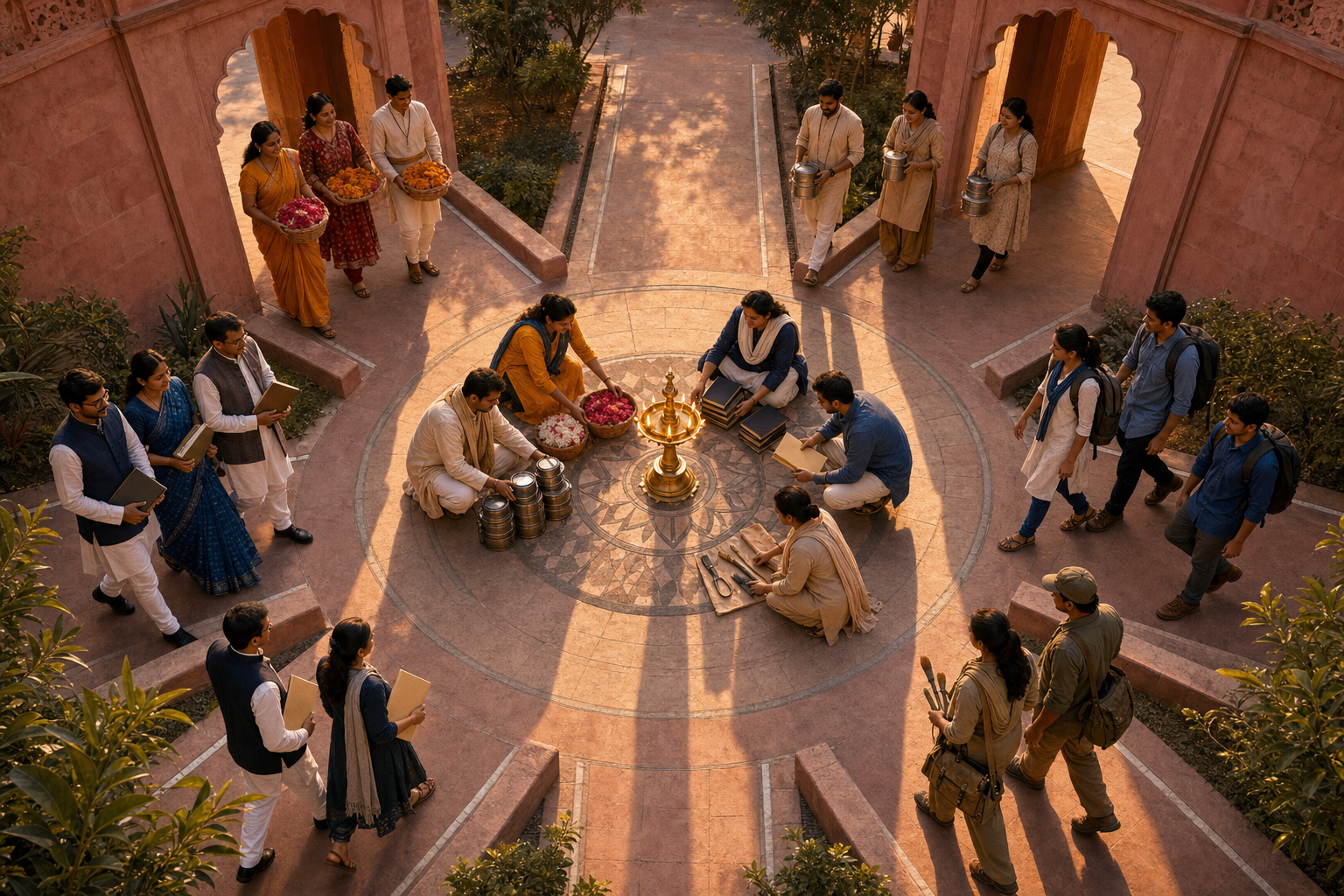
Dharmic unity cannot mean doctrinal uniformity. Hindus, Buddhists, Jains and Sikhs have distinct scriptures, institutions, histories and disciplines. Hindu sampradayas themselves disagree on metaphysics, worship and authority. A useful coalition does not ask participants to settle these questions before they can clean a stepwell, support a vulnerable family or prepare a festival safety plan.
The stronger basis is ethical and civic. Ahimsa, satya, seva, karuna, daya and concern for the welfare of all provide a shared vocabulary without making every tradition identical. Anekantavada can encourage intellectual humility; Sarbat da Bhala directs attention toward universal well-being; Vasudhaiva Kutumbakam keeps civilisational confidence from shrinking into social hostility. These ideas become credible when they shape conduct, not merely banners.
The phrase Hindu Rashtra also needs an operational meaning. People bring different political expectations to it, so ambiguity can quickly overwhelm practical work. Within this Abhiyan, the ideal is framed as constitutional, plural and respectful of regional and religious diversity. That creates a clear public test: outreach must remain non-violent, follow due process, respect freedom of conscience and religious practice, and protect the dignity of people outside the coalition as firmly as it protects the rights of those within it.
Before adopting a joint activity, ask four questions:
- Does it answer an identifiable community need rather than merely display organisational strength?
- Can every participating body explain the activity to its own members without compromising its principles?
- Are the methods lawful, voluntary and consistent with equal dignity?
- Could the coalition publish its objective, decision process and use of resources without embarrassment?
If an activity fails one of these tests, do not place the coalition’s name behind it. Unity built by obscuring purpose or pressuring reluctant participants will fracture at the first serious disagreement. Consensus and subsidiarity are safer: agree on the common outcome, then leave decisions as close as possible to the community that will live with them.
Use six pillars to turn contact into public value
Sampark is more than collecting telephone numbers. It is sustained relationship-building through dialogue, shared problem-solving and transparent coordination. The six-pillar model of Samvad, Samanvay, Seva, Sanskara, Suraksha and Sanchar gives organisers a practical way to see what their network has built and what is still missing.
| Pillar | Question to settle | Useful first output |
|---|---|---|
| Samvad | How will participants disagree without breaking the relationship? | Facilitation rules that require careful listening, factual claims and prompt clarification of rumours. |
| Samanvay | Who is responsible when several organisations join one activity? | A verified contact directory, named task owners, backup contacts and a shared calendar. |
| Seva | Which public need can the network address together? | A limited project with a defined beneficiary group, responsible lead and visible completion measure. |
| Sanskara | How will younger participants learn the values behind the work? | Mentoring, cultural-literacy sessions and multilingual educational material grounded in dharmic ideas. |
| Suraksha | How will volunteers respond lawfully to emergencies or tension? | Festival, disaster and de-escalation procedures linked to legal, medical and administrative contacts. |
| Sanchar | How will the coalition communicate without spreading fear or misinformation? | A verification and correction protocol, with designated communicators and privacy safeguards. |
No organisation needs to lead every pillar. A temple trust may provide space and local credibility. A women’s seva group may understand household needs that larger institutions miss. A youth association may handle surveys and digital documentation. Lawyers and mediators can build legal literacy. Heritage architects, conservators and artisans can guide work involving murtis, mandapas, temples and water structures. Panchayat and neighbourhood representatives can keep district plans connected to local realities.
Choose seva that produces a public benefit people can inspect. Suitable themes include scholarships, health camps, blood-donation drives, river and stepwell rejuvenation, heritage documentation, craft-linked livelihood training and dignified assistance for vulnerable families. Do not launch several merely to fill a calendar. Start where participating organisations already have complementary strengths, then record who was served, what was completed and what should change before the activity is repeated.
Sanchar requires particular discipline because a careless message can undo months of samvad. A responsible group protocol should require members to find the original claim before forwarding it, distinguish verified information from an unresolved report, send potentially inflammatory material to a designated verifier, correct false information in the same channel where it appeared, and keep personal contact or incident details out of public groups. Accuracy is not timidity. It is part of protecting both social trust and the credibility of dharmic advocacy.
Pair Jaipur and Jodhpur without creating a hierarchy
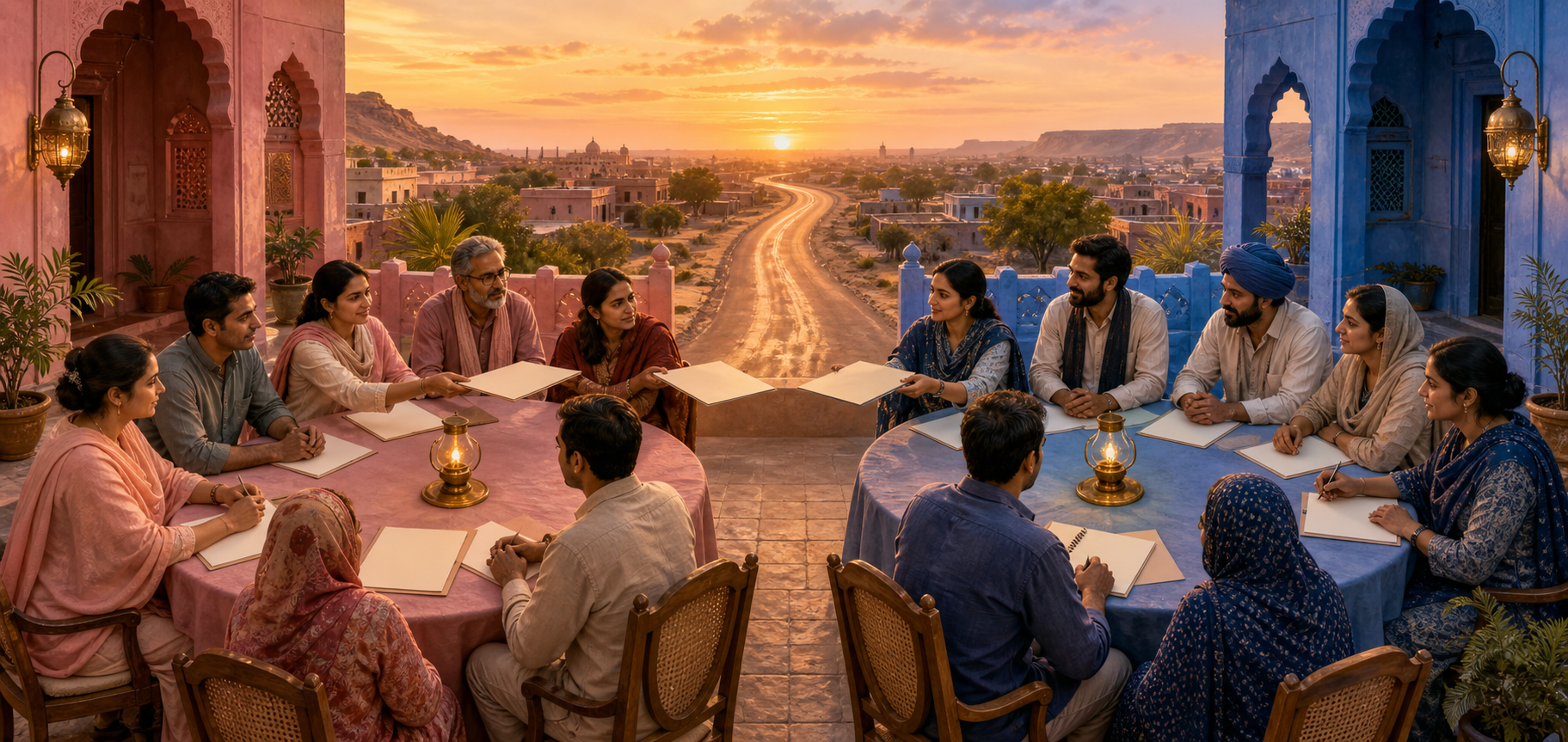
Rajasthan’s two-city opportunity lies in complementarity. Jaipur has dense networks of archives, museums, universities and living temples that can support research partnerships, public education, legal-literacy programmes and documented training material. Jodhpur brings strong heritage custodianship, artisanal knowledge and connections extending into western Rajasthan. A working corridor should move knowledge in both directions rather than treating one city as headquarters and the other as a field office.
Jaipur-based teams can help turn archival, legal and academic knowledge into usable templates. Jodhpur-based teams can test whether those templates make sense for conservators, artisans, rural communities and smaller institutions. Lessons from the field should then revise the material used in both cities. This is what peer review looks like in a civic network: not one organisation grading another, but each location exposing blind spots the other cannot see.
Rotating convenorship prevents the network from becoming dependent on a single personality or institution. A quarterly joint review can compare programmes, participation, beneficiary satisfaction and response times. An annual Jaipur-Jodhpur review can then decide which practices deserve wider adoption. Where public dashboards are feasible, they should show service outputs and agreed progress without exposing private contact information, vulnerable beneficiaries or sensitive incident details.
Urban-rural balance must be designed, not assumed. Include panchayat representatives, neighbourhood organisers, dharmashalas and rural service groups when priorities are selected, not after a city committee has completed the plan. A stepwell, school forum or craft cluster may require local knowledge that a metropolitan organisation simply does not possess. Subsidiarity gives that knowledge decision-making weight.
Youth and women should also hold operational authority rather than ceremonial seats. Mentored cohorts can conduct community surveys, document heritage, create eco-friendly festival toolkits, organise heritage-focused hackathons and produce multilingual explanations of dharmic concepts. Give a new volunteer a defined task, then a chance to co-own a programme, lead one and eventually mentor another participant. That progression preserves institutional memory and makes leadership renewal part of the system.
Make every Sampark meeting produce usable commitments
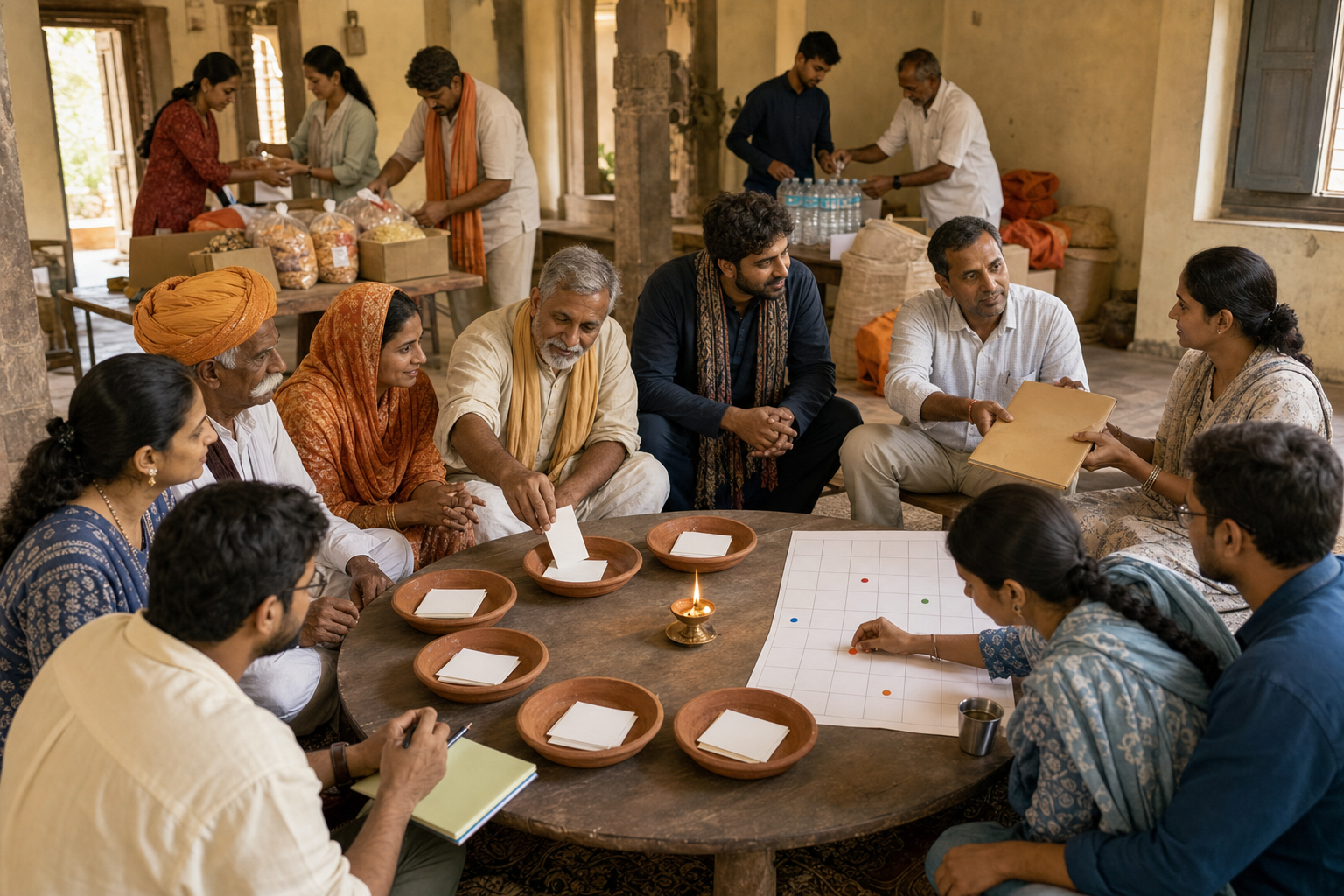
A meeting should begin with an issue, not a sequence of ceremonial addresses. Circulate a short note describing the need, the communities affected and the decision required. Use a small roundtable to surface concerns, issue-focused breakouts to develop options and time-bounded action planning to decide what happens next. Participants should leave with artefacts they can use, not only a photograph and a declaration of unity.
Five outputs make a strong minimum:
- A verified directory. Record each contact’s organisation, role, district, relevant capability and backup person. Obtain consent before sharing details, and state who may access the directory.
- A joint calendar. List festivals, seva activities, training sessions and review meetings. Every entry needs an owner, a cooperating organisation and the next decision date.
- A practical operating procedure. For festivals or emergencies, identify administrative liaisons, medical and legal contacts, communication responsibility, escalation paths and the point at which volunteers must hand the matter to competent authorities.
- A lightweight cooperation charter. State the common purpose, boundaries of joint work, method for reaching consensus, financial responsibility, data-sharing norms and process for correcting a mistake.
- A quarterly scorecard. Compare results with a recorded baseline using participation, beneficiary satisfaction, completed outputs and incident response times. Add a short learning note explaining what will change.
The charter matters because goodwill does not answer operational questions. Who may speak for the coalition? Can one member use the shared directory for an unrelated campaign? Who approves a public statement? What happens if an organisation misses a commitment? A short memorandum of understanding can resolve these issues without creating a heavy central bureaucracy.
Suraksha must remain lawful. Volunteers can prepare routes, emergency numbers, first-response checklists and rumour-control procedures, but they should not improvise policing, detention or legal judgement. When a matter involves rights, criminal allegations or denominational control, send it to a qualified legal professional and use due process. Early liaison with local administration and clear de-escalation rules protect civil liberties as well as public order.
Build a pause rule into every meeting and communication channel. If rhetoric becomes incendiary, a rumour cannot be verified or a participant is being reduced to a communal label, stop the discussion long enough to establish facts and restore the agreed norms. Restraint at that moment is not a retreat from advocacy. It is the discipline that keeps advocacy from injuring the society it claims to serve.
Practical questions organisers should settle early
Who belongs in a dharmic outreach network?
Include people who can contribute to a defined civic purpose: temple and dharmashala representatives, Hindu, Buddhist, Jain and Sikh bodies, women-led and youth-led seva groups, scholars, educators, heritage specialists, legal and mediation cells, neighbourhood and panchayat representatives, and diaspora liaisons. Participation should reflect useful capability and local trust, not only organisational size.
Does unity require agreement on every religious or political question?
No. Cooperation can be limited to a shared task while each body retains its teachings, identity and independent voice. Record the scope of agreement so that a joint health camp, conservation project or legal-literacy session is not later presented as endorsement of an unrelated position.
What should happen when a serious dispute appears?
Move it out of reactive group messaging and into a defined mediation or legal process. Preserve relevant facts, avoid publishing personal allegations, identify the competent authority and appoint a liaison who can report verified developments. The coalition’s role is to support lawful resolution and reduce confusion, not to conduct a public trial.
How do you know whether one quarter of outreach worked?
Do not count messages, meetings or social-media reach as the main result. Compare the quarter with its baseline: Were more organisations able to coordinate? Did a service reach its intended beneficiaries? Were participants satisfied? Did an emergency or festival issue receive a faster, clearer response? Were errors documented and corrected? A network is becoming durable when coordination no longer depends on personal improvisation.
Your next useful step is modest: convene the relevant Jaipur or Jodhpur stakeholders around one bounded public need, choose the organisations with the right capabilities, assign named responsibility and set the quarterly review before anyone leaves. If the work earns trust, connect it to the other city and let documented results carry the case for wider dharmic cooperation.
A Hindu Rashtra outreach worthy of dharma will be recognised by its conduct: confident without coercion, plural without vagueness, organised without needless centralisation and devoted to seva that improves the common life of Rajasthan.
References
