

If you arrived at this episode while tracing Satyavati’s ancestry, the likely problem is not the number of characters. It is that two extraordinary births occur in one compressed chain. Shuktimati and Kolahola belong to the first; Satyavati is born through a later event involving King Uparichara Vasu.
Keep those births separate and the passage becomes much easier to read. You can then see what the Mahabharata is doing with kingship, blocked movement, unexpected descent and the consequences that continue long after one decisive act.
Start with the sequence, not the symbolism
The episode occurs in the Vamshavatarana section of the Adi Parva, identified here as chapter 57. Uparichara Vasu rules Chedi and is described as a rajarishi: a king whose conduct also carries the discipline associated with a sage. That description matters because his authority is neither passive contemplation nor uncontrolled power. He must act, but his action must answer to dharma.
Read the events in this order:
- The mountain Kolahola obstructs or confines the river Shuktimati.
- King Uparichara Vasu intervenes by kicking the mountain, releasing the river from the obstruction.
- Shuktimati presents the king with twins connected to her encounter with Kolahola: a son and a daughter.
- The son is given a military role under the king. The daughter, Girika, becomes Vasu’s queen.
- Later, Vasu’s seed is meant to reach Girika while the king is away. Its aerial delivery is interrupted, and it falls into water.
- A fish swallows it and subsequently yields two children, one of whom is Satyavati. Satyavati is then raised in a fishing community rather than in Vasu’s palace.
This order supplies the essential correction: freeing Shuktimati begins the chain that leads toward Satyavati, but Shuktimati does not directly give birth to Satyavati. The connecting person is Girika, Shuktimati’s daughter and Vasu’s intended queen in the later transmission.
Do not collapse the two sets of twins
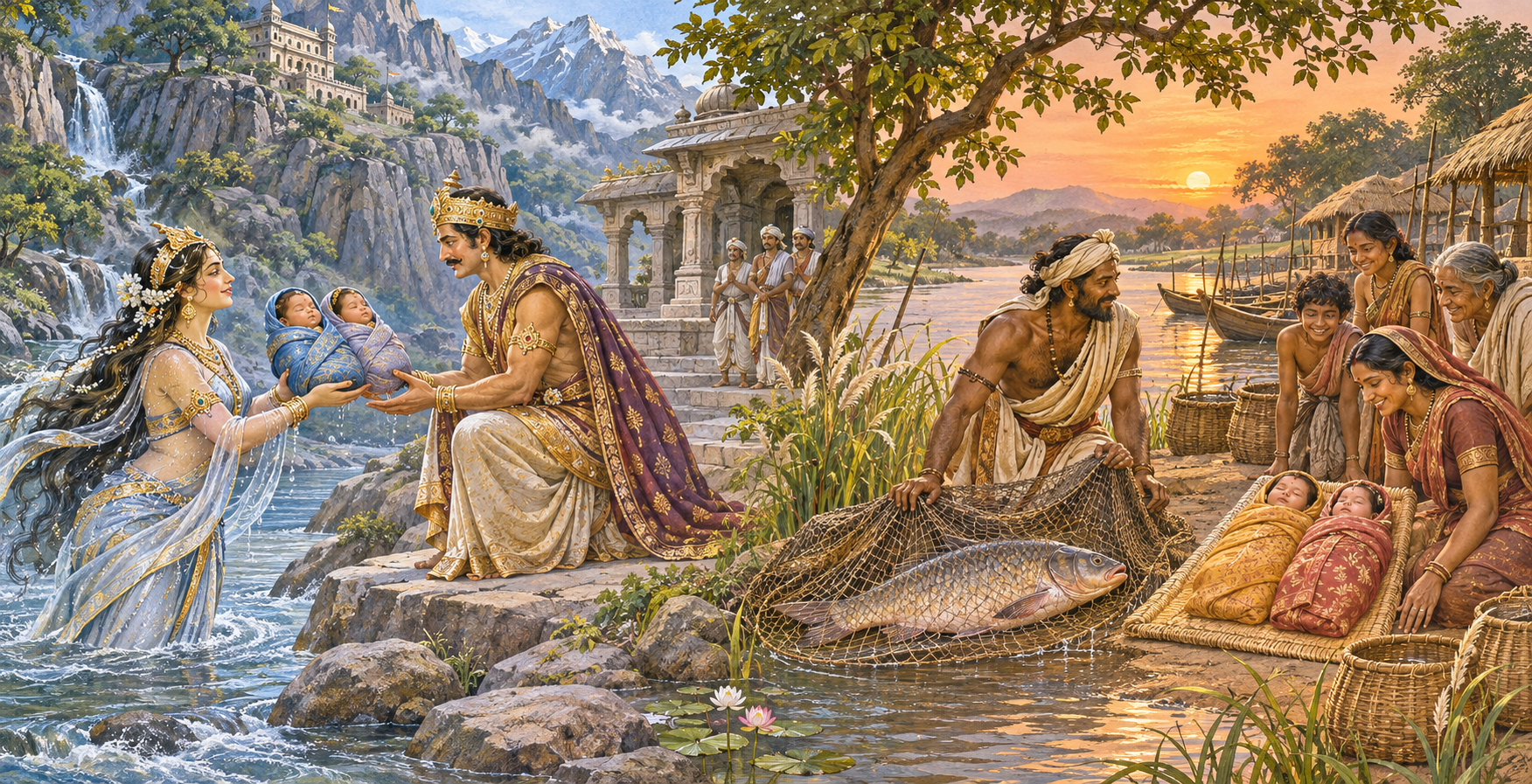
The easiest way to lose the genealogy is to remember only that a river, a fish, a king and two pairs of children appear near one another. The Mahabharata’s compressed narration rewards a simple discipline: identify the parents or causal agents of each birth before asking what the birth means.
- First pair: Shuktimati and Kolahola are associated with a son and Girika.
- Link between the episodes: Girika becomes the queen of Uparichara Vasu.
- Second pair: Vasu’s interrupted attempt to send his seed to Girika leads to the fish-birth in which Satyavati appears.
- Social outcome: Satyavati’s royal paternity does not result in a palace childhood; she grows up within a fishing household.
If you are making notes, write the relationship as a chain: Kolahola and Shuktimati lead to Girika; Girika’s marriage to Vasu sets the context for the interrupted delivery; that interruption leads to Satyavati’s unusual birth. This is a map of narrative causation, not a claim that every participant has the same kind of parenthood.
This distinction also prevents a misleading description of Satyavati as simply the daughter of Shuktimati. Shuktimati belongs to Satyavati’s genealogical background, but the text places another birth mechanism and another upbringing between them. In an epic where lineage repeatedly affects duty and succession, that difference is not a minor technicality.
Why King Vasu’s kick is an act of rajadharma

The kick is memorable because it is abrupt, physical and effective. Yet its moral significance does not come from force by itself. The king acts against an obstruction and restores the river’s movement. Force is placed in the service of release.
That gives you three tests for reading Vasu’s conduct:
- Identify what is blocked. Shuktimati cannot continue in her proper course while Kolahola holds her back.
- Identify what the intervention restores. Vasu does not manufacture the river’s nature; he removes what prevents that nature from operating.
- Examine what follows the intervention. The consequences enter Vasu’s kingdom and household. The king does not strike, depart and pretend that the aftermath belongs to someone else.
This is where the title rajarishi becomes useful. A king must sometimes act decisively, while a sage-like orientation keeps action tied to a rightful end. Rajadharma is not mere gentleness, and it is not a licence to impose the ruler’s will. It asks whether power protects order, releases what has been wrongfully restrained and accepts responsibility for the result.
You should therefore resist turning the kick into a general endorsement of violence. The episode supplies a much narrower principle: decisive power can serve dharma when it removes a clear obstruction and restores a proper course. Detached from those conditions, the gesture loses its moral frame.
Read the river and mountain on more than one level
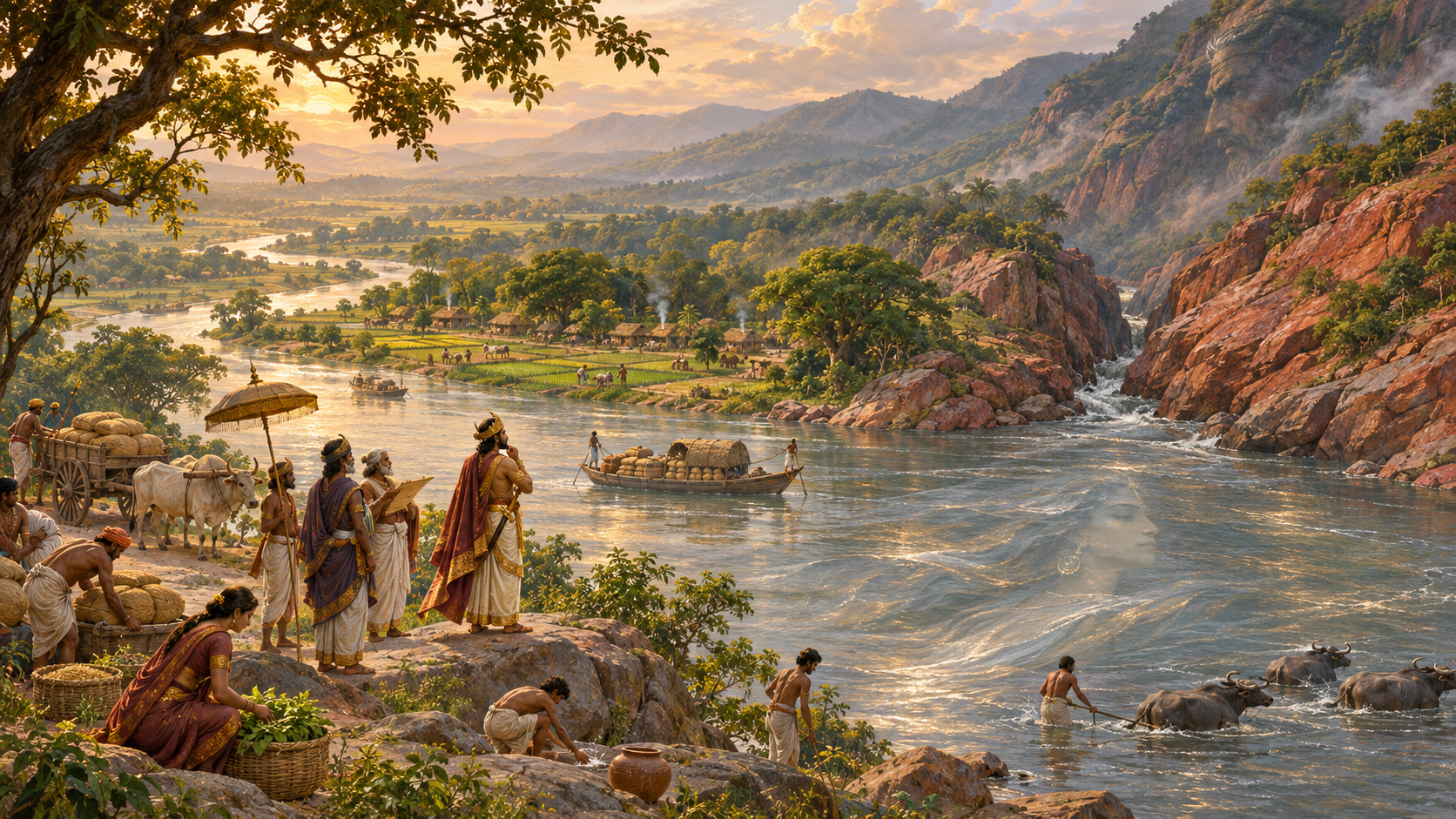
Shuktimati and Kolahola are not pieces of scenery placed behind a human drama. They act within it. The landscape participates in genealogy, political order and moral consequence. That personification is normal to the narrative world; it should not be treated as an embarrassing ornament that must be removed before the passage can mean anything.
A careful reading can hold three levels together:
- Narrative level: a named mountain obstructs a named river, and a king releases her.
- Political level: the ruler responds when a life-giving course within his realm is blocked.
- Spiritual and ethical level: dharmic action restores movement where fixation, possession or excess has produced confinement.
The third level is an interpretation, not a replacement for the first. If you reduce Kolahola to nothing but an inner psychological obstacle, you discard the king, the river and the genealogy that make this particular story what it is. If you refuse every symbolic reading, you miss why the image of released water carries moral force beyond the incident itself.
The better question is not, “Did this happen literally or symbolically?” It is, “What does each level allow you to notice?” At the plot level, Vasu solves a concrete obstruction. At the ethical level, he demonstrates that authority is justified by what it restores. At the contemplative level, Shuktimati’s recovered flow can help you recognize where a rightful movement in your own life has been confined by fear, attachment or inertia.
Satyavati’s unusual origin is part of the teaching
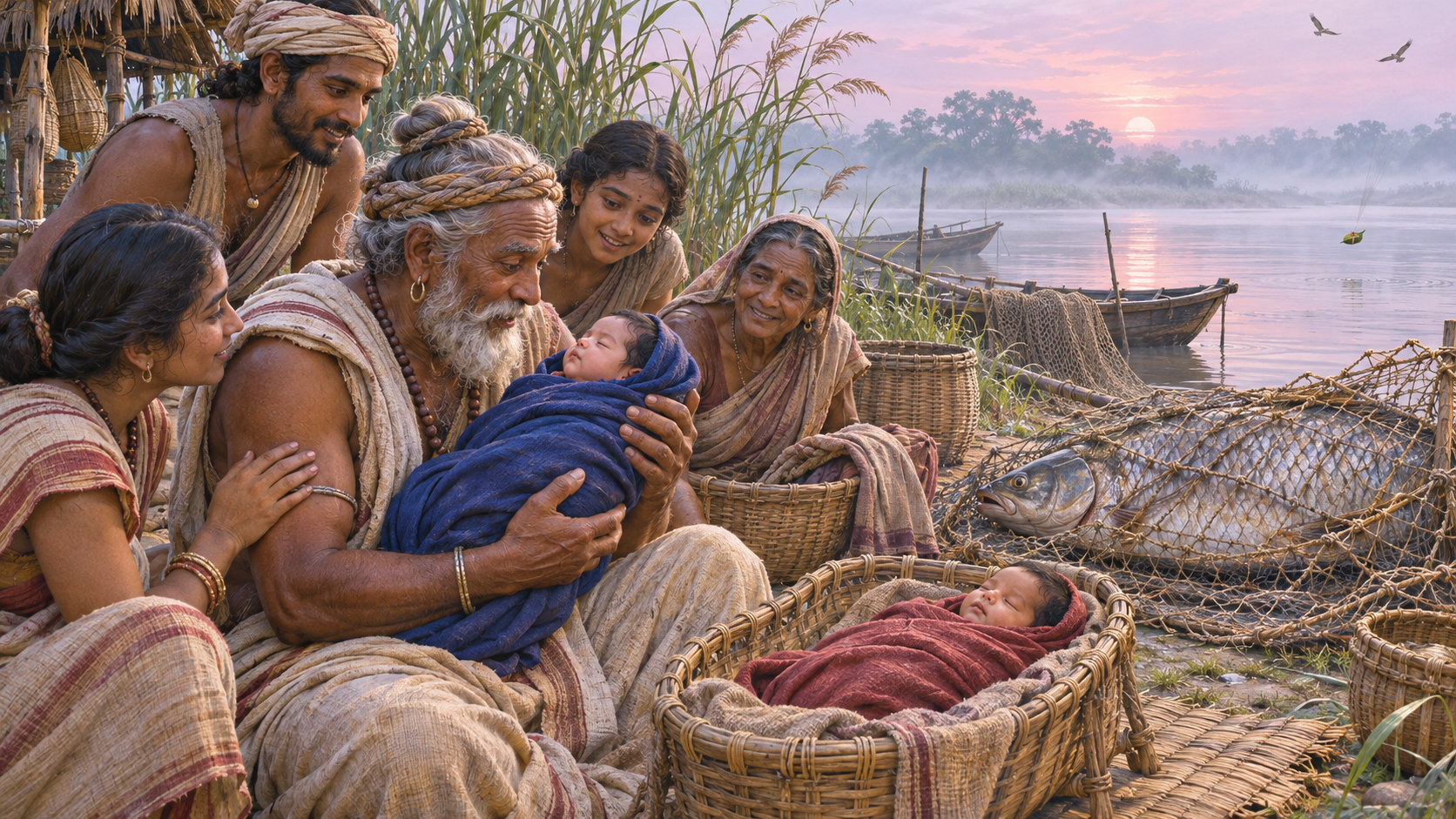
Satyavati enters the chain through interruption rather than orderly delivery. Vasu’s intention is directed toward Girika, but the intended route fails. The seed reaches a fish, and the child who carries royal descent grows up outside the royal household. Intention, biological descent, social identity and lived upbringing no longer occupy the same place.
That separation prepares you for the Mahabharata’s wider treatment of lineage. Birth matters, but descent alone does not exhaust a person’s identity. Fosterage, occupation, recognition, circumstance and later choices also shape how someone stands in the world. Satyavati’s beginning should therefore be read as more than a marvel inserted to make her memorable.
Her origin also shows why an apparently local act can have consequences far beyond its first setting. Vasu frees Shuktimati; Shuktimati’s daughter Girika enters his household; a later effort involving Girika is interrupted; Satyavati emerges from that interruption. The chain does not move in a straight line, but it does retain moral and genealogical continuity.
Three overclaims should be avoided. The sequence does not make Shuktimati Satyavati’s immediate mother. It does not turn every detail into a simple code for modern social categories. And it does not teach that a ruler’s force becomes righteous merely because the ruler invokes a good intention. Each of those readings erases a distinction the narrative carefully preserves.
Key takeaways
- Uparichara Vasu is the king of Chedi and a rajarishi, joining royal responsibility with sage-like discipline.
- Kolahola obstructs Shuktimati, and Vasu’s kick releases the river.
- Shuktimati’s daughter Girika becomes Vasu’s queen; she is the principal link between the river episode and Satyavati’s origin.
- Satyavati is born later through a separate sequence involving Vasu’s seed, an interrupted delivery and a fish.
- The kick illustrates a limited principle of rajadharma: power is defensible when it removes an obstruction, restores a rightful course and owns the consequences.
- The genealogy works best when read on narrative, political and spiritual levels without allowing one level to erase the others.
When you next read the passage, mark three transitions in the margin: obstruction to release, Shuktimati to Girika, and intended delivery to unexpected birth. Those transitions will keep the genealogy clear and reveal the deeper pattern: dharmic action restores movement, but no action controls every consequence that follows.
References

Leave a Reply
You must be logged in to post a comment.