

If your family observes Shraddha, you may eventually face a difficult question: which parts belong to Hindu scripture, and which parts are family or regional custom? The distinction matters when relatives disagree, when an inherited procedure has been forgotten, or when someone claims that only one form is legitimate.
You do not have to choose between blind repetition and casual reinvention. Begin with the enduring purpose of Shraddha, identify the authority claimed for each ritual detail, and then follow one coherent tradition under knowledgeable guidance.
The scriptural foundation is a lineage, not one isolated quotation
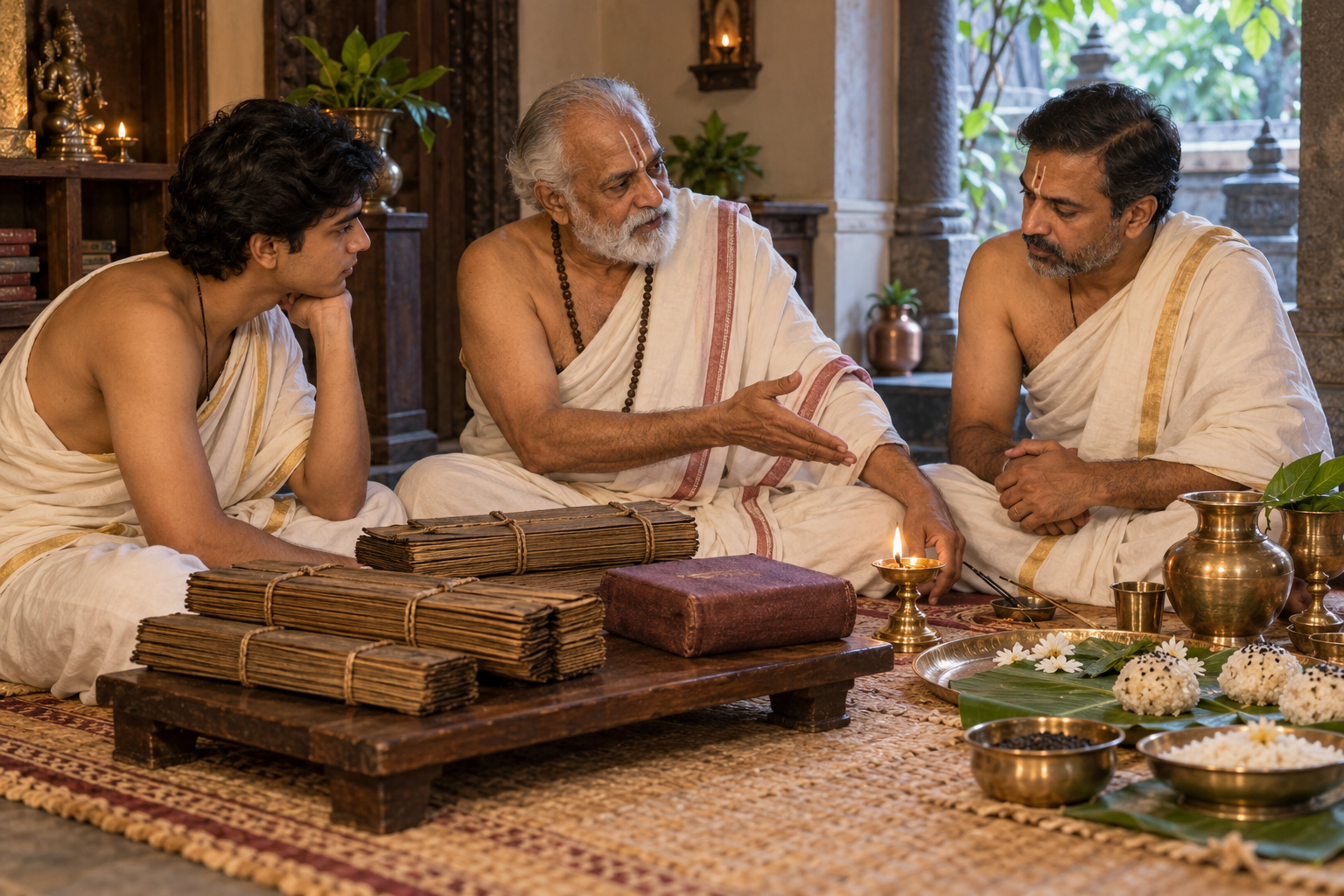
Shraddha belongs to an ancient stream of Hindu duty extending from the Vedas to later compendiums. That long continuity answers the first practical question: Shraddha is not merely a recently assembled social custom or a private memorial created by individual preference.
It also prevents a common mistake. An ancient foundation does not mean that every detail now followed in every household appears in an identical form in the earliest textual layer. A religious principle may be established early while later authorities preserve, arrange, explain, or apply it more fully. Families then receive the practice through teachers and inherited custom.
When someone calls a particular rule “scriptural,” ask what kind of claim is being made. Is the person pointing to the ancient foundation of the duty, a later explanation of its procedure, or the established custom of a particular family? All three can matter, but they are not interchangeable.
- Ancient foundation: Why does the duty exist, and what relationship does it honour?
- Ritual explanation: How has that duty been given an ordered form?
- Inherited application: How has a family or community faithfully received and practised that form?
This layered view lets you respect tradition without making an exaggerated claim that every familiar local detail is directly and uniformly Vedic.
Three elements reveal the stable heart of Shraddha

The name Shraddha carries the sense of faith or sincerity. The rite concerns departed parents and forefathers, and it expresses gratitude toward those from whom we received life and family continuity. These ideas give you three reliable tests for understanding the practice.
- The inward disposition is faith and sincerity. Shraddha should not be reduced to motions performed only to satisfy appearances. The participant’s seriousness is part of the rite’s meaning.
- The relationship is ancestral. The focus is not an abstract celebration of the past. It is directed toward departed parents and forefathers with whom the family has a real bond of descent and inheritance.
- The moral response is gratitude. The rite acknowledges that your life and place within a family did not begin with you. It turns that acknowledgement into disciplined remembrance.
Faith does not make ritual form irrelevant, and ritual form cannot replace faith. Shraddha holds the two together: sincerity gives the action its proper orientation, while an inherited discipline prevents sincerity from becoming whatever an individual happens to prefer.
This provides a useful way to evaluate an explanation of the rite. If it talks only about technique and never about gratitude, it has missed the centre. If it treats sincere remembrance as sufficient reason to discard all received form, it has missed the discipline. A faithful observance needs both.
Variation does not cancel authority
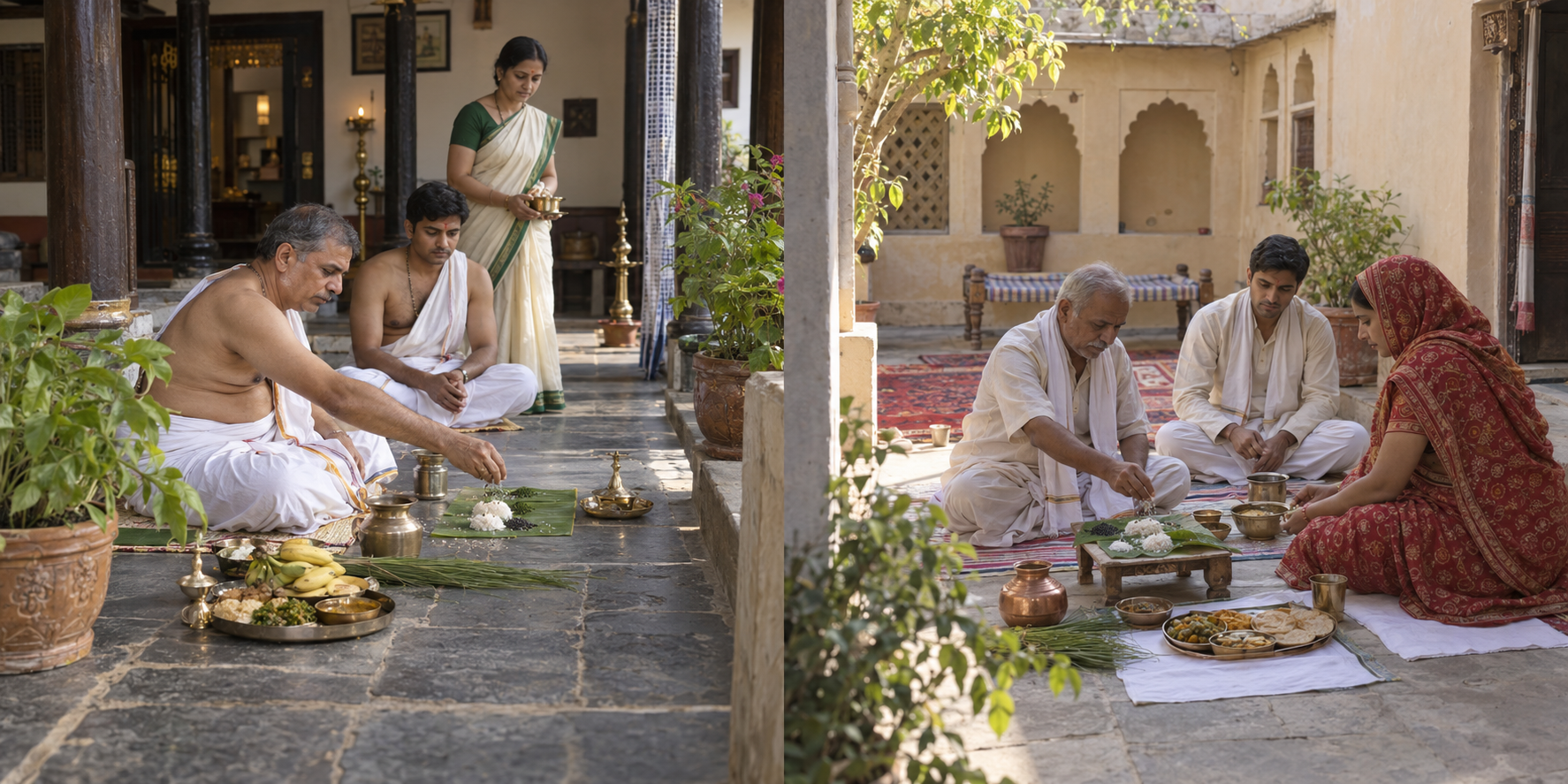
Differences between households can create unnecessary doubt. One family remembers a particular sequence; another follows different wording or an additional customary act. People then draw one of two sweeping conclusions: either their own family form must be the only scriptural form, or the existence of variation proves that Shraddha has no firm scriptural basis. Neither conclusion follows.
The better approach is to separate the stable core from its transmitted expression. The core remains faith, remembrance of departed parents and forefathers, and gratitude for life and lineage. The expression may be carried through a particular teaching lineage, regional discipline, or household custom.
When you encounter a difference, classify it before debating it:
- A difference of purpose is serious. If an interpretation removes ancestral remembrance or sincere gratitude, it changes the character of the rite.
- A difference of prescribed procedure calls for knowledgeable guidance. Ask which body of ritual teaching is being followed and whether the procedures belong to the same coherent tradition.
- A difference of household custom should not automatically be promoted into a universal command or dismissed as meaningless. Determine how the custom relates to the rite’s purpose.
Do not resolve uncertainty merely by choosing the strictest available opinion. Strictness and authority are not the same thing. Nor should you assemble a new ceremony from disconnected instructions found in several places. A shorter, coherent observance received from a trustworthy guide is more intelligible than a collection of impressive-looking fragments whose relationship you cannot explain.
How to examine a claimed scriptural rule

You do not need to become a textual specialist before performing a family duty. You do need enough clarity to tell the difference between a precise citation and a floating appeal to “scripture.” When a disputed requirement is presented as mandatory, ask five questions before changing an inherited practice.
- What exact authority is being invoked? Ask for the name of the text or the clearly identified tradition, not simply the statement that “the scriptures require it.”
- What does the cited passage establish? It may establish the duty’s principle without prescribing every detail attributed to it.
- Is the rule presented as universal or particular? Clarify whether it is said to apply to all practitioners, to a defined ritual tradition, or to one family and region.
- Which elements are essential and which are inherited additions? A knowledgeable guide should be able to distinguish the rite’s centre from supplementary custom without insulting either.
- Can the whole observance be explained coherently? Every main action should belong to the same religious logic rather than being borrowed at random from unrelated procedures.
If your family has preserved a settled practice, document it before memory becomes uncertain. Record the sequence, the names used for its parts, who taught it, and which details elders regard as family-specific. Then take unresolved questions to a knowledgeable purohit or teacher. If no living family memory remains, say so plainly; that allows the guide to help you adopt a coherent practice without pretending that a newly learned detail has always belonged to your household.
If relatives disagree, do not begin by asking who cares more about tradition. Begin by asking what kind of authority each person is claiming. One may be defending the rite’s scriptural purpose while another is defending a treasured household expression. Naming that distinction often reveals that the disagreement is narrower than it first appeared.
Key takeaways
- Shraddha is an ancient Hindu duty with a textual continuity reaching from the Vedas to later compendiums.
- Its stable centre is faith or sincerity directed toward departed parents and forefathers in gratitude for life and family continuity.
- Scriptural foundation, later ritual explanation, and household custom are related forms of authority, but they should not be confused with one another.
- Differences in local procedure do not erase the rite’s ancient basis, and an ancient basis does not make every local detail universally binding.
- Before changing family practice, request the exact authority, determine what it actually establishes, and ask whether the rule is universal or tradition-specific.
- Follow one coherent discipline under knowledgeable guidance instead of building a rite from disconnected instructions.
Your next step can be modest and concrete. Write down your family’s present Shraddha practice, mark each part as core purpose, received ritual discipline, or household custom, and bring the unclear points to a trusted purohit or teacher before the next observance. That small act protects both fidelity and honesty: you neither discard Shraddha because forms vary nor call every familiar habit Vedic.
References

Leave a Reply
You must be logged in to post a comment.