
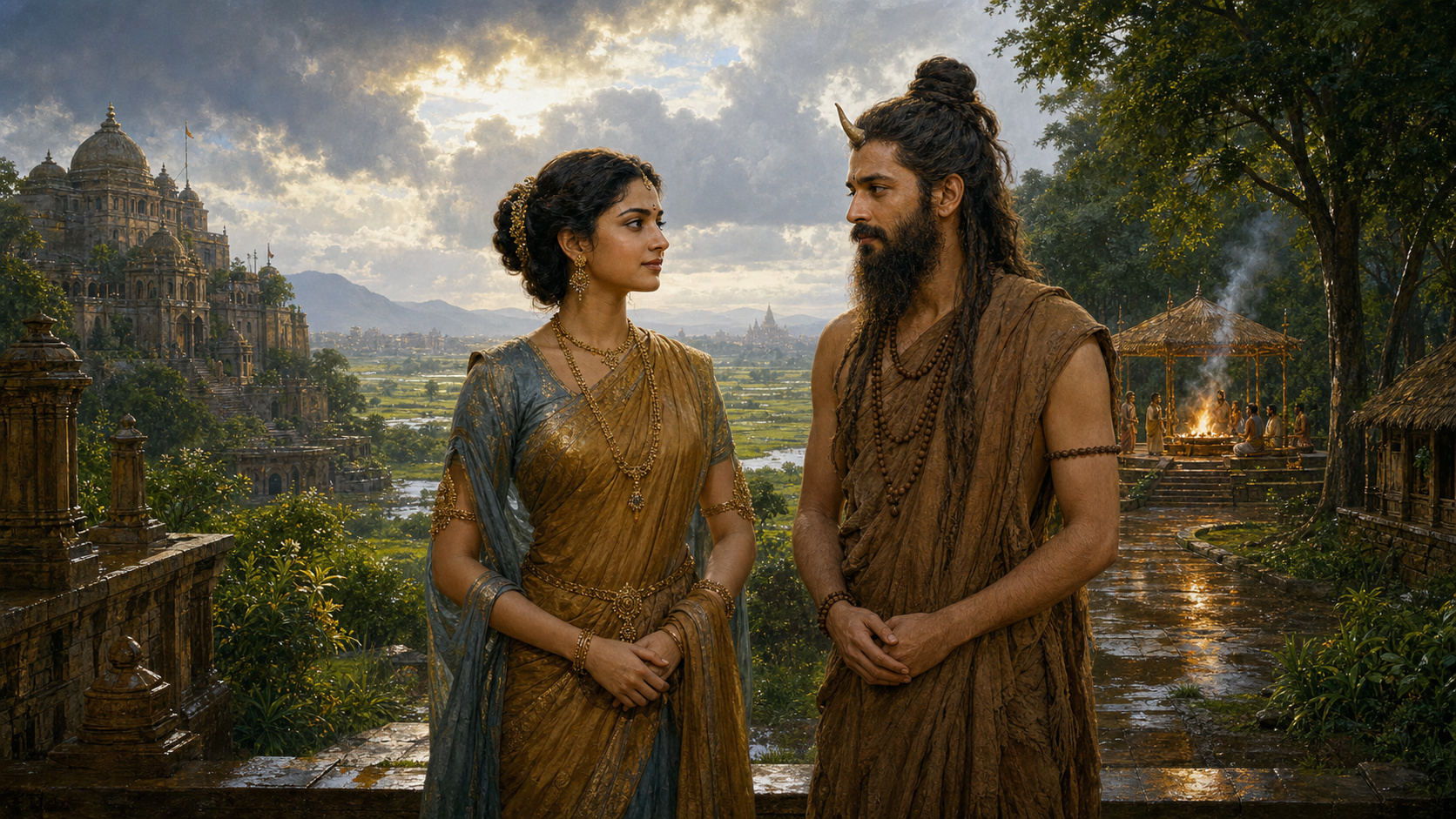
If you have just discovered that Sri Rama is remembered in many traditions as having a sister named Shantadevi, the obvious question is why she disappears from so many familiar retellings. The answer is not that one genealogy is simply right and every other one is wrong. Her parentage receives different treatment across the Ramayana tradition, while her marriage to Rishyasringa and her place in the events preceding Rama’s birth remain remarkably important.
Once you separate those two questions – who Shantadevi’s parents are in a given telling, and what she does in the larger narrative – the confusion clears. You can identify the tradition behind a claim, follow the sequence from Anga’s drought to Ayodhya’s succession, and see why a princess with relatively little narrative space can still be indispensable.
Is Shantadevi Rama’s sister? Give the tradition with the answer
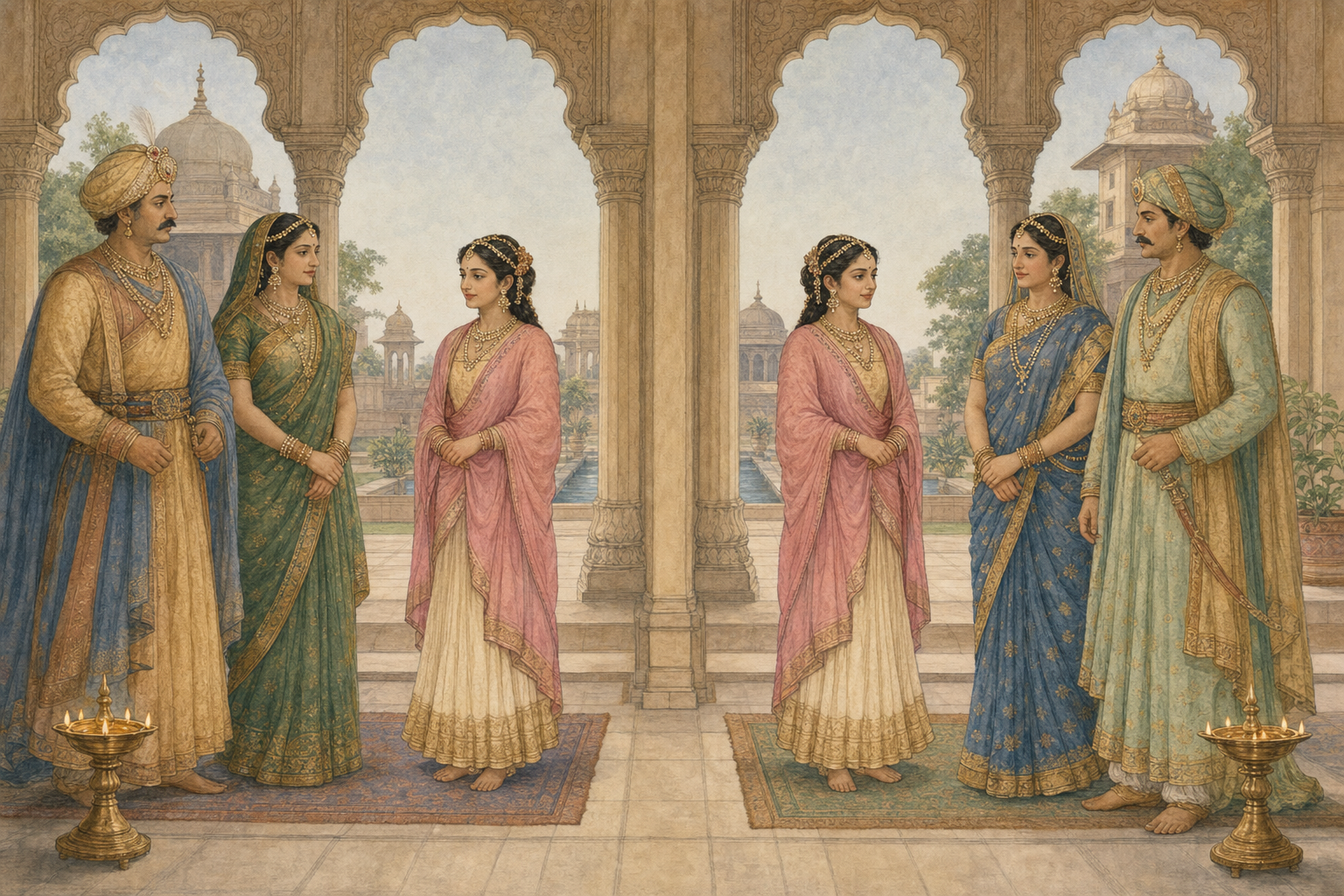
In widely circulated later Puranic and regional traditions, yes. Shantadevi, also called Shanta or Śāntā, is remembered as a biological daughter of King Dasharatha who was ceremonially given in adoption to King Romapada of Anga. Some tellings identify Kausalya as her mother. In that genealogy, she is Rama’s sister by birth and the princess of Anga by adoption.
The Valmiki Ramayana’s Bala Kanda places the emphasis differently. It introduces Shanta within the royal house of Anga and concentrates on her marriage to Rishyasringa, the crisis in Romapada’s kingdom, and the sage’s later ritual service to Dasharatha. Bala Kanda’s presentation of Shanta as the princess of Anga does not foreground the later adoption explanation. Saying that Valmiki explicitly presents the complete Dasharatha-adoption genealogy would therefore blur the distinction between textual layers.
A careful answer is simple: in many later traditions, Shantadevi is Dasharatha’s daughter, Rama’s sister, and Romapada’s adopted daughter; in the Bala Kanda narrative, she is presented first as the princess of Anga. That wording preserves both traditions without pretending that every recension supplies the same biographical details.
The identities do not have to cancel each other. Within the dharmic political world reflected in these traditions, adoption could preserve a royal lineage, fulfill family obligations, and establish a durable bond between kingdoms. A daughter born in Kosala could consequently belong to Anga’s royal house through dattaka adoption. At the same time, you should not force this harmonization back into every telling. Where a text says only that she is Anga’s princess, let that text retain its own emphasis.
This distinction matters whenever you teach the episode, discuss it online, or answer a child’s question. Replace the unqualified statement that all Ramayanas identify Rama’s sister with a versioned statement: many later traditions remember Shantadevi as Dasharatha’s daughter and Rama’s sister. One small qualifier prevents a large textual mistake.
The six-link chain from Anga’s drought to Rama’s birth
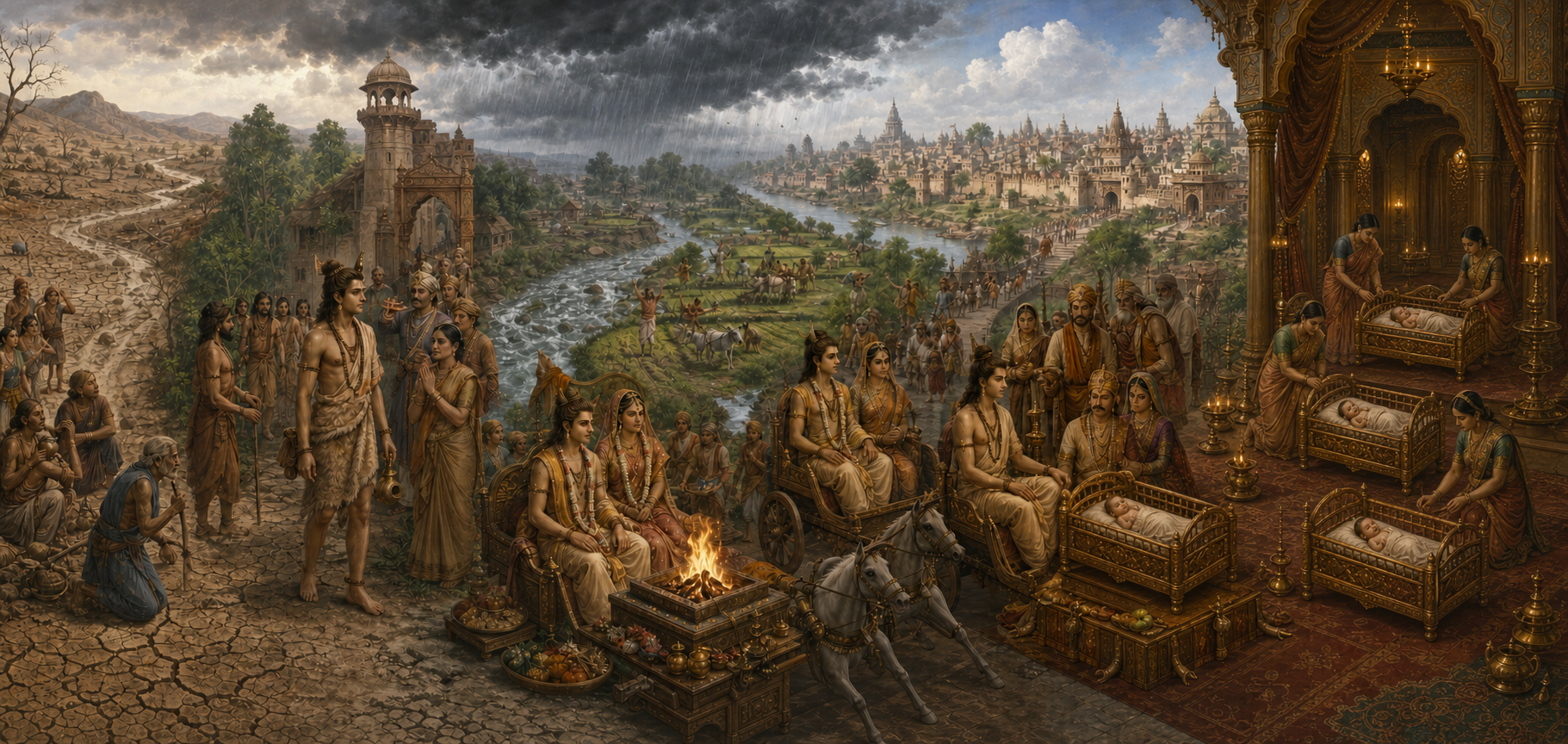
Shantadevi’s importance becomes clear when you stop counting how many verses or scenes she receives and instead follow the consequences around her. The relevant sequence crosses two kingdoms, joins royal and ascetic life, and ends with the resolution of Dasharatha’s succession crisis.
- Anga suffers a public crisis. Romapada’s kingdom is afflicted by drought and distress. The narrative treats the failure of rain as a disorder affecting the whole realm, not merely as the king’s private problem.
- Rishyasringa is brought from the forest into royal society. He is the son of the sage Vibhandaka, raised in seclusion and renowned for tapas. Romapada’s court arranges his arrival because his spiritual and ritual power is expected to help the suffering kingdom.
- Balance returns to Anga. In these tellings, Rishyasringa’s presence and rites are associated with the end of the drought. The restoration of rain marks the renewal of order and abundance.
- Shantadevi marries Rishyasringa. Their marriage gives lasting social form to the encounter between Anga’s royal house and the forest-trained ascetic. In traditions that elaborate her role, Shantadevi also helps Rishyasringa enter the responsibilities and relationships of household life.
- Dasharatha gains access to the needed ritual officiant. Rishyasringa is invited to Ayodhya, where he presides over royal sacrifices associated with Dasharatha’s desire for heirs. Shantadevi’s relationship with him connects the succession problem in Kosala to the solution first encountered in Anga.
- The sacrificial sequence leads to the four princes. The divine payasa arising from the rite is distributed among Kausalya, Kaikeyi, and Sumitra. The resulting births are Sri Rama, Bharata, Lakshmana, and Shatrughna.
This chain corrects two opposite mistakes. Shantadevi does not personally perform the sacrifice or give birth to Rama, so she should not be assigned ritual or maternal actions that belong to others. Yet she is not incidental. Her marriage creates the human and political relationship through which Rishyasringa’s ascetic discipline and ritual qualification become available to Ayodhya.
The Putrakameshti also deserves more precision than it usually receives in casual retellings. It is not a generic prayer for a child. It is a purpose-specific kamya ishti within the Vedic ritual world, requiring appropriate offerings, mantras, officiants, and sequence. Rishyasringa serves as a qualified ritvik. The rite belongs to a shrauta environment associated with the Yajurveda and is often narrated near the Ashvamedha, but the two should not be carelessly collapsed into one undifferentiated sacrifice.
When you retell the episode, keep its verbs distinct: Romapada brings Rishyasringa to Anga; Shantadevi marries him and joins royal life to ascetic power; Dasharatha invites him to Ayodhya; Rishyasringa officiates; the sacrificial payasa is distributed to the queens; the queens bear the four sons. That sequence honors Shantadevi without exaggerating her part and honors her part without erasing it.
What Shantadevi’s role shows about dharma

Adoption joins kinship to public responsibility
The dattaka tradition does more than reconcile two royal identities. It places kinship within rajadharma. Dasharatha’s relationship with Romapada is expressed not only through diplomacy but through family, continuity, and mutual obligation. Shantadevi consequently becomes a bond between Kosala, centered on Ayodhya, and Anga in the eastern Gangetic region, associated with parts of present-day Bihar.
You should still resist turning a dynastic narrative into a simple manual for modern adoption. The duties, institutions, and power relations of royal houses are not identical to those of a family now considering adoption. The more durable insight is narrower: adoptive belonging need not erase birth ancestry, and birth ancestry need not make an adoptive relationship unreal. Shantadevi’s two affiliations can be read as complementary forms of responsibility rather than rival claims of ownership.
Marriage connects disciplines that cannot solve the crisis alone
Anga’s king possesses political authority but cannot command rain. Rishyasringa possesses tapas and ritual competence but begins outside courtly and household life. Shantadevi stands at the point where those worlds become capable of sustained cooperation. Her marriage joins kshatra, the domain of protection and governance, with brahma, the domain of sacred learning and ritual discipline.
This is not a claim that royal power and ascetic power become identical. Their value lies in remaining distinct while serving loka-kalyana, the welfare of the people. The ruler must respond to suffering among his subjects. The ritual specialist must exercise a disciplined vocation. The household creates relationships through which specialized capacities can serve a wider community. Shantadevi’s story lets you notice that dharmic cooperation is often relational before it becomes institutional.
Quiet agency should be recovered, not invented
Textual brevity creates a temptation in both directions. One reader may conclude that Shantadevi did nothing because she receives little attention. Another may supply a complete modern psychological biography – her private wishes, conversations, motives, and emotions – that the particular telling never provides. Neither approach is careful.
You can make the stronger case without invention. Shantadevi changes the structure of relationships around her. Through adoption, she links two royal houses. Through marriage, she connects the court to a forest-formed sage. Through that connection, Rishyasringa enters the ritual sequence leading to Dasharatha’s heirs. Some regional traditions expand her education and her role in preparing her husband for household life, but those details should be identified as version-specific rather than silently inserted into every Ramayana.
Her significance also should not be used to romanticize the expectation that women must serve silently. Seva and tyaga have dharmic force when they are understood as responsible action for the good, not as excuses to make a person’s contribution invisible. Recovering Shantadevi means recognizing the public consequence of work performed through kinship, trust, and continuity.
Even her name invites a measured observation. Śāntā means peaceful or pacified, and that meaning resonates with the return of order to a drought-stricken kingdom and the resolution of a succession crisis. It is a fitting symbolic association, but a name’s meaning should illuminate the narrative rather than be treated as proof of every interpretation placed upon it.
How to compare versions without forcing a false choice
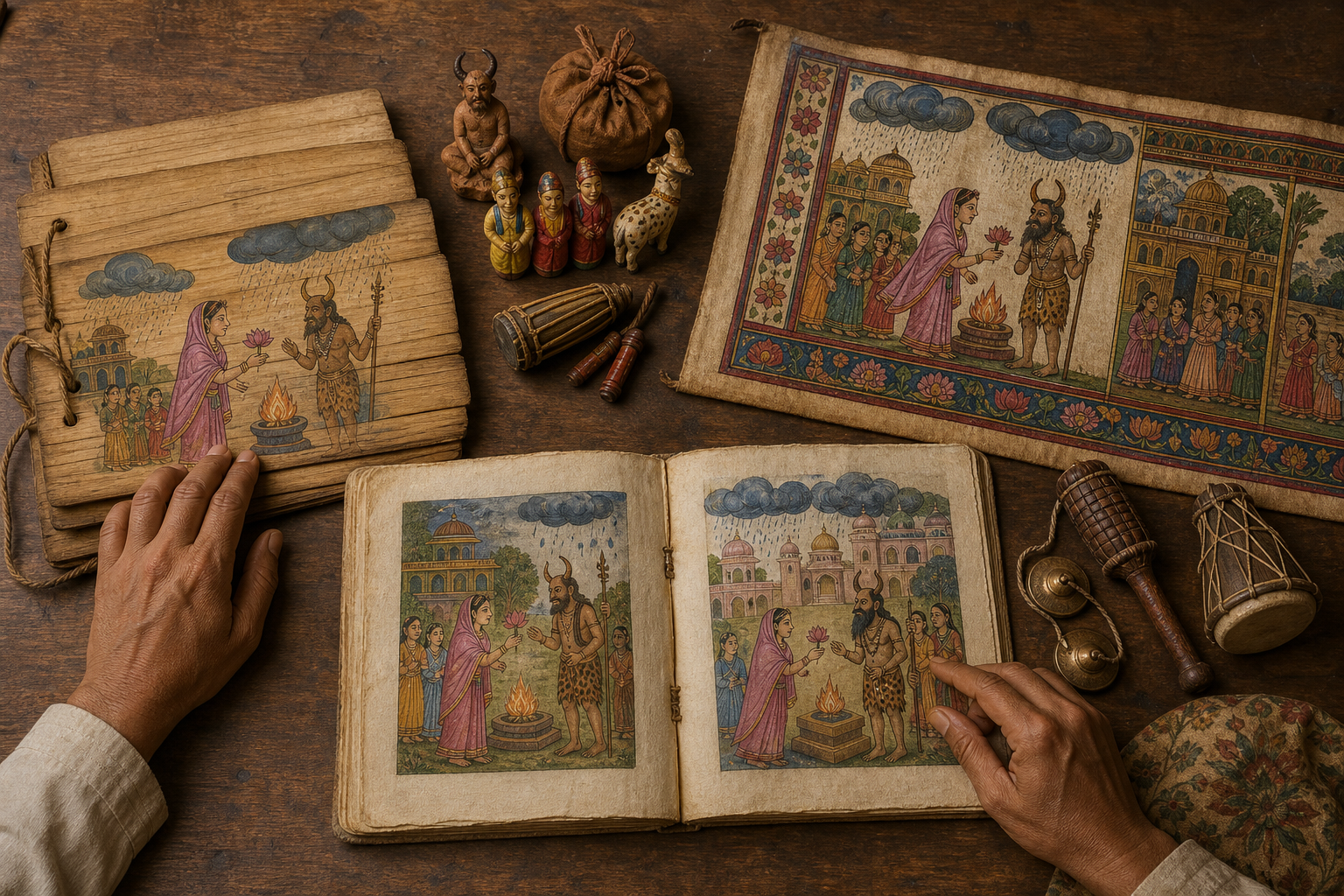
Ramayana traditions preserve a shared narrative world without repeating every detail in the same form. Tamil, Bengali, later Sanskritic, and Puranic tellings may expand Shantadevi’s parentage, upbringing, education, or household role. Reception associated with works such as Kamban’s Iramavataram gives readers a broader setting in which briefly treated figures can acquire greater prominence. Variation is part of this transmission, but it is not permission to pretend that all details are equally present in all texts.
| Question | Careful formulation |
|---|---|
| Is Shantadevi Dasharatha’s daughter? | Yes in widely circulated later Puranic and regional traditions; Bala Kanda foregrounds her identity as Anga’s princess. |
| Is Kausalya her mother? | Some traditions explicitly say so, but the identification is not uniform across the Ramayana tradition. |
| Is Romapada her father? | She belongs to Romapada’s royal house as the princess of Anga; later traditions explain this through adoption from Dasharatha. |
| What remains stable? | Her marriage to Rishyasringa and his subsequent connection to the rites preceding the births of Rama and his brothers. |
| Why does she matter? | She is the relational hinge joining Anga, Rishyasringa, Ayodhya, and the resolution of Dasharatha’s succession crisis. |
A practical reading method is to ask four questions whenever you encounter a claim about her. Which recension or regional tradition is being told? What does that telling actually say about parentage? Which details concern Shantadevi herself, and which concern Rishyasringa or the sacrifice? Which elements remain stable when the genealogy changes? Those questions are more productive than demanding a single composite biography assembled from every available tradition.
Spelling can hide material from you as effectively as an omitted scene. Search for Śāntā, Shanta, Shanta Devi, and Shantadevi. Romapada may appear as Lomapada. Ṛṣyaśṛṅga is commonly rendered without diacritics as Rishyasringa, while Anga may appear as Aṅga. These are usually orthographic or regional variations, not separate characters and kingdoms.
The stable core is more important than any one spelling: Shantadevi’s marriage connects Rishyasringa to the royal world, and Rishyasringa’s ritual role connects Anga’s restored order to Ayodhya’s long-awaited heirs. Parentage, maternal identification, education, and the degree of narrative attention can vary around that core.
Key takeaways for reading or teaching Shantadevi
- Say that Shantadevi is Rama’s sister in many later Puranic and regional traditions, rather than attributing that complete genealogy to every Ramayana.
- Keep both royal identities visible: she can be Dasharatha’s daughter by birth and Romapada’s daughter through adoption.
- Follow the causal chain from Anga’s drought to Rishyasringa’s arrival, Shantadevi’s marriage, the Ayodhya sacrifices, the payasa, and the births of the four princes.
- Do not confuse connective agency with ritual agency. Shantadevi makes the relationship possible; Rishyasringa serves as the officiant.
- Treat the Putrakameshti as a specific Vedic rite, not as a vague fertility prayer or merely another name for the Ashvamedha.
- Label details from particular regional tellings instead of blending them into a supposedly uniform biography.
The next time you encounter an Ayodhya genealogy or hear Bala Kanda recited, look beyond the figures with the most dialogue. Trace the relationship that enables the next decisive event. That habit will restore Shantadevi to her proper place: neither an invented central heroine nor a dispensable footnote, but a quiet link without which the Ramayana’s movement from royal anxiety to Rama’s birth is incomplete.