
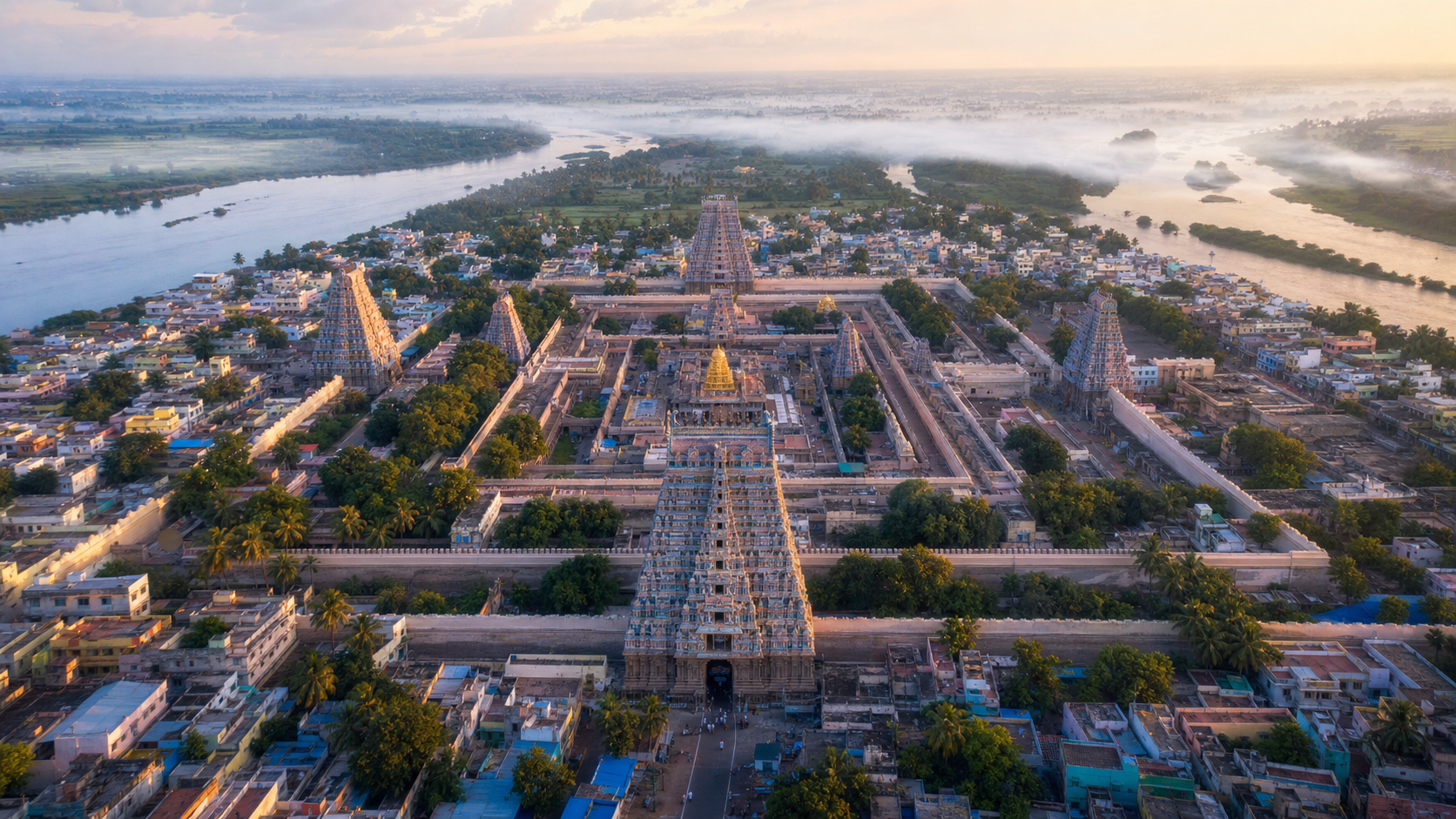
If you are preparing to visit Srirangam, or trying to understand why Sri Vaishnavas simply call it Koil, memorizing a list of kings and festivals will not take you very far. The temple becomes legible when you see its stories, rivers, enclosures, deities, hymns, and historical ordeals as parts of one sustained claim: Lord Ranganatha has made Himself accessible here.
That is what the name Bhooloka Vaikuntham, Vaikuntha on earth, asks you to notice. Srirangam is not understood merely as a human attempt to reach the divine. Its theology begins with the divine choosing to come near, remain near, and move among devotees.
Five ideas that make Srirangam legible
Keep these distinctions in mind and the complex will stop looking like an accumulation of unrelated legends and monuments.
- Sacred history explains presence. The journey of the Ranganatha murti answers why the Lord abides at this particular island.
- Institutional history explains continuity. Patronage, invasion, exile, restoration, ritual organization, and conservation account for how worship endured.
- Orientation carries meaning. The south-facing sanctum preserves Lord Ranganatha’s relationship with Vibhishana and Lanka.
- Stillness and movement belong together. The moolavar remains in the sanctum while Namperumal, the festival form, comes out among devotees.
- Architecture is part of the teaching. Seven enclosures turn approach, protection, inwardness, and proximity into bodily experience.
The most common mistake is to force all five ideas into a single category. A sacred account is not a dynastic inscription, and an inscription cannot tell you the full theological meaning of a south-facing sanctum. Read each form of memory for the question it is equipped to answer.
Sacred history and political history answer different questions
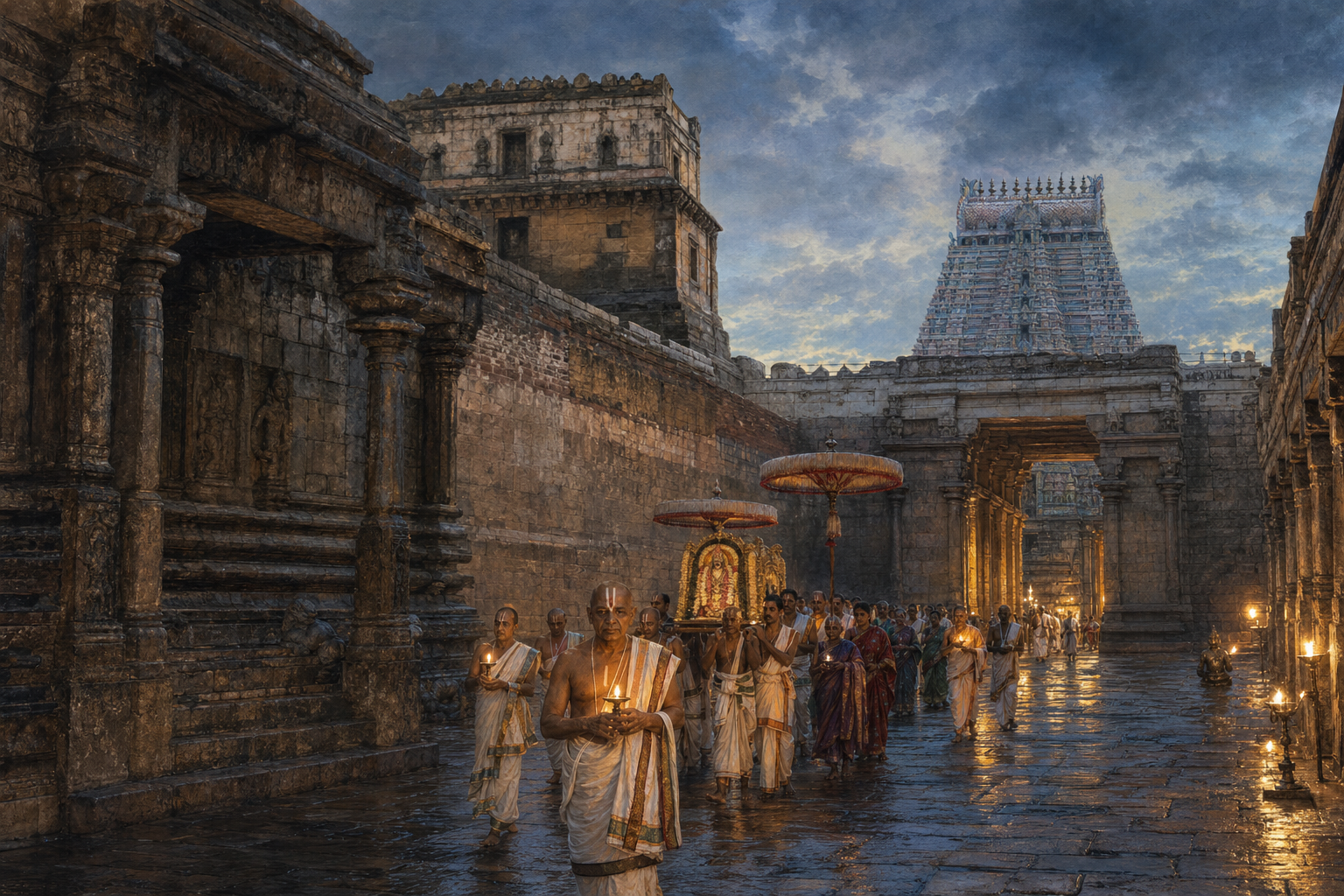
Srirangam has two intertwined histories. One tells you why this is the Lord’s chosen abode. The other tells you how generations of devotees, rulers, acharyas, artisans, and temple servants maintained that abode through political change.
In the Sriranga Mahatmyam associated with the Skanda Purana and in temple tradition, the Ranganatha murti descends from Vaikuntha to Brahma, enters the Ikshvaku lineage of Ayodhya, and passes from Sri Rama to Vibhishana after the Ramayana war. During Vibhishana’s journey toward Lanka, the murti is set down beside the Kaveri and chooses to remain at Srirangam. This sequence is a theology of divine initiative expressed as sacred history.
The point is not simply that an old image travelled a great distance. Lord Ranganatha is presented as the real author of His location. Kings may preserve the murti, devotees may carry it, and Vibhishana may intend to take it to Lanka, but the final abode follows divine will. Srirangam is therefore a chosen kshetra, not merely a convenient site on which people later constructed a shrine.
The institutional chronology has different kinds of evidence. Inscriptions record Chola, Pandya, and Vijayanagara patronage. Institutional memory survives in the Koil Olugu, which preserves accounts of endowments, rituals, administration, disruption, and restoration. The buildings themselves also retain successive periods of construction, including the Vijayanagara-era thousand-pillared hall.
The fourteenth-century chapter, preserved in temple memory, describes invasions that forced Namperumal away from Srirangam for decades. The processional deity travelled through South India before a ceremonial return under Vijayanagara protection around 1371. That episode matters theologically as well as politically. The community protected the form through which the Lord comes out to His devotees, then restored the ritual order that makes this accessibility public.
When you encounter a claim about Srirangam, ask what kind of claim it is. A divine journey expresses the meaning of the kshetra. A dated restoration belongs to political and institutional history. A gopuram is material evidence of architectural development. A continuing procession is living practice. Keeping those categories distinct prevents both credulity and condescension: you do not have to mistake theology for an inscription, or reduce theology to something an inscription alone can validate.
The journey to Kaveri explains the temple’s orientation
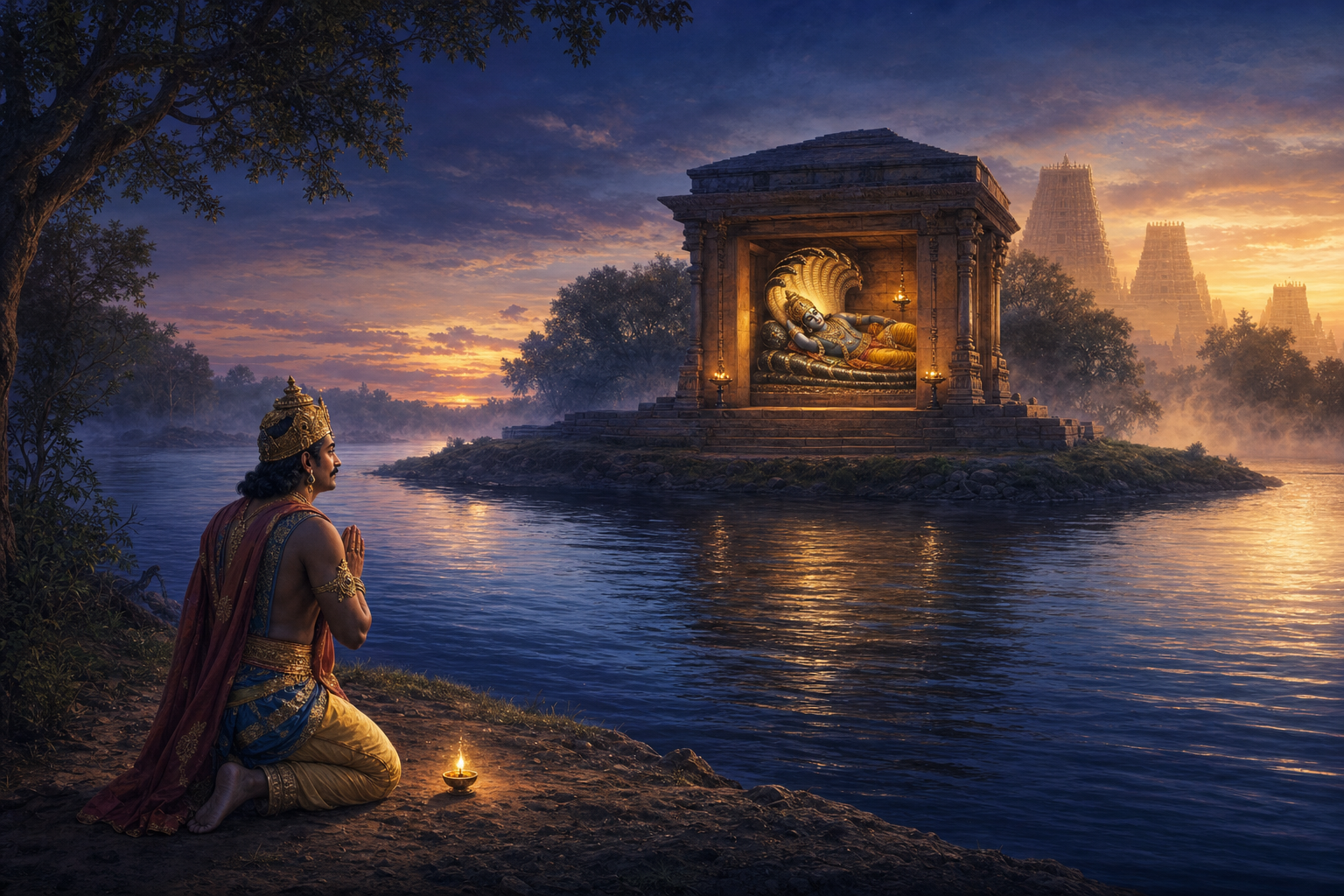
The defining sacred narrative continues beyond the moment when the murti reaches the riverbank. Local tradition connects the settling of Ranganatha with Ucchi Pillayar at the Trichy Rockfort. Ganesha, appearing as a playful boy, facilitates the placement of the deity and then runs toward the hilltop when Vibhishana pursues him. Read together, the Srirangam and Rockfort traditions turn the surrounding landscape into a connected field of divine action.
Vibhishana does not disappear from the theology after losing the opportunity to carry Ranganatha to Lanka. The main sanctuary faces south, an unusual and intentional orientation understood as the Lord continuing to grant him darshan. When you notice that direction, do not file it away as architectural trivia. It is the sacred account made permanent in stone and ritual space.
This southward gaze also corrects a narrow idea of belonging. Vibhishana is not excluded because he comes from Lanka or because the Lord remains in Bharat. Divine grace reaches across the separation. The temple stays rooted at its chosen place while its darshan extends beyond that place. Srirangam’s rootedness and its openness are therefore complementary, not competing, principles.
The river has an equally active role. Srirangam occupies an island between the Kaveri and Kollidam, and its identity cannot be detached from that setting. The Kaveri is not decorative scenery around an otherwise self-contained monument. It is the sacred geography within which the Lord chooses to stay.
Srirangam also belongs to the Pancharanga Kshetrams distributed along the Kaveri: Adi Ranga at Srirangapatna, Madhya Ranga at Shivanasamudra, Srirangam, Parimala Ranganatha at Mayiladuthurai, and Appala Ranganathar at Koviladi. A pilgrimage through these sites reads the river longitudinally. Sacred presence accompanies its flow, binding distinct regions into a connected Vaishnava landscape.
The useful question is therefore not only, “Where is the temple?” Ask instead, “Why does this theology require this river, this direction, and this relationship with Vibhishana?” Once you ask that, geography becomes part of doctrine rather than a backdrop to it.
The enclosures, deities, and hymns enact Vishishtadvaita
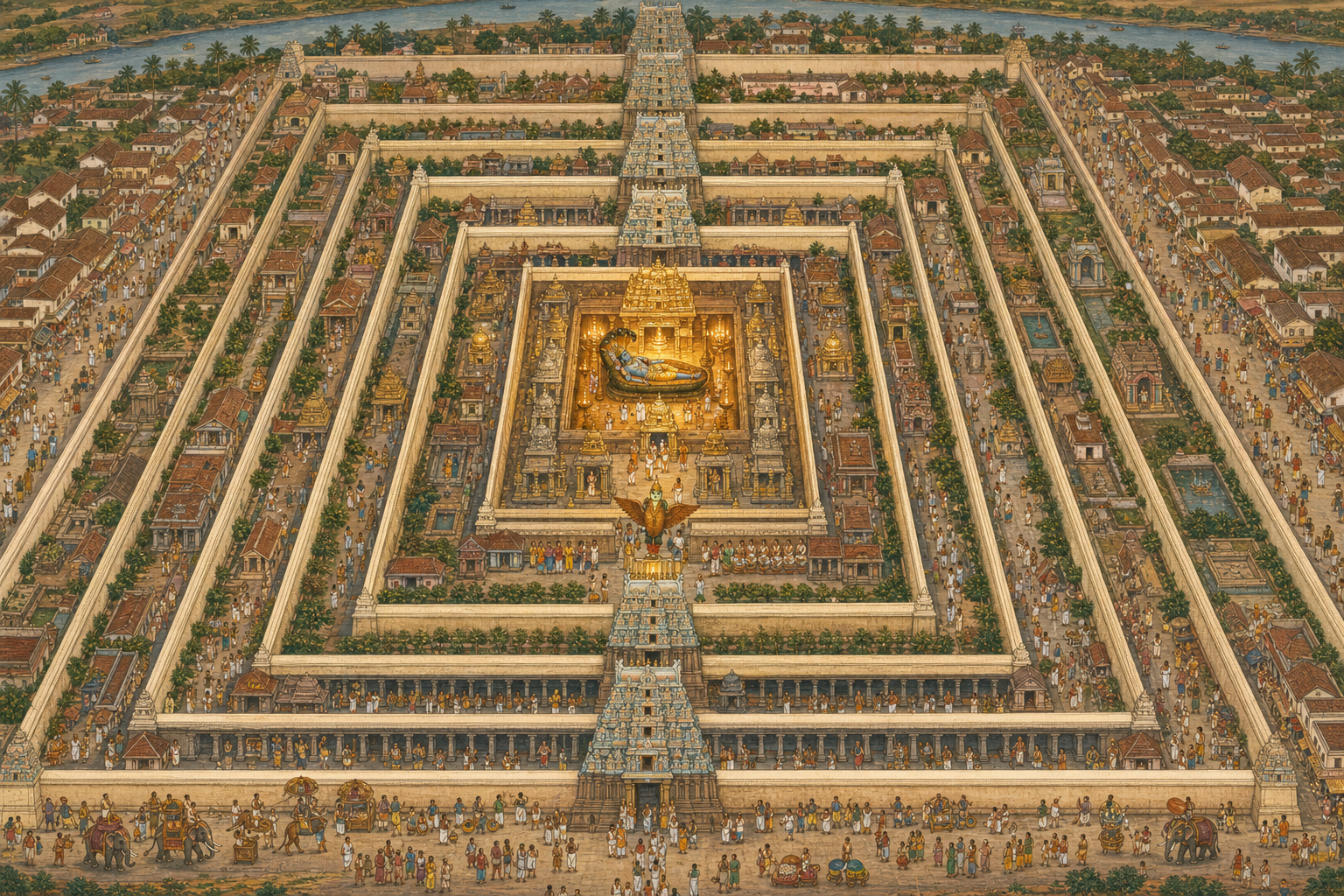
Srirangam covers roughly 156 acres, contains more than twenty gopurams, and is dominated by a Rajagopuram rising about 72 metres. Those numbers convey scale, but scale is not yet meaning. The more revealing feature is the arrangement of seven concentric prakaras through which ordinary urban activity gives way, threshold by threshold, to increasing proximity to the sanctum.
The outer bazaars and residential streets are not accidental clutter surrounding a pure religious core. They show a sacred centre embedded in inhabited life. As you proceed inward, the shift is gradual rather than abrupt. The temple does not teach that divine presence can exist only after the world has been discarded. It orders the movement from dispersed attention toward concentrated darshan.
The Lord who remains and the Lord who comes out
Two forms help you understand the temple’s theology of accessibility. Ranganatha, the moolavar or immovable presiding deity, reclines in Ananta Sayana within the sanctum. Namperumal, the utsava murti, leaves the inner precinct during processions and travels through the veedhis. One form establishes abiding presence; the other brings that presence into public encounter.
Do not interpret the reclining form as divine absence or indifference. The same Lord who rests eternally also faces Vibhishana, receives worship, and becomes accessible in procession. Repose and gracious activity coexist. Namperumal’s movement makes that principle visible to devotees who cannot remain at the innermost threshold.
The Pancharatra ritual system sustains this accessibility through nitya, or daily, observances; naimittika rites for particular occasions; and utsavas, the public festival cycle. Koil Alwar Thirumanjanam periodically purifies the precincts. At Vaikuntha Ekadashi, the opening of the Paramapada Vasal dramatizes entry toward the Lord’s abode. The doorway matters because an enduring theological hope has been given a place, a time, and a shared ritual form.
Surrender becomes disciplined participation
Srirangam is a principal centre of Vishishtadvaita and bears the lasting influence of Ramanujacharya. Here, prapatti means surrender to the Lord’s grace, but surrender is not treated as carelessness or inactivity. It is surrounded by exact ritual duties, scriptural interpretation, temple administration, teaching, hospitality, artistic practice, and seva. Dependence on grace produces an ordered life of service.
That is an important correction if you think surrender means merely having an intense private feeling. At Srirangam, devotion has a calendar, a route, a vocabulary, a community, and responsibilities. Ramanuja’s association with the temple joined philosophical exposition to liturgical and institutional order. Pillai Lokacharya, Vedanta Desika, and Manavala Mamunigal continued the work of preserving doctrine, pedagogy, and practice.
You can hear the same integration in the coexistence of Sanskrit Vedic chant and the Tamil Nalayira Divya Prabandham. Hymns by Nammalvar, Periyalvar, Tirumangai Alvar, and other Alvars are not treated as decorative vernacular additions. They belong to the temple’s authoritative devotional life. Ariyar Sevai goes further by presenting Divya Prabandham through recitation and abhinaya, allowing theological poetry to be heard, seen, remembered, and inhabited.
Vishishtadvaita can appear abstract when encountered only as a philosophical label. Srirangam gives you concrete points of entry: the transcendent Lord accepts a local abode; the immovable deity remains while the festival deity moves; Tamil devotion stands beside Sanskrit revelation; surrender becomes service; and a vast community orders itself around darshan.
A focused way to approach Srirangam
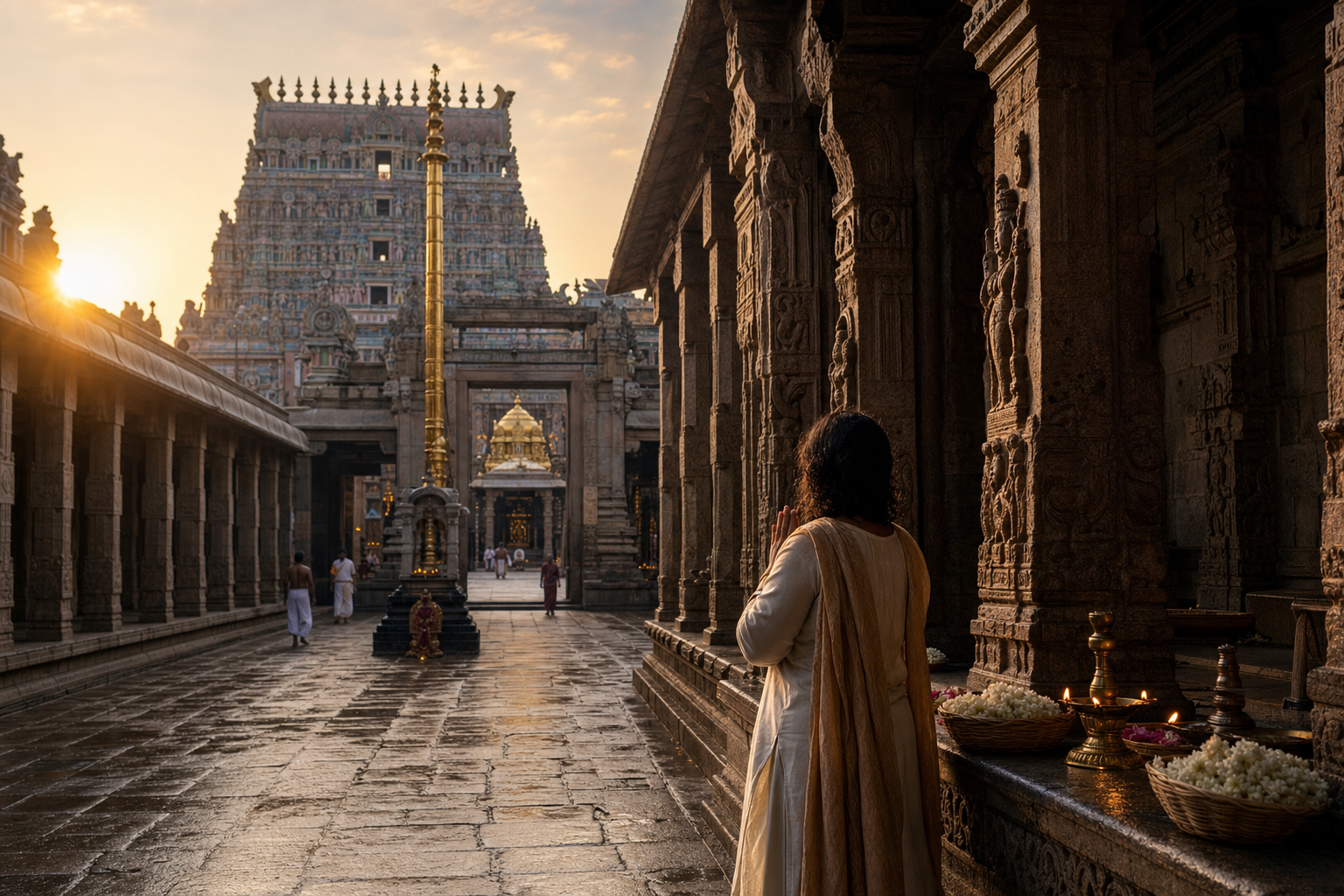
You do not need to master every dynasty, acharya, or festival before approaching Srirangam. You do need a sequence of attention. The following route works for a physical visit and, with photographs or plans, for serious reading from a distance.
- Learn three names before you begin. Ranganatha is the reclining moolavar, Namperumal is the processional form, and Koil is the Sri Vaishnava name for the temple par excellence. These names prevent basic confusion later.
- Start with the island, not the sanctum. Locate the Kaveri and Kollidam and remember that the riverine setting belongs to the sacred account. You are approaching a chosen landscape, not a monument that could mean the same thing anywhere.
- Let the outer precincts count. Notice commerce, homes, movement, gateways, and changing degrees of enclosure. Do not rush through them as though sacred experience begins only at the final doorway.
- Track direction and movement. At the inner sanctuary, remember why the Lord faces south. If you encounter Namperumal in procession, contrast His movement with the moolavar’s abiding repose.
- Listen before trying to classify everything. Tamil Prabandham, Sanskrit chant, ritual sound, and abhinaya belong to a single living order. Even when you do not understand every word, notice which parts are recited, enacted, carried, opened, or repeated.
- Leave with one obligation, not only a collection of images. Ask what prapatti would change in your own conduct. The temple’s answer is practical: surrender should become disciplined attention, gratitude, and seva.
Because Srirangam remains a functioning place of worship, allow temple practice and the needs of worshippers to set your pace. Its artistic and architectural importance is immense, but treating it only as a museum reverses its priorities. The buildings have been conserved so that worship, recitation, procession, and community life can continue within them.
The 2017 UNESCO Asia-Pacific Award of Merit for Cultural Heritage Conservation recognized restoration that balanced structural integrity, ritual use, and community participation. That balance offers a sound rule for every visitor: appreciate the fabric without displacing the life for which the fabric exists.
Go to Srirangam with one question: what does divine accessibility ask of the devotee? Let the river establish the setting, the southward gaze establish relationship, the enclosures discipline your approach, and the movement of Namperumal show that grace does not remain locked behind the innermost wall.