

You may have reached the Sāṅkhya Kārikā through Yoga, a lecture on Indian philosophy, or a diagram of the twenty-five tattvas. Then the terminology began to pile up: Purusha, Prakriti, buddhi, ahankara, manas, gunas and indriyas. Memorizing that vocabulary won’t answer the question that makes the system worth studying: what does this map change in the way you understand your own experience?
Read the work with one distinction in view: everything you can observe changes, but the conscious witness of change is not one more changing object. Once that hinge is firm, the cosmology, psychology, theory of knowledge and goal of liberation begin to fit together.
Begin with the hinge: the seer is not the seen
Ishvara Krishna’s formulation is commonly dated to roughly the third through fifth centuries CE and formed from seventy-two concise kārikās. Those compact verses organize classical Sāṅkhya around two irreducible principles: Purusha, the conscious witness, and Prakriti, primordial nature.
Prakriti is not merely physical matter. It includes the body, senses, feelings, thoughts, memories, preferences, self-images and powers of judgment. On Sāṅkhya’s analysis, a thought cannot be the ultimate knower because the thought appears, changes and becomes known. The same applies to an emotion, a bodily sensation and the inner assertion that says, this is me or this is mine.
Purusha is the conscious witness to which those events appear. It is not a miniature personality hiding inside the body. Thinking, choosing, remembering and constructing an identity are functions on Prakriti’s side of the distinction. Purusha also isn’t a particular mood of calmness. Calm and agitation can both be noticed, and both pass. They therefore belong to the changing field.
This corrects three common misreadings. First, Sāṅkhya does not ask you to hate the body or world; hostility is another movement within Prakriti. Second, witnessing does not mean becoming careless about conduct; speech, decisions and consequences still occur within the field where discernment matters. Third, a pleasant meditation state is not automatically Purusha. However clear or subtle the state becomes, its arrival and departure mark it as an experience rather than the unchanging seer.
Kaivalya, the liberation sought by classical Sāṅkhya, can now be approached without mystification. The decisive movement is not the manufacture of a superior personality. It is discriminative clarity about what belongs to Prakriti and what is Purusha. The practical question is therefore not merely, How do I improve this state? Ask first, Is this state the knower, or is it something known?
Learn the twenty-five tattvas as a functional map

A flat list makes the tattvas harder than they need to be. Treat them as a map of manifestation and experience. Twenty-four principles belong to Prakriti and its evolution; Purusha is the twenty-fifth principle, standing outside that chain of transformation. The grouping below is a study aid, not a substitute for following the causal order in the kārikās.
| Place in the map | Tattvas | Count | Function to notice |
|---|---|---|---|
| Conscious witness | Purusha | 1 | The unchanging seer of experience, outside Prakriti’s evolution |
| Root of nature | Prakriti | 1 | The unmanifest source from which the changing field develops |
| First evolutes | Mahat or buddhi, followed by ahankara | 2 | Determination and judgment; then the appropriation expressed as I and mine |
| Faculties of experience and action | Manas, five capacities of knowledge and five capacities of action | 11 | Coordination of sensory material, receiving experience and acting |
| Subtle potentials | Five tanmatras | 5 | The subtle potentials associated with sound, touch, form, taste and smell |
| Gross elements | Space, air, fire, water and earth | 5 | The manifest elemental field of embodied experience |
The number matters less than the distinctions it protects. Buddhi, ahankara and manas should not all disappear into the single English word mind. Buddhi determines and judges. Ahankara appropriates experience as I or mine. Manas coordinates sensory material, attention and alternatives. Keeping the Sanskrit terms in your notes prevents an English translation from quietly erasing the structure you are trying to understand.
The capacities of knowledge are also not simply the physical organs. An eye is a bodily structure; the capacity of seeing occupies a functional place in the analysis. This is why the tattva map should not be treated as an early anatomy chart. It classifies the conditions and operations of experience.
Try the map on an ordinary moment. Someone criticizes you. Hearing receives the words, manas coordinates what was heard, ahankara turns the event into a claim about me, and buddhi judges whether to answer, withdraw or reconsider. Bodily tension and an urge to speak also appear. The entire sequence changes from moment to moment, and every part of it is known. That last fact returns you to Purusha without requiring you to deny any part of the event.
Prakriti’s activity is further understood through the three gunas. Sattva tends toward clarity and illumination, rajas toward movement and activation, and tamas toward heaviness or obscuration. Use these as descriptions of changing conditions, not as permanent labels for people. A mind may be clear in one situation, restless in another and dull in a third. Even a strongly sattvic condition remains within Prakriti because it can be experienced and altered.
Read every kārikā as an argument, not a slogan
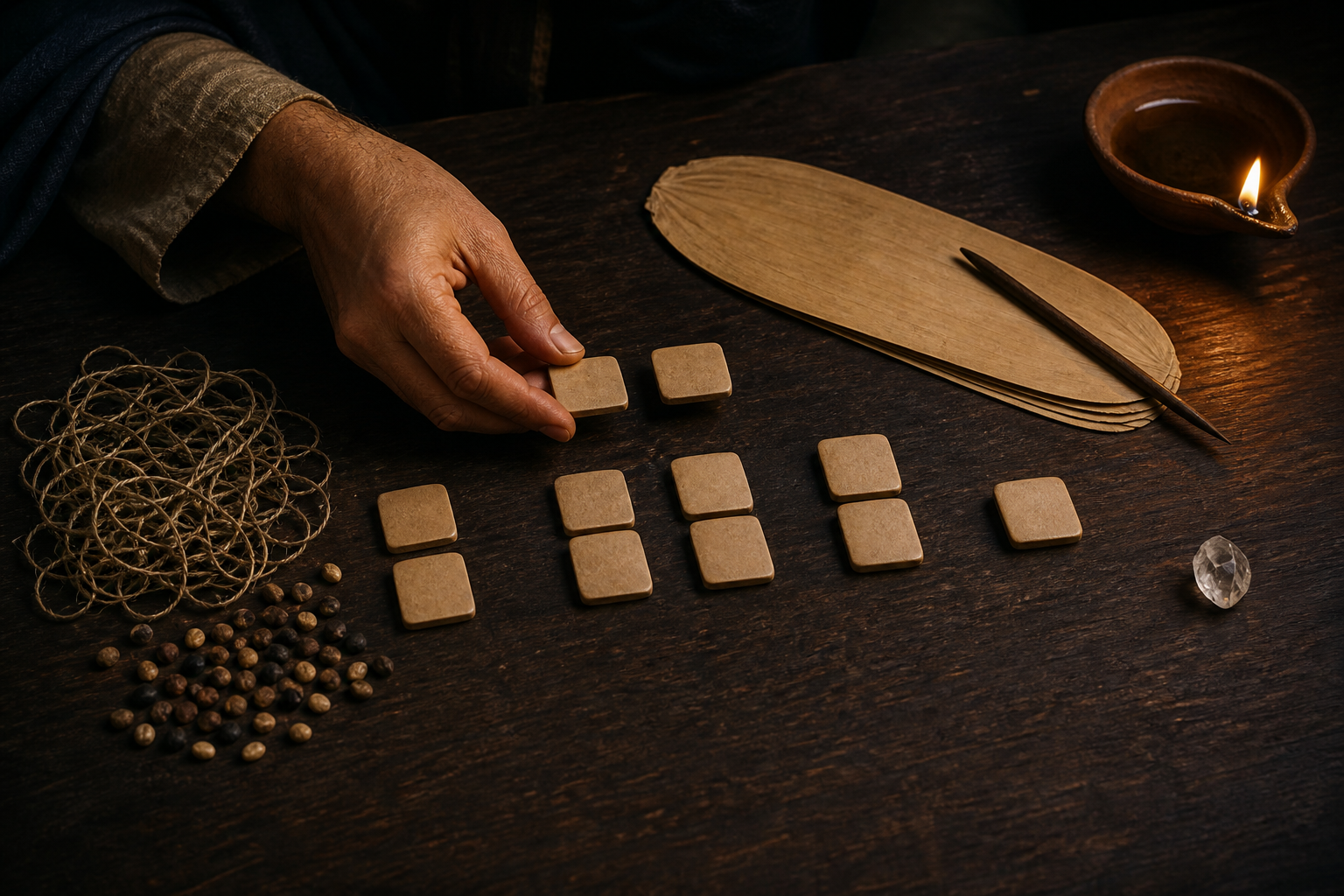
The brevity of the verses rewards slow reading. One kārikā may depend on a distinction established several verses earlier, so an isolated line can sound more absolute than its argument permits. Work through one verse at a time with four questions.
- Which Sanskrit terms carry the claim? Keep buddhi, manas, ahankara, Purusha and Prakriti distinct in your notes.
- What is being asserted: a definition, a causal relation, a classification or a conclusion about liberation?
- What reason supports the assertion? Do not treat a familiar translation as self-evident.
- What would you misunderstand elsewhere in the system if this distinction were removed?
Sāṅkhya recognizes three means of valid knowledge: pratyaksha, anumana and aptavacana. Pratyaksha is perception. Anumana is inference from what is available to what is not immediately presented. Aptavacana is reliable testimony. These are not three decorative terms at the edge of the system; they tell you how to examine its claims.
When reading or discussing a verse, mark what is directly perceived, what is inferred and what you have received through trustworthy instruction. For example, the presence of a sensation is perceived. A claim about an unseen cause may be inferred from an observed effect. The meaning of a compressed technical expression may initially be learned through reliable teaching. Confusing these routes produces avoidable arguments: a person may demand sensory perception of something presented as an inference, or repeat testimony as though it were direct observation.
Reliable testimony is not a license for passive belief. You still have to preserve the claim accurately, understand the competence of the teacher or text, and check whether the interpretation coheres with the rest of the system. When a translation makes every inner faculty into mind, compare how the disputed term functions in the surrounding verses.
The Gauḍapāda Bhāṣya, Yuktidīpikā and Vācaspati Miśra’s Tattvakaumudī belong to the major commentary tradition around the Kārikā. A commentary is most useful after you have stated the difficulty precisely. Ask whether you are uncertain about grammar, the order of evolution, the function of a tattva, or the reasoning for a conclusion. That focused question keeps commentary study from becoming another pile of undigested statements.
Compare Dharmic traditions without flattening them
Sāṅkhya’s vocabulary and seer-seen distinction deeply informed Yoga, which is one reason many readers encounter the system through practice. That relationship makes comparison productive, but it does not make every formulation in Yoga and Sāṅkhya interchangeable.
Buddhist Abhidharma also analyzes experience into discernible factors, while Jain thought has its own accounts of tattva, bondage and liberation. Sikh readers may find a useful discipline in distinguishing transient mental movements from what should command spiritual allegiance. None of these resonances authorizes us to insert the Purusha-Prakriti dualism into traditions that formulate self, reality and liberation differently.
Use a two-column page when making a comparison. In the first column, write the shared question: How does suffering arise? What changes? What is bondage? What constitutes freedom? In the second, write each tradition’s distinct answer in its own vocabulary. This method reveals a genuine Dharmic conversation while preserving the integrity of its participants. Unity in diversity requires both recognition and restraint.
Turn discrimination into a daily observation practice

You do not need to wait for a retreat or finish every commentary before testing whether the map clarifies experience. Set aside ten minutes and examine one recent episode in which you became reactive, confused or strongly self-protective.
- Describe the event in one factual sentence. Remove explanations of the other person’s motives.
- List what appeared: sensory impressions, bodily changes, emotion, thought, memory, identity claim, impulse and action.
- Mark every item that changed or could be observed. On Sāṅkhya’s terms, each belongs to Prakriti.
- Identify the active functions. What did manas coordinate? What did ahankara claim as I or mine? What judgment did buddhi make?
- Notice the guna pattern without turning it into an identity. Was there clarity, restless propulsion, obscuration, or a changing mixture?
- Ask what knew the changing sequence. Do not answer by inventing a mental picture of Purusha; that picture would itself be another known object.
- Return to action. Decide what a clearer buddhi now requires: a pause, verification of an inference, more measured speech, a correction or an apology.
The final step prevents metaphysical language from becoming spiritual evasion. Saying that anger belongs to Prakriti does not undo words spoken in anger. Saying that Purusha is the witness does not exempt the personality from repairing harm. Discrimination should make responsibility more exact because you can separate a raw sensation, an identity claim, an inference about another person and the action you finally choose.
Repeat the exercise with one episode a day for a week. At the end, look for the point at which confusion usually enters. You may find that manas is scattered before the facts are clear, ahankara personalizes neutral events, rajas rushes buddhi toward a verdict, or tamas postpones an action already judged necessary. Choose one correction for that recurring point. The measure of progress is not an unusual inner experience; it is cleaner discernment followed by less automatic conduct.
This practice also exposes a subtle trap: trying to make Prakriti permanently quiet so that Purusha can appear. Purusha is not produced by a successful state-management technique. Quiet may help buddhi discern more clearly, but both quiet and disturbance remain observable conditions. The philosophical work is to stop assigning the status of the seer to either one.
Key takeaways
- Start with the seer-seen distinction: Purusha is the conscious witness, while every changing physical and mental event belongs to Prakriti.
- Learn the twenty-five tattvas as a functional and causal map, not as an isolated vocabulary list.
- Keep buddhi, ahankara and manas distinct; translating all three as mind conceals the analysis.
- Separate perception, inference and reliable testimony when deciding how a claim is known.
- Do not mistake a calm, sattvic or meditative state for Purusha merely because it feels subtle.
- Use witnessing to improve discernment and action, never to deny pain, consequences or accountability.
At your next reading session, take one kārikā and do three things: preserve its Sanskrit terms, identify the means of knowledge supporting its claim, and trace the relevant tattvas through one lived episode. That is enough to turn a compact classical system from a diagram you remember into a discipline of discernment you can actually use.
References
- DharmaRenaissance Blog — Ishvara Krishna and the Sankhya Karika: A Timeless Beacon of Dharmic Wisdom
