
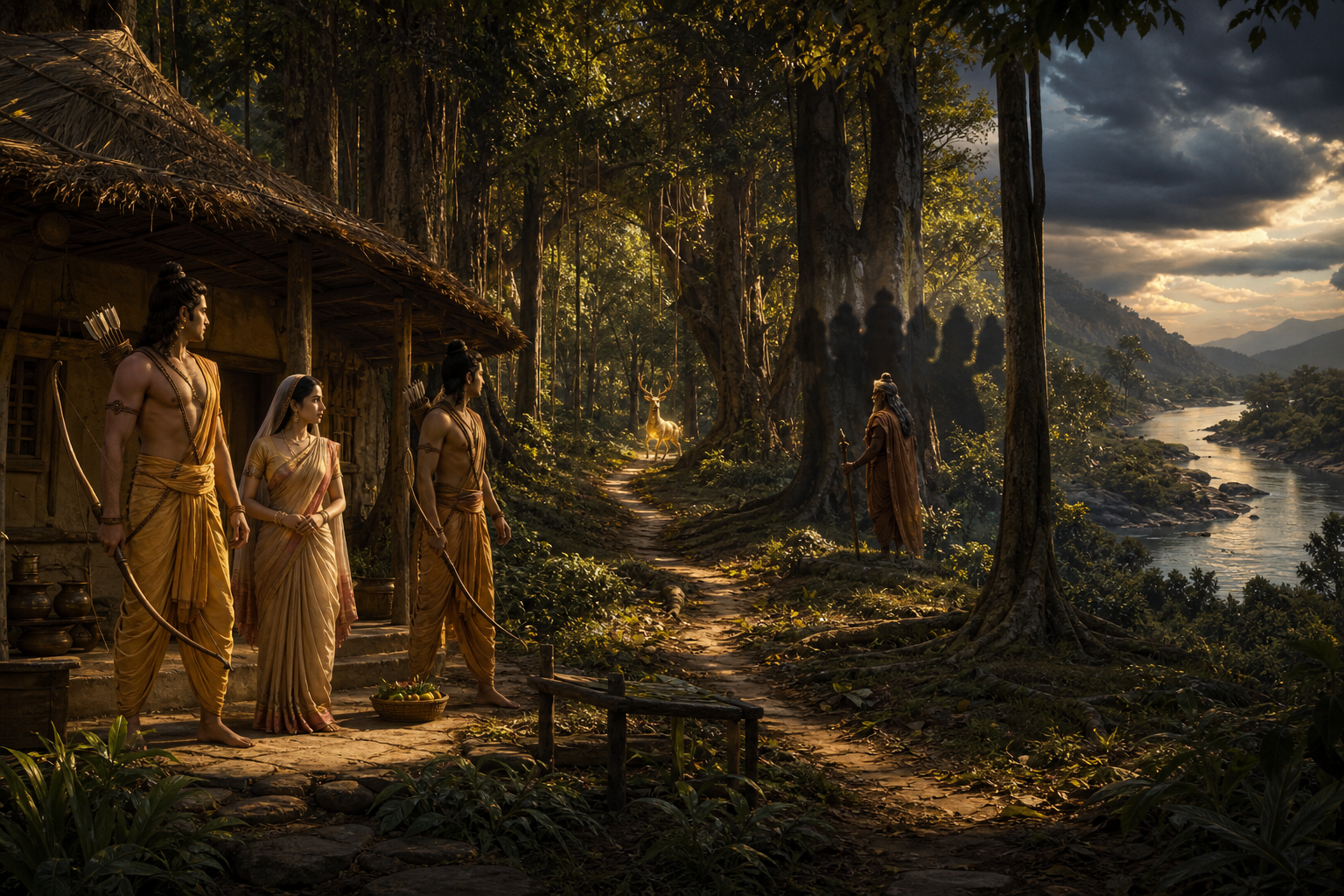
If you have wondered why the ruler of Lanka did not answer the events at Panchavati with an army, the easy explanations are inadequate. Ravana was neither blindly confident nor unaware of Rama’s strength. He recognized a dangerous opponent, changed his method, and still made the decision that destroyed his kingdom.
Panchavati therefore gives you a precise way to examine any strategy. Separate the threat assessment, the tactic, the objective, and the likely aftermath. Ravana showed competence in the first two and ruinous judgment in the last two. That tension, not the golden deer alone, is the heart of the episode.
The missing army is the first strategic clue
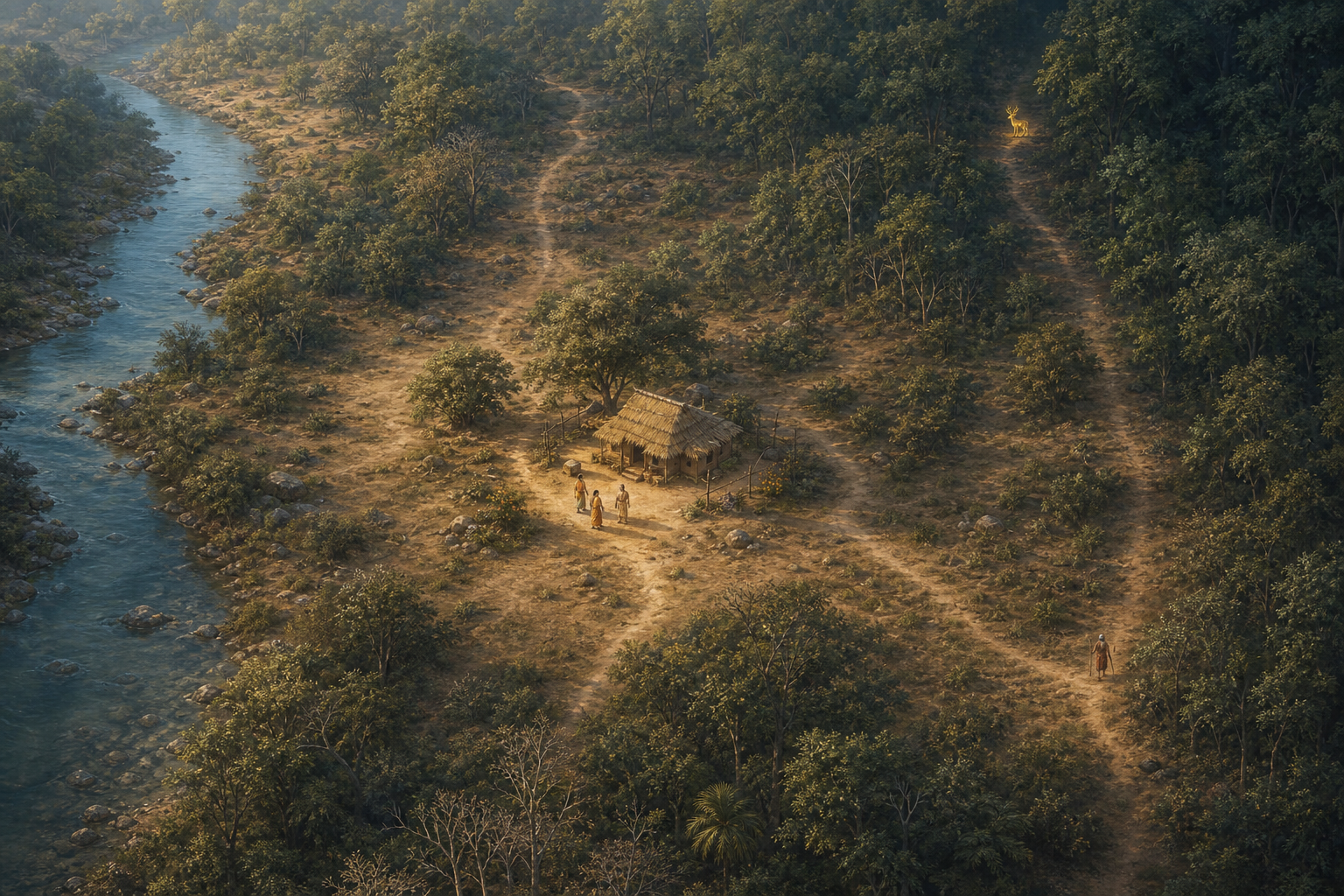
Surpanakha’s humiliation gave Ravana a grievance, but the recent battlefield record gave him a warning. Rama had just destroyed Khara, Dushana, and a Janasthana force reportedly numbering 14,000 rakshasas. Within the epic’s account, one warrior had defeated the kind of numerical advantage on which another direct assault would have depended.
That result functioned as deterrence. Sending more troops immediately would not have demonstrated courage; it would have repeated an approach that had just failed on a devastating scale. Ravana’s decision to avoid a massed attack was rational in this narrow sense. He allowed new evidence to change his method.
Geography reinforced the warning. An army is not equally powerful wherever it goes. Moving a large force from Lanka into the Dandaka forest would have meant difficult terrain, longer supply lines, and considerable strength committed away from Lanka’s maritime and palace defenses. Ravana would have exposed his own center of power while trying to overwhelm an opponent whose full capability he could not measure.
This is the first question Panchavati teaches you to ask when anger is pushing a decision: what has changed since the last plan was formed? Ravana updated his estimate of Rama’s combat power, but he did not reconsider whether retaliation through Sita was a legitimate or sustainable objective. Updating the method without re-examining the goal is only partial intelligence.
Reconstruct the plan as a chain, not a single trick

The golden deer is the most memorable image in Ravana’s operation, but it was one link in a four-stage design. Each stage addressed a problem created by Rama’s superiority in open combat.
- Avoid the proven danger. Ravana declined to bring a large force into a forest battle after Janasthana had demonstrated the risk.
- Create an attraction stronger than ordinary caution. Maricha would appear as the golden deer, drawing Rama away without requiring Ravana to defeat him.
- Break the protective arrangement. The diversion was designed to separate both Rama and Lakshmana from Sita, turning a defended position into a temporary opening.
- Relocate the conflict. By abducting Sita and taking her to Lanka, Ravana expected to unsettle Rama and make any later confrontation occur closer to Ravana’s own power.
Maricha’s role matters because his fear was based on battlefield experience. A single shaft from Rama had previously hurled him across the sea. Ravana did not dismiss that intelligence. He applied it selectively: direct combat was too dangerous, so indirect action seemed preferable.
That is the difference between using information and accepting wisdom. Information can help a ruler optimize an operation. Wisdom asks whether the operation should exist at all. Ravana used Maricha’s knowledge to improve the means while leaving his pride, desire, and objective outside scrutiny.
The plan also depended on more assumptions than its elegance initially reveals. Rama and Lakshmana had to be separated at the right moment. The abduction had to be completed before they returned. Distance had to prevent pursuit. Lanka had to remain beyond Rama’s reach. Most importantly, Rama had to remain isolated. Once Hanuman and the Vanara forces entered the conflict, the final assumption collapsed.
Tactical success concealed strategic failure

A tactic succeeds when it produces its immediate result. A strategy succeeds only when that result creates a tolerable and durable position. Ravana’s deception produced separation and enabled the abduction, but those achievements did not make Rama less capable or the underlying conflict more manageable.
| Decision | Immediate logic | Strategic blind spot |
|---|---|---|
| Avoid a massed attack | Do not repeat a form of battle that had just failed at Janasthana | Rama’s capability remained intact |
| Separate the defenders | Create a temporary opening without defeating Rama | The opening did not settle the conflict |
| Take Sita to Lanka | Shift the contest toward terrain Ravana expected to control | Rama’s cause and eventual allies were drawn toward Lanka |
| Rely on Lanka’s security | Use distance and home defenses as protection | The kingdom became the final theater of war |
Ravana confused choosing the location of escalation with controlling escalation itself. Lanka initially looked like the safer arena because it was his seat of power. Yet the abduction connected Rama’s personal mission directly to that seat of power. Defensive geography became target geography.
The plan also increased the very force it was supposed to manage. Ravana wanted psychological asymmetry: he would act unexpectedly, take what Rama valued, and leave Rama reacting from a position of loss. Instead, the wrongful act gave Rama a clear mission and created the moral cause around which Hanuman and the Vanara sena would eventually align.
When you evaluate a clever plan, ask what remains true after the first move succeeds. Is the opponent’s capacity reduced, or has contact merely been postponed? Has the opponent lost purpose, or gained a stronger one? Has your valuable ground been protected, or identified as the destination? Ravana’s answers were unfavorable even before the golden deer appeared.
Dharma is a strategic test, not a ceremonial addition
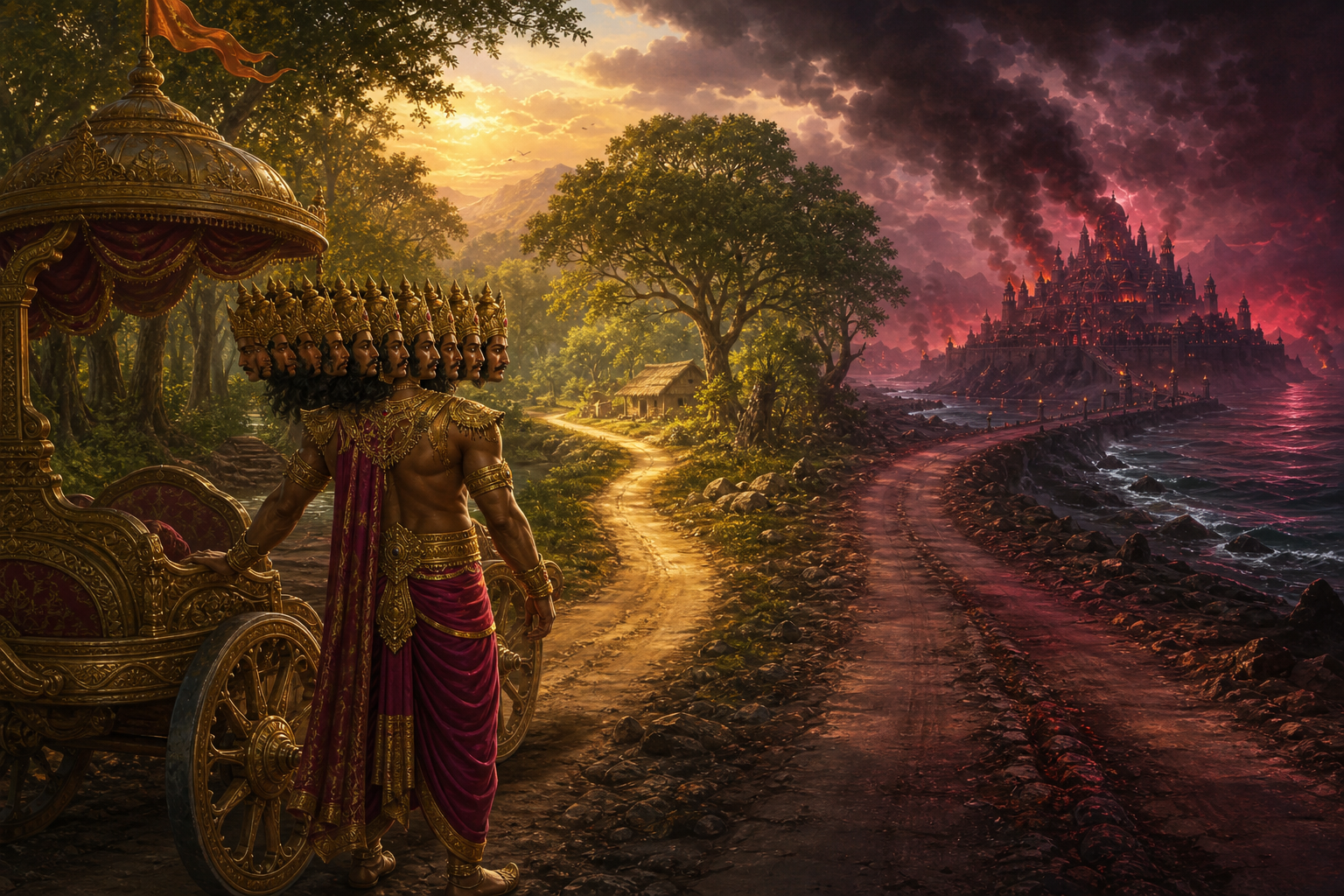
The Panchavati episode does not treat deception as an ethically empty tool. Within the epic’s moral grammar, dharma-yuddha values recognizable rules of engagement, while the rakshasa repertoire includes maya, ambush, and psychological disruption. Ravana’s deception was especially corrosive because it served an abduction. Sita was not an opposing army to be defeated; she was made the instrument through which Ravana tried to affect Rama.
The objective test comes first. Was Ravana seeking a just restoration of order, or turning wounded pride and desire into state policy? Whatever grievance he attached to Panchavati, taking Sita did not repair it. The act redirected the cost toward someone who was not the military threat he feared.
The means test follows. Did the operation confront the responsible opponent, or avoid him by exploiting trust and separation? Ravana selected the second course precisely because he did not want to meet Rama’s demonstrated power openly. Tactical prudence cannot cleanse an unjust means; it can only make that means more effective for a time.
The consequence test asks what order will exist if the plan works exactly as intended. After the abduction, Rama remained active, Sita remained wrongfully held, and Lanka depended on continued control rather than resolution. Ravana had not ended a danger. He had created a chain in which concealment led to pursuit, pursuit to alliance, and alliance to war at Lanka.
Hindu, Buddhist, Jain, and Sikh traditions are not interchangeable, and their ethical vocabularies should not be flattened into one formula. Yet each gives us ways to reject the belief that intelligence, power, or an attractive end can purify betrayal and wrongful harm. Panchavati makes that shared concern concrete: adharmic means do not remain confined to the moment in which they appear useful.
This is why dharma belongs inside strategic analysis rather than after it. A moral boundary would also have protected Ravana from a catastrophic policy. Restraint would have preserved Lanka, avoided a conflict with a proven warrior, and prevented a personal grievance from becoming a kingdom’s fate. Ravana passed one narrow prudential test by avoiding an unfavorable battle, but failed the ethical and strategic tests that mattered more.
Key takeaways for reading Panchavati
- Do not confuse deterrence with defeat. Janasthana persuaded Ravana not to attack openly, but Rama’s power remained undiminished.
- Reconsider the objective when the threat changes. Ravana changed how he would act without asking whether he should continue pursuing the same aim.
- Count every dependency in a deceptive plan. The golden-deer operation required precise separation, rapid execution, secure distance, and Rama’s continued isolation.
- Judge the position created after tactical success. Abduction gave Ravana temporary control of Sita while giving Rama a direct cause to reach Lanka.
- Include dharma at the design stage. If success requires wrongful harm, broken trust, and continuing coercion, the plan is already carrying the conditions of future failure.
When a policy, leadership decision, or personal retaliation looks ingenious, do not ask only whether it can work. Ask what it leaves unresolved, whom it motivates, what it exposes, and whether its success can be defended without concealing its means. Apply that discipline before the first move, and Panchavati becomes more than an episode you remember; it becomes a mistake you know how to avoid.
References
